Jeremy Harris
-
Posts
26430 -
Joined
-
Last visited
-
Days Won
360
Everything posted by Jeremy Harris
-
IIRC, the instructions for laying our system included doing a resistance test and earth leakage test on the wires when they were taped down, then repeating this immediately after laying the tiles, when the adhesive was still wet. If there was any problem, then you pull the tiles up, wash them off and replace the wire (there's no way of repairing it). As long as you have a multimeter, and ideally an insulation tester (I still have an ancient Megger) then it's easy to check that there is no damage caused when laying, and although it would be a pain if you did find you'd damaged the wire then at least you could re-use the tiles (assuming they weren't laid with rapid set). TBH, the wire I used was pretty tough stuff, with what seems to be PTFE insulation, so it would be hard to damage, I think.
-
I also have a couple of spare 16mm couplings here that you can have if you want one quickly. Just yell and I'll stick it in the post tonight (post goes at 5pm here).
-
As I made very clear above, the facts speak for themselves. The manufacturer has provided a lambda value, that lambda value shows that the insulation effectiveness is similar to EPS, and a lot worse than PIR (Celotex, for example). 150mm of the Hybris gives the same insulation value as 100mm of PIR like Celotex, but with a significantly shorter decrement delay. The history of multifoil products (and I'm not singling any one manufacturer out, just as I didn't originally) is one of claim and counter-claim, investigation by BRE, withdrawal of approval, re-approval with changed specifications, adding real insulation to the highly thermally conductive foils, changing the certification to show that the claimed performance is achieved under specific conditions with airtight spaces of particular dimensions and additional insulation in some cases, etc, is clear for anyone to read up on. This does tend to raise suspicion when any multifoil product comes to market, even if that suspicion turns out to be unjustified. If these materials (again, not singling out any specific manufacturer) had always reliably performed in accordance with all the manufacturers claims then I would not be spending so much time pointing out the potential issues here. What is very clear from all the testing is that, unlike some other forms of insulation, the performance of multifoil products is highly dependent on the installation being exactly compliant with the BBA certificate approved detail. If the stuff is compressed at all, or the air gaps that may be required aren't sealed up tight and of the right dimensions, or if the additional insulation layer isn't fitted exactly as specified, then the performance will suffer. In the case of any sort of compression of the material the performance will suffer very badly indeed, as the proper insulation inside that spaces out the foil layers has to be at its full depth in order to work.
-
I used a loose wire system under the tiles in the bathroom of our current house. Easy to lay, the only challenge was working out the layout of the wires. The nice thing is that you can run the wires around things like the toilet or any projections, and you can have a lot lower power by just increasing the wire spacing. I bought ours as a kit on-line around 10 years ago. It was the cheapest I could find as I thought we'd not be staying in the house long....................... It's been 100% reliable, with an easy to use thermostat/programmer, and has a sensor embedded in the floor to control the floor temperature. Installing it was easy, just prime the floor, layout the wire and hold it down with the tape provided in the kit (the primer is needed to make sure the tape sticks, I believe). Tehn just apply tile adhesive and lay the tiles normally, with the wires embedded in the adhesive.
-
Your experience, and that of Peter W above, matches everything I read when researching insulation materials. I'll admit to having been provoked by that Grand Designs programme from several years ago, because what Kevin McCloud was saying (which was just repeating the manufacturer's claims at the time, I'm sure) seemed to defy the laws of physics to me. The claim at that time (I still have it here, in my spreadsheet of lambda values, with a note by it highlighting that the claim is false) was that "Gen X Multifoil" had a lambda value of 0.019527 W/m.K, working back from their claimed U value for a given thickness of the stuff. If true, this would have made it only slightly worse than silica aerogel, which at that time was the very best insulation material I knew of. As noted above, approvals were withdrawn, advertising claims had to be changed and the manufacturers of the stuff had to come up with hybrid solutions, using insulation materials and/or added sealed air gaps in addition to the foil to get the stuff to perform as an average insulation material. When you work back through the build up and calculate where the bulk of the insulating effect is coming from, you find that the foil is contributing very little, it is the sealed air gap and/or other insulation material that is providing most of the insulation. The reason is fairly simple. Foil insulation works by reflecting radiated heat. The vast majority of heat transfer through closed areas like a wall, roof, ceiling etc is by conduction. Unfortunately, metallised plastic films (which is what these foils are) are relatively good conductors of heat, even though they are pretty good reflectors of radiated heat. The issue we are currently looking at with regard to radiated heat (in the latter part of this thread: is a good illustration of an area where reducing radiated heat can be beneficial, somewhere where the heat reflective material being used is directly exposed to infra red radiation and can reflect it back to good effect. Unfortunately, the outer and inner skin of a wall or roof will very effectively absorb (and reflect a little) of the radiated heat, and will conduct that heat to the insulation inside the wall or roof, so internal insulation needs to primarily have as low a thermal conductivity as is practicable (and affordable). The lambda value I've mentioned previously is the measure of thermal conductivity; the lower it is the less thermally conductive the material is.
-
Jane, Something worth taking account of is the insulation decrement delay, especially in a roof that may well be exposed to hot sun. There is a useful article here about it: http://www.greenspec.co.uk/building-design/decrement-delay/ It can sometimes be worth making a compromise on the insulation value in order to get a better balance between it and the decrement delay, in terms of overall comfort level. Clearly you have to meet building regs insulation levels, and they are far from a high standard, IMHO, so I'd suggest going for better if you can manage it. I spent a long time looking at insulation materials before making a decision, as our first choice was SIPS, with foam insulation that has a short decrement delay, and in order to improve both the insulation value and increase the decrement delay I was looking at adding a layer of wood fibre to the outside. The manufacturers found this a challenging idea, and in the end the cost of it ruled it out, so we accepted a compromise on interior space and accepted a system with thicker walls that used a longer decrement delay insulation. It's all about compromise in any building project, and often getting hold of accurate information to make a decision as to what that compromise should be can be difficult.
-
Nick, You can check the edit history and see what I did. It is exactly as I described - I had problems getting the table (cut and pasted from Excel) to format - it had a big gap between rows at the bottom that I couldn't find a way to edit out). That is the only reason for the delete and repost, and the rest is pretty much identical, as I cut and pasted the first section (above the table) and stuck it straight back in the cleaned up repost. As a tip to anyone posting tables, complete your post first, then paste in the table. If you try and add text after the table you can mess up the formatting (this is what I found).
-
Just for completeness, I'm far from being the only one to look at, and question, the real performance of multifoil insulation. It's been discussed to death elsewhere, with a range of opinions and facts being expressed: http://www.greenbuildingforum.co.uk/newforum/comments.php?DiscussionID=125 and here are some facts about the stuff, from BRE and as guidance to LABC building inspectors: multi-foil-insulation_july2005.pdf MG0190512 Use of Multi-foil Insulation Products - Compliance with Regulation 7 and Requirement L1.pdf just to show that I'm reporting facts, not making something up because I don't like it. As it happens I've stated elsewhere, more than once, that there is a role for reflective insulation wherever there is a significant probability that it may reduce re-radiation. The main use for it that I can see (there may be others) is as a reflective barrier immediately under a roof covering, where it may well act to reflect back re-radiated heat from the under surface of tiles, slates etc, and so be an aid in reducing solar gain.
-
I'm just stating facts, facts taken from the certification for the product, not bashing anything. The post change was pure accident, nothing more. The table I inserted didn't format properly, so I tried several times to edit the post as soon as I'd written it. In editing it the formatting of the table went really haywire, so I copied the text, deleted the post and then started again, just so I could get the table formatted properly. I've no doubt I was struggling to edit the table formatting at the time you posted. Nothing libellous there either - the data comes from their published data and BBA certificate, so is not my data, it's the manufacturers data. If you check back to find some of the withdrawn adverts for other multifoils (and I honestly can't recall if Actis was one of those early multifoil manufacturers or not) you will find some ludicrous claims, which is why many of the adverts have been modified or withdrawn. At the time they came out they were arguing that their stuff should be measured differently from all other types of insulation, because by using this different measurement technique the stuff appeared to be an insulator. This was argued about by other insulation manufacturers and, I believe, the BRE, to the extent that there were a lot of changes made, and the BBA certificates are now clear as to what the make up is that gives the quoted insulation performance. To give credit to Actis, they have been increasing the thickness of their product a great deal with added proper insulation, and they do make it clear what the lambda of the correctly installed system is, 0.033 W/m.K. It's not that great, as to meet building regs you need about the same thickness overall as you would for EPS, and it does have a very short decrement delay, shorter than EPS, and much shorter than systems with a greater heat capacity. I don't know the price of the stuff, so maybe it's so cheap as to make it worth fitting thick layers to get a decent insulation level.
-

BT/Openreach New Connection
Jeremy Harris replied to worldwidewebs's topic in General Self Build & DIY Discussion
Wouldn't it be nice if the same company was consistent? We found Openreach to be a complete PITA to deal with at their main office, but the local engineer was great, a really helpful chap who made up for his bosses being so damned useless. I think Openreach really just don't care too much. They have an effective monopoly and so don't have to be the slightest bit concerned about customer service, especially as builders are not, to them, customers. -
BT/Openreach New Connection
Jeremy Harris replied to worldwidewebs's topic in General Self Build & DIY Discussion
That's a contrast to our local Openreach chap who just dropped off loads of their Duct 56, bends, two cast iron boxes and a roll of cable and was happy for our ground works chap to just lay all the duct and put their new cable in, leaving it coiled up at either end. It seems it really is just pot luck! -
The reflective multifoils are snake oil, pure and simple. They are tested in a way that is atypical for use in a house and rely on the addition of real insulation to gain 99% of their insulating properties. It's about time their mis-selling was picked up on as they've been sailing exceedingly close to the wind with their descriptions of the stuffs supposed performance for years. They started out with what can only really be called an open lie years ago, around the time when Kevin McCloud infamously held up a thin bit of insulation and declared that it worked as well as a bit ten times or more thicker during a GD show. It had those of us with a bit of a basic scientific background reaching for calculators and proving within seconds that it was total bunkum. I wrote about it over on Ebuild last year, when the Hybris stuff came up in discussion: Here's a list of materials, including the Hybris multifoil stuff with the added insulation and air gap, listed in order of lambda. The lower the lambda the better the insulation and so the thinner the layer needed. You can see that the Hybris stuff is not great, even with added insulation and an air gap. You need around a 50% thicker layer in order to achieve the same U value as you would using ordinary PIR foam: Concrete (dense) = 1.2 W/m.K Range is 0.6 to 1.8 from Kaye and Laby Sandstone = 1.2 W/m.K Plasterboard = 0.22 W/m.K Wood (12% moisture content) = 0.15 W/m.K OSB/3 = 0.13 W/m.K Glass fibre roll = 0.044 W/m.K Warmcell = 0.04 W/m.K Steico wood fibre = 0.038 W/m.K Low density EPS 0.037 W/m.K Kore SD High density EPS = 0.034 W/m.K Kore floor HD Hybris (multifoil with insulation and air gap) = 0.033 W/m.K λ value taken from BBA certificate PU foam = 0.025 W/m.K PIR board = 0.022 W/m.K Silica aerogel = 0.017 W/m.K Silica carbon aerogel = 0.0135 W/m.K
-
COP doesn't really change much with air temperature, the really big impact is when it's cool (not cold) and wet. In cold and dry conditions ASHPs perform very well, which is one reason they are used a fair bit in countries where the winters are cold and dry. You can get 2 stage heat pumps, as Dave mentions, but they are expensive and there are challenges in getting the refrigerant in the second stage to work well, because of the high condensing temperature. The best practical solution is to pre-heat hot water with an ASHP and then just boost to get hot water. An ASHP run at no higher than 40 deg C will have a pretty good COP no matter what the outside temperature or humidity, as it may well never, or only rarely, run a defrost cycle (and it's defrost cycles when it's cool and wet and the heat pump is being asked to work hard that kill the COP). If you heated a UVC to 40 deg C with an ASHP, then just put some form of boost heater inline then the boost heater doesn't need to do much, as you only want the DHW to be at around 45 to 50 deg C, anyway. This is pretty much what the hybrid heat pumps do, and they are probably one of the best solutions around for hot water.
-
The lower limit is set by the temperature you want, the flow rate and the incoming temperature of the cold supply, the upper limit is anything that's safe to come out of the hot taps. If the incoming water to the instant heater is hotter than the set temperature it just doesn't turn the heating element on and lets the water go straight through. It does appear to come on, as it detects the flow and the light comes on, but if you measure the power being used it's near zero when the water coming in is above the set temperature. If you want 10 litres/minute for a shower, at 42 deg C, then the incoming supply water has to be at least 29 deg C, below that and the instant heater doesn't have the power to boost the temperature to the set level. If you lower the flow rate then it will deliver the set temperature down to a lower input temperature. It modulates the amount of electrical power it uses depending on the difference in temperature between the incoming and outgoing water, and will always try to heat to whatever the set temperature is. I have ours set to 42 deg C, as that's just about hot enough to get the shower to work comfortably. I have the thermostatic mixer on the Sunamp PV set to 45 deg C, so as long as that is delivering water above 42 deg C the instant heater stays off. The preheat from the ASHP can warm the water to between 30 and 35 deg C, so if the Sunamp PV has exhausted its charge, then for as long as the preheated water is above 29 deg C we can still have shower flow rates at 42 deg C OK. If the Sunamp PV has exhausted its charge and the preheat tank is cooler than 29 deg C, then we can still get hot water, but the flow rate is lower. This means we can use all the charge in the Sunamp PV in the morning for showers, but still have hot water for hand washing etc through the day, even if there is no sun to re-charge the Sunamp and we're relying on the backup charge from the time switch in the early hours of the next morning.
-
Any pre-heating from waste heat seems to be a good thing to me, and I can't see any downsides at all with the principle. It's better to pre-heat the really cold incoming water for the hot system, as the bigger the temperature difference the easier it is to transfer heat energy and so the greater the potential benefit. I can't think of a hot water system where preheating wouldn't work, and preheating the feed to any hot water tank or cylinder is going to give much the same benefit,
-
Archaeological Survey Planning Requirements
Jeremy Harris replied to Ferdinand's topic in Planning Permission
The "reasonable in all other respects" point seems to be ignored by planners with monotonous regularity. I'm a reasonable person, who probably regards sensible protection to archaeologically significant items, nature conservation etc as being a higher priority than many, but if I were faced with a site where something like this was likely to be included as a planning condition (and here in Wiltshire you can hardly stick a spade in the ground anywhere without finding a bit of worked flint), then I'd be inclined to just get an excavator in and level the site down to foundation base level before submitting a planning application. We've been seeing people do this with trees, to avoid getting hit with TPOs and expensive tree protection measures at the instigation of objectors, and I'm sure that some try to avoid getting hit with ecological survey costs by removing potential habitats before making an application. If the "reasonable in all other respects" bit was applied then we'd probably have better real protection to archaeology and ecology, IMHO. -
Yes, it will, so just like we do with the Sunamp PV, you have to arrange for a non-preheated cold supply to be fed to the TMV. Our system preheats the water to the Sunamp to around 30 to 35 deg C, and this isn't that much different to preheating using waste water in principle.
-
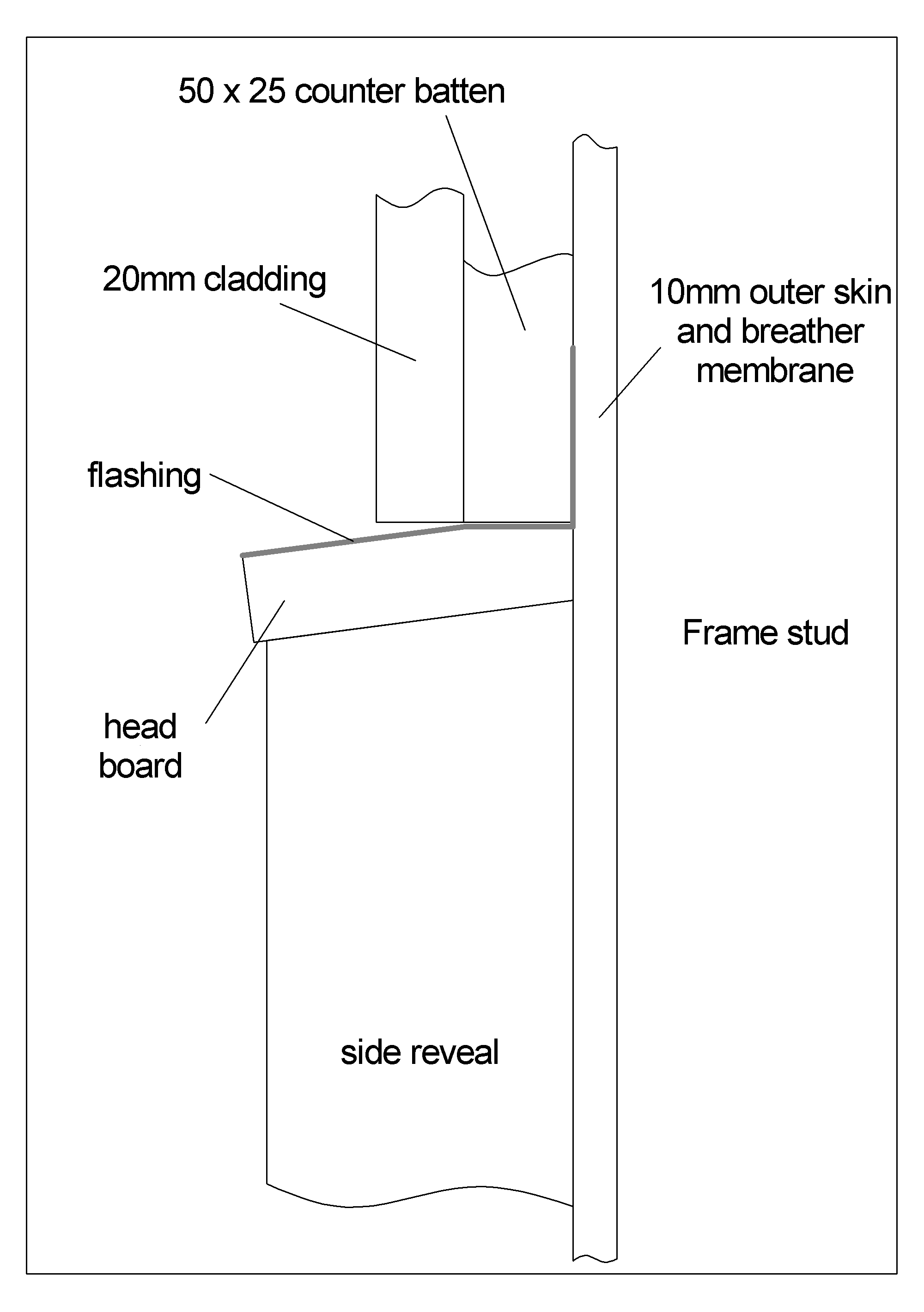
There's a TRADA detail for this. What Trada suggest is that you don't fit a batten across the head but that there be a bent aluminium flashing fitted behind the counter battens at the window or door opening head, to direct any water ingress that might get through the cladding and out over the timber fitted across the head of the window as a part of the cladding. I did a drawing of how we did this as it came up on Ebuild, and this is what our's looks like: After some debate, I chose not to have solid aluminium flashing bent up, mainly because I wanted it to be black, so it didn't stand out and the cost of getting black anodised or powder coated flashing was a bit high. There was also the potential problem that the flashing would spring away from the timber at the head, and so would probably need to be bonded down. What I did was fit lead substitute flashing, as this was sufficiently malleable to stay bent without being at all springy and could be neatly trimmed so that it doesn't show at all in practice. I can't remember the brand, but it was 150mm wide, with a black external finish. The head board in that sketch is 70mm x 20mm thick, with a planed bevel where it meets the ends of the counter battens. It is skew nailed in place, through the end of the counter battens and into the underlying house frame. The gaps between the battens were filled with stretched out stainless steel industrial pan scourers, available from large catering suppliers very cheaply and ideal for allowing ventilation whilst keeping insects out, and a lot cheaper than insect mesh.

-
I'd keep it as simple as you possibly can, and avoid anything that needs a lot of upkeep. Project planning tools are OK, but there are really only two key things you, as a manager, need to be able to pull out of them quickly. The first is that you need to know that you have captured every single key activity, quantified its resources, dependencies and timing and entered it into the tool. The second is that you want to know instantly which activity, or activities, are on the critical path, so you can direct resources where they are needed most. Simple is best, even for really big projects. I was the programme manager for a £1.382bn "project" that had thousands of activities and hundreds of people working on it. I managed that (successfully, I like to think) using two key bits of information. One was "does the expenditure right now look about right for where we are?", the other was "what are the five top risks of failure for the programme?". Crazy as it might seem, I was appointed to manage this programme with no project management experience at all. I was a scientist who'd been promoted away from the bench and into management, crazy, because the promotion was on the basis of scientific achievement, not management ability - I had none................. Anyway, because I didn't know any better I decided that if I concentrated on accurately identifying risk and putting my effort into putting resource into reducing the most critical risks each week, the chances were that things would run effectively. As it happened they did, colleagues managing other large programmes thought I was some sort of guru and I was asked to give presentations on "risk focussed management". I'm tempted to say that it was all management bullshit, but I'm still inclined to the view that this was a good approach. It's hard to beat a white board on the office wall for the scale of management you're looking at, and it's also hard to beat the simplest form of spreadsheet you can come up with to manage cost. If it were me I'd have a system where one white board had a list of risks, and on which every single person had an equal right to add risks. I'd get these collated in order of severity, probability and impact and review them very regularly. What you'll probably find is that early risk mitigation will reduce both your operating cost and your failure rate on jobs. Finally, don't get seduced by project management tools and their features. I still use a method I was taught back in the late 70's when I was working on the Stingray torpedo development programme. It was the system that was created to manage Polaris, the program evaluation review technique (PERT). It can easily be hand drawn on a white board, it's easy to see the critical path and I find the concept of activities having an earliest start, latest finish, dependencies on other activities completing and an estimated period of time and resource level for completion, an easy one to grasp. It's not fashionable, probably because it's as easy to do on a white board as it is to use a bit of software. It has one overwhelming advantage, and that is that even someone with no experience of project management can look at it and see where the critical path lies and where resources must be committed to keep things on track. GANTT charts are, IMHO, a complete PITA, as they are regularly frigged to show what the presenter wants you to see, they don't naturally show you the critical path and I've yet to find them to be useful for anything other than office wall paper.
-
Yes, as you can choose whether to keep the heat or chuck it away depending on whether or not you need it. I still like the idea of pre-heating the incoming cold water that's feeding the hot water system with waste heat, and wish the regs were changed to make this more practical. Recovering 50% or so of the waste heat from hot water usage seems a worthwhile saving in a house where hot water energy use dominates the overall energy consumption.
-
Retrospective planning permission for oversized porch
Jeremy Harris replied to VickyHodges's topic in Planning Permission
Yes, if there was an accident and if the failure to maintain the visibility splay was determined to be a factor, or even the primary cause (unlikely, as the primary liability would still fall on the driver to take account of the poor visibility) then the council might well be found liable in part. My guess is that they would bear a proportion of the liability depending on how severe the visibility restriction was and what the precise actions of both drivers were. This balance could be changed; for example if warning signs were erected highlighting the "hidden" driveways, then some liability could transfer to the driver of the vehicle driving along the road, on the basis that the warning places an additional duty of care on that driver to be more vigilant and adjust his/her driving to reduce the chance of an accident. I've spent the past 15 odd years working with liability and insurers; it's always a can of worms but there is one universal truth - they ALWAYS go after the money. That means they seek to take action most vociferously against those with the deepest pockets, so they will go after other insurers, companies and public bodies first, and rarely go after an individual unless they know that he/she is sufficiently wealthy as to justify action. -
It would work to an extent, but the MVHR will be very, very slow to re-distribute heat (because of the low heat capacity of air and the low flow rates) and the tank will lose heat more and more slowly as it cools, so could take a long time to get down to room temperature. It's also only a benefit during the heating season, which is only two or three months for a well insulated house, if that. The combined slow heat distribution and cooling of the tank then bears on the capacity of the tank. To be effective it may well need to have enough capacity to store waste water from several showers/baths, so could need be around 200 to 500 litres to cope with showers or baths taken within a few hours of each other. That's pretty big, especially for something that would need to be bypassed with a valve for around 8 or 9 months of the year when room heating is either not needed or would be a nuisance. Hot water demand is pretty much the same all year around, so if there is a way to reduce that from waste heat then that is a significantly greater benefit. At a guess, you might be able to halve your hot water energy needs with a very good system.
-
Retrospective planning permission for oversized porch
Jeremy Harris replied to VickyHodges's topic in Planning Permission
I suspect that in the present financial climate there may well be a reluctance to take enforcement action where there is a risk that the local authority could incur cost, too. I'm in the middle of an argument with our council over a visibility splay, that illustrates this. There is a legally binding obligation on the council to maintain a visibility splay either side of our drive where it crosses a wide verge they own. They have chosen to stop cutting the verge, as a cost-cutting measure, rather than add a pound to the Council Tax. They have a dogmatic rule that no matter what central government does they are refusing to increase the Council Tax and are just cutting services, like road sweeping, grass cutting etc instead. Some of us have got together and go out and keep the verges cut, at our own cost, instead, and this worked until early this year when we were issued a letter warning us of criminal trespass, because a telecommunications company alleges that our unlawful grass and weed cutting has caused damage to their (already badly corroded) cabinet. We haven't damaged the cabinet at all, I'm sure, but in the mean time we've decided we have no choice but to stop the volunteer effort, as none of us want to risk prosecution. The verge has now grown to around 3 to 4ft high and contravenes the visibility splay requirements for several houses along the road. Clearly the council have a legal obligation to comply with the requirement to maintain visibility for road safety, yet they are point-blank refusing to, on the basis that they have no funds to cut the verges. In essence, they have decided that it's better to wait and see if there is an accident, and then pay out damages if it was found that the lack of visibility was a factor, rather than pay out now to cut the undergrowth down. I am sure the same sort of cost-based decision making goes on in planning enforcement, too. -
Paddle or Shoe Valves? (Now Ball Valves)
Jeremy Harris replied to le-cerveau's topic in General Plumbing
I used 2 port motorised ball valves. 100% seal, unlike the paddle or shoe valves; I tested a paddle valve and it did let by a tiny fraction under pressure, and as I wanted 100% isolation between the warm and cool sides of our ASHP pipe work was not prepared to risk using a paddle valve. I also bought a three port motorised ball valve to test, but that was very restrictive, as it uses a slot in the ball as the feed to the ports, rather than a hole right through. I bought a box of DN20 12V motorised valves, having bought one sample, taken it apart and found it to be well designed and made (it came from China). I also bought some similar DN15 valves. The DN20 valves are just like a normal DN20 ball valve body, with 3/4" BSPF threads in the ends, but they have a small geared motor, a relay and two micro switches as limit switches inside the housing on the top. The ones I have are three wire types, one wire to ground and apply power to each of the other wires to open or close the valve. As soon as the valve has opened or closed it stops drawing any power, as the limit switch operates. They only draw around 100mA max at 12V for the two or three seconds the motor is running. The ones I have use standard small micro switches and a standard relay internally, but the motor and gear train seemed to be specific to the valve. This is why I bought a box of them, as I have loads of spares. In all probability the only thing that might fail is the motor unit, and it's ten minutes work to replace this. I paid about £8 each for them and bought 10 altogether, although I'm only using 2. Here's a photo of a spare 12V DN15 three port valve that I happen to have as a sample here, the ones that have the restrictive flow (the two port valves have a straight through bore that's the same as a standard ball valve when open):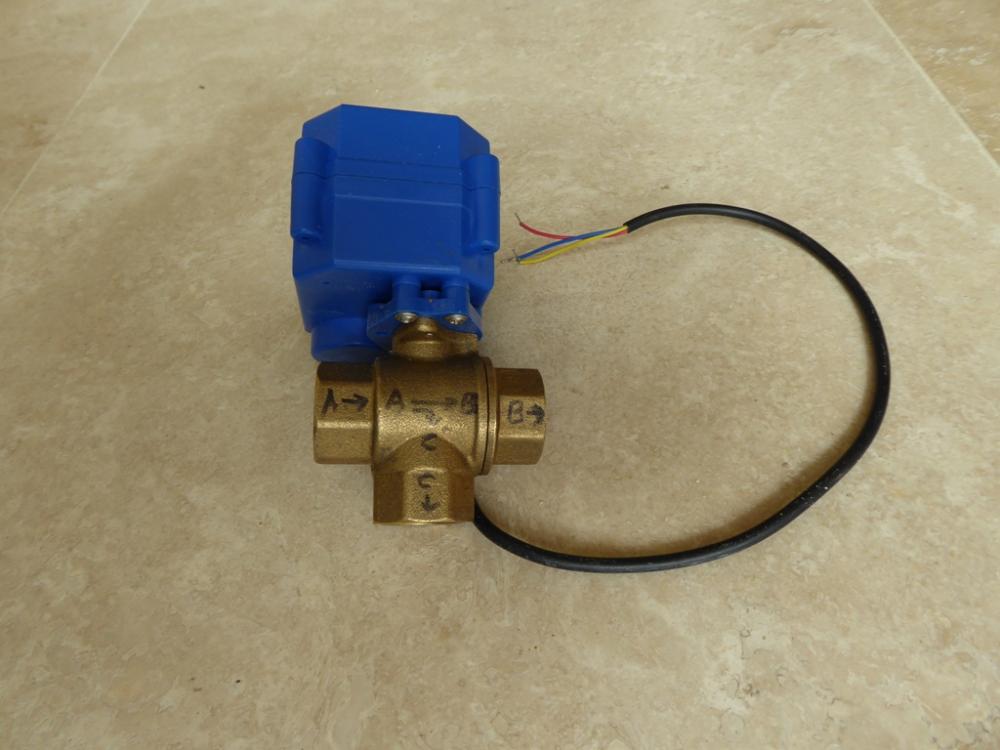
-
Retrospective planning permission for oversized porch
Jeremy Harris replied to VickyHodges's topic in Planning Permission
My thoughts align pretty much with Ferdinand's. There is only one consideration that the planners will take into account, and that is "does this application comply with planning policy and guidance?". If it does they will approve it, if it doesn't they may either ask for some changes to make it compliant, or exceedingly rarely, they may refuse permission and then seek to take enforcement action to have it taken down. Neighbours personal views don't count for anything at all, unless they are pointing out a failure to comply with planning policy and guidance, or they are directly impacted by the development, such as loss of light, privacy, increase in traffic density etc. Neighbours routinely object to things they personally dislike; a read of pretty much any planning application on any local authority website will show this, hundreds of people write letters of objection every week, and 99% of the time they carry no weight as they are not referring to planning policy or guidance. The planning application for our self-build plot that was extant when we bought it had 14 letters of objection on file from neighbours. All were ignored by the planning officer and committee, as not one was objecting on the grounds of any valid planning policy - all were basically "we don't like the idea of someone building there" letters, which frankly were a waste of paper as far as having any effect on the application went, all they did was cause a delay and inconvenience for the applicant, the planning officer and the council planning committee. If you feel that this porch doesn't comply, then quote the specific policy or guidance that it is in breach of in your letter of objection, and make it very clear as to why, in your view, it fails to comply. Not liking the bricks etc is not a valid reason for objection, unless the house is in a conservation area or other area with specific restrictions on external finishes. There is always a slim chance that you may spot something in the policy and guidance for your area that the planning officer dealing with the application may not have seen (unlikely, usually, as they generally tend to know their own policies pretty well).