Jeremy Harris
-
Posts
26430 -
Joined
-
Last visited
-
Days Won
360
Everything posted by Jeremy Harris
-
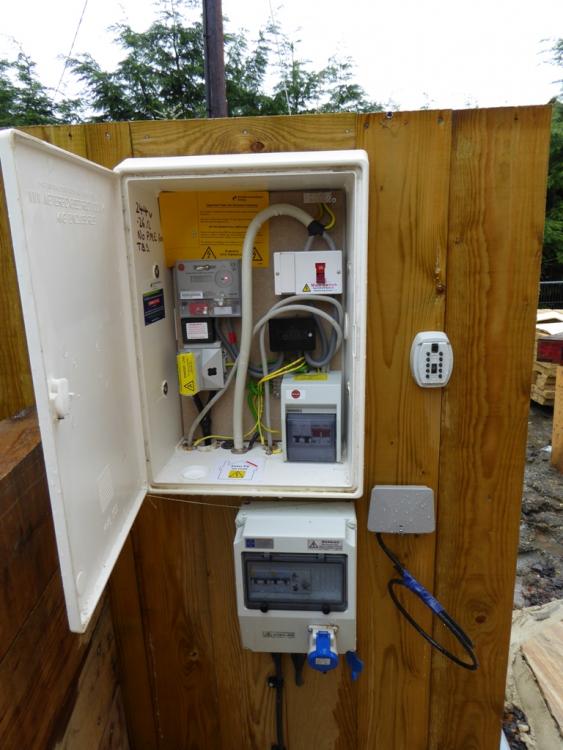
I was a bit cheeky and stuffed everything into one meter cabinet, something that has been known to cause raised eyebrows with the supplier, but which isn't actually against any rules, as you own the cabinet, not them: The 80A fused isolator is at the top right, and feeds a length of 25mm² three core SWA that runs underground and into the house services area, where there is a ten way consumer unit. The two way consumer unit at the bottom right feeds the outside stuff, including the caravan box underneath that has the 16 A Coommando socket that was used as a temporary site supply.
-
My experience was that a newly plastered wall takes a week or two to dry out. The surface may have been dry after a weekend, but the chances are that there was still moisture deeper in the plaster, and when covered with a moisture impermeable bathroom paint, that's come up to the surface and caused the bubbles. You can get away with painting over new'ish plaster with something like ordinary emulsion, that will let any trapped moisture come out, but probably not with a water resistant bathroom paint that forms a waterproof skin on the surface.
-

How to get airtight seal around services?
Jeremy Harris replied to Novice's topic in General Construction Issues
I sealed our ducts up this way: First poke a ball of expanded metal down as a rodent barrier. Next shove a plastic bag round the cables/pipes, deep into the duct, with the open end upwards. Finally, squirt expanding foam deep inside the plastic bag, trim the top flat and add a bit of airtightness tape for good measure. This sealed things up very well, and also had the advantage that it could be undone. I needed to pull the length of 25mm² SWA further into the building, when I decided to relocate the CU upstairs, and found that it was easy enough to pull the foam-filled plastic bag out of the duct, because the foam hadn't been able to adhere to the cable or duct. -
Personally, I doubt that the 2mm of PE inside the aluminium skins of the Reynobond was a significant factor at all. The 150mm of RS5000 that was bonded and fixed directly to the existing concrete was almost certainly the major fuel component. The major issues seem to have been a failure to consider the whole design from a fire risk perspective, and a reliance on the individual materials approvals in isolation. A major contributory, perhaps fundamentally causal, issue was the apparent absence of proper fire stops around openings, that should have stopped fire escaping from the kitchen window of the burning flat from getting into the ventilation cavity behind the Reynobond, and in front of the RS5000. Once the RS5000 was hot enough to give off flammable gasses, then the fire could quickly propagate up behind the cladding. Even if the cladding had been something like stainless steel sheet I think the outcome may well have been much the same, as I can't see how a 2mm thick layer of PE could add much in the way of additional fuel to this fire.
-
Welcome, As @Crofter, says, a few of us have opted to fit the meter cabinet in a wall or fence away from the house, so that we could avoid either paying for a temporary site supply on top of the permanent connection, and because in many ways it makes life a bit easier. We fitted a meter box in a thick timber fence that acts as the screen for our wheelie bins now, and fitted a caravan outdoor consumer unit, with a Commando socket on it, as a temporary site supply. Here in England this was a two stage process. I had to get the DNO (SSE in our case) to run a cable to the right place, then contracted with a supplier to install the meter and connect it. @ProDave did much the same, and he's in Scotland too, so may well be able to shed some light on how things work there.
-
FWIW, I spent an inordinate amount of time and effort in taking risk out of the ground works (which was where three quarters of our build risk was), so understand the problems extremely well indeed! However, even people that have done very good due diligence checks can get caught, and a read through here will reveal loads of ground work related issues, many of which could not have been easily predicted. There's also the big problem of cost of investigations. For a single plot of modest value, things like the mobilisation cost of drilling rigs, let alone the cost per metre for borehole drilling (something I'm painfully and intimately familiar with!) can be very costly. In our case, we bought a plot worth around £150k, for a lot less, then spent well over £50k on ground works just to get the plot to the point where we could lay the foundations and start building.
-
I agree that plot hunting is far and away the hardest part. We looked around for about 2 years, with me working pretty much full time every day just looking for plots and driving out to see them. It was pretty soul destroying, as there seem to be so few plots available for self builders. I even tried hunting around looking for potential plots (overgrown large gardens, etc) and searching through local planning applications every week to see if there might be anything in the pipe line. We were at the point of giving up when we found our plot, but it took a heck of a lot of effort to actually buy it - it was a year from having our offer accepted to completing the purchase. The London area presents an especially large challenge, I think, because of the very high demand and the associated high prices. Demolition and rebuild seems to be one of the only reasonable ways to get a decent plot in many areas now.
-
Do you not mean firm price? A fixed price contract allows for some variation in the final price, depending on the reason, a firm price contract doesn't. If there is significant risk involved, then it's not likely that either a firm price or fixed price contract will give best value, as the builder will just add the risk contingency into the pricing. It can really pay dividends to break the work down into smaller contracted elements sometimes, just as a cost and risk mitigation measure. The best example is probably breaking ground works out from the build contract, as most of the risk will be in the ground works usually. As risk pricing will be on a percentage of total price basis, restricting the greatest risk elements to a smaller overall proportion of the whole cost can make a significant difference in price.
-
I'd second looking at @jamiehamy's project, as they've tackled some very similar challenges with their water tank conversion. The key thing is probable the one you've already identified, whether to insulate outside or inside the existing structure. Outside is likely to mean a lot more work, but means you can gain the benefit of having the thick concrete at near room temperature, which will massively increase the thermal time constant, from the long decrement delay. Inside is probably a fair bit cheaper and easier, but will reduce the decrement delay, but that may well not be important, depending on the orientation of the open side. Having three sides and the roof earth sheltered will help, as it means that those surfaces will have a year around near-constant temperature differential of around 14 to 16 deg C. Another point about where to put the insulation relates to the internal space, and whether or not you can accept losing 200mm or so all around from adding internal insulation. I doubt that waterproofing will be a problem, as water tanks are always built way above the water table, so there should be little or no risk of ground water penetration. Concrete that thick will also be very watertight, so the chances are you don't need much, if anything, in the way of further tanking. The worst case may be that you have to fit a dimpled membrane against the concrete, draining to a small sump and drain outlet (which may well be just a gravity drain) and then internal insulation and lining inside that, pretty much like a basement.
-
I got prices from Supergrund, Kore and Isoquick and once adjusted for all the missing stuff, the quotes were similar; around £10k to £11k for a 75m² insulated slab, installed. That was based on the ground works already having been done, in as much as the site was level and the 150mm layer of stone had been laid and compacted. The prices included the insulation, steel reinforcement and concrete pour, but not UFH pipes (they would have added maybe £500 at most, I think).
-
I think that's a pretty unusual example, as plots are usually a lot more than that, especially in sought after areas. For example, our plot is pretty small, just big enough for a 75m² footprint house and tiny garden, and was valued at £150k just over two years ago. Our build cost came in at about £1380/m², for 130m², with no architect, planning consultants etc fees. Had we used an architect then we were looking at around £18k for his fees, on top of the build cost. Total cost to build for us came to around £335k, valuation at completion was around £340k, so no real profit, and that cost takes no account of around two years full time labour by me. If you're very, very lucky you may find a site that no one has yet discovered, and buy it for a song, but I get the feeling these cases are pretty rare, especially anywhere near London or the South East, where plot prices are a lot higher than around here. We're around 80 miles South West of London, and a local builder I know reasonably well stopped building speculative one off's years ago, as there was little or no profit in it. I found that a fair number of plots we looked at were being sold by small builders, because they'd realised that it was no longer worth their time to build a house to sell on now. I think a fair part of that is that build costs have increased a fair bit, and that coupled with the high premium that single plots seem to attract makes self building more of a way to get the house you want, rather than get a house for a substantially lower price.
-
Sadly, one of the ways to make something appear as if it is some sort of technological marvel is to charge a high price for it. The high price lends credibility to the claims in some ways. The chemistry of water treatment is pretty straightforward, as the compounds dissolved in it are all very well understood. When it comes to scale, then there are two main groups of metal compounds that cause permanent hardness, calcium sulphate and calcium chloride, plus magnesium sulphate and magnesium chloride. No device that uses a non-renewable catalyst, magnets, and electric field etc will remove these compounds. The most obvious thing to ask with any treatment system is "Where do the unwanted compounds go?". In the case of all the inline water treatment devices that have no drain, the answer has to be that they cannot go anywhere, so they must still be in the water at the outlet of the device. There is some pretty vague evidence that by altering the charge on some of the compounds their tendency to stick together is reduced slightly, but it's far from proven, and there's no evidence that there is any permanent change to the outlet water at all. For devices like ion exchange water softeners or reverse osmosis filters, then there is a waste drain that removes the waste metal compounds from the water. In the case of the common ion exchange softeners, they chemically replace the calcium, magnesium and to a lesser extent iron, compounds in the water and replace then with the equivalent sodium compounds that don't form scale. When the softener regenerates, using sodium chloride solution, the calcium, magnesium and iron collected in the ion exchange resin is flushed out and replaced with sodium, ready for the next water treatment cycle.
-
I understand that the Model 3 has just gone into production, two weeks earlier than planned, with deliveries to start at the end of the month. I will watch with interest, as it's my hot favourite for a replacement for the Prius Plug-in, the snags may well be the eventual UK price and the long lead-time.
-
I agree, it was 50/50 whether we went for a Kinetico or a Harvey. Both are twin tank, both use water metering, both are non-electric. In the end we went with a Harvey, because one came up at the right price, but I doubt there's much to choose between either. I like the fact that they work with no power, and don't need to regenerate over night (a potential problem for us as our main water filtration system backwashes overnight). The low water use during regeneration is also useful, as is the relatively low salt use.
-
This is definitely not a water softener, it seems to be one of the many "water conditioners" that "claim" all sorts of things. There's no scientific evidence that any of these devices do much, if anything, but some "may" change the way some of the minerals in the water behave (although there is no hard evidence to say one way or the other). The claims are carefully worded to suggest, rather than guarantee, what the devices "may" do, so they skate as close to the ASA rules as possible, but stay just on the right side of the law. None remove any of the metals, chemicals or minerals in the water at all - what comes out is chemically the same as what went in.
-
Worth noting that phosphate dosing doesn't remove anything from the water, the proportion of metals in the water on the inlet side is exactly the same as the proportion of metals in the outlet side, so there is the same amount of calcium, magnesium, iron etc in the water post treatment as before. The primary effect is to coat the inside of the pipework, heat exchangers, water heaters etc with a protective coating that reduces the level of scale build up. A secondary effect is that the small amount of phosphate makes the water easier to lather with soap. In essence, it's the same as adding Calgon to the water supply, but in a continuous, low level, dose. Ion exchange water softeners do remove metals from the water, primarily calcium and magnesium, but also iron to some degree. They replace those metals with sodium. You can remove pretty much everything from water with reverse osmosis, but the water tastes pretty awful, it seems we need some mineral content to make water taste OK. If all you want to do is protect a boiler, water heater etc from scale damage, then phosphate dosing works fine, and is probably the cheapest way of providing protection. The water boiler for our boiling water tap was supplied with a phosphate dosing filter for just this reason. If you want to soften the water, by removing high levels of calcium and magnesium compounds, then it's hard to beat a standard ion exchange softener. As a useful side effect this will also prevent scale formation in boilers and water heaters (but be aware that there is a lot of false data about from manufacturers regarding this - all of it relates to an absence of product certification testing with soft water).
-
DIY Airtightness test (the Blue Peter method)
Jeremy Harris replied to ProDave's topic in Boffin's Corner
Sadly this is probably true. When we were looking for a builder we went to look at a small development of 6 houses that were being built, at the invitation of the builder. Part way through the tour, the "sales chap" that had been showing us around the most complete build had to go and answer a phone call. There were two chaps inside taping things up, and I asked what the air tightness target was that they were aiming for. One of them said that the house had been tested twice and failed, and they were busy taping it up to try and get a pass. The other remarked (sounding a bit pissed off) that they weren't going to go through all this hassle on the other houses.............. -
DIY Airtightness test (the Blue Peter method)
Jeremy Harris replied to ProDave's topic in Boffin's Corner
Yes, it was. I made it when I was still trying to improve the airtightness of our old house, which was a bungalow. -
Building Regs / Construction drawings - what is needed?
Jeremy Harris replied to Weebles's topic in Building Regulations
Here's a link to a blog entry that has copies of everything I provided for Building Control that might help: http://www.mayfly.eu/2013/09/part-fifteen-the-site-is-finally-ready/- 26 replies
-
- 3
-

-

-
- building regulations
- planning
- (and 1 more)
-
DIY Airtightness test (the Blue Peter method)
Jeremy Harris replied to ProDave's topic in Boffin's Corner
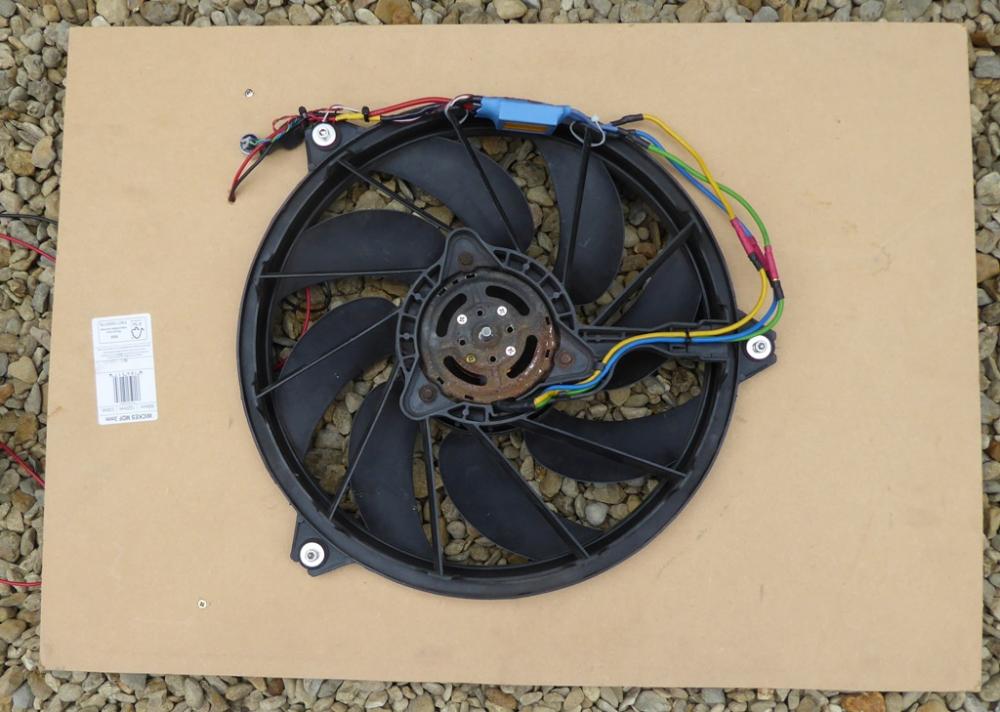
The dynamic pressure of the wind speed doesn't match the test pressure for the blower test, for a few reasons. The first is that the wind is not stopped dead by the house, so not all the dynamic pressure is converted to static pressure on the windward side of the house, only a small part of it. There's a corollary here with the Betz Limit and wind turbines - if you extract all the energy from the moving airstream (which is what full conversion of dynamic to static pressure implies) then there will be a stagnation zone on the windward side and the house will be absorbing all the kinetic energy in the wind. Clearly this doesn't happen, and the wind finds a way to flow around and over the house, so the dynamic pressure on the windward side will be a great deal lower than that implied by the wind speed. The second significant effect comes from Bernoulli's Principle. Because the wind has to flow around and over the house, the distance it has to travel is greater than if the house wasn't there. Downwind of the house the wind individual streams will join up and flow at the same velocity again, which implies that the air flow velocity over the house will have increased, so lowering the dynamic pressure. The effect of this is to reduce the pressure above and around the house, and on the leeward side, so there is an increase in pressure differential across the house, from the windward to the leeward side. However, because there is still a substantial air flow velocity downstream of the house, it's clear that, as above, the house has not extracted all, or even a significant proportion, of the energy in the wind. Working backwards this implies that the actual pressure differential that the house experiences, from one side to the other, will be a lot lower than 1/2 ρv² would suggest. If I had to guess, I would say that the worst case might be around 30% of the dynamic pressure given by 1/2 ρv² as the highest pressure differential the house would see in practice, but this will vary a great deal from one house to another, depending on the location, local terrain shape of the house, wind direction etc. On the topic of home brew pressure test fans, I made one up a few years ago to try and improve the airtightness of our old house, or at least help me find the biggest leaks. Because the air flow requirement for the fan is small, but the pressure differential is relatively high, I chose a forward sweep fan, as these tend to cope with a higher differential pressure without running into serious blade stall. I found a suitable fan in a scrap yard, a big car radiator cooling fan, but when I tried it I found that the brushed motor it came with wouldn't work well over a wide speed range. I ended up replacing that motor with a brushless DC motor and speed controller, which allowed pretty fine control of motor speed. Here's a couple of photos of the thing (it was made to fit tightly into a open window): The speed control knob allows the fan to run right down to a very low speed, to reduce the airflow rate. To measure the differential pressure very approximately I made up a sloping U tube manometer, with the sloping tube set at 30 deg, in front of a bit of paper printed up with stripey lines. The stripey lines make it easier to see the exact position of the water in the tube, as it refracts light and makes the lines look kinked. Even so, getting 50 Pa was a very rough and ready thing, and I doubt I got closer than around 20% accuracy. I did look at buying a low pressure Magnahelic differential meter, but they were a bit expensive for what was really just a rough and ready test.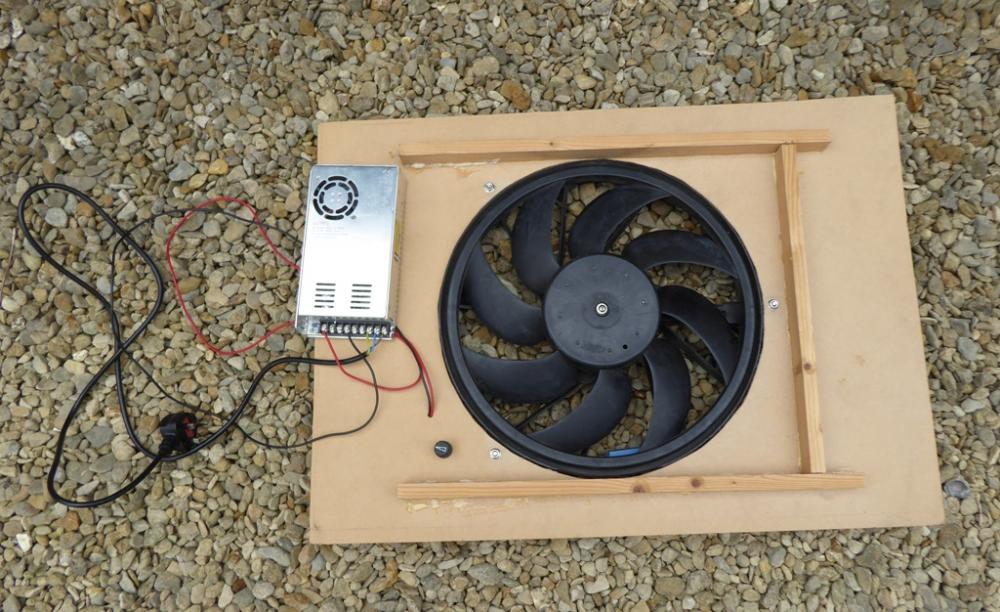
-
Yes, just a junction box, as the EVSE has the electronics in to control the charge point, and provide safety isolation, so needs to be hard wired to the supply. A typical charge lead will be 5m long, so you should be able to connect from a centrally mounted EVSE to any car parked in the garage, as long as the vehicle charge connector end is facing the right way. These vary, my Prius Plug in has the charge connector on the rear offside wing, the Nissan Leaf has it's connector under a flap on the front of the bonnet, so you may need to position the cars the right way around in order to connect. Some EVSEs have a fixed charge cable, but if you're unsure of the type of car you might get, then an EVSE with a socket, the same as those on public charge points, might make more sense. I have one of each, the one by the garage has a socket on the front, the one at the other end of the drive has a fixed lead and charge plug. It would be great to see more charge points around. Anyone who's in our area is welcome to use one of mine, and the more people prepared to share charge points the better, in my view.
-
If you have 3 phase, then I'd run a hefty 3 phase feed to where you think you may want a charge point. Few EVs can charge from 3 phase at the moment, but there are 3 phase to DC fast charge points around, and a 32A 3 phase supply would allow the fitting of one of these. No need for a socket, as the EVSE will have to be hard wired, so just run a suitable 3 phase cable to a junction box, near to where you think you may want a charge point fitted. You may want to think about having two charge points, depending on the layout of your parking areas. I have a 15A EVSE at one end of the drive and a 30A one by the garage. This makes it easier to plug in wherever I happen to park..
-
I get you, I misunderstood what had been released. If it's just a specific instruction to a search engine, with the mic under your direct control, then that sounds a reasonable compromise. Like you, I have an issue with the data collection that these systems do without you being aware. The idea of having an always-on mic in the house seems just a bit too much like Big Brother (in the 1984 sense) for me. With a mic button, the system would presumably work a bit like the way the speech interface in my car works. That has a "push to talk" button on the steering wheel, which activates the speech recognition system. Frankly the Toyota system isn't great, and it's usually quicker to just reach across and tap commands directly on the screen, but from the adverts, the Google and Amazon systems seem to work a lot better, presumably because they can quickly access a massive amount of data on their respective servers.
-
Being able to close these systems off is good news indeed, as it seems clear that the always-on mic does collect and record data not directly related to a command, hence the recent trial where Amazon were asked to release audio recording data as evidence as to what had happened in a room immediately before a crime was committed. How are Google and Amazon going to make money from a closed loop system though? Their business model is primarily based on data sales, in one form or another, and a closed system isn't going to pass them any data to profit from. I had a look a couple of months ago at some DIY options, like Alexa Pi, but all these really did was allow a RPi to act as the front end client and pass data back to Amazon servers for processing, AFAICS, so there's the same issues with data privacy as there are with the Amazon product.
-
I've got a dead blow hammer. Doesn't bounce, and gives a much heftier blow. No good for banging in nails, as it has a soft face, but a lot more effective than an ordinary soft face mallet.