Jeremy Harris
-
Posts
26430 -
Joined
-
Last visited
-
Days Won
360
Everything posted by Jeremy Harris
-

How to store 10,000 litres of water
Jeremy Harris replied to Tin Soldier's topic in Rainwater, Guttering & SuDS
I used 20 crates to build our surge storage, that's under the drive. Each crate has a capacity of 196 litres, IIRC, so we have a permeable "tank " that's a bit under 4,000 litres. The total cost, including the excavation, came to around £1k, IIRC, but I bought the heavy duty Aquacell crates very cheaply from a local chap that had loads of surplus ones from a big road job (I think I paid around £20 a crate, delivered) so saved around £1k on the price of the crates. -
So the UK government is looking to spend (not necessarily invest) £264M and expects to become a " world leader in the design, development and manufacture of electric batteries"? Remind me again how much investment has gone into building the Tesla Gigafactory, plus all the Panasonic/Tesla R&D spending? I'm pretty sure Panasonic alone have invested over £1bn in it, and I think that there has been another £2bn or so from Tesla and their backers. Just how deluded is our government to think that investing less than 10% of just one of the many companies investing in battery technology is going to somehow make them "world leaders"?
-
Nice to see that so many former Ebuild members are still managing to find us! Welcome back.
-
Reading what has been reported suggests a level of misunderstanding by government, presumably at the hands of their puppet masters, the energy companies, as to how things work that is a bit more than staggering. It's been years since you could buy a washing machine that could be turned on by a time switch controlling power to the machine, something I've long been annoyed about (we used to have our very old washing machine connected via a time switch so that it ran overnight on E7). Modern machines just reset whatever the set programme is, ours even resets the integral time delay setting, when the power goes off, so they cannot be controlled by just turning the supply on and off. We are some way away from "internet of things" washing machines, and given all the many security vulnerabilities in the first generation IoT devices I think there may well be a lot of resistance to the idea. Reading between the lines, I think this is a way to tear up FIT "contracts" (it can be done, I believe) to reduce the payments that are currently given to microgenerators. I think what we will see is some minor (in the overall scheme of things) investment in battery technology, that will have near-zero impact (are the government REALLY going to invest as much as people like Elon Musk in battery technology?). There may well be an incentive tariff for those who are prepared to invest in home storage solutions, and who are willing to use them to support the grid, rather than reduce their own electricity bills. The big problem the grid has is imbalance, and that's got worse as old nuclear and coal plants have been closed, and as renewable generation capacity has increased. We now get very big swings in renewable generation, with it providing a large percentage of the power we need from time to time, and producing very little power at other times. This means that fast-acting generation capacity has to be available to take up the dips, but is then shut off (and so making no profits) during the peaks. The industry wants to find a way to try and shave the peaks and reduce the depth of the dips so that it is more profitable to run power stations. Part of the problem is the generation funding model, which is a free market, with the spot price for generated electricity changing through the day, and from one day to the next. It's questionable as to whether such a totally free market is a good model for reliable long term electricity generation infrastructure. There needs to be an incentive to build new generation capacity, and that depends on the investors being able to predict the likely long term return, and I suspect that at the moment that isn't easy (hence the massive government subsidy/guarantee for Hinkley Point C).
-
Vat reclaim
Jeremy Harris replied to johns's topic in Self Build VAT, Community Infrastructure Levy (CIL), S106 & Tax
Shouldn't be a problem, our detached timber frame garage was supplied and erected without VAT, as a part of the build. As you say, as long as it's on the approved plans, then that's fine. -
Making a Piggery of it: stone slips
Jeremy Harris replied to ToughButterCup's topic in Building Materials
One problem with cutting slips is that you'll only get two per stone, assuming you want the outer face to look natural, rather than sawn. I think the way they are normally made is to cleave stone into sections that are a bit wider than two slips, then saw them down to size to get a consistent thickness. That seems to be how our sandstone paving slabs were made; the face looks to be cleaved whereas the rear has clear saw marks. -
The upper air test limit to meet the Passivhaus spec is 0.6 ACH, so 0.8 ACH is non-compliant, but a bit better than the Part L1A building regs requirement (hard to compare directly, as Part L1A uses a different measurement system). First test on our build, for example, was around 0.43 ACH, IIRC, and it's now a bit better than that having adjusted the front door and French windows. To allow for a bit of degradation with time (door seals gradually getting a bit more leky, for example) it's probably better to aim for an air permeability that's initially a bit better than the PH worst allowable figure.
-
On a much smaller scale, we were assured by all the utility companies that there was nothing at all under the lane in front of our house, in writing, as a part of the mandatory checking your have to do before digging across a highway. The water company even came out on site, twice, to check, when we were arguing the toss with them about a connection and assured me there was no pipe under the lane at all, and that the nearest pipe on our side of the stream was 140m away. We needed to dig across the lane to put a drain in, and what did our digger chap find running down the middle of the road? A water pipe. A bit of checking showed it was the supply to the cottage over the road, and ran to a nearly-new stopcock that the same water company that said there was no pipe in the road had installed a couple of years earlier. When they were then questioned about it, they said we couldn't connect to it as it wasn't a water main, but a communication pipe. I asked how they knew this, when they didn't even know the pipe was there, and, after a bit of digging around their local engineer told me that they had deliberately decided to call it that to try and extract £24k from me to run a new pipe up the road. The existing cast iron pipe had been laid back in 1934 and needed urgent replacement, and they were trying to get us to pay for it............. Bear in mind that we found this unknown water pipe during construction, and I'd spent several months double checking the location of everything before we bought the plot, even getting a survey done with a CAT to locate another unknown major power cable across the plot and factor in getting that moved as a part fo the work. There is no such thing as too much checking of details before purchase, and really no substitute for carefully walking all over the plot, ideally with a surveying tape, and noting down where there are any indications at all of drains, cables, pipes etc. Often there will be indications on the site that don't match the plans, and it's also very common for there to be errors in the actual position of boundaries, relative to where they appear on plans. I'd go so far as to say that the majority of site plans that haven't been derived from a proper survey will be in error, often by several metres.
-
Members here have had to deal with all sorts, from a major oil pipeline with a wide "no build zone" either side, to buried HV cables that have similar restrictions. A very big problem is that plans for things like this, and services, are often very wildly inaccurate, so if there is even a hint that there may be a pipe or cable near the plot it is very wise to check exactly where it is. As an example, have a read of this post, which is far from untypical when it comes to the accuracy of plans:
-
It's in the middle of a village, with houses behind, to the side and opposite. We ended up drilling a borehole for water and fitting a treatment plant for sewage, that we managed to get consent for to discharge to the stream across the lane. We had power and phone at the edge of the plot. Power cost around £3.5k, phone around £300, the sewage treatment plant and installation was around £4k and the borehole and associated water treatment plant was around £10k.
-
It shouldn't. I still have an old metal cased Fibron tape that I used to use for surveying caves, and when I dug it out to use on site it was still fine (if a little bit muddy - full of South Wales mud.........). My old Fibron 30m/100ft tape says that it's accurate to 1/8" inch at 100ft, according to the label on the case, so about 3.2mm. I can live with that level of accuracy for setting out............
-
There's a water main and a main sewer within 30 metres of our plot. I couldn't connect to either of them, because of EA rules. The cost of getting water from another main 140 away was going to be around £24k and the cost of getting a pumped sewerage solution and connection to another sewer around 100m away was going to be around £18k all in, so just getting mains water and sewerage would have been around £42k. There was no indication at all of these problems on the plans or the particulars of sale; had I not made full and detailed enquiries before purchase I could have been in for a nasty surprise. As it happened, we negotiated the plot price down by a lot (around 1/3rd) to cover the additional costs that building on it would incur.
-
Nothing in building regs apart from the general provisions in Part A with regard to the foundation/slab being designed to take the load. This can be shown either by using a standard detail that's accepted by building control, or by getting an SE to sign off the design. I doubt a 50mm slab, would be OK, as it couldn't be reinforced (not enough cover for the steel fabric), and most probably wouldn't be able to take standard floor loads. My gut feeling is that 100mm with reinforcement is probably about the minimum, largely because you need around 40mm cover either side of the steel fabric
-
Planning is rarely a certainty, I'm afraid, and if it is, then the question is still the same, why hasn't the seller got PP? There has to be a very good reason for a seller to not bother to get PP before offering a building plot for sale, and that says to me that there is a risk there somewhere, even if it's not obvious. If it's not an obvious planning permission risk, then it may well be something else, like the provision of services to the site, or something adverse that impacts what may be built there (underground cables, pipes, pipelines etc, even if only nearby). I've never once heard of a bit of land being sold as a potential building plot, at a price that is roughly the same as a building plot with PP, without there being a gotcha in there somewhere.
-
Worth bearing in mind that a plot without planning permission is worth perhaps 5% to 10% of the value of a plot with planning permission. If someone is trying to sell a plot without planning permission you have to ask the very big question, "WHY?". Anyone with sense will get planning permission before selling a plot, even if only outline, because of the massive uplift in value that it gives. A plot without planning permission would be valued on the basis of possible use, but could be as low as agricultural land value (roughly £4k per acre) up to maybe ten times that for use a garden or paddock for horses (for some reason equestrian use land seems to attract way over agricultural land prices). The value uplift from gaining planning permission creates a significant risk if looking to buy a bit of land with a conditional contract, as the contract needs to be bolted down very tightly to ensure that only you, as the person getting planning permission, can buy the land at the agreed price.
-
When to start worrying ?
Jeremy Harris replied to Triassic's topic in General Self Build & DIY Discussion
It goes to show how difficult it can be to spot a monkey, and sadly there do seem to be a fair few monkeys around. I doubt there was anything more your friend could have done, other than try and track down previous customers to get their view.- 25 replies
-
- 1
-

-
- liquidity
- project management
- (and 1 more)
-
When to start worrying ?
Jeremy Harris replied to Triassic's topic in General Self Build & DIY Discussion
Sounds a bit of a nightmare. Our planning officer said, unofficially, that they generally allowed 100mm to 200mm for normal tolerances on overall dimensions, but would want to see a material amendment or new application for anything over that. One has to question quite how a builder could make such large setting out errors. I can understand things being out a bit, but 1200mm on one dimension and 750mm on another is way OTT, and smacks of having seriously misread the drawings. Given the slightly dubious track record of this builder to date, one has to wonder whether he's even half-way competent. I suppose that, given the suspected precarious state of the builder's finances, they may not be much point in pursuing him for the cost of remedial work. A former colleague had his parked car written off by a drunk driver years ago, took him to court and won, but the bloke didn't pay up, so he took him to court again, where they made an order for the bloke to pay something like £20 a week. The bloke made a couple of payments and then stopped, so was taken to court again, and another order was made. Again he paid a couple of payments then stopped, at which point my former colleague gave up, as it was now over a year since he'd lost his car, and it just wasn't worth the hassle of continuing to take the bloke to court. -
If you get stuck, then you're not that far from me, I suspect, maybe an hours drive, so I could possibly bring my thermal camera up and take some images. Ideally you'd want to try and position one of the new glazing units next to one that doesn't have the externally reflective coating, facing towards the sun, if possible, with a colder surface behind.
-
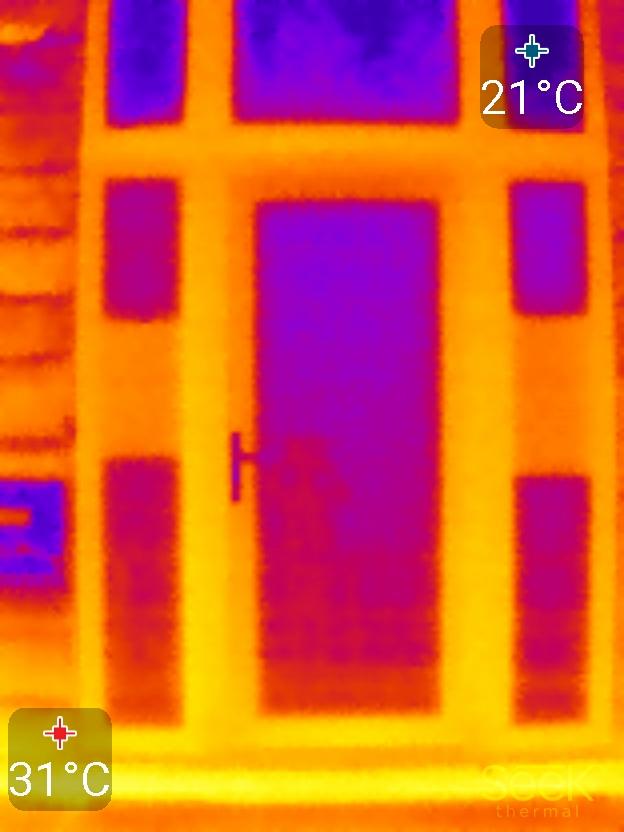
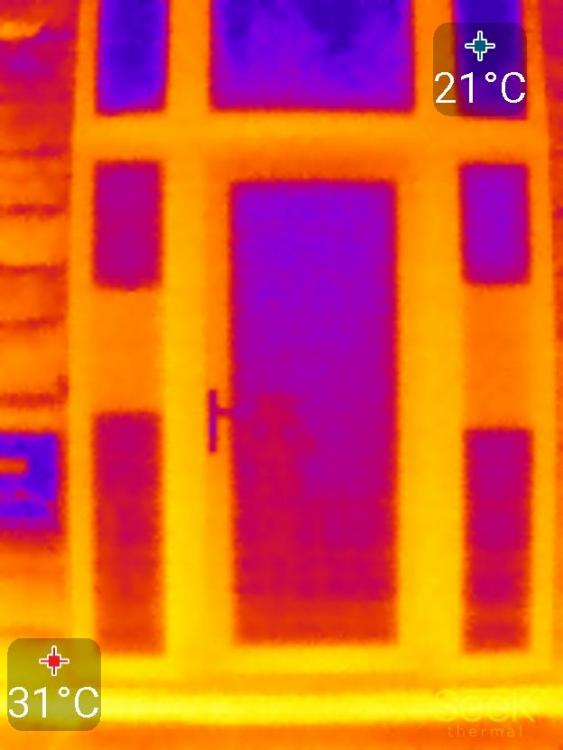
As above, the easy to prove where there is an externally reflective coating is to get someone with a thermal imaging camera to take an image of the outside face of the glass, on a sunny day. If it isn't externally reflective then it will show the temperature behind the glass (as in my image above, that shows the inside temperature of the house at 21 deg C). If it does have an externally reflective coating then the temperature will be a lot higher; in the image above it looks like the two rectangular patches of coating are around 30 deg C, for example. That's not the true surface temperature, it's just heat from the sun being reflected back to the thermal camera and fooling it into thinking the surface temperature is a lot higher.
-
That's just the marking to show that the glass is laminated/safety glass, it doesn't indicate any coating. The coating type isn't usually marked on the glass, AFAIK, but only on any sticky labels there may be on the glazing units (our glazing units all had sticky labels on giving the spec, not sure if this is common practice or not).
-
The easy way is to point a thermal imaging camera at it. If it's coated then it will reflect back pretty much all the long wavelength IR that the imager looks at. The effect is very dramatic - I took a thermal image of samples of external reflective film stuck on one of our windows and it stands out very clearly indeed. The two rectangles in the glazed panels either side of the glazed door are samples of solar reflective film, showing just how dramatic the effect is.
-
Same here. I did look at other passive slab companies, but overall I felt the risk was too great by using separate companies.
-
How to store 10,000 litres of water
Jeremy Harris replied to Tin Soldier's topic in Rainwater, Guttering & SuDS
I worked for a while at an office and lab at the top of Portsdown Hill, Portsmouth. The water pressure up there was too low to use for fire fighting, or the main was too small, I'm not sure which, but the solution was to build large ornamental ponds at the front of the building that doubled up as a source of water for fire fighting. Something similar was done at another place I worked at for a time, Abbey Wood, near Bristol. There the large ponds also acted as storm water run off storage, as well as providing water for fire fighting. I think it's a fairly common commercial solution to this problem, so it should work OK for a domestic situation. 10,000 litres isn't massive for a pond, and could be pretty easily created with a digger and pond liner. -
I can understand the concern, as the OSB is only 10mm thick, I suspect. Screws would seem to be a better bet than ring shank nails. I've had lots of 75mm ring shank nails pull out of out larch waney edge cladding (which is nailed to 50 x 25 counter battens, lined up with the frame studs, under 10mm OSB)and have had to go around easing out the old nails and replacing them with decent screws. It's important to choose the right screws, too. I made the mistake of using some screws with thin shanks and they just sheared off from movement in the timber within a few months. I've replaced them all with screws with shanks that are thicker than the threaded part and they are all holding up really well. FWIW, I used good quality galvanised ring shank nails originally and they were all driven in properly, with their heads set just beneath the outer surface of the cladding. There was no sign of corrosion, the damned things just pulled themselves out with repeated small movements of the timber. I had places on some walls (the East and West facing ones only) that looked like hedgehogs, with the nails poking out maybe an inch from the cladding.
-
Balancing MVHR system
Jeremy Harris replied to Stones's topic in Mechanical Ventilation with Heat Recovery (MVHR)
The plan is easy to draw up, but any system will need to be checked to ensure the flow rates as-installed are both sensible and meet the requirements. As an example, I calculated the resistance of every length of ducting, bend and fitting in our system, to ensure that the Part F requirements would be met. When I measured the actual flow rates they were barking mad, massively exceeding the Part F requirements in some rooms, and overall the system was way out of balance in terms of the extract matching the fresh air feed. No designer of any radial duct system is going to be able to calculate the flow rates to the degree needed to make the system perform at its best, all anyone can do is make sure that it is designed so that there is little or no risk of the key flow rates for Part F (the extract rooms and the whole house ventilation rate) being lower than the requirements after installation. I tried hard to make sure that I had an equal flow resistance on both the extract side and the fresh air feed side, by detailed calculation, but then found that the installation screwed up all the theoretical calculations. This wasn't because I deviated from the plan, it was just because small variations in curvature in semi-rigid ducting have a disproportionately large impact on resistance. This is largely down to the relatively small diameter of semi-rigid ducting, with larger diameter rigid ducting, with known radius fixed bends, you can calculate the flow rates far more accurately. Frankly you can design a semi-rigid system very well using some simple rules of thumb; what I did by doing a lot of detailed calculations was a total waste of time and effort. What's worse, I should have realised that there would be a large disparity between theory and practice, as it was blindingly obvious after the event..................