Jeremy Harris
-
Posts
26430 -
Joined
-
Last visited
-
Days Won
360
Everything posted by Jeremy Harris
-

Kingspan heating (or lack of) issue
Jeremy Harris replied to Lynford's topic in Air Source Heat Pumps (ASHP)
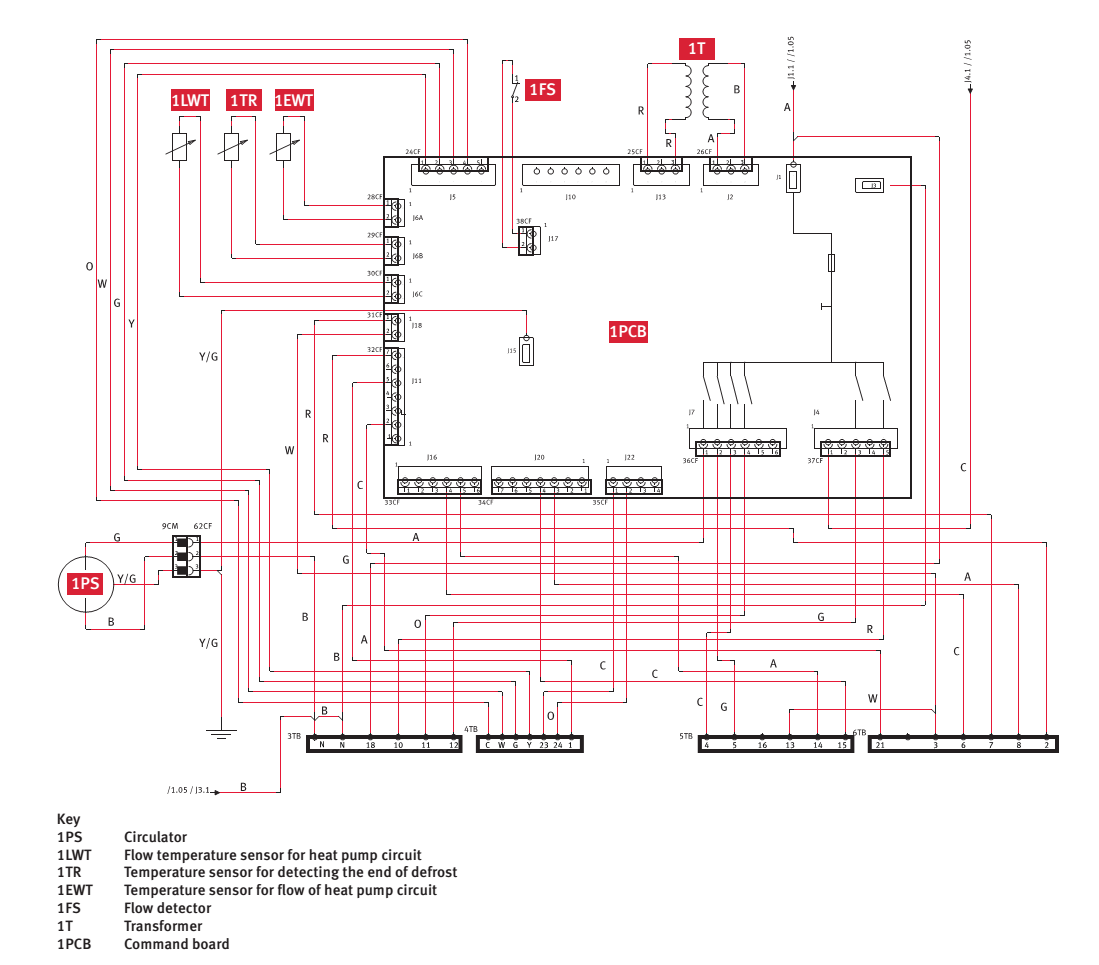
There may be space to fit it inside the case, as the case etc is the same as the other Carrier units. The pump in mine is at the bottom right hand corner of the case, you may find there is a space there in yours where the pump could be fitted. The internal command board is the same for the Kingspan units as it is on mine, and that has a connection to drive an internal pump. It's marked as 1PS on this diagram and looks to be easy enough to wire up to the board: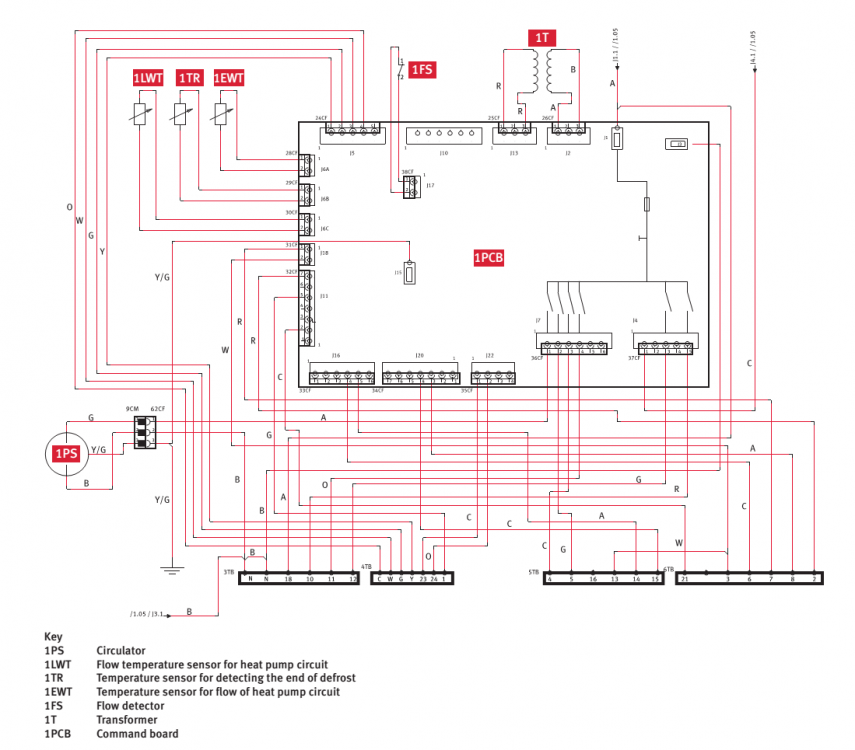
-
There's no real driving need for it though. Once the system has been balanced, it tends to just stay balanced permanently, with the exception of external effects on the overall balance. The self-balancing units around get around the latter problem, and adding greater complexity just to avoid the need to do a one-off room balancing exercising doesn't seem worth it to me. All the motorised air valves would spend their entire life, after the initial setting up event, in the same position.
-
Kingspan heating (or lack of) issue
Jeremy Harris replied to Lynford's topic in Air Source Heat Pumps (ASHP)
Thanks for that, I'd assumed that the Kingspan was near-identical to the Glowworm-badged Carrier that we have, and that has a variable speed Grundfos pump inside the case, so can have the flow rate adjusted to suit the size of the system. I'm not sure why there are two pumps though, as I'd have thought one would be enough. -
Paying on the spot : why I shouldn't.
Jeremy Harris replied to ToughButterCup's topic in General Self Build & DIY Discussion
The one time that I needed an urgent job done, which was my own fault; I'd not thought about the temporary site supply needing a Part P sign off and thought I could DIY it as it was so simple, I had to get an electrician in a hurry. I found a chap that could do the work a day or two later. I did say to him that although this was a small job, there would be a lot more work as the whole house would need wiring in a few months time, in the hope that this might both entice him to do a good job for a fair price. The price was fair but the work was positively dangerous, so dangerous that there was no way that I could let anyone near it until it had been fixed. Building control did have the Part P chit for this work, though, so it "must" have been OK............ -
Sadly it doesn't really help much with balancing on the house side, all it does is balance total airflow rates in the unit, which is a good thing once the system has been balanced and set up as it compensates for natural dynamic pressure variations to some extent, like the wind, doors and windows being opened and closed, etc. There are some self-balancing MVHR units around, but they don't remove the need to check and adjust for every room, and they can make balancing the room flow rates a harder task, as the constantly varying fan speed as any adjustment is made is yet another variable in an iterative process that is already a bit tedious, I think.
-
When laying up GRP on concrete (only once, to line a leaky pond) I used the G4 primer that CFS sells: https://www.cfsnet.co.uk/acatalog/G4_Primer_Sealer.html and that seemed to work very well. Not only does it improve adhesion, but it acts as a barrier that prevents any chemical reaction between the concrete and the resin.
-
Paying on the spot : why I shouldn't.
Jeremy Harris replied to ToughButterCup's topic in General Self Build & DIY Discussion
I suppose one question to ask is "Why won't someone I've used before come back promptly when I want more work done?" I've suffered from this a lot with our landscaping guy, his "order book" seems to always be full for at least three or four months ahead, which is a blasted nuisance when you are trying to get tree planting done during the dormant season (I've just given a job to a new chap because of this). Likewise with the plasterers we used and a brickie, they all seem booked up months in advance. I've always paid up promptly, often as not on the day they've finished a job. I've done all the usual polite stuff, like make lots of tea, have a tin of biscuits on hand, etc, and have got on really well with all of them. As mentioned earlier, I think it's just that around here building work has picked up massively since four or five years ago, and they would rather have big jobs than small ones. Most self-builds probably aren't seen as being that attractive, perhaps, offering just a week or two's work, whereas the big boys are hiring guys for maybe three or four months work at a time. -
Kingspan heating (or lack of) issue
Jeremy Harris replied to Lynford's topic in Air Source Heat Pumps (ASHP)
I doubt that one stuck lock shield (LS) valve would cause a restriction, but with thermostatic radiator valves the LS valves often don't do much, and it's worth checking to see if all the LS valves are wide open (undo the screw, take the cover off and turn the shaft fully anticlockwise). Also worth making sure that there isn't any air in the radiators,by cracking open each of the radiator bleed valves, just in case there's an airlock. It looks as if both the circulating pumps are being switched by the auxiliary relay in the heat pump, and that should normally shut those pumps off when the heat pump is turned off by the thermostat, or when the system goes into hot water mode and the motorised valve switches across to heat the tank. The puzzle here is that there seems to be loads of pump capacity (more than I would have thought was needed for a heat pump with just a 12 kW maximum output) in that in heating mode there are three pumps all working together to push water around the heating circuit. I can't help but wonder why the original installer fitted a second pump. Often the integral pump in the heat pump is powerful enough on it's own, although for a large system there is the option to add an auxiliary pump, but why two of them? There must have been a reason, and it suggests that the installer suspected that the system would need two auxiliary pumps in order to overcome the flow resistance in the system. The problem is that it's hard to understand where that flow resistance might come from. My best guess is that the design took into account the operating condition when all the thermostatic radiators valves were partially closed, although the normal fix for that is to fit a pressure bypass valve across the heat pump flow and return (it's what I had to do, to over come the same over-pressure shut down problem on our system). Another thing worth checking is that all of the thermostatic radiator valves are actually open. It's quite common for the operating pins to get stuck, usually closed, or partially closed. To check, remove the thermostatic valve head (unscrew the threaded ring) and check that the pin is fully up. It's worth putting something hard on top of each pin and making sure it pushes down and comes back up freely, under fairly strong spring pressure. If any are jammed, then a squirt of silicone or PTFE spray, followed by repeatedly pushing them right down and letting them spring up a little more each time will often free them. Be cautious of trying to grab the pin to pull it up, as the lower part of the pin goes through a seal. Down is closed and up is open on these valves. I'll have another think about what the problem might be, and post again if I can think of anything. -
Paying on the spot : why I shouldn't.
Jeremy Harris replied to ToughButterCup's topic in General Self Build & DIY Discussion
Try getting paid by insurance companies.................. I now request a retainer up front, as they are so bad at paying. On average I'd guess most pay up within about 6 months of me submitting an invoice, some have taken well over a year, and none have ever paid up in less than 3 months, even though my contract and the invoice states clearly that payment is to be within 30 days. -
Log burner
Jeremy Harris replied to jpinthehouse's topic in Mechanical Ventilation with Heat Recovery (MVHR)
If you're determined enough to fit one, then have a look at narrowboat stoves. There are some pretty small ones made for that market. Far from clean burning, I suspect, as their flue output often looks pretty nasty whenever I've seen one operating. -
BUT, check that the car you own, or intend to buy, can legally be fitted with a tow hitch! I speak from (expensive) experience, when I purchased a Mercedes SLK a few years ago. I'd bought the car, and was waiting for delivery, when I thought to ask the dealer for the price for a tow hitch, as I couldn't find any after market ones. Sadly, like a fair few cars nowadays, the dealer told me that it cannot be fitted with a tow hitch, so that left me unable to tow either my aircraft or boat trailers. The solution was to buy a second car, an old, but very good condition, Daihatsu Fourtrak. Cost me £2,000, but came fitted with a tow ball and wiring. I kept that car for years, only ever doing a few hundred miles a year with it, and never spent anything on it other than fuel, tax and MOT. In the end I decided to get rid of it when I was buying my second Prius, when I chopped it in under the scrappage scheme and got back the £2000 I'd paid 8 years earlier for it. Shame really, as it was still in great condition when I scrapped it, but it just wasn't worth £2,000, so scrapping it made more sense financially.
- 77 replies
-
- 1
-

-
- estate car
- load capacity
- (and 2 more)
-
Carbon Air Filter
Jeremy Harris replied to MikeGrahamT21's topic in Mechanical Ventilation with Heat Recovery (MVHR)
Both! On the good side: As a very powerful oxidising agent it's probably one of, if not the, best way to disinfect water, as it kills pretty much all bugs, cysts etc in seconds, much more quickly that chlorine, and best of all it has no harmful breakdown products. The main alternative, chlorine stays in sealed water systems and also produces harmful breakdown and reaction products, like chloramines. As a means of removing odours, when used at very low concentrations, it is safe and useful, again because it leaves no harmful residuals behind. As a bleaching agent (from oxidation) ozone has the same advantages as it does for water disinfection, but the concentration needed is greater. As a means of disinfecting sealed rooms and both removing persistent odours and killing pretty much anything in the room (bugs etc) then it can be very effective, as it breaks down quickly (in around 30 mins) to oxygen when the ozone generator is turned off, This makes it safer in most respect than other forms of fumigation. As a protective layer in the upper atmosphere it allows life to survive on our planet, by being one of the major filters against harmful ultraviolet radiation from the sun. On the bad side: It causes irritation to our nose, eyes, lungs etc at quite low concentrations - as a general rule if you can smell it the concentration is bordering on that which may cause irritation. The irritation from low concentrations goes away, with no lasting damage, soon after the source of exposure is removed. At high concentrations it can very quickly cause serious damage to any mucous membrane it is exposed to, and may lead to long-lasting damage to the nose, airways, lungs and eyes in particular. At a high enough concentration it can kill, mainly as a consequence of this sort of damage. On balance: If used carefully it can be very useful as a chemical free disinfectant, that leaves no residuals behind, and can also be very useful in removing volatile odour molecules. You can smell it at concentrations that are below those that cause harm, so that makes it hard to accidentally suffer the harmful effects. In general I think that, used sensibly, ozone has a place in disinfection, bleaching and odour control and some types of fumigation. -
Toilet waste pipe placement
Jeremy Harris replied to vfrdave's topic in Bathrooms, Ensuites & Wetrooms
Same here, not a good layout IMHO. -
They fit in a Prius, as I've carried doors flat in mine. That has a rear opening that is about 995mm and plenty of length with the rear seats down for around 5 or 6 doors stacked up before the available length becomes a problem because of the slope of the rear window. The limiting factor on every car I've had has been the width of the hatch/rear door opening mainly, not the load space inside. Of the two 4 x 4s I've owned, one was very poor, as the door opening was a lot narrower than the actual load space. I'm taking a double bed to the recycling centre later today, and was surprised to find that a folded divan base easily fitted in the back, with room on top for the headboard and rolled up mattress. So you may not need an estate, and might well find that one of the longer hatchbacks will manage OK, which may broaden your choice a bit.
- 77 replies
-
- 1
-
-
- estate car
- load capacity
- (and 2 more)
-
Toilet waste pipe placement
Jeremy Harris replied to vfrdave's topic in Bathrooms, Ensuites & Wetrooms
It does make sense, and my experience has been that some of the the underground stuff doesn't bond as well as the grey/white/black stuff. I tried to fabricate a sort of water spillage catchment tray thing under our water filter, to catch the drips when changing filters and direct them down a bit of waste pipe, using a left over bit of the orange stuff, and the adhesive didn't really work well, even with the pipe cleaned and primed with a wipe of MEK. The second one I made was fine, that used a left over bit of the grey stuff. -
Paying on the spot : why I shouldn't.
Jeremy Harris replied to ToughButterCup's topic in General Self Build & DIY Discussion
I also paid promptly, and offered stage payments to one or two of the best guys didn't ask for them, but were clearly grateful to get some cash part way through the job. I'm inclined to think that availability may be the reason for guys not showing up. We noticed a marked change between the start of our build, when guys would turn up pretty quickly, and the end, when they had to put us off for weeks, due to a surge in the local demand. -
Toilet waste pipe placement
Jeremy Harris replied to vfrdave's topic in Bathrooms, Ensuites & Wetrooms
The brown stuff seems to be a three part sandwich when you sand a taper on the end to ease a push fit. There's the brown inner, then a whitish looking almost foam like core, then a brown outer. Might explain why it doesn't solvent weld very well. I wonder if @Barney12 has a proper push fit underground rest bend, deep down, then a length of solvent weld AG pipe coming up through the slab. That might help explain the wobble and the fact the pipe rotates. -
Toilet waste pipe placement
Jeremy Harris replied to vfrdave's topic in Bathrooms, Ensuites & Wetrooms
Thanks, I thought so. More investigation needed by the sound of things, as a rest bend is needed at the bottom of a vertical soil pipe in order to ensure it remains clear (because it has a much bigger bend radius than a normal bend) plus a rest bend has a support to allow it to be firmly embedded and not move under normal vertical loads. If there's no rest bend at the base of this then that needs looking at, in my view. -
Toilet waste pipe placement
Jeremy Harris replied to vfrdave's topic in Bathrooms, Ensuites & Wetrooms
But the bend at the bottom should be a rest bend, and aren't they only available as UG? -
Toilet waste pipe placement
Jeremy Harris replied to vfrdave's topic in Bathrooms, Ensuites & Wetrooms
What colour is it? Underground rated pipe is orange or brown, indoor/outdoor rated pipe is either black, grey or white. As said earlier, I can't find anyone selling underground pipe that's solvent weld. -
The problem is that the council don't run building control, it's a self-funding entity within the council, but at arms length from it in many ways. This was done when they opened up the market for building inspection, allowing building inspection companies to carry out building control work. At that time, the council building control departments were hived off into an entity called LABC (Local Authority Building Control) that is effectively a nation wide** organisation, that can even offer warranties. ** At least in England. Scotland is different, they retained the old system they had I think, not sure about Wales or NI.
-
Down the drain! - CCTV, Spurs and Mysteries
Jeremy Harris replied to Ed_MK's topic in Waste & Sewerage
TBH, I don't know how steep it was or where the blockage was each time. It was our first house and I wasn't at all clued up on stuff like this then, I just called a chap out to clear it whenever it blocked. The drain ran from the back to the front of the house, under a gated path/tunnel that went through the house (it was an old Victorian terraced house). All I remember is that it always blocked in the section from the rear side of that path, to the very front of the front garden, where it met the much deeper shared foul. drain that ran along all the front gardens of the terrace. Thanks for that, so it seems that there has been a change of view on this over the past 35 years! Makes me wonder what caused our old drain to block so often. That was in pre-drain camera days, so the views of the guys clearing it was probably guesswork. It was also clay pipe, so might have been a dislodged joint or similar. -
Toilet waste pipe placement
Jeremy Harris replied to vfrdave's topic in Bathrooms, Ensuites & Wetrooms
I did a quick bit of hunting around and I can't find anyone selling underground solvent weld pipe, either. All the underground stuff seems to be push fit. -
Down the drain! - CCTV, Spurs and Mysteries
Jeremy Harris replied to Ed_MK's topic in Waste & Sewerage
That's interesting, as the foul drain on the very first house we bought used to regularly block, and the reason we were given by everyone that came out to clear it was that it was too steep. There seem to be other references to having too steep a gradient, too, for the same reason I was told around 35 years ago, although I'm not at all sure of their veracity. I do know that the purpose of a back drop chamber is specifically to avoid having too steep a gradient, though, so there must be something behind it. A quick look around found these, non-definitive, quotes: http://www.greenbuildingforum.co.uk/newforum/comments.php?DiscussionID=12674&page=1 the relevant post being a quote allegedly from a government website (which I can't find) that is: Much the same appears on this website, too: http://www.arca53.dsl.pipex.com/index_files/drain7.htm and this one: http://www.drainageconsultantsltd.co.uk/about-drains/drainage-gradients-falls/ -
Toilet waste pipe placement
Jeremy Harris replied to vfrdave's topic in Bathrooms, Ensuites & Wetrooms
All our drains were put in place by our ground works team, so we already had pipes and ducts poking up where I thought they were supposed to be before the foundation team arrived on site. I think all the foundation team did was replace the capped stub soil pipe that the ground works guys had left with a longer bit of pipe, to make sure it poked up well above the slab. They couldn't shift it's position, as the rest bend was firmly bedded in the underlying trench. TBH, I didn't think you could get solvent weld underground soil pipe, I thought it was all push fit.