
Jeremy Harris
-
Posts
26430 -
Joined
-
Last visited
-
Days Won
360
Everything posted by Jeremy Harris
-

Snug passivhaus dwellers?
Jeremy Harris replied to epsilonGreedy's topic in General Self Build & DIY Discussion
-4 deg C here, too, outside, but very clear skies, bright sunshine and loads of lovely PV generation! The combination of clear skies, bright sun and very cold air really does kick up the output of a PV system. Right now it's exporting more than the house is using, and the heat pump is running and my car is charging...................... -
There seem to be two main issues with tariffs, one being that they are different depending on where you live, often by a pretty large amount, the other being that is can be really challenging to work out if some of the more complex tariffs will be cheaper or more expensive than any other. The Octopus Agile tariff is a nightmare to work out, as you need to know how much you can shift your usage through the day and how much electricity you use hour by hour before you can attempt to do a price comparison. Some may well be easily able to shift their energy usage patterns, some can't. For example, if it's sunny then my car will start charging, but if there is no sun for a day then I'd need to reset things to charge during the low tariff rate from Octopus. If we needed to charge the car during the day for some urgent use reason, we could pay up to around 33p/kWh to do so. It's now seemingly harder to set things like washing machines to come on at a set time. I used to do this with a battery-backed plug in time switch years ago, but our newer machines have had a timer. Great, except even a very short power interruption kills the timer functionality on the machine and it doesn't then come on at all. I've lost count of the number of times this has happened to us, but it's always been just a nuisance before. With something like that Agile tariff it could turn into a very expensive nuisance! I'm coming around to the view that battery storage is a better solution overall, it's just that the cost of them doesn't justify the investment at the moment, but that looks likely to change before too long.
-
One problem is when you introduce a pump into the system though, and I think the baffles that some manufacturers fit are mainly to limit the turbulence caused by the return from a pump. Because our buffer tank isn't designed as a thermal store, and has no baffles or whatever, within a minute or so of the plate heat exchanger pre-heat pump coming on cool water reaches the mid-point of the tank where the temperature sensor is and causes the heat pump to fire up. In this case that's an advantage, but it does seem to indicate that the turbulence created by pumping water from the top of the tank, cooling it through the PHE and then injecting it back at the very bottom of the tank tends to disturb the natural stratification that would otherwise occur.
-
BC appointed and questions I had not anticipated.
Jeremy Harris replied to MikeSharp01's topic in Building Regulations
This was exactly my solution to this, both for the house and the garage. When I put a shed up in the 1.2m gap between the garage and the boundary I used a metal one. On @MikeSharp01's question about the network access, I just fitted a length of FT Openreach Duct 56, with a hockey stick at either end, running under our slab and coming up in the utility room. Right now all it has in it is an underground copper phone cable plus a spare length of draw cord, and the ends are sealed up to keep rodents out and to make the house and airtight. If we ever get FTTP here then it's just a matter of pulling the fibre into the house through the duct. This complies with that BR requirement. -
I suspect we are about to see a plethora of complex tariffs over the next few months, as suppliers come up with ways to retain revenues when the standard tariff cap comes into force. According to the news last night, around 11 million people are still on some form of standard tariff - that's a lot of potential customers who could find that the cap impacts on the bills, and potentially a fair bit of lost revenue for suppliers. The small suppliers have the greatest flexibility, it seems, as this is the second novel tariff structure I've seen in the past week, the other being the one offered by Octupus Energy, their Agile tariff: https://octopus.energy/agile/
-
Welcome, I too remember being in the very steep learning curve phase, and the daft thing was we'd been planning to self-build for years before I realised I needed to sit down and learn a hell of a lot of stuff! All we'd been thinking of is our wish list and where we'd like to live. With hindsight I should have spent those years learning all the nitty gritty stuff that is key to actually building a house.
-
Yes, I posted some info I had when I was enquiring about them earlier in this thread, here:
-
Sounds sensible. The only fitting that I couldn't get at was the one to the shower head connection, and with that I tested the hidden bit with the wall board it was fitted to hanging off the wall and a blanking cap fitted to the shower head pipe, leaving it pressurised for a day whilst I got on with other stuff. Even then I worried about it when all was finished and the water was on, and kept checking the ceiling beneath!
-
Looks like a modified (thickened) form of isocyanate to me (super glue) much like Loctite or the Liquid PTFE stuff. The problem is that adhesives don't really bond that well to metals, and the surface prep is critical, as the bond is largely mechanical, with the adhesive locking into the very find scratches made when cleaning up the surfaces. The bond area is pretty large, so that helps a lot, and the force trying to push the pipe joint apart is pretty small, even under a few bar of water pressure, which is why it works. The main problems that I can see are that vibration, movement and heat cycling may well cause the joint to loosen over time. It may work OK on well-secured fittings not subject to any vibration etc, but I have grave doubts that it would hold up long term when near something like a washing machine. Frankly I'd not trust it, and have to wonder quite what the advantage is. If you have a joint like the one in that video and don't have the skill or ability to shield the surroundings from heat whilst soldering, then why not use a copper push fit, or better still a compression fitting?
-
Welcome. Can you give any more info, like the measured and certificated COP under standard conditions (it will be on the paperwork), as I spent a lot of time looking into this product but failed to get any real data on performance.
-
Sadly, we are still having warranty problems rectified by them, nearly three years after installation. They are responsive, and they do fix the problems very well, but it's far from an ideal situation. On the positive side, the performance is very good indeed. The major issues we've had have been related to the challenges of dealing with the company and some pretty clear manufacturing shortcomings. I can say that the good windows and doors are fine, so if you are fortunate enough to get a good set from them, with a good installation team, then I doubt you'll have problems. They are winning a great deal of big contracts around here. At a guess they must have supplied and fitted well over 500 new builds with doors and windows over the last year or so, so the big developers (Persimmon, Redrow etc) are using them a lot. I'm not convinced that's necessarily a good sign, but it does mean that our local defect rectification guy (with whom we're on first name terms, he's been here so often) is pretty damned good.
-
It's unlikely to be a cable that's bigger than 4mm2 so will easily run over the edge and be disguised easily enough, I'd have thought. I ran our 6mm2 inverter cable through a bit of 20mm conduit sealed into the wall then ran it inside to the consumer unit. The AC isolator switch and generation meter are mounted under the consumer unit.
-
When using an IR thermometer (strictly speaking it's a bolometer) then there are a few things worth noting down. Firstly, as already mentioned, the laser pointer has nothing to do with the measurement, it's just a guide as to roughly where to point the thing, and is extremely inaccurate when used close to the thing you're trying to measure. If you look at the business end (with the laser OFF) then you will see that the laser is offset from the conical black hole that has the bolometer sensor at the bottom of it. When using it close to a pipe, then line up this hole with the pipe, don't use the laser guide. Secondly, the bolometer is calibrated for a specific surface IR emissivity, usually around 0.9. Shiny surfaces may be as low as 0.1 or less, so will very seriously under-read. Ideally, paint the surface to be measured with something like a thin coat of white or grey matt paint, as that will have a surface IR emissivity that's pretty close to 0.9. Finally, the further away you are from the thing you are trying to measure, the larger the area that the sensor will "see". It will effectively average the temperature over the whole area it "sees" which may well also make it under-read when measuring small, hot objects. Try and place the measurement aperture as close as possible to the object you want to measure and try to make sure that object has an emissivity as close to 0.9 as possible and you should get a reasonably accurate measurement. As guide, here is a link to the surface emissivity of some materials: https://en.wikipedia.org/wiki/Emissivity#Emissivities_of_common_surfaces
-
MvHr in cottage refurbishment
Jeremy Harris replied to Cpd's topic in Mechanical Ventilation with Heat Recovery (MVHR)
The reality is that there is enough air flow 24/7 to dry any residual moisture out from ducts etc, especially as they are only exposed to moist air for a relatively short part of the day. My home made silencers are lined with ordinary "eggbox" type acoustic foam, and they show no signs of ever having been damp. -
Dead easy. No wiring connections needed on the roof, as everything has plugs so just plugs together and it's all safe, as the microinverters stay dead until they see the 230 VAC mains coming in, plus you're only ever dealing with a single panel as far as the DC goes, so it's only about 60 VDC at most, a lot less if the panel is covered whilst you plug it in. You just need an electrician to make the 230 VAC connection to the CU, via an isolator switch and generation meter.
-
No problem with fitting them on EPDM, in fact as long as the roof is strong enough fitting can be DIY, using these: This puts the panels at a slight angle (15 deg) to allow them to self-clean, but you just ballast the plastic wedge with a couple of blocks and it just sits on the roof. The panel bolts to the top of the box and you just arrange them to take best advantage of the sun.
-
No problem at all, microinverters grid tie individually.
-
Fitting microinverters under each panel mitigates the partial shading problem and gives you a direct 230 VAC feed from the array.
-
Doesn't seem to on ours. IIRC there is something in the blurb about the pleated filters that says they are made from a hydrophobic material, so the thing tends to repel moisture. Edited to add: I've just checked and this is the case, plus the filter on that side is a G4, presumably because all it needs to trap is house dust
-
Or just add a filter in the main duct from the extract ducts to the MVHR? That would both help the balance and also keep house dust out of the unit. I found that the latter can be a problem, as I left our MVHR on by accident when we were doing the joinery, and ended up with loads of fine dust clogging the relatively low capacity filter on the extract side of the MVHR.
-
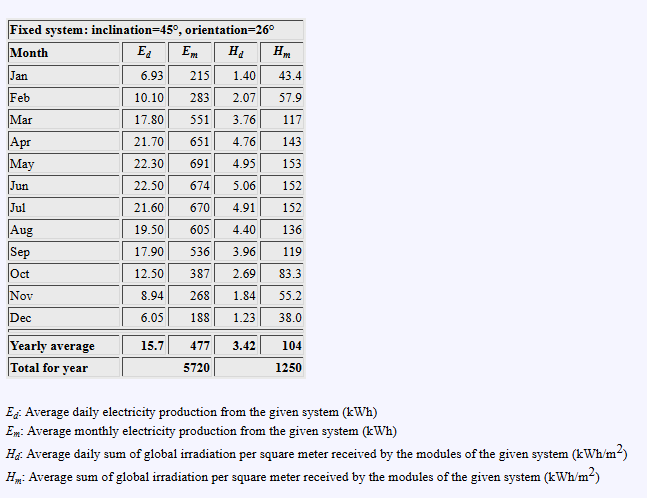
It's easy enough to work out using PVGIS: http://re.jrc.ec.europa.eu/pvgis/apps4/pvest.php?lang=en&map=europe As an example, our 6.25 kWp array that is angled at 45 deg and faces 206 deg (26 deg W of S) has a PVGIS predicted annual output of 5720 kWh The same array at the same location, but horizontal, with no shading, gives a PVGIS predicted annual output of 5070 kWh. Not a massive difference really, but the flat orientation has a lower output in the winter months and a slightly higher output in the summer months:

-
That's a good point, as that 292 x 292 x 45 filter has roughly about 60% to 65% of the effective area of the 415 x 220 x 50 pleated filter in our unit. I've found that the F7 filter has significantly more flow resistance than the G4 filter, though. Our unit was originally supplied with a G4 filter, and I later swapped it for an F7 filter and had to turn up the inlet side fan speed by a few percent to compensate.
-
I think I suggested this before, but submarines used to have a timed shower valve that would sort this problem out. You pressed a button and got just enough water to get wet before it shut off. You then lathered up with a flannel, then pressed the button again and rinsed as fast as you could to get all the soap off before the shower shut off again. Pressing the button again did nothing, you only got two shots of water for each shower.......................
-
I do this for heating, the slab holds a fair bit of heat. Our buffer tank really only pre-heats our hot water, that's what it's really there for. It is heated to 40 deg C by the ASHP, which keeps the heat pump working at high efficiency (no de-icing cycling) and then I have a plate heat exchanger (PHE) and flow actuated pump connected to the buffer. Whenever a hot tap is opened, the flow switch that's in the feed to the hot water manifold turns on a pump that circulates water from the top of the buffer through the PHE and back to the bottom of the buffer tank. Cold mains water flows through the other side of the PHE, is pre-heated to close to the buffer temperature and then flows to the Sunamp PV. This means that the Sunamp PV only has to raise the temperature of the water from around 35 deg C or so to 58 deg C or so, and it's then mixed down to around 45 deg C with cold water before going to the taps. The advantage is that the Sunamp PV doesn't have to supply so much heat to the incoming water, so has it's effective capacity more than doubled. Pre-heated water is relatively cheap to heat, as the ASHP seems to run with a coefficient of performance (COP) of between 3.5 and 4, so for each kWh of pre-heated water we only use around 0.25 to 0.28 kWh of electricity, or in cost terms instead of 1 kWh costing about 15p, it only costs about 4p.
-
All we have behind the wall terminal grills is a fairly coarse plastic mesh. Because the area is pretty small, compared to the area of the main filters, I think anything finer would clog with insects and cobwebs pretty quickly. As it is I find that I have to get a stiff brush up to the intake terminal a couple of times a year to remove stuff, often the fluff from some sorts of floating seeds. I have thought about relocating our fresh air intake a bit lower down, by adding an external duct and bend. Luckily it's completely hidden from view, in the narrow back alley between the house and the retaining wall, so wouldn't look obtrusive. One thing I'd like to do is add a large filter box on this lowered intake, so that I can try and stop insects getting inside the MVHR chamber before the main filter. Cleaning that out with a vacuum cleaner every 6 months is a pain, plus I think that the main pollen filter would last a lot longer with some form of pre-filter. If I get around to it then I wanted to make a vertical filter, with a gap at the base on the intake side to allow dead insects to drop out. Not sure how to do it yet, but I think a filter made from some smooth stainless steel gauze might work, and still be relatively easy to clean.