Jeremy Harris
-
Posts
26430 -
Joined
-
Last visited
-
Days Won
360
Everything posted by Jeremy Harris
-
Yes, and it would give me a significant advantage in terms of buffer heat capacity, but the cost and the nuisance factor of changing them over is a strong argument for me to stick with what I have for now. Apart from anything else, I'd have to practically dismantle the airing cupboard, as the buffer tank is boxed in at the base of it. I don't think that would go down very well right now!
-
 This is what the filters look like in ours: They are a tight fit into a pair of channels top and bottom, with a neoprene seal at either end to make sure nothing gets past the filter.
 -
Graven Hill - Custom Build Site
Jeremy Harris replied to Charles Ebden's topic in Introduce Yourself
That's probably my main objection, the scheme forces the use of a thermally poorer foundation system, just to meet a desire for design harmony and comply with the inflexibility of the VAT legislation. Why on earth the government, who encouraged schemes of this sort, couldn't have simply amended the VAT legislation to make bare plots zero rated, as they would be in any virtually other circumstance, is beyond me. -
If Ventaxia don't offer a proper inlet filter, then I'm sure that one of the specialist filter companies could supply one. I bought five sets of custom made filters for our MVHR from Jasun Envirocare, who charged me around the same for five sets (ten filters) that the UK Genvex agent wanted to charge for one set of the branded filters. As far as I can see they are identical, folded paper filters in a card frame that fits tightly to the slots in the unit. They don't seem to be restrictive, unless they get very clogged up, but they do keep out pollen and dust, so ensuring that the heat exchanger core, fans etc all stay spotlessly clean.
-
Graven Hill - Custom Build Site
Jeremy Harris replied to Charles Ebden's topic in Introduce Yourself
The fact remains that if the VAT legislation wasn't so obstructive, then this dodge wouldn't have been required. It would have been straightforward to put all the controls they wanted in place using a covenant, or similar mechanism, or they could even have amended the local plan to add a policy specifically for the site. The main issue is that it seems to have forced the use of less energy efficient foundation systems, unless the builders choose to try and get around that limitation at additional complexity and cost. The house footprint and design restrictions they wished to impose did not require them to go so far as to put in all the foundations. I was similarly constrained on our plot, by some very tight planning restrictions, and they included exactly where the house would be, what size of footprint would be allowed, even what the finishes were and the floor and ridge height were. However, I retained the freedom to use any build method I chose, as long as the external appearance, size and shape met the requirements. Had the VAT legislation been flexible enough to accommodate what was ultimately the government disposing of land for development, then none of this barking mad shenanigans would have been needed, and there could have been substantial cost savings for all involved. -
Graven Hill - Custom Build Site
Jeremy Harris replied to Charles Ebden's topic in Introduce Yourself
@Charles Ebden, I think it's worth looking at why Graven Hill had to put in place such a restrictive, and potentially expensive, solution for the self-build plots. The driver seems to have been inflexibility in the VAT legislation, which prevented the local authority from selling off plots VAT free. Normally building plots don't attract VAT, and neither does the house build itself, but in the case of Graven Hill there was a glitch that meant that all the self-build plots would have attracted VAT on the sale price. They got around this by using the "golden brick" dodge, but that both added restrictions and increased the price of the plots, but it was the only way they could come up with to avoid buyers having to pay VAT. If there had been a more sensible way around this, which would have needed a change in the VAT legislation, it would have been a very much better scheme, and would have cost far less both for the buyers and for the local authority. In many ways, what they've had to do is barking mad, but they seemingly had no other choice. I don't believe that the affordable housing there are self-builds, they are a traditional Housing Association development, just like any other. -
How do the insects get past the filters so they reach the core? Looking at ours, the filter frames are a pretty tight sliding fit in the case, with what look to be neoprene foam seals at either end to make sure they are sealed in place. The fresh air inlet filter is a pollen filter, so pretty fine. If insects are getting to the core, then it sounds as if there must be gaps somewhere around where the filters fit. Might be an idea to see if there's an easy way to get the filter to seal more effectively, and remove the problem. I suspect that mould spores are also getting in the same way, as they are around the same size. If the pollen filter is sealed and working properly, then it should also keep out mould spores and the like. As an example, a G4 filter will typically catch most particles over 10µ, and F7 filter will catch most particles over 1µ. The smallest spores are around 2µ, and some of the more potentially harmful ones, like aspergillus, are around 20µ, so if such a filter is well-sealed into the MVHR case it should be able to catch the majority of both spores and pollen particles.
-
MvHr in cottage refurbishment
Jeremy Harris replied to Cpd's topic in Mechanical Ventilation with Heat Recovery (MVHR)
@PeterW, I really admire your ingenuity! I wish I'd thought of doing something similar, as using standard plumbing fittings allows a heck of a lot more freedom when trying to fit things in. -
There are two different units,the Sunamp PV, which has a built in circulating pump and water heater to heat the batteries and the Sunamp Stack (and variations of it) that just have the heat batteries and some plumbing and control equipment, so they can be heated by hot water.
-
I had much the same. I decided to fit a new kitchen, drove 60 miles up to Ayr to pick it up, then 60 miles back home again. The next day I discovered some hinges were missing for the doors, so had to drive back up to Ayr and back to pick them up, around 2 hours each way.
-
When we lived in Dumfries and Galloway we either drove around 60 miles to Ayr to do a "big shop" or drove 60 miles to Dumfries. Most of the time it was quicker to get the Seacat over to Belfast and shop there...........
-
Nice reliable internet data.......... I reckon a fair proportion of the information on the internet is just plain wrong, much of it repeated from other sources with zero fact checking. A bit like some news sites.
-
It's actually the phase change temperature, rather than the input temperature, in deg C. So PCM34 changes phase from liquid to solid, releasing heat at 34 deg C. Equally it changes phase from solid to liquid when heated to 34 deg C (actually a wee bit over). Same for PCM58, but at 58 deg C. The Sunamp PV uses PCM58, and the water temperature that comes out when it's running is pretty close to 58 deg C when it's got rid of it's residual stored heat. The heat batteries store heat in two ways in the Sunamp PV. One is by absorbing heat energy by changing the phase of the sodium acetate salt, the other is just heat stored conventionally by the heat capacity of the heat batteries. The total storage capacity initially, when the heat battery is still hot, is a bit higher than the phase change temperature. This means that when you draw hot water from one, initially the heat being drawn off is just that stored by the heat capacity of the heat batteries, then when it drops to 58 deg C, the salt starts to self-nucleate and change phase to a solid, releasing the heat from the phase change, plus a small amount of residual heat from the heat capacity of the material. This means there is a variation in heat storage capacity that is time dependent since the last charge for a few hours.
-
I agree, definitely try to sell it, or if you cannot be bothered, then maybe someone here who lives nearby may offer to look at it, take some photos and list it for you. I'm certain it should fetch a decent price - might even pay for the work needed on the heating system.
-
Sorry, haven't a clue, as it was all specced, signed off and installed by the same company, and there's nothing on any of the paperwork I have that gives that level of detail about the concrete spec. I'm not sure there are many who've done a DIY passive slab, which may well be why you're not getting answers.
-
Shouldn't do, unless the system has been boiling for a long time and has vented off all the steam. Even then it should flush clean OK. AAVs are normal, as is a PRV to allow steam to blow off if they boil. Shouldn't happen normally, as they reach stagnation temperature and just sit there, assuming the controller is working.
-
Graven Hill - Custom Build Site
Jeremy Harris replied to Charles Ebden's topic in Introduce Yourself
I believe we have at least one member here who is building at Graven Hill, plus another that did a LOT of research into it. Might be worth doing a search here, as there have been some lengthy discussions on the pros and cons of the way Graven Hill has been set up. Here are a few threads to get you started: -
MvHr in cottage refurbishment
Jeremy Harris replied to Cpd's topic in Mechanical Ventilation with Heat Recovery (MVHR)
From what I've seen, pretty much all the 75mm/68mm duct is identical. From what I can gather the design has been licensed to several different manufacturers, who now all produce their own version of it, from Polypipe (Domus), though to HB+, and several others. The main difference between the various suppliers is in the design of the plenum chambers and terminals, and the method they have chosen to regulate flow rates. I used the HB+ system, and that uses open room terminals and restrictor rings fitted inside the plenum chamber to adjust flow. It's fiddly to set up, but has the advantage that the flow restriction (which can create flow noise) is inside the plenum, which tends to make the terminals a little bit quieter, I believe. Other manufacturers use a simpler plenum chamber without the ability to fit restrictor rings and use adjustable room terminals. There's the potential for these to very slightly increase the noise level on boost, plus they could have their adjustments accidentally changed when cleaning them, but frankly I don't think it makes a great deal of difference. I found that silencers fitted close to the MVHR unit made a very big difference, and completely removed all noise when the system is running normally. There is still some very slight noise when the system is on maximum boost, but even that is far from intrusive and only really barely audible in the kitchen and bathrooms, it's a lot quieter than a conventional kitchen or bathroom extractor fan. -
I clean our Genvex heat exchanger around once a year, although TBH it never needs it, it always seems sparkly clean inside whenever I've removed it. I do change/clean the filters every 6 months (the thing has a filter alarm and shuts down if you ignore it) and they are always pretty filthy, particularly the fresh air feed filter. I also have to vacuum out the outer side of the filter chamber, as that is usually full of dead flies etc that have been drawn in. I've not seen a trace of mould anywhere, the internals all seem sparkly clean as far as I can see. There is a large stainless steel condensate tray at the base of the unit, with drains at either end, but again that always seems clean, with no trace of any mould or anything. There is often a fair bit of condensate dripping down the drains when the thing is running, especially during the summer when it's running in cooling mode, with the integral air to air heat pump operating. Maybe this tends to flush the unit out and keep it clean.
-
I found that things like fitting and external cill profiles can make a big difference to prices. Internorm, for example, gave us a quote, but when I enquired further I found that when fitting and external cills were added to the price it went up by over £3k. As with all things, it seems the devil is in the detail, and not all companies quote an all-inclusive price.
-
Does anyone have a potter's wheel?
Jeremy Harris commented on vivienz's blog entry in Blackmore House
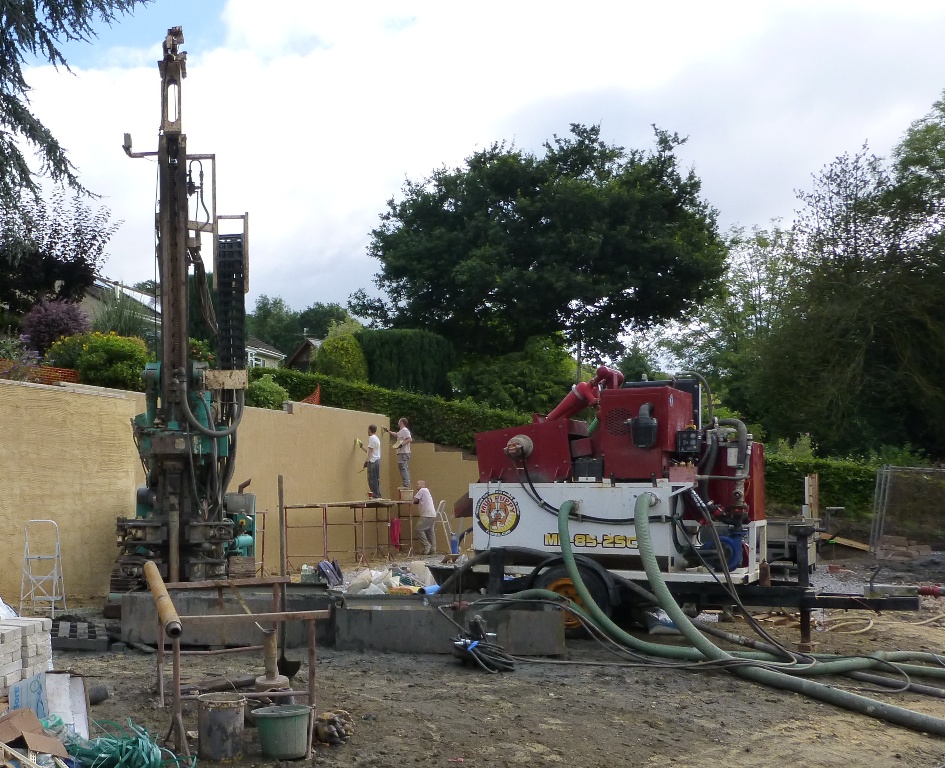
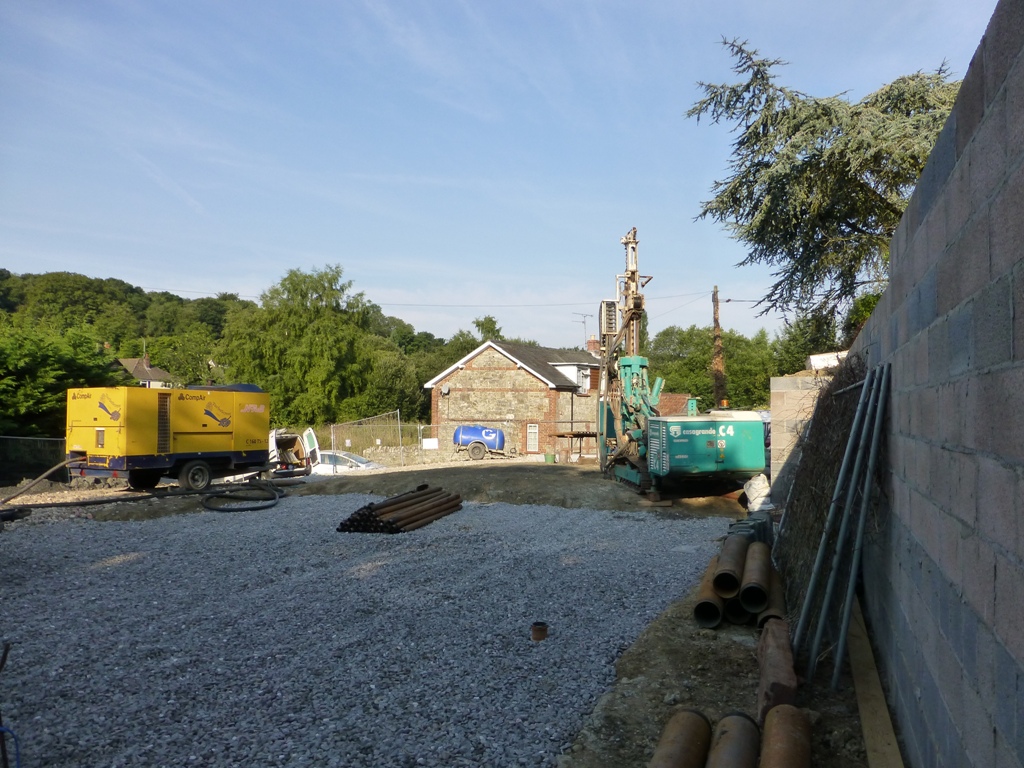
That it does, and a lot of noise! Mind you, when that Casagrande rig was running at full tilt through hard rock it made enough noise to make even the compressor seem quiet! -
Does anyone have a potter's wheel?
Jeremy Harris commented on vivienz's blog entry in Blackmore House
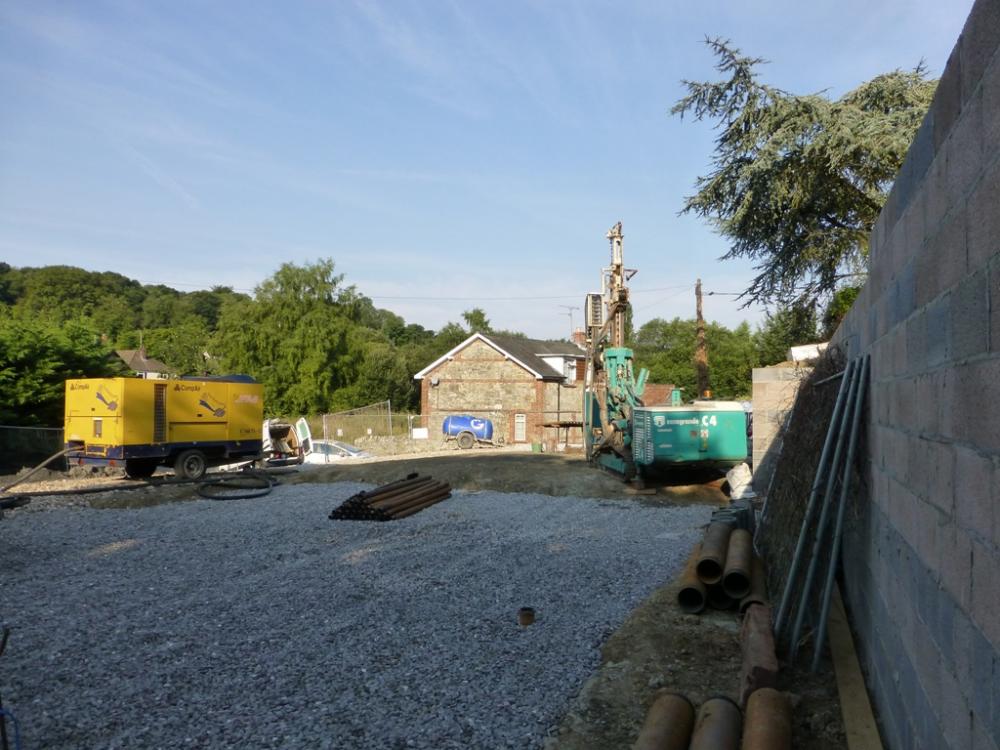
This is what our drill rig and Mud Puppy looked like for comparison: Plus it had this large compressor as well: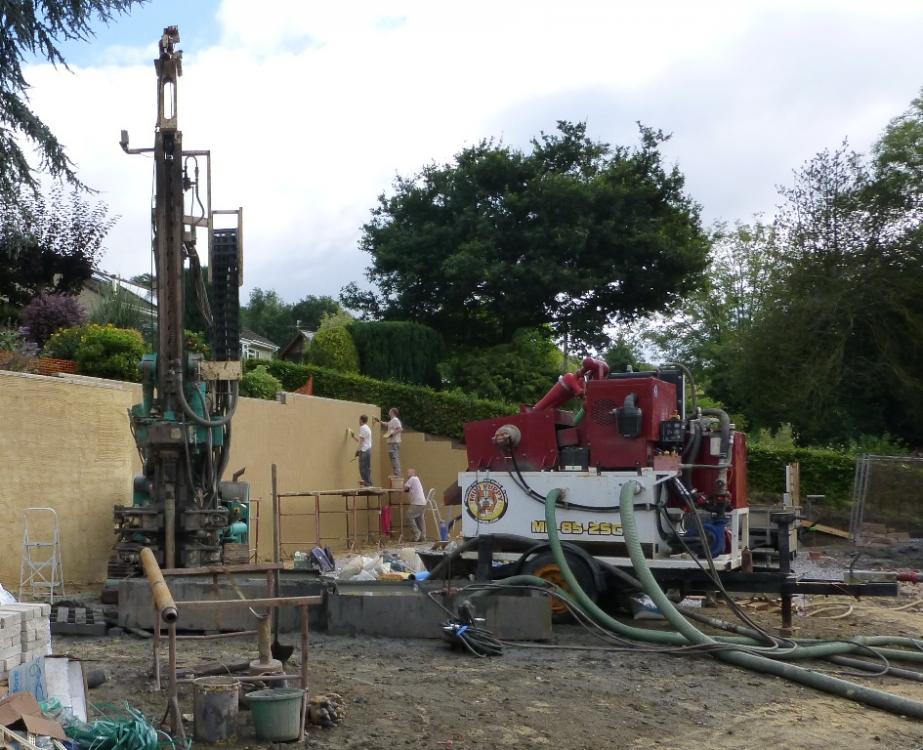
-
I agree, but my experience with one showed that thermal store losses can be quite high, without having the complexity of heating pipes connected to them. Add in a lot of connected pipes that may not be well insulated and I think it's quite likely that a lot of heat could be lost from it.
-
Unless there is mixing within the thermal store, which seems quite possible, having read through @Nickfromwales description of it. In that case the hot portion at the top might quickly be diluted by the large cool portion at the bottom, so cooling the whole tank down pretty quickly.
-
Members' experiences of Timber frame and slab suppliers
Jeremy Harris replied to TerryE's topic in Timber Frame
All we are able to say at the moment has been said. This has no similarity to the situation that Ebuild ran into.