Jeremy Harris
-
Posts
26430 -
Joined
-
Last visited
-
Days Won
360
Everything posted by Jeremy Harris
-

Real World SIPs Experiences
Jeremy Harris replied to LA3222's topic in Structural Insulated Panels (SIPs)
The specific challenge with SIPs is because the "sole plate" is loaded in compression at both the inside and outside edges, because it's only the skins of SIPs panels that are load bearing. This means that the outer edge of a SIPs panel needs to bear on the foundation, which isn't the case for something like twin wall timber frame, or externally insulated timber frame, where the perimeter insulation around the foundation can be under the outer edge of the walls, so providing contiguous insulation all around the wall/floor joint. Adding perimeter insulation around the outside of the wall/floor joint is one way to mitigate the condensation risk. Adding structural insulation underneath is another way. When we were looking at using SIPs my preferred way was to use the thinner 140mm panels, that only just meet building regs on their own, but add about 100mm of external insulation all around, extending down to meet the foundation perimeter insulation. I spent a fair bit of time working on the details to get this to work (from a passive house standpoint). I also had the design detail agreed (after some debate) with the SIPs manufacturer. I was planning to use Steico wood fibre externally, covered with membrane, counter battened and then timber clad. The overall performance, in terms of U value and decrement delay wouldn't have been much different from what we ended up with. It was the cost, together with the poor responsiveness from the supplier, that stopped us going down this path. -
Worth getting someone to identify what type it is, as there's a big difference in the way different types have to be handled. Is it made of corrugated sheets? If so then the chances are that it's made from asbestos cement, which is generally fairly easy to remove and dispose of, as long as it's not broken up to release fibres. It still needs dismantling with care, and treating as hazardous waste, but it isn't anywhere near as hazardous as some other forms of asbestos, mainly because the fibres are contained within the cement (as long as it's not broken up, cut, drilled etc).
-
Since we switched to E7 at the beginning of January (as of lunchtime today) we'd used 58% at the off-peak rate, 42% at the peak rate, so a useful saving by being on E7.
-
Yes, that's what I did, SSE changed the meter for free, no obligation to stay with them.
-
Real World SIPs Experiences
Jeremy Harris replied to LA3222's topic in Structural Insulated Panels (SIPs)
Worth looking at this thread: and this one archived from Ebuild: https://web.archive.org/web/20171227081506/http://www.ebuild.co.uk/topic/15950-kingspan-tek-sips-panels/ -
There aren't separate safe zones in ceilings, only in walls. This post has the relevant pages from the OSG:
-
Depends on what your building inspector wants. Some changes can just be inspected and checked on the fly, others will require new plans and structural details to be submitted. Every build will have some variations from the plans, and even a full plans submission doesn't include every detail. For example, I changed the way the Part M access requirements were met, but didn't need to send in any new drawings, as the inspector just looked at what I'd done and said it was OK.
-
If the plans change then you're supposed to re-submit for approval, if the changes are structural.
-
Wiring in sloping surfaces
Jeremy Harris replied to Ed Davies's topic in Regulations, Training & Qualifications
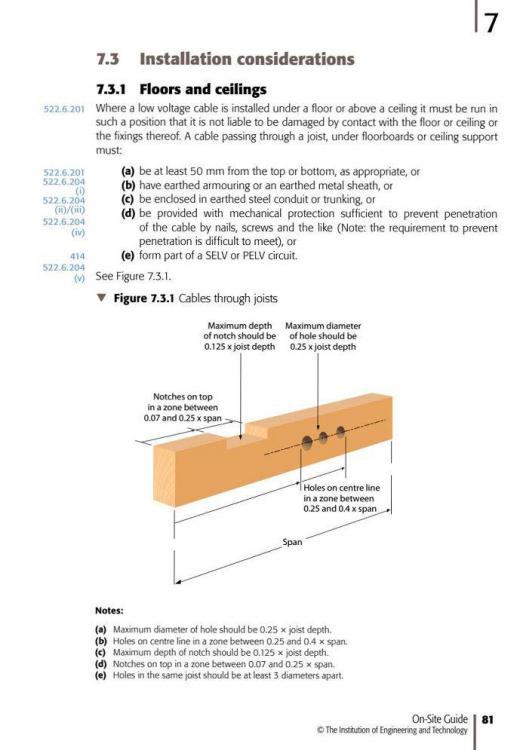
The regs don't make it clear, I'm afraid, they just refer to walls and ceilings without defining any angle that makes a wall a ceiling, or vice versa. Here are the two pages from the OSG that cover locations: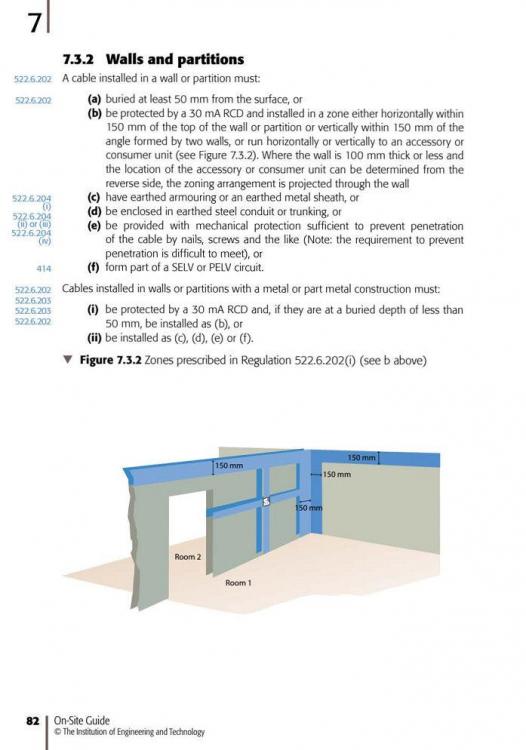
-
First off, welcome to the forum. Interesting first post. Are you in any way associated with this company?
-
Edited to add: Here's whole of the relevant section from the the blue book: 522.6.201 looks to be essentially the same as the wording in 522.6.100 in the 17th Ed to me, in that it applies to cables going through a joist, where they have to be either >50mm from the edges or be protected as in 522.6.204. Looks like all they've done in the 18th is to move things around, so that the distance requirement and the protection requirement are now in different paragraphs.
-
As a very rough indicator of the wind loading, a 25m² array, flat on to the wind, would have a wind loading imposed on it in a 60mph wind of around 13,200 N, or about 1,346 kgf (1.346 tonnes force). The wind loading could be at least as high as this in an upward or downward direction if the array was inclined at a shallow angle, too, due to the lift forces act on it. The small efficiency improvement would have to be justified by the higher cost, and maintenance needs, for a tracker mounted array. Could take a long time to recover the extra cost.
-
The EA were generally a PITA with regard to flood risk, run off from the building site, etc when we were getting PP, but when I asked them if I could discharge our treatment plant to the stream alongside our lane they gave consent within a couple of hours, with a (free) permit to discharge sent by email. The process was easy; all they needed to know was that the stream ran all year around (they don't officially allow a discharge to a stream or ditch that doesn't have water in all year around).
-
If looking to build a tracker, then it's probably easiest to use an electric motor driven linear actuator, as these are available at a reasonable price for use on things like electric gates. The control system needs something to reset the array at night, ready for the next morning, plus something like a 4 quadrant optical sensor to drive the array to point directly at the sun (something like the crude sensors used on early heat-seeking missiles). Not that hard to come up with a tracking control system, I think, but the engineering involved in making a strong enough mount for the array might be a bit challenging.
-
There are a couple of popular in-roof systems, GSE and EasyRoof, as you've found. I've not heard of any others unfortunately. Peltier devices aren't very efficient at pumping heat, only a few percent, which means that there would be a great deal more heat that needs to be got rid of from the hot side of the Peltier element, making the problem of cooling a great deal worse. The Peltier devices would also use a lot of the power generated by the panel, far more than would be gained from any cooling effect.
-
Single screw brand for a whole build.
Jeremy Harris replied to epsilonGreedy's topic in Tools & Equipment
Torx head screws are pretty good IMHO. They do need decent quality Torx bits, though. I shattered a couple of bits from a set (think they were the ones that came with one of the Makitas), which apart from being a nuisance tends to send bit of metal shrapnel flying in all directions. Since I switched to using Wera bits I've had no problem at all, apart from the price of the things. I now use the Wera HF bits exclusively, as they have the advantage of gripping the screw tight, so you can fit a screw to the bit and it stays there, useful for one-handed operation. -
MVHR Duct Design
Jeremy Harris replied to Triassic's topic in Mechanical Ventilation with Heat Recovery (MVHR)
No point at all in putting ventilation in any space that's either non-habitable or not a source of smells/moisture, IMHO. Fit extracts in the rooms that need it, so kitchens, bathrooms, WCs and utility rooms, and fit supplies in all living rooms and bedrooms. As far as the calculations are concerned, then yes, all the air volume within the insulated and airtight space needs to be included, so that includes built-in cupboards, service areas etc, although there's usually no point in sticking terminals in those spaces. It generally makes life a lot easier, when balancing the system during commissioning, if the number of extracts is roughly equal to, or perhaps one, or maybe two, less than, the number of supply terminals. This is because the extract rate from the kitchen, bathrooms, WC etc will be a fair bit higher than supply to any other room. Having more extracts than fresh air supply terminals means upping the flow rate through the supply terminals with the risk of flow noise in rooms that you'd normally wish to be a bit quieter (bedrooms and living rooms), so isn't a good idea, really. -
Ye Gods, that's a heck of a lot of water to have just drained away and been wasted. Just goes to show how a serious leak can go undetected, and makes you wonder how many other leaks of this sort of magnitude there are in the system. That's roughly two thirds of our annual water usage, I think.
-
SUDS drainage design quote? High?
Jeremy Harris replied to Dreadnaught's topic in Rainwater, Guttering & SuDS
I agree, every time I've looked at this there seem to be apparent anomalies, but I suspect that's to do with it being an intensity map, rather than a rainfall map. Places on the West coast of Scotland, for example, are well known for being very wet, but they don't tend to get lots of very heavy rainfall, it just rains gently every other day... -
SUDS drainage design quote? High?
Jeremy Harris replied to Dreadnaught's topic in Rainwater, Guttering & SuDS
Use the chart and method in the building regs, Part H3, Section 1 -
Ouch! That is an expensive leak. How much water does that £600 represent?
-
I designed our kitchen to fit multiples of standard cabinet/appliance widths, and generally the multiples are 300mm, 400mm, 500mm and 600mm, but corner units can screw things up a bit (ours are 950mm, for example).
-
Off the shelf non vented roof windows
Jeremy Harris replied to vivienz's topic in Skylights & Roof Windows
Fakro do PH certified rooflights, that have U values ranging from 0.58 W/m².K to 0.81 W/m².K, so a heck of a lot better than the US Velux ones. -
Off the shelf non vented roof windows
Jeremy Harris replied to vivienz's topic in Skylights & Roof Windows
I read that as being the US (Imperial units) U value = 0.44 BTU/ft².°F and the metric U value as being 2.49 W/m².K If 0.44 was the metric R value, then the U value would be 2.27 W/m².K -
Off the shelf non vented roof windows
Jeremy Harris replied to vivienz's topic in Skylights & Roof Windows
That U value looks pretty grim to me, 2.49 W/m².K? UK building regs minimum fabric standard is 2.00 W/m².K, and that's not exactly great, either.