


Jeremy Harris
-
Posts
26430 -
Joined
-
Last visited
-
Days Won
360
Everything posted by Jeremy Harris
-
I'm still happy to test samples to check whether or not the hardness is reduced by the Halcyan unit. Probably not worth it though, as they've already admitted that it doesn't, despite this claim on the FAQ section of their website (how they get away with this under the ASA rules I really don't know): FWIW, this is just plain nonsense. There's absolutely no scientific basis for stating that "minerals change shape". What is it even supposed to mean? Surface tension has nothing at all to do with hardness, either, it's caused by the cohesive forces that act to hold water molecules together as a liquid being unbalanced at a surface. In simple terms, a molecule in the centre of a body of water experiences equal forces in all directions from it's neighbouring water molecules, whereas a molecule at a surface only experiences forces from those molecules below and to the side, as there are none above. This tends to cause water droplets to pull into a sphere, just as it also causes a meniscus on a open water surface. It has nothing at all to do with hardness, which is caused by calcium and magnesium compounds in solution. I know that you are happy with your Halcyan unit, and that's great. My issue is that they make claims that it softens water, when it very clearly does not.
- 199 replies
-
- 1
-

-
- hard water
- water softener
- (and 1 more)
-
@lizzie, you don't have the same unit as @Mr Punter. He has a Combimate.
-
£400/day would be a lot for around here, down in the expensive South! As luck would have it, a friend popped around a few minutes ago to borrow something, and mentioned that he's getting an electric car this summer. He's had a couple of quotes to install a charge point, and frankly the prices being charged for the electrical installation are pretty shocking. If any electricians want to make some easy money, then I suggest getting in on the charge point installation business. These things are usually eligible for a government grant, from OLEV, that contributes up to 75% of the cost of supplying and installing a charge point. I have just checked the price of one of the units he's been quoted for, and I can buy it retail for just under £500 (which is a rip off for what it is). Installation related materials would be no more than about £50 - £60 for this chaps installation (it's going in his garage, about 3m tops from the CU, not sure if there are any spare slots). The quote he's had is for £395 for the unit installed, including the OLEV grant funding. Working backwards, £395 implies that the total cost, before the grant, is £1,580 (!), so subtracting the £495 cost of the unit and a very generous amount for installation-related materials means that the electrician installing the thing is getting about £1000. The quote estimates that the work will take 4 hours. I thought I charged a lot for consultancy work, but that pales into insignificance when compared to an electrician getting £250/hour. All I can assume is that it's the usual problem when there is any government funding for anything, the price is just increased so it's the installer that gets the lion's share of the grant.
-
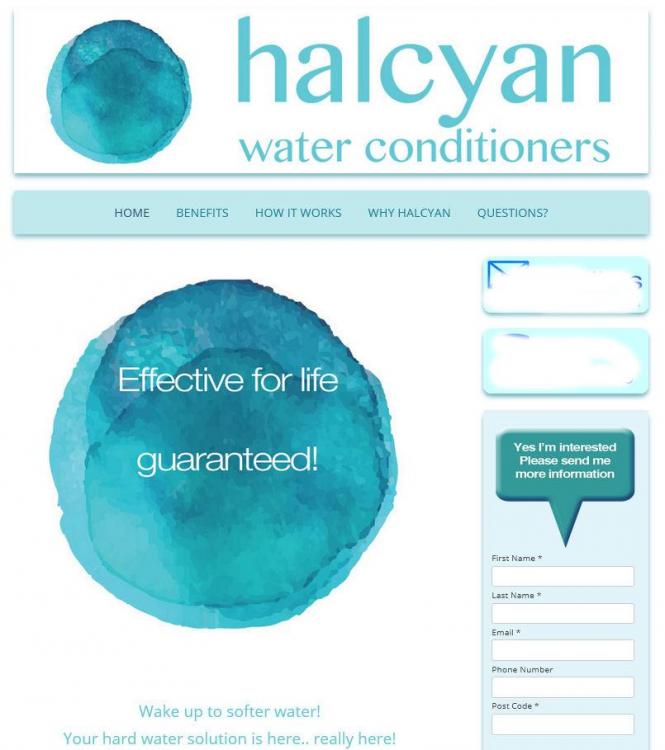
FWIW, my first degree was in chemistry. This website does a reasonable job of explaining the pseudo-science of these things: http://www.chem1.com/CQ/catscams.html If you are happy with your £600 unit, then that's fine, but when tested, and by Halcyan's own admission when pushed, there is exactly the same amount of calcium in the water that comes out of one of these units as there is in the water flowing in to it. No one has been able to provide evidence that the Halcyan unit softens water at all; every test shows that there is no measurable reduction in hardness. Halcyan have made other spurious claims, earlier in this thread, which undermines their credibility further. For example, they claimed that permanent magnets use power, which is obviously hogwash: Halcyan mentioned a patent then refused to supply details, claiming it was commercially sensitive. That's rubbish, too, as patents are in the public domain and can be viewed by anyone. They were covering the fact that there was a patent issued in 2006, in Australia, that has expired: https://worldwide.espacenet.com/searchResults?ST=singleline&locale=en_EP&submitted=true&DB=&query=halcyan @jack made some knowledgable observations on the inaccuracy with which Halcyan were referring to "their" patent earlier in this thread. A patent search (easy to do) doesn't show any patent registered to this company, which begs the question as to why they claim to have a patent on the "technology" when clearly they don't seem to. The Halcyan website makes a false claim (all I've edited is their email address and phone number, to comply with forum Ts and Cs): Note the wording at the bottom that says "Wake up to softer water! Your hard water solution is here..really here!". This is false. The unit does not soften hard water at all. I offered to test samples earlier in this thread to prove this, but the offer wasn't taken up. It's dead easy to do a water hardness test, though, so I wonder why hardness test results aren't quoted? Halcyan have also written this earlier in this thread when I offered to do blind testing on samples to see if the hardness was reduced, which states the opposite to their website: Just for clarification, all of the above refers to the Halcyan product, NOT the Combimate. The Combimate is a perfectly good product, that works on well-proven principles and which is advertised honestly and with no misleading pseudo-science.
-
The Combimate is a very different product to the Halcyan, and uses phosphate dosing, which is another well-proven way to reduce the effects of hard water. It doesn't remove the calcium from the water, but stops calcium carbonate from "sticking" to surfaces and causing scale.
-
Just seen this, the image on the top left on the Polypipe website:https://www.polypipe.com/inspection-chambers Might be able to get two of those almost side by side.
-
A quick search seems to throw up several with opposing inlet/outlets: https://www.plasticdrainage.co.uk/cs320-inspection-manhole-chamber-set.html https://www.drainagepipe.co.uk/products/complete-inspection-chamber-sets/300mm-mini-inspection-chamber-complete-set-unique/300mm-mini-inspection-chamber-complete-set/ maybe two of the smaller ones can be set side,by side, offset down the run by a metre?
-
The situation regarding all the various "water treatment" units being sold is very like the way that various magic fuel catalyst type products were being sold back when unleaded petrol was introduced, or when 5 star was phased out. There were lots of claims made that putting some type of catalyst, often tin-based beads, into a car fuel tank would magically give better mpg, stop detonation from lower octane fuel, decrease the risk of valve seat damage from using unleaded fuel etc. One by one these units were all proven beyond doubt to have no benefit at all, but that didn't stop a lot of people from believing that they worked wonders. One interesting observation made back then was that the more "reassuringly expensive" a unit was, the more likely people were to strongly believe it worked, even though there was rock-solid evidence that it didn't. Never underestimate the power of the placebo effect, it can be far stronger than any amount of hard evidence! The main issue with the Halcyan claims in this thread is that they are either based on a flawed theory, or they are just meaningless. Pretty much every point made about this product is pseudo-science, most of which has no meaning at all (which is why they can include this stuff in advertising, it's carefully worded gobbledegook). On the other hand, the ion exchange principle is well-proven science. We know exactly how it works and why it works and can calculate the exact ion exchange ratio and then prove that this is correct by analysis. It's so well-proven that a simple home testing kit can show both whether or not an ion exchange unit is working, and measure the reduction in calcium in the water resulting from it.
- 199 replies
-
- 2
-
-
- hard water
- water softener
- (and 1 more)
-
Welcome Sean. My concern would be over the very low decrement delay of EPS. You will probably find that this is so short as to allow a lot of heat into the in-roof rooms in bright summer sunshine, leading to them being perhaps a bit too warm. I'm not sure whether blown bonded EPS beads have a BBA approval for use between rafters, either, might be worth checking. In general EPS is about 2/3rds as effective (in terms of thermal resistance) as PIR, with much the same short decrement delay. This means you need about 50% greater thickness than PIR to achieve the same U value. If you want to reduce cost and increase the decrement delay then you could look at one of the higher heat capacity insulation materials. Wood fibre, blown cellulose and even dense rock wool, all have a longer decrement delay that either EPS or PIR for a given U value, with blown cellulose being the longest, and wood fibre only slightly shorter.
-
It does, and when using it I always tend to have the charger on, so I can just swap batteries and stick the discharged one back on charge. I realise this isn't an option on your plot, with no mains power, but have you thought about using the 12V car charger that Makita sell? (https://www.amazon.co.uk/Makita-LXT-DC18SE-Automotive-Charger/dp/B001UGMC9U )
-
I paid our chap £160/day, no VAT, in 2014, which is less than half that hourly rate, and we're down South, where rates tend to be more expensive.
-
Mine's just the standard 165mm blade cordless circular saw. For a cordless tool I've been amazed at how good it is, and I used it a lot when fitting all our oak joinery. One thing I found really useful was to fit a fine tooth blade, I tend to use the 40 tooth blade most of the time, as it gives a clean finish to cuts in hardwood and ply. Another advantage of this saw is that the blade kerf is narrow, so cuts are only a bit over 1mm wide.
-

Best stage to lay a concrete garage floor slab.
Jeremy Harris replied to epsilonGreedy's topic in Foundations
Probably not. A few years ago I had a workshop slab that was a few metres from a large willow tree, also on clay. That used to move up and down by around 5 to 10mm in one corner, taking the whole workshop with it. There weren't any cracks, but the movement was a real nuisance and something I only discovered when I found that a wing jig I'd built was going out of true. Heave will happen unless there is some provision to allow the soil to expand and contract without moving any structure that's laying on it. -
Best stage to lay a concrete garage floor slab.
Jeremy Harris replied to epsilonGreedy's topic in Foundations
That's what I did. Just as strong, perhaps slightly more resistant to cracking, but most of all quicker to lay, and no faffing around with steel fabric. Our guys used a smooth mould for the front lip, where the door goes, which was a part of the steel shuttering system they used, so there's a ~100mm section with a very smooth finish and a rounded edge at the doorway. The rest of the slab was tamped, levelled and power floated, like the house slab, as I wanted a smooth floor that would be relatively easy to paint later (still haven't got around to it, though). -
Just done a quick count of the Makita cordless tools and accessories I have (all run off the 18V lithium battery packs): Two chargers, one single pack the other dual pack Eight battery packs, six 3 Ah ones, two 4 Ah ones Two drill/drivers, one having hammer function Circular saw Jigsaw Garden strimmer Lawnmower Hedge trimmer The battery packs generally get swapped around amongst all the tools, with the exception of the two 4 Ah packs, which are pretty much exclusively used in the mower (it uses two packs in series to get 36 V). The oldest tool is a black BDF452 LXT drill that I've had since around 2010, and which has been hammered, racing boats around a lake, as well as having been used more than any other tool on our build. The original two battery packs from 2010 are still OK, and don't seem to be noticeably poorer in performance than the newer packs.
-
I second the above. I think our topographical survey cost about £450 and proved to be invaluable, as it was used as the base plan for every site drawing, even including the latest landscaping work we've been doing long after the house was finished. That topo survey provided the info needed to work out excavation depth, quantity of spoil that needed to be removed (and hence price) as well as drainage runs etc.
-
I ended up with loads of Makita stuff, pretty much by accident. Makita sponsored a boat build/race challenge, I won a set of Makita tools years ago and once you have battery packs, chargers etc it makes sense to just stick with the same make, so you can interchange battery packs etc. Having said that I've yet to have a problem with any of the Makita stuff, and some of it has been seriously abused. One drill has been used for boat racing*, where it gets too hot to hold, yet it's still my most used Makita drill. *Makita have been long-term supporters of the Water Craft Makita Cordless Canoe Challenge.
-
Where are all the SIPs suppliers???
Jeremy Harris replied to hmpmarketing's topic in Structural Insulated Panels (SIPs)
A short time ago I came across some stuff on issues that had been encountered with MgO boards. The main problem seems to be chlorides coming from MgO when it gets damp, leading to corrosion of fasteners and failure of the board. A web search will quickly find some evidence that MgO boards do seem to have some issues. Take a read of this, for example: http://www.quitahumedades.com/en/blog-en/tips-and-tricks/worst-construction-scandal-in-decades . In the USA MgO is referred to as "Chinese drywall" and has a pretty dire reputation now. This is the paper on the Danish issues with MgO: MSSCE2016_Word_208.pdf -
Worth looking at a mist system, I think. When we were considering fitting sprinklers I faced a similar problem, in that we have a borehole supply, so if the power was switched off there would be no water for the sprinklers. The mist systems offered the option of a small pressurised tank to run the nozzles, and because the water usage with a mist system is a great deal lower than conventional sprinklers this tank didn't need to be very big.
-
One reason for introducing E7 was the shift to nuclear power stations in the 1960s and 70s. Nuclear power stations can't shut down when demand drops, they have to be kept running, which created a potential problem for the grid, as there was a low demand during the night. The solution was to encourage people to install night storage heaters and introduce a cheap rate to charge them, so allowing the grid to stay in better balance.
-
As above, some of us didn't use an architect. In our case we didn't, not because of the cost (at that stage we still thought we had plenty of spare cash in the budget) but because we couldn't find one we could have worked with. An architect can definitely add something, the question is really whether the nature of the house and plot would really benefit from that, some may, some may not. Architectural technicians are both cheaper and more used to domestic scale work (the majority of UK houses aren't designed by architects, apparently). If using a build company that include detail design in their package (as is often the case with timber frame companies) then you could even do the outline design yourself (we did this, a steep learning curve, but I don't regret it). £48k seems silly money to me. When we were looking around the cost of using an architect to design the house and oversee the build was around 15% of the completed house cost. £48k implies a completed house cost of around £320k. The really big question is how much time you can afford to put in to the project. Those of us who have gone down the route of reducing build cost as much as possible all tend to have put in a great deal of our own time. If you're not in a position to be able to spare the time then the costs are likely to be a fair bit greater. There's nothing particularly difficult in building a house, but it does involve learning about a wide range of things that most people probably aren't that well aware of.
-
MVHR Duct Design
Jeremy Harris replied to Triassic's topic in Mechanical Ventilation with Heat Recovery (MVHR)
If you can feel the airflow in the area where a terminal is then that suggests that the flow rate from that terminal is too high. We have a couple of low level fresh air supply terminals and you can't feel anything coming from them unless you put your hand close to them, when you can just about feel air coming from them. -
We have a Harvey, but the Twin Tec is a Harvey sold under licence. They fit inside a kitchen cabinet, if need be, so aren't that large. Our's sits in our service room, raised up slightly off the floor to save having to bend down too far. Like all ion exchange softeners, it removes pretty much all the calcium from the water, so there isn't any limescale at all, nor do we get any sign of white marks on taps, worktops etc. We don't have to use salt in the washing machine, and we use a lot less washing powder, soap, shampoo etc. The saving in shampoo alone probably comes close to paying for the salt (I'd like to know why shampoo is so damned expensive for what it is, too). In terms of cost, I think our Harvey retails for about £900, that's for the non-electric, metered, twin-tank unit, which is, I think, the best all round solution. The metered units tend to use less salt and water than the electric ones with a timer, but cost a bit more initially. I suspect it doesn't take long to recover the cost from the reduction in salt and water usage, though.
-
Real World SIPs Experiences
Jeremy Harris replied to LA3222's topic in Structural Insulated Panels (SIPs)
12 hours is fine. The aim is to try to iron out the peaks and troughs of external temperature that occur between day and night, so that by the time heat from the sun (for example) has reached almost to the inside face, the outside has cooled down again so that that heat can flow back outwards. The same applies when heat is flowing out of the structure during a cold night. -
@Willster, please accept my apology for seeming a bit suspicious! I've looked at lots of ways to treat water to reduce limescale, and after a lot of looking around settled on using an ion exchange softener. There are two of us and we are using two bricks of salt about every 6 weeks, at a cost (buying the salt bricks in bulk) of about £3 for a twin pack, so a running cost of around £0.50 per week. Testimonials are always tricky, as they are driven by personal perception, rather than any formal analysis. Our water has been analysed three times now, so I know beyond doubt what's in it.
