


Jeremy Harris
-
Posts
26430 -
Joined
-
Last visited
-
Days Won
360
Everything posted by Jeremy Harris
-
We've only been running our ASHP overnight on E7 since early January. Despite some pretty cold (for here) weather the house has maintained a fairly steady temperature of around 22°C. It seems that with the slab being charged up overnight it can easily maintain the house at a comfortable temperature all day. I've not accurately worked out the cost, but would guess that the worst case has been around £0.60 per day (at E7 off-peak rate), with quite a few days when the heating hasn't come on at all.
-
I've just tried to take a photo but even close up I can't see the rail from the outside, because of the film on those windows. The rail is 15mm wide, with about 3mm over the trim/seal on the inside of the window, so it projects about 10mm from the edge of the glass when viewed from outside. The adhesive pad is black, so looks rather like the ones used to attach car interior mirrors.
-
If connecting to the grid then the old regulations used to be G83/2-1 (for up to 16 A per phase) and G59/3-4 (for over 16 A per phase). G83/2-1 has been superseded by G98/1 for up to 16 A per phase. http://www.energynetworks.org/electricity/engineering/distributed-generation/engineering-recommendation-g83.html and http://www.energynetworks.org/electricity/engineering/distributed-generation/engineering-recommendation-g59.html These are "engineering recommendations", but in practice they have the power of being regulations because the DNO won't grant consent to attach any equipment to the grid, or allow equipment to be attached to the grid that doesn't require formal consent (in the case of G98/1), unless the equipment is tested and approved to these requirements. The situation regarding engineering recommendations being given the power of regulation is much the same as existed for electric vehicle charge points prior to BS7671 18th Ed coming out, in that they also were covered by an engineering recommendation from IET that had to be complied with if the charge point was being funded by an OLEV grant (although practically all manufacturers just ignored that and fitted non-compliant charge points to save money...).
-
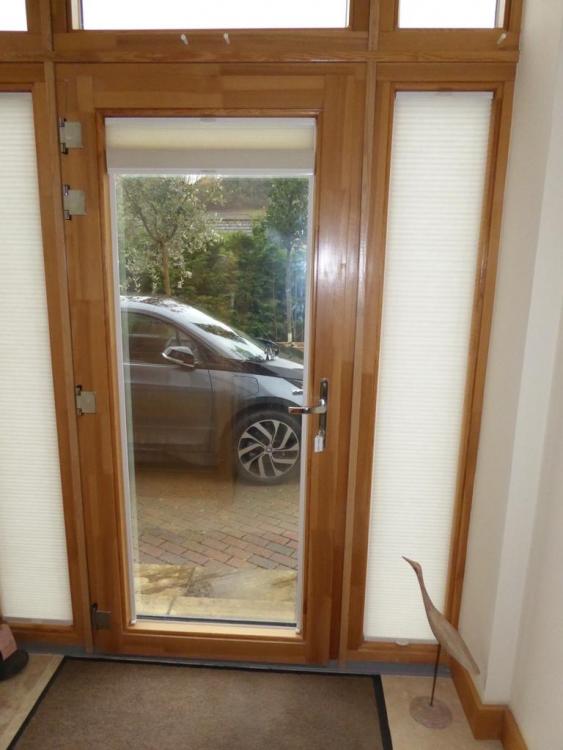
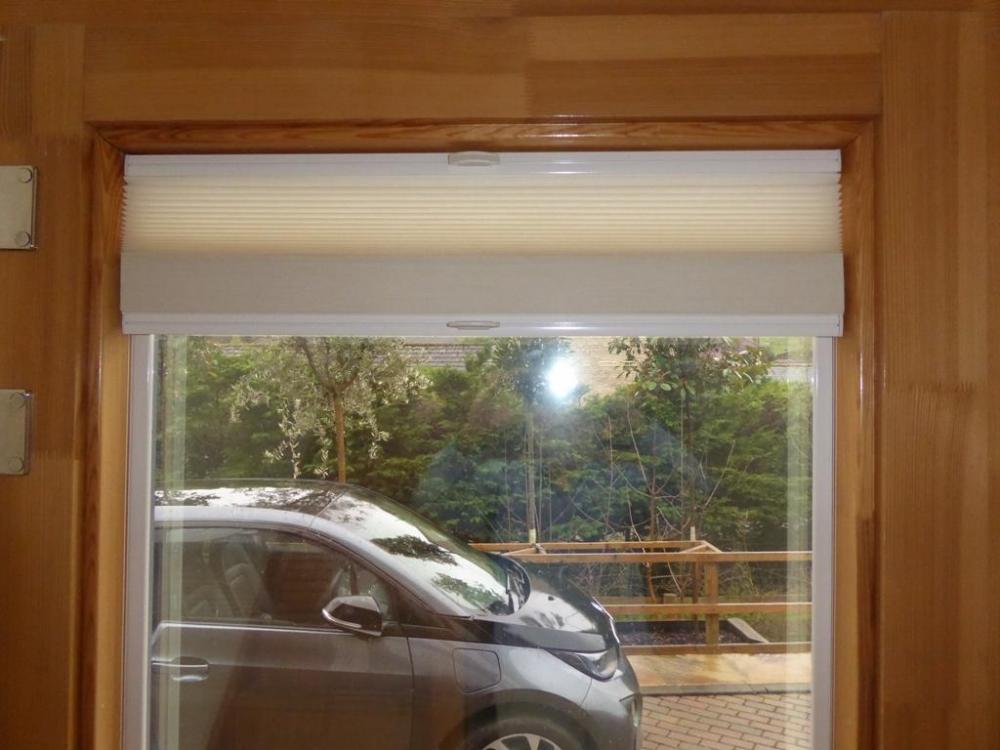
The ones we have aren't the Perfect Fit ones (although they came from the same company) but are the Duette ones, that fit tight to the glass with a very slim rail down either side. Easier to fit than the Perfect Fit ones, as the rail is just fixed to the glass on either side with a self-adhesive backing:
-
You can get films that aren't "silvery", we have some on our east facing windows. The tint effect doesn't give anywhere near as much privacy as on a car through, unless very dark. This has a lot to do with the tendency for there to be more light inside houses than inside the back of a car. The tint on the rear windows of my car looks very dark, but in reality it's little different to that on some of the lightest films I looked at. Your best bet is perhaps to get some samples of different films and see how they look. I suspect you'll find that they don't provide as much privacy in any condition except a bright day as you'd like. The films probably have a limited life, not sure how long they last, but I'd guess that they may start to look a bit tatty after 10 years or so. Not hard to peel it off and replace it though. Tinted glass may be an option, but getting a supplier to be able to supply it the timescale you need may be a challenge. Another option might be to look at fitting some form of external shutter or blind. Not easy to do over a door, but there are sun screen/privacy blinds around. One slight snag is that external blinds really need to be built in to the external wall for the neatest installation, but you may be able to hide these OK. For the door, then you can usually fit blinds inside the door for privacy. We have some very slim blinds that fit wholly inside the internal rebate between the inner face of the frame and the glass, so don't project into the house and, being fitted to tight cords, they stay firmly in place when the door is opened and closed.
-

DIY Arduino based solar PV dump controller
Jeremy Harris replied to ProDave's topic in Photovoltaics (PV)
You should be able to use pretty much any terminal emulator easily enough. I tend to use PuTTY, as it has versions for Linux and Windows: https://www.ssh.com/ssh/putty/linux/ It's pretty versatile and covers pretty much any use case where you might need a terminal interface. -
You can add a privacy film, but it doesn't work at night, when the lights are on inside. We have a heat reflective film on our glazed gable and it is very effective at reflecting heat outwards, plus it provides good privacy during the day, but as soon as it is darker outside than in it provides no privacy at all. Our solution was to fit close-fitting duette pleated blinds to all the glazing, motorised gable versions at the top (as our glazing is over 5m high) and hand operated versions on the lower panes. Not a cheap option though, I think the blinds came to around £2.5k altogether, and the reflective film was over £1k. We might have been better off fitting electrochromic glass, as the cost may not have been very much more overall.
-
Low emissivity glass is usually fitted as one (or two in triple glazing) coated panes within the glazing unit, arranged to reflect heat back into the house, so keeping it warm. If you want to cut down the amount of heat getting in, then the glass needs to have a heat reflecting coating or treatment on the outside, so reflect heat outwards. It is possible to specify glass that has a low inward heat transmission, but until relatively recently it's mainly been used for commercial applications, like big glazed office blocks, as a way to reduce the air conditioning demand. It's definitely a special as far as most window companies are concerned, so needs to be specified carefully, and may well attract a price premium.
-
DIY Arduino based solar PV dump controller
Jeremy Harris replied to ProDave's topic in Photovoltaics (PV)
When I was playing around with the CT burden resistors I found that things worked best with them inside the CT, despite the length of the cable. Having the burden in the CT case lowers the source impedance of the CT a lot, as the burden resistor(s) are a pretty low value usually. There's also a safety advantage in having the burden resistors inside the CT case, as with no burden the output voltage of the CT can be pretty high. There's a risk that with the burden remote from the CT, plus a relatively high current in the meter tail, if a connection comes loose then the voltage on the open circuit cable could reach a dangerous level. -
With no expansion room at all, then the pressure will rise a very great deal with even a small temperature change. Water is, to all intents and purposes, incompressible under the sort of conditions in a heating system. A 70 litre volume system will try to increase in volume by roughly 0.3 litre for a 20°C temperature change, so with no expansion vessel, and ignoring the slight increase in system volume from the thermal expansion of the buffer tank and pipes, the pressure will increase by a lot, possibly several bar unless a pressure relief valve were to operate. My earlier guess of the PRV letting by around a cupful seems to be about right, too, at 300ml!
-
Glazing position on ICF
Jeremy Harris replied to EverHopefull's topic in Insulated Concrete Formwork (ICF)
I'm at a bit of a loss to understand how any supplier can sell a non-Part M compliant threshold, so the 100mm bit seems really puzzling. Part M is pretty clear, so threshold steps inside and outside cannot be higher than 15mm IIRC. Edited to add: Just found the details referred to in Part M for accesible thresholds. Any new door should comply with this: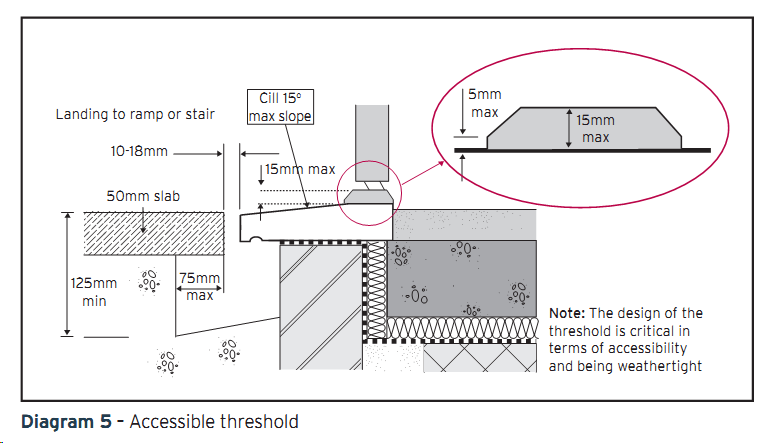
-
Glazing position on ICF
Jeremy Harris replied to EverHopefull's topic in Insulated Concrete Formwork (ICF)
Our external door cills are fitted to the finished surface of the slab, which is level with the base of the walls, so the only additional thickness we have is the floor covering (about 14 to 15mm). That's about as level as you can get, I think, as the bottom edge of our doors only clears the finished floor by about 8mm, and I don't think it's very practical to have much less than this clearance at the bottom of an external door. -
I think your plumber has nailed it. The pressure will rise in the sealed ASHP circuit as it heats up, and there should be an expansion vessel in that circuit to allow for this and limit the pressure rise. I see about 1/4 bar change in pressure between hot and cold on ours, but that's with an expansion vessel. Without one I suspect the pressure is rising to the PRV threshold and dumping a tiny bit (probably only a small cupful) which is then causing the pressure to drop a lot when it cools down.
-
Glazing position on ICF
Jeremy Harris replied to EverHopefull's topic in Insulated Concrete Formwork (ICF)
It makes a lot of sense to have the windows in the middle, so there's insulation outboard of their location. Apart from being structurally a lot easier, it will tend to reduce the thermal bridge around the outside of the frames a bit, too. Although not ICF, I made sure all our doors and windows were set into the insulation layer, so well back from the outside face of the walls, in order to reduce thermal bridging a bit. -
Changing electricity supplier
Jeremy Harris replied to Crofter's topic in General Self Build & DIY Discussion
For a moment there I misread that as "merkin"... ? -
The major problem with HE seems to be that there is a great deal of it that is not aimed at equipping graduates with the skills and knowledge needed to gain useful employment. The diversification of studies into so many esoteric areas that have little or no value to an employer, but which seemed designed only to attract students, is probably the worse thing that's been happening over the past 30 years. I was lucky; I received a grant and when I left I walked straight into a job. I had even more luck when a year later I decided I hated chemistry and chose to get a job in the Scientific Civil Service in a completely different discipline, as they sponsored me to do a sandwich course. The key thing, though, was that all that education was focussed carefully on what employers needed, especially my second stint, which, because it was paid for by my employer was very carefully focussed on what they wanted me to learn. One thing I noticed over the last fifteen or so years of my career was that, as an employer, we were having to spend more and more resources on training graduates in the workplace. Despite having seemingly good degrees, the majority were ill-suited to the working environment. I, and many of my former colleagues, were of the view that incorporating part-time education with employment, rather like the old sandwich courses, gave greater benefits to employers.
-
We have triangular blinds for the triangular gable at the front of our house. Not cheap, but they look very neat when I either up or down. Ours are the duette pleated ones, and came from these people: https://www.conservatoryblinds.co.uk/gable-blinds/#
-
Changing electricity supplier
Jeremy Harris replied to Crofter's topic in General Self Build & DIY Discussion
SSE just put the rates up here, too, I got a letter from them yesterday and they've whacked up the price of E7. I've switched to Bulb, around £200 cheaper. If you find Bulb are competitive where you are, you can use this code to get £50 free credit: https://join.bulb.co.uk/?referral=jeremyh2413 -
Do I need one or is this some sort of jape.
Jeremy Harris replied to MikeSharp01's topic in Ventilation
It's a swamp cooler, but packaged in a tiny box. We had big (as in around 4ft diameter) swamp coolers for making life somewhat tolerable in a place I worked at in the US. They are just a fan with a water reservoir and some form of evaporative system. The ones we used had a water pump and loads of fine nozzles around the fan cowling, that sprayed water into the draft and cooled the air by evaporation. They work fine in the desert, not so fine in places like Florida, where the humidity in the afternoons is already very high. -
Should I fit solar panels
Jeremy Harris replied to Russell griffiths's topic in General Self Build & DIY Discussion
Our PV has been running for a while now, and having switched to E7 I'm finding that far and away the greatest proportion of our purchased electricity is now at the cheap rate (around 8.5p/kWh). With the good weather we've been having lately the house has been "energy neutral" (i.e. not using any grid power) by around 09:00 each morning, and has tended to stay like that until around 16:00. Every day that "no cost" window is getting longer, and reducing the time when we are using full price electricity. -
Companies going to the wall in this sector has been an ongoing problem ever since I first joined Ebuild in 2008, so I think it's just the nature of things. Late bill paying seems to be completely normal in the building trade, and it doesn't take much for a company to have a cash flow crisis and fold.
-
Looking for electric system/combi boiler advice please
Jeremy Harris replied to MrM's topic in Boilers & Hot Water Tanks
What on earth needs "servicing"? Our ASHP is essentially an air con unit, and all that's required is an annual inspection (which the owner can do in ten minutes) to ensure that the external unit is clean, free from cobwebs etc, plus a functional check. An air-to-air unit needs, in addition, a check of the drain line and peristaltic pump, but again that's a ten minute DIY job. -
It cannot be a septic tank, as by definition a septic tank is anaerobic, hence the need for tertiary aerobic treatment in order to make the effluent safe, by reducing it's BOD. If worms are living in the thing then it has to be non-septic and aerobic, although how it remains aerobic when being filled with high BOD effluent I've no idea.
-
In roof PV - internal heat transfer?
Jeremy Harris replied to TFnovice's topic in Photovoltaics (PV)
I had this discussion with the planning officer. The "rule of thumb" they seem to use is +/- 100mm on the nominal dimensions is considered to be a normal build tolerance. -
The vent at the treatment plant is the key thing, and the chances are the BCO isn't aware that there is one, I think.




