Jeremy Harris
-
Posts
26430 -
Joined
-
Last visited
-
Days Won
360
Everything posted by Jeremy Harris
-
 You're spot on. We have no heating upstairs, just towel rails in the bathrooms, and the bedrooms never get below about 19°C, and are usually around 20°C, which we find OK; if anything I think we might prefer them to be slightly cooler. I did include switched FCUs in the bedrooms, so we could fit electric panel heaters if we felt we needed them, but I doubt that we'll ever bother to fit them now. The only thing I'd have done differently would have been to install very low power electric heating mats under the stone flooring in the bathrooms, not to provide room heat, but just to take the chill off the stone. It's not a major issue though, and we've just got used to it now.
 -
Indemnity on track to the land
Jeremy Harris replied to Plumberzanna's topic in Party Wall & Property Legal Issues
Just an additional thought. As well as a right of access to the plot, will you also need a right to put services under the access track/lane as well, or will they be able to get to the plot without needing to go over or under the access? This may have a bearing if there is found to an existing right of access for people and vehicles, as it may well not include running services as well. Some utilities can (when pushed very hard) use their statutory powers to put services under land, but I believe this may only apply to water and sewerage; I'm not sure if the other utilities have such statutory powers. It's a bit of a moot point anyway, as when I discussed this with Wessex Water years ago they made it clear that they would be very reluctant to use their statutory powers and would rather that we find an alternative route, even if that meant digging up 140m of single track lane and restricting access to half a dozen houses for a day or two. -
Get rid of those awful downlighters...
Jeremy Harris commented on Ferdinand's blog entry in God is in the Details
There are plenty of those about too, but the smaller round panels are pretty similar to flush-faced downlighters, but without the projection behind. The 3 W ones are pretty much the same, in terms of light output, as a downlighter fitted with an LED, but with a wider and more even light distribution. The ones we have fitted into a 65mm diameter hole, so were a straight replacement for the downlights we used to have in the kitchen and dining room. I opted to replace four of them (two over the island, two over the sink) with the larger 6 W panels, which meant opening the holes out a bit, but this wasn't that hard, and the mix of 3 W and 6 W units in the same ceiling seems to work well. We have cool white ones in the kitchen area and warm white ones in the dining area, and TBH I prefer the look of the warm white ones, and may change the cool white ones over one day, as the warm white ones seem just as bright. -
An ASHP is going to really struggle to provide water at a high enough temperature to charge a Sunamp for hot water, as the charging temperature has to be around 65°C, which is hotter than pretty much any ASHP will be able to run at, and even if you did get one to run as high as this it would struggle a fair bit. Around 50°C is a reasonable maximum for hot water from an ASHP, perhaps as high as 55°C at a pinch. This is OK if fed to a well-insulated UVC though, although the UVC will need to be fitted with a high efficiency coil to allow reasonably quick water heating. I wouldn't oversize the ASHP too much, as you will probably find that it won't modulate down enough to meet your heating requirement, and that will lead to it short cycling. A small amount of over-sizing is OK, but look carefully at the lowest modulation level that the ASHP will run down to. We have a 6/7 kW ASHP and that will only modulate down to about 2 to 2.5 kW, which isn't low enough for our heating requirement, so I had to have a buffer tank, to allow the ASHP to run for a reasonable length of time at it's lowest modulation level. This isn't ideal, as the tank takes up space, but the ASHP was one of the smallest I could find at the time (a 3 to 4 kW one would have been a much better bet). Because (with luck) your passive house should have a long thermal time constant (good insulation, high decrement delay, good airtightness and efficient MVHR) then having the heating off for three or four hours whilst the ASHP charges the UVC won't have any noticeable impact, so the ASHP doesn't need to be sized to deliver heating and hot water simultaneously (none will do this anyway, AFAIK, they all turn off the heating when they switch to hot water mode), and I suspect the size may be a compromise between the mean heating requirement and the desired UVC recharge time. Having a larger UVC increases the recharge time but also gives a larger DHW buffer, and you can often just charge the UVC with hot water overnight, when there probably isn't any need for heating.
-
Still a bit less than the 7 kW figure that you had originally, though. You can subtract a bit from that 3.1 kW, as the spreadsheet takes no account of incidental heat gain. Each occupant will contribute around 80 W or so, there will be a couple of hundred watts of gain from all the electrical stuff in the house and there will be some heat that comes from the losses from the hot water system. However, sizing the heating based on the worst case heat loss from that spreadsheet should give you a bit of headroom. If you opt for an ASHP, then the smallest models available tend to be around 4 to 5 kW anyway.
-
Indemnity on track to the land
Jeremy Harris replied to Plumberzanna's topic in Party Wall & Property Legal Issues
First of all, stating the obvious, do not complete the purchase until this is resolved, as there looks to be a chance that you may end up with a near-worthless piece of land unless you can get an agreed right of access. I believe that an indemnity won't work here, as you now have knowledge of someone who may have the ability to prevent access to the land (although because this letter was anonymous I suspect if may be a bluff from an objector). An indemnity is fine when the identity of a landowner is genuinely unknown, despite best endeavours to find them, but in this case the landowner can reasonably be expected to be known, and refuse a right of access. It should be the vendor's job to offer you the land free of encumbrance and with the necessary rights needed for you to be able to use it in the way in which the vendor has advertised it, so it's really up to them to get this sorted. If they do choose to sort it by means of an indemnity policy then you need to check carefully to be absolutely certain that the indemnity covers the case when someone has claimed to know the owner of the access and threatened to refuse to grant the use of it. -
Get rid of those awful downlighters...
Jeremy Harris commented on Ferdinand's blog entry in God is in the Details
I've used a mix of of different shapes and sizes of them, but they all seem to be very similar in design, like these: https://ledlam.co.uk/product-category/led-panel-light (random site chosen from the web, don't think I bought from here). -
I just run a soft brush over the cameras every now and again, or wait for weather like we're having now and let the wind and rain get rid of the cobwebs.
-
The key bit is that it has to be able to comply with the ventilation rates in the building regs, even though most people find these a bit high. It also needs a bit of additional capacity to be able to boost ventilate if required. You can download both Part F and the compliance guide here: https://www.gov.uk/government/publications/ventilation-approved-document-f . The bit you need is the section covering continuous mechanical ventilation, and the applicable rates for this in Table 5.2 and in the notes underneath that refer to the whole house minimum ventilation rate.
-
MVHR air flow rates
Jeremy Harris replied to lizzie's topic in Mechanical Ventilation with Heat Recovery (MVHR)
@lizzie, I'm concerned that you can feel a "rush of air" as that indicates a pretty high air flow rate. When our system is running at it's normal setting, there is no sound at all in the house, and the only way to feel air movement is to stand on a chair and hold a hand over a supply terminal, when it's just possible to feel a very slight draught up close to it. Ours is set to change all the air in the house about every 2 1/4 hours, which seems fine. The air always feels fresh, smells don't seem to linger or move from one room to another (an example, I've just cooked a chicken korma in the kitchen, with no cooker hood and without boosting the MVHR and there's no smell at all outside the kitchen door). We do tend to get low relative humidity (down to maybe 30%) when it's very cold outside, which reflects the low humidity outside. I find this a bit annoying, as I've suffered from chronic rhinitis for years, which is triggered by high or low humidity (and alcohol...). We've never had the humidity in the house high enough to trigger it, but have had it low enough to do so, so I've invested in an ultrasonic humidifier for my study, which seems to work very well (when I remember to top it up). I suspect that you may be reacting to the low relative humidity rather than the air quality, as the feeling I get when the air is excessively dry is one of being bunged up. It starts as a subtle feeling that the air's a bit stuffy, then progresses to being increasing harder to breathe, enough that I become aware of the effort involved. The only drug-free fix is to spend ten minutes breathing in clean steam, which is a bit like a miracle cure for an hour or so, until the dry air brings the symptoms back. -
Timber cladding, recommendations
Jeremy Harris replied to Russell griffiths's topic in Building Materials
Very much depends on the look you want, Russell. We wanted a rustic look (pretty much had to because of planning restrictions) so opted to use very cheap local waney edge larch. Not that easy to fit, and it's proved to be a bit wild, in that I've needed to go up and remove a fair few ring nails (anyone know an easy way to remove these bastards?) and replace them with screws. I'd have liked to have used a more tidy-looking, vertically planked, cladding, perhaps in planed cedar, but the planners (well, conservation officer) wouldn't go that far, it was either local stone cladding (ludicrously expensive) or waney edge (cheap but a bit wild and mobile). When looking around I found that Vastern Timber (not who we used) were the best in terms of price and quality for planed timber cladding. They were also very helpful the couple of times I drove up there to get samples to try and convince the planner that tidy-looking cladding would look OK. -
Dew Point - What is it and why does it matter
Jeremy Harris replied to Triassic's topic in Boffin's Corner
My concern has always been how a structure will behave under rapidly changing conditions, as I'm not sure that the tools often used for construction modelling can account for this properly. The situation that springs to mind is a fairly typical one for this time of the year, where a wet day may be followed by a very cold, clear night, which is then followed by a bright, sunny morning. The wet day may result in there being moisture on, or in, the outer skin. The cold night then lowers the temperature of the wall. The warm sun the following morning then heats up the wet outer wall and, because the core of the wall may well still be pretty cold, there would seem to be a risk that water vapour (from the near-saturated layer of air in the cavity) may condense out at some point deeper in the wall. Whether that then turns back into vapour and moves out of the wall structure depends on how quickly enough heat can travel through the wall so as to cause it to evaporate, as well as how vapour permeable the structure is outboard of where moisture may have condensed. I have a suspicion that this sort of dynamic effect may act to "pump" moisture into a condensing region deep in the wall, that may remain too cool to allow the moisture to evaporate out again before the next cold overnight period. I've not seen any interstitial condensation model that seems to allow for dynamic changes like this, as to do so requires more data than just the relevant material U values, the heat capacity of each layer within the wall also needs to be taken into account, as that will determine how long each element takes to heat up or cool down under any given set of changing conditions. Having spent years modelling the dynamic conditions experienced when weapons hit the water at relatively high speed, I'd say that this is probably a pretty difficult thing to model accurately. The big question that I've never seen answered is whether or not it's worth modelling rapid changes like this. My gut feeling is that it may not have been for conventional construction methods, but may well be for new methods of construction. My reasoning is partly driven by the apparent lack of thought given to the design of some standard details for things like SIP construction (and I know this has now been reconsidered by at least one SIPs supplier). -
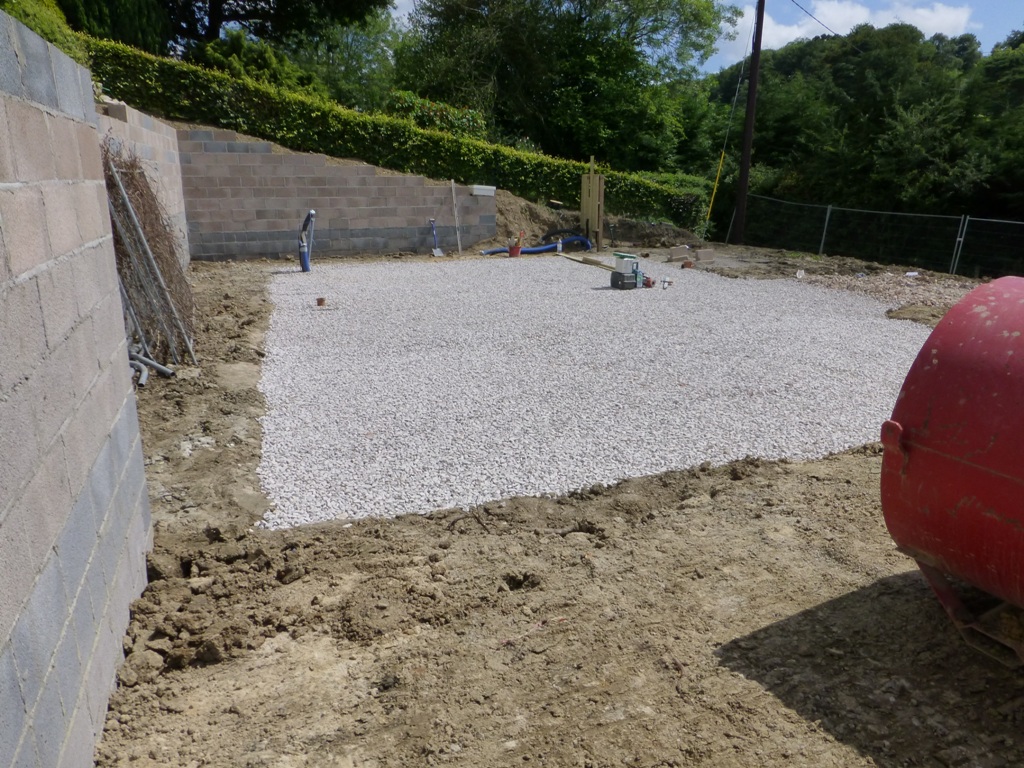
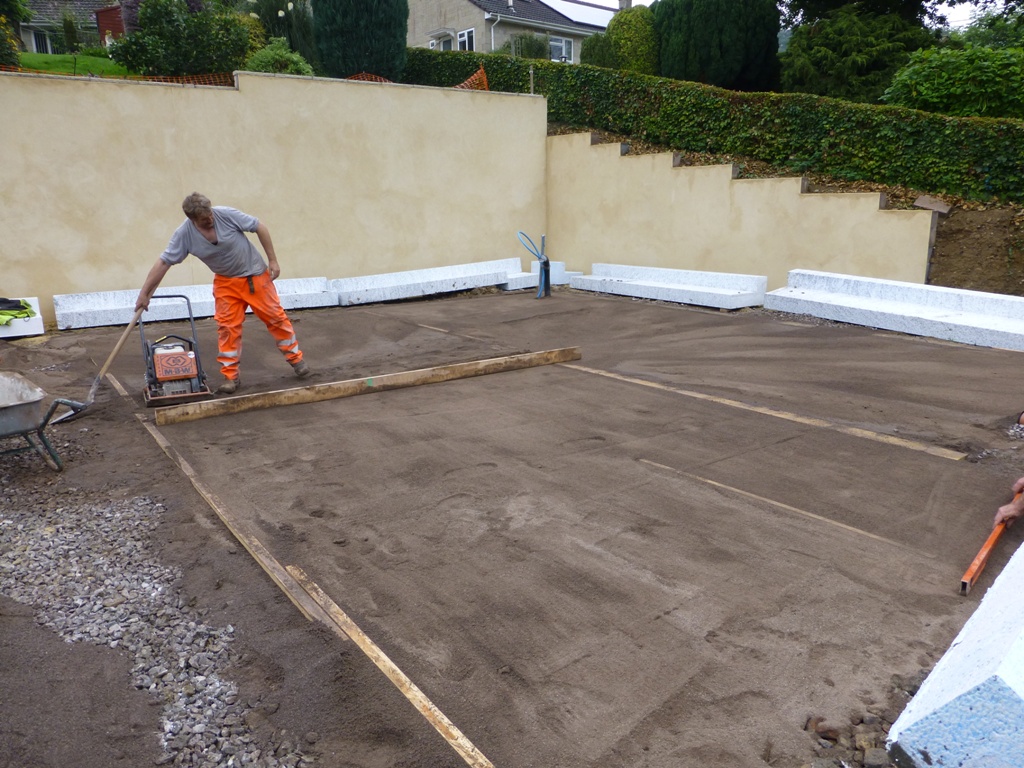
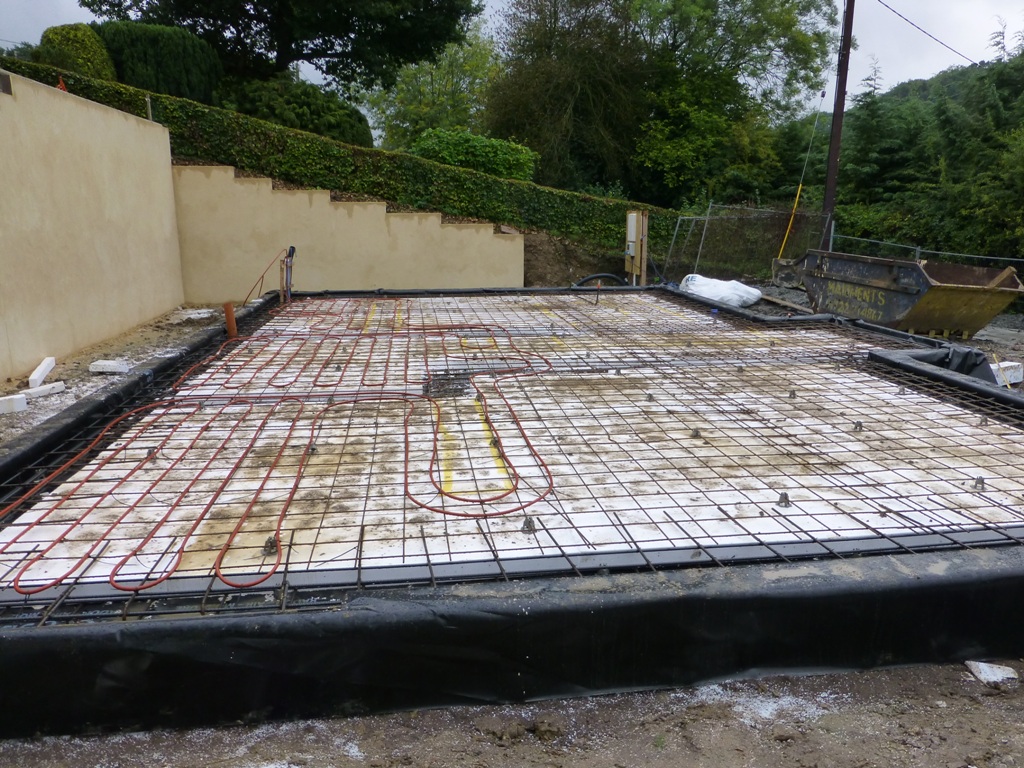
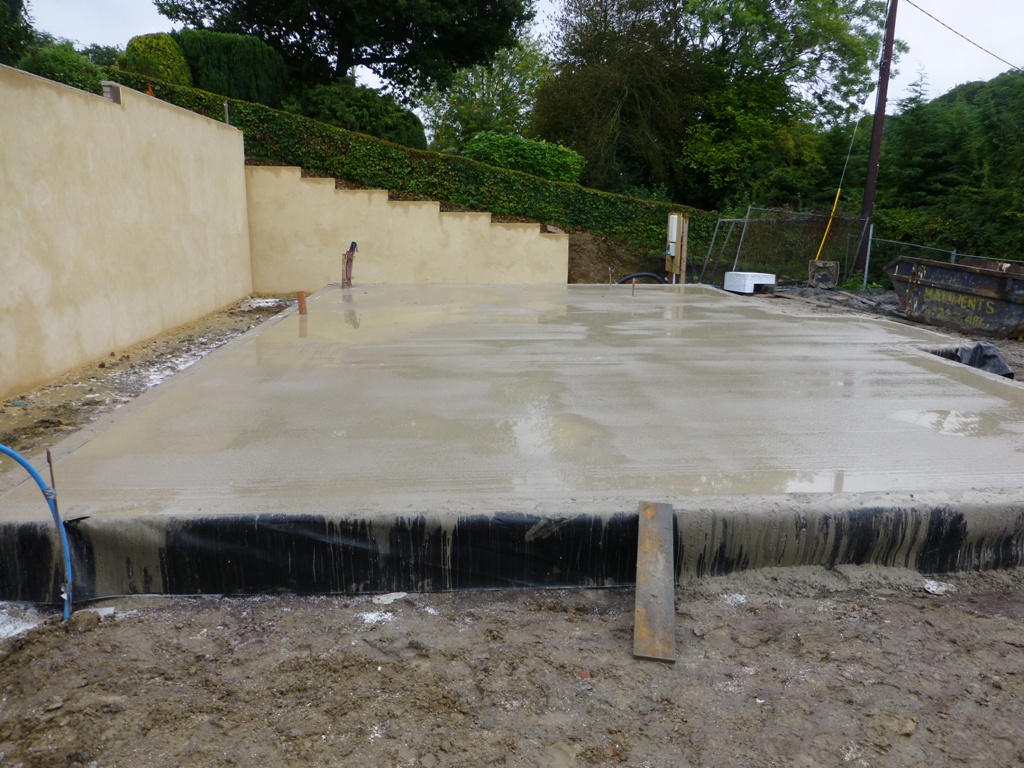
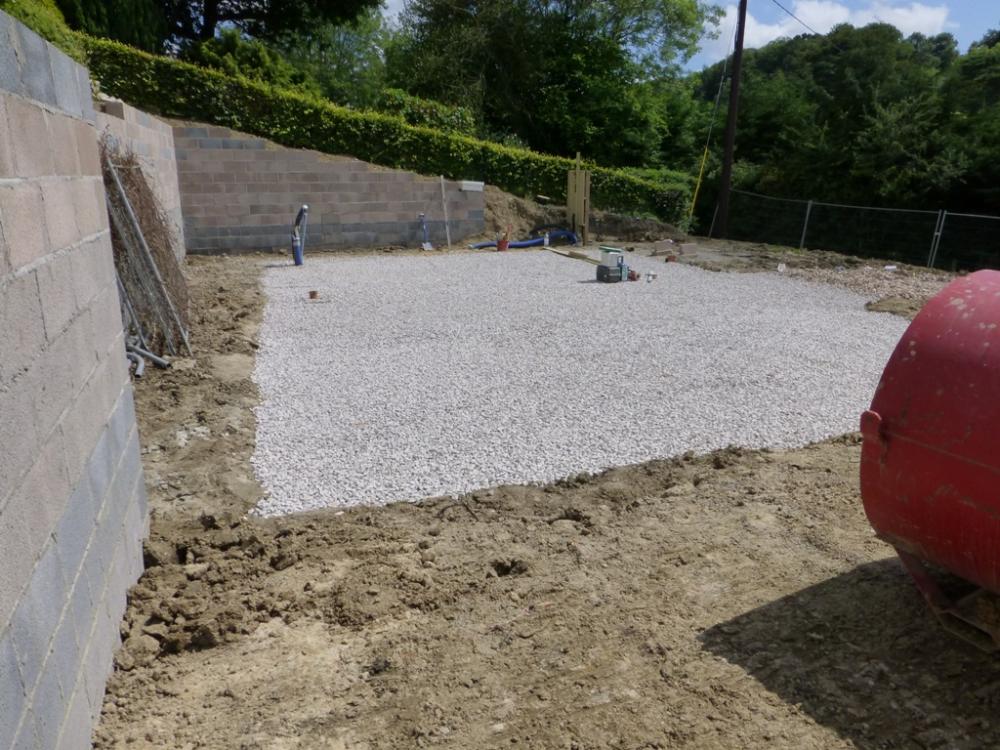
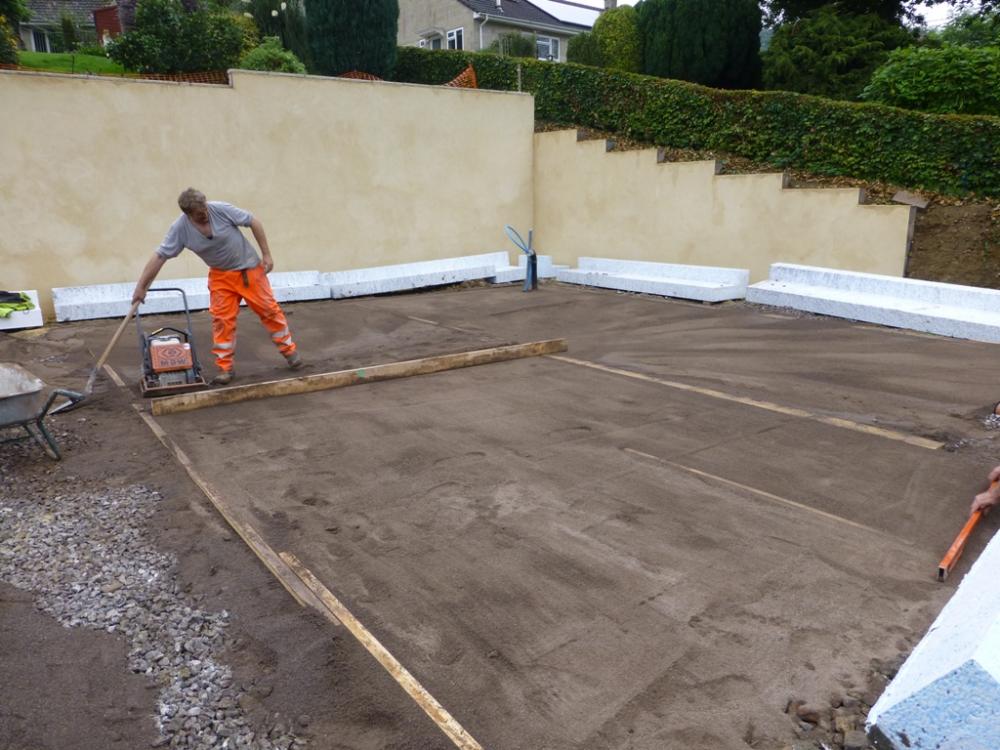
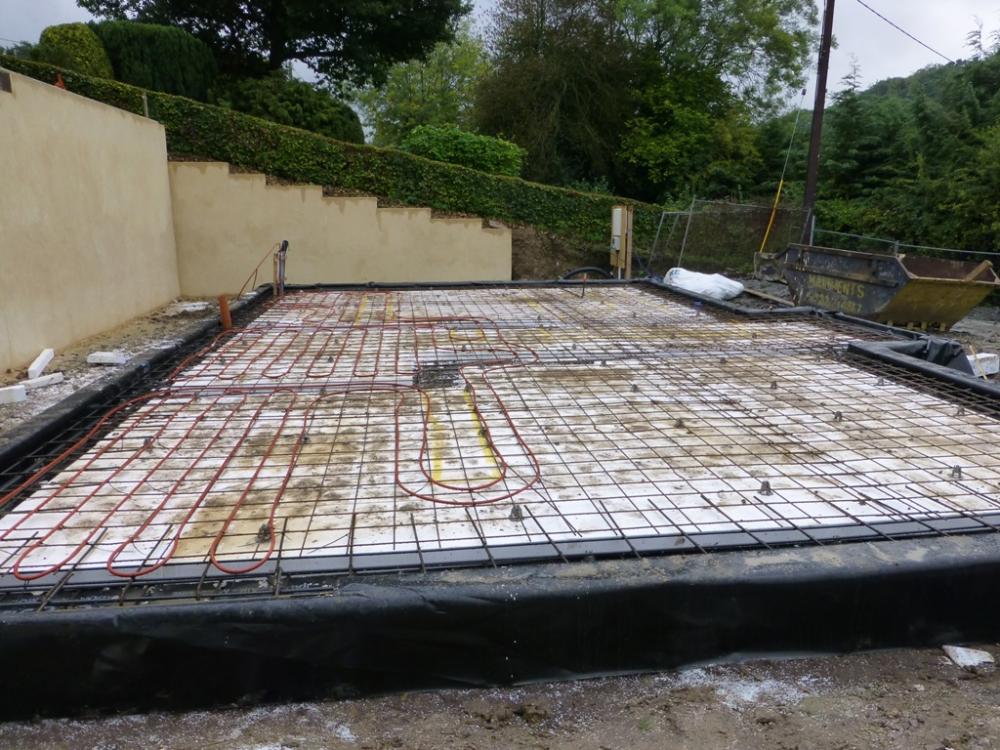
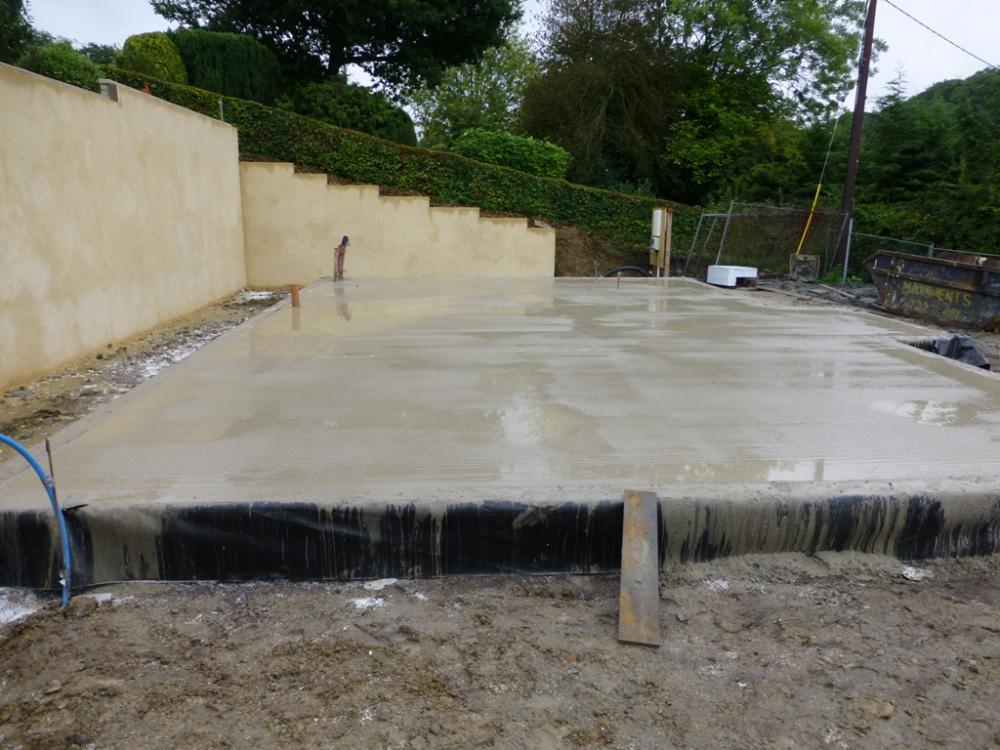
Our passive slab was laid on a bed of whacked down coarse stone: You can just see the pipes and ducts coming up through this, they were all placed accurately in trenches underneath the sub-base. Next the sub-base stone was blinded and levelled with grit, to form a dead level bed for the shaped EPS blocks and sheet: You can see some pipe/cable ducts poking up at the back of this photo. Once the foam blocks and sheet were all laid, a DPM was laid and sandwiched between the top foam sheet and the two underneath, the reinforcing steel was added and tied in and the UFH pipes were laid and tied to the steels: The day after the photo above was taken the concrete was poured and trammelled roughly level, as shown in this photo: A couple of hours after the photo above was taken the slab was power floated smooth, leaving a finished floor that was flat and smooth enough to tile and floor to directly, with no need for screed or levelling compound.
-
Finding a blockage in a 50mm mdpe pipe ?
Jeremy Harris replied to ProDave's topic in Waste & Sewerage
Could be the reason it's gone through a couple of pumps, too, perhaps. Maybe they've been working against that partial blockage right from the start. -
Other than the obvious common sense stuff to keep the installation reliable, no, as PoE is too low a voltage to be classified as LV and is isolated, so falls within the SELV/PELV classification. This means that it's largely outwith the provisions of BS7671:2018 and is also not notifiable work under Part P of the building regs.
-
Finding a blockage in a 50mm mdpe pipe ?
Jeremy Harris replied to ProDave's topic in Waste & Sewerage
Bugger, what a swine of a thing to find after all that trauma. I'm kicking myself, too, as our unit has exactly the same brass flap-type non-return on the pump outlet; I should have thought of it sooner, but the memory was only triggered when I saw your photo. -
I've just been digging out prices we had from a couple of other suppliers, for comparison. The company that we were going to go with originally, and who worked up two sets of prices for us, with a lot of chasing and donkey work from me (not sure why, but it was really hard work even getting indicative prices out of most companies we approached) had three stage payments, but they didn't offer an integrated foundation solution, so we would have had to do that separately. Their payment schedule was 30% with order, 50% on the date of delivery of the frame and 20% on completion of frame erection (they didn't guarantee airtightness or include an air test). I had several quotes for an insulated slab foundation, and most were full payment for the insulation and steel reinforcement with order, concrete paid for just before delivery and labour paid on completion of the slab. One didn't supply the steel reinforcement, just a schedule, and so there would have been another payment with order for that.
-
Our payments were rounded to the nearest £100, so the percentages aren't very neat, but they were roughly: 16.5% deposit with order 21.6% two weeks before commencement of foundation works 33% on the morning of frame delivery 12.4% on completion of frame erection, including felting and battening of roof 16.5% on completion of a successful air test (less than 0.6 ACH @50 Pa)
-
I would guess that it's the contract that you agree to that's definitive, as a quote is often just a rough guide as to what the price and payment schedule might be. Until such time as a contract is agreed, everything is really negotiable to a degree.
-
MVHR air flow rates
Jeremy Harris replied to lizzie's topic in Mechanical Ventilation with Heat Recovery (MVHR)
I believe the different MVHR manufacturers have different terminology for the settings. Our Genvex can have the four speed settings programmed to various percentage flow rates, with extract and supply being individually programmable. The recommended set up is for level 2 to be the normal background ventilation rate with level 3 being the normal boost rate. Level 4 is a sort of super boost (100%) and level 1 is a trickle ventilation option for when the house is unoccupied. Being able to adjust extract and supply individually is useful, as if it is hard to get the system to balance from just adjusting the terminals/restrictors in each duct, then the system can be fine tuned to fix a small imbalance, say a couple of % or so. Getting the system to balance well does mean ensuring that the design is correct, though. As extract flow rates will generally be higher than supply flow rates then it's normal to have slightly fewer extract terminals than supply terminals, for example. This also helps to keep any slight flow noise down, as this is most noticeable in rooms that would normally have supply terminals, like bedrooms and living rooms. A little bit of flow noise is often more tolerable in a kitchen or bathroom. -
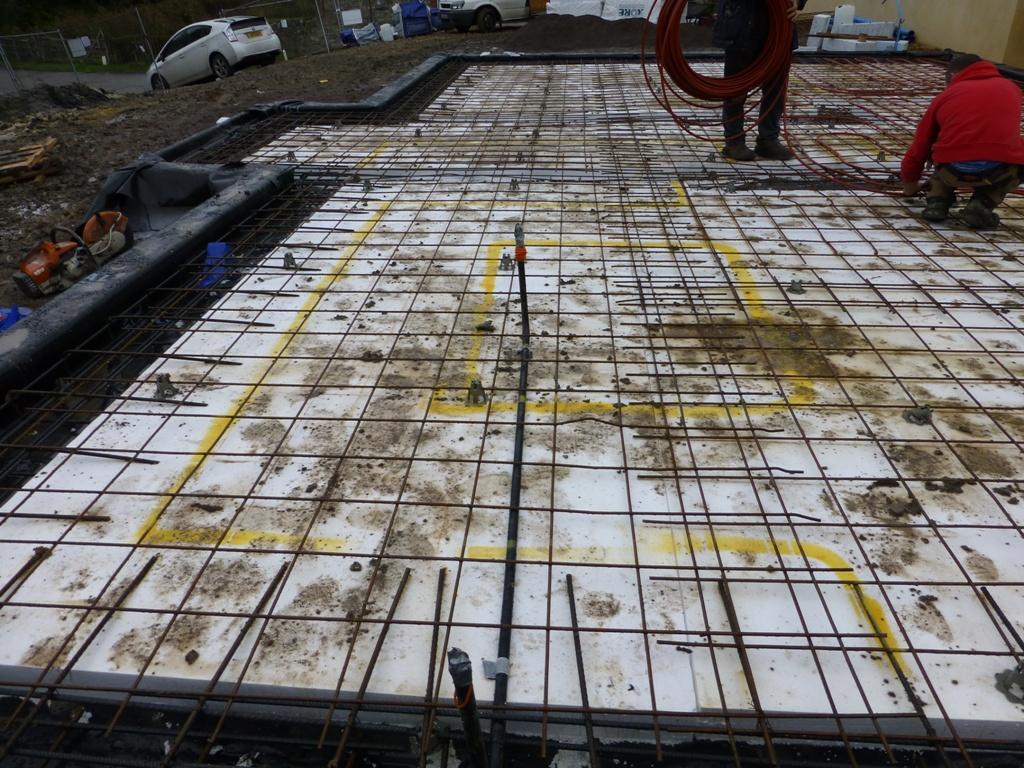
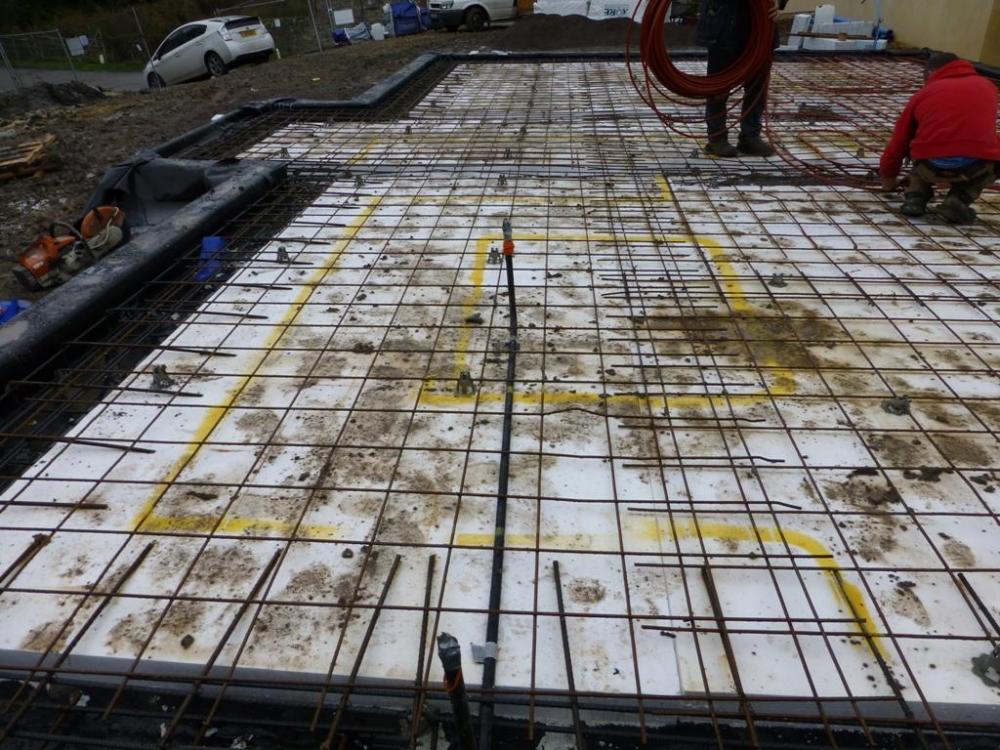
DIY pipe laying takes a fair bit of time, and that means arranging for a break in the middle of the slab laying process. At a guess I'd say you need to allow a couple of days to mark out, lay and tie in the UFH pipes. This would be a fair bit quicker if there were two of you doing it. The guys that laid ours had a well-worked out system where they spent an hour or so accurately spray marking the locations of walls, doorways, the stairs, kitchen and utility room units, the WC etc, on to the EPS, just after the steel fabric and the ring beam steel was laid and tied in (a bit over a days work for our smaller slab). The UFH pipes were laid and tied in the afternoon before the concrete pour. When laying the pipes, one chap held the coil of pipe and paid it out as the other tied the pipe to the steel. Seemed to be an efficient way of working. Here's a photo showing how they did it:
-
Me too. Some friends have skirting heating and it works very well indeed, and you wouldn't know there was any heating system fitted unless you were told about it.
-
We also looked at Potton, as they have a house built inside the Swindon centre. Looked OK, but when I drilled down to the technical detail airtightness was not great and increasing the insulation to a level above building regs minimum seemed a bit problematic. The finer detailing of things like door and window opening, cavity closures, airtightness by design, all seems a bit lacking, but then this was over 6 years ago now. They were also pretty expensive, but then they were offering what amounted to a turn-key package.
-
Our slab was ~75m². We had ~300m of UFH pipe. The cost of the pipe would have been about £200, plus maybe £20 worth of cable ties, plus two guys working for around half a day. At a rough guess, I'd say that came to around £400 to £450 for 75m² back in 2013. Not sure how the length of pipe needed or the time taken scales up for a bigger slab and perhaps more complex floor layout (a fair bit of time was spent marking all the wall, toilet, stairs and kitchen unit positions on to the EPS). Prices may well have changed in the intervening years too. Do you know how much pipe there is in the slab? Might be able to scale up the cost by just scaling up the pipe length and the likely layout complexity increase, as both will also increase the time taken.
-
MVHR air flow rates
Jeremy Harris replied to lizzie's topic in Mechanical Ventilation with Heat Recovery (MVHR)
There are official guides as to how to do this. They vary a bit, but in essence follow much the same procedure as above: NHBC MVHR Commissioning.pdf Passivhaus MVHR Commissioning Requirements V121.pdf domestic_ventilation_compliance_guide_2010_edition.pdf Buildhub has two ventilation system air flow meters in the tool loan pool, which members can borrow to undertake testing if they wish.