Jeremy Harris
-
Posts
26430 -
Joined
-
Last visited
-
Days Won
360
Everything posted by Jeremy Harris
-
Interestingly, for anyone looking at using an electrically heated Sunamp, charged either by off-peak electricity on a time switch, or excess PV generation, then there is a very good case for not over-sizing at all. If I had opted for a UniQ 6 as a replacement for our Sunamp PV we would definitely have not had any problems with the controller 50% threshold, as every day we would have used at least 65% of the full capacity. It was my decision (and it was my decision, Sunamp suggested I buy the UniQ 6 as a replacement for the 5 kWh Sunamp PV) to choose to over-specify, by opting for the 9 kWh model, when I knew that our requirement was usually around 4 to 4.5 kWh per day.
-
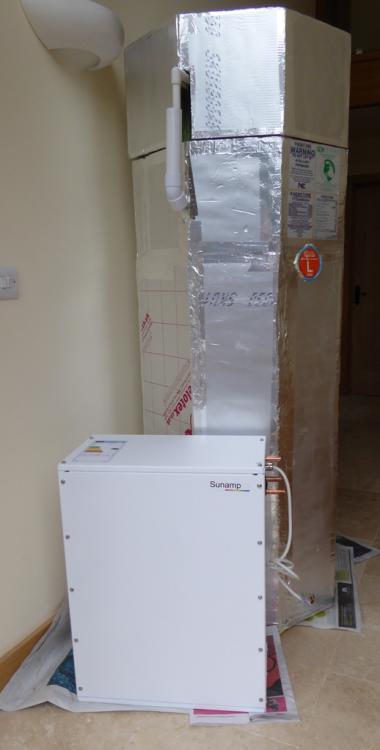
I would have said the reduced heat loss, but having just looked at the specification again I'm not at all sure that's correct. If it's sensible, as @Nickfromwales suggests, to over-specify the capacity to be sure of being able to reliably deliver a requirement that's around half the specified capacity, then the reduced heat loss advantage almost disappears, and the cost is so much greater than a hot water cylinder that it doesn't make economic sense. The only slight advantage would then seem to be that the overall height of a Sunamp installation would be around half that of a hot water cylinder, but the footprint would be much the same, maybe slightly greater.
-
There must be an easy fix, as just powering the controller off and then on again cures the problem completely. Every single time I do this the controller resets and starts accepting charge, with no exceptions. Doing this reset makes the Sunamp UniQ eHW work 100% reliably. The problem looks to me to be related to there being no real time clock in the controller, so timing is a bit arbitrary, and I doubt if elapsed time is used at all in the logical test that determines when to allow the unit to accept charge. I can easily add a timer to reset the unit, and am absolutely certain that would fix the problem permanently, but I'm reluctant to do this until we've heard from Sunamp (they are aware of the problem, at a pretty high level within the company).
-
FWIW, when I contacted Sunamp towards the end of last summer, looking to possibly change our Sunamp PV (rated at 5 kWh, and which reliably delivered 5 kWh) Sunamp's initial suggestion was for me to replace it with a Sunamp UniQ 6 eHW (rated at 6 kWh). At that time it was clear that they believed that the 6 kWh model would equal or exceed the capacity of the 5 kWh Sunamp PV, and given their very good track record with the Sunamp PV I had no reason not to believe this. There was no mention of needing to de-rate the new unit by 50% (or over-specify by 100%). I opted to increase the capacity to 9 kWh for the reasons given earlier, I wanted to be able to store a reserve from days when we had a lot of excess PV generation, so it could be used if the following day had very little (yesterday and today here would be a good example - yesterday we generated around 27 kWh, today I doubt if we will generate 2 kWh). At no time was there any mention of the need, or desirability, to double the capacity of the unit in order to be able to reliably deliver the required capacity.
-
The 5 kWh Sunamp PV weighed about 70kg. The 9 kWh eHW unit weighs about 160kg As there isn't an 18 kWh version, then it would have to be two 9 kWh models, so about 320 kg Yes, you're probably right, an installer should not feel the need to double up on the specification because he or she knows that the true usable capacity is half that in the specification.
-
I've owned and lived with both versions of the Sunamp, probably one of very few that have, plus I've now got 3 1/2 years experience with these things, a fair bit longer than anyone here, and longer than any Sunamp installer (there were none at all when I fitted our Sunamp PV). I can say categorically that, as far as the electrically heated models are concerned, the Sunamp PV was significantly more reliable, worked pretty much exactly like an immersion in a hot water tank and was able to utilise all of the heat storage capacity available, i.e. the 5 kWh model could usefully store and deliver 5 kWh. On the other hand, the electrically heated Sunamp UniQ models are far less capable. They can only usefully store around half their rated capacity, even though they are practically double the weight and significantly larger. What's worse is that in practice, they can deliver LESS than half their rated capacity when used with an excess PV generation diverter. We never ran out of hot water with the Sunamp PV, with it's 5 kWh capacity, but have run out twice with the much bigger 9 kWh capacity Sunamp UniQ. What's more, we would have run out of hot water many more times if I hadn't discovered that this could be prevented by resetting the unit manually every day. I've stressed the electrically heated models above because both models we've had have only been electrically heated. If heated with hot water, then I would guess that the major flaw in the controller that we have experienced may well either not be an issue, or be an issue that can be easily worked around. As long as a hot water heated model is provided with hot water at a few degrees above the PCM phase transition temperature of either 34°C or 58°C then it will charge, if there is any charge capacity available. I'm afraid I do not agree that the solution to the flaw in the controller is to just spend a lot more money on a unit that has twice the storage capacity required. It may get around the severe design flaw in the controller, but frankly a 9 kWh unit should be able to always store and deliver 9 kWh, not be artificially de-rated by an installer to 4.5 kWh, as bodge to cover up inadequacies in the product. Apart from anything else, the specifications are clear, and if a 9 kWh model is not able to reliably deliver 9 kWh every day, then it's not compliant with the manufacturers specification, so should be marketed as a 4.5 kWh model.
-
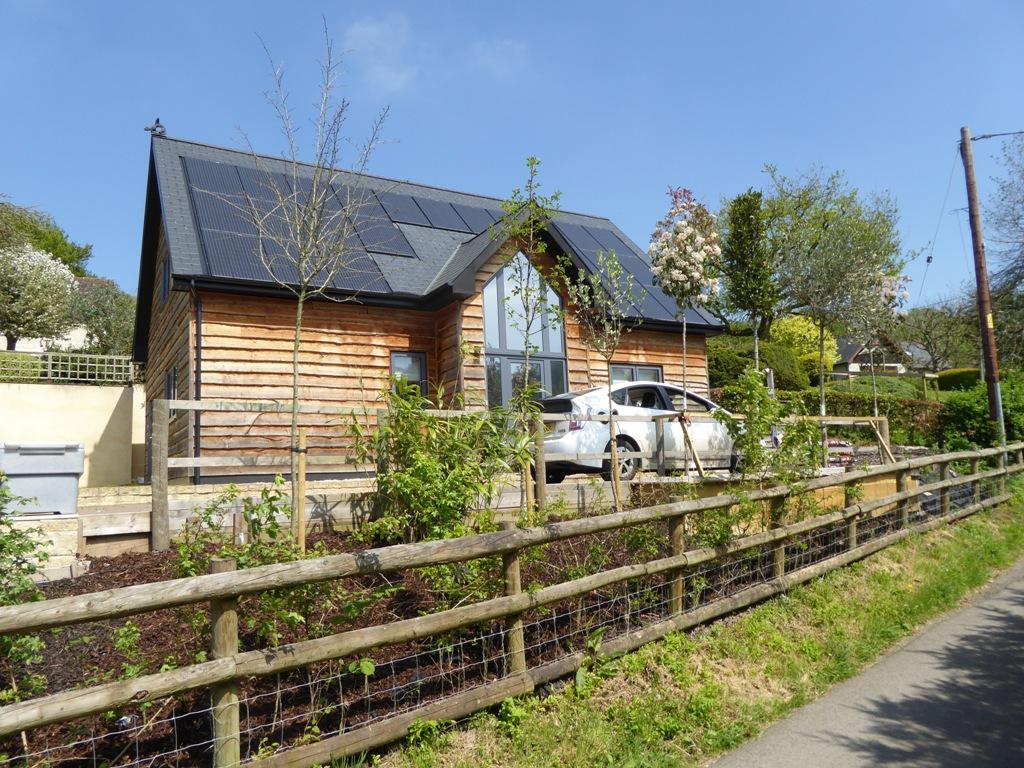
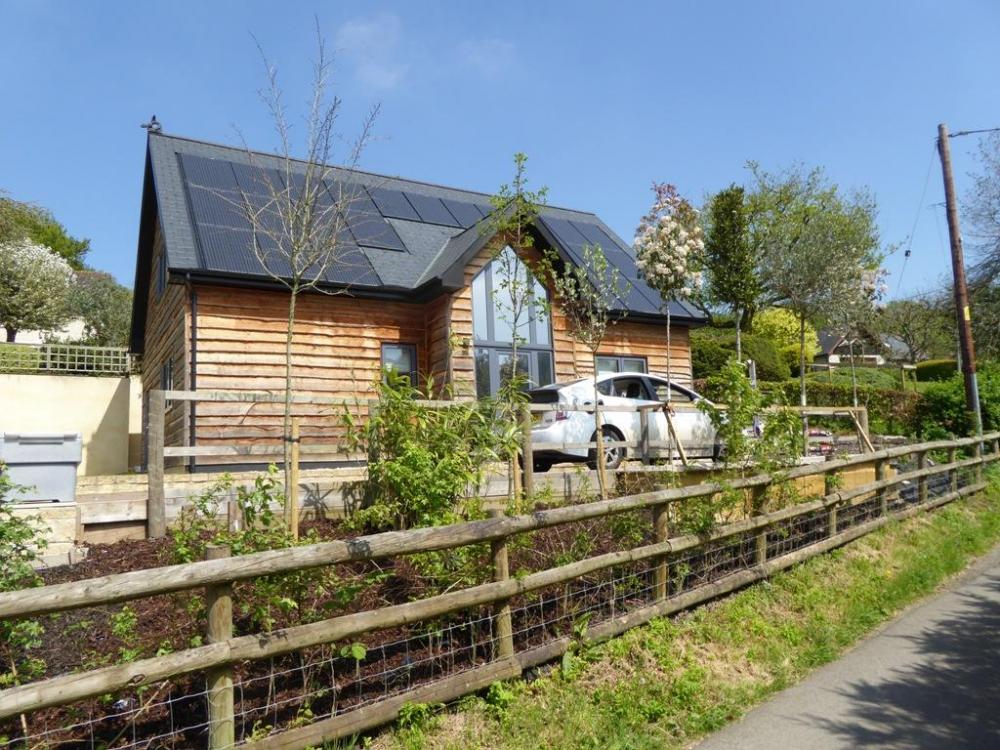
 Thanks, it's deliberately irregular, as it's rough sawn waney edge larch, with the bark on the lower edges (although some of the bark is now beginning to peel off). The trees were grown on Fonthill estate (about 6 miles away from us) and were milled in the local sawmill in Ansty (about 3 miles away from us), so it's a very local product. We went to see the trees before they were felled, and chose (with the invaluable assistance of the sawmill chap) the trees that would provide the wide boards to clad our house (the average board width is around 300mm)
 -
TBH, that's very understandable, as the way these things work isn't something we've ever seen before in any domestic heating/hot water system. It is a bit geeky, and to Sunamp's credit they have worked quite hard to try to simplify their promotional material, so as to emphasise the advantages that using a phase change material (PCM) offers. We're all familiar with the core principle that these things use, though. Ever noticed how large lumps of snow/ice hang around for a long time after the temperature rises well above freezing? Part of that is due to the relatively high energy needed to melt ice (cause it to change phase from solid to liquid). The stuff inside a Sunamp uses the same principle, but with stuff that melts at either 34°C or 58°C (PCM 34 or PCM 58). This property enables the Sunamp to store a lot more heat within a given volume than a water tank of the same capacity. When "charged" a Sunamp is full of liquid PCM, when discharged it's full of solid PCM. That change from liquid to solid releases a lot of heat, and it's reversible, with virtually no loss, so heating the solid to turn it into liquid absorbs a lot of heat.
-
Doesn't look massively more complex or expensive than our build. Our's is smaller at 130m², excluding a detached garage that's about 22m², but it's also built to passive house thermal performance standards, which mean that heating bills are almost non-existent and overall the only bills we have are Council Tax and house insurance. Excluding Council tax and insurance, the house running cost is less than zero, as we get around £1000 a year for the electricity we generate and pay about £600 a year in electricity bills (the house is all-electric and my car is electric, and is usually charged at home). Here's a photo of our build, which cost around £1,380/m². albeit a couple of years ago: The details of our trials and tribulations are in my blog, here: http://www.mayfly.eu/
-
Probably worth restating the circumstances surrounding my acquisition of an early Sunamp PV, and our current Sunamp Uniq 9 eHW, as they are different, and although I think I explained my relationship with Sunamp back in 2015, that was on ebuild, not here, so is now probably lost. I was introduced to Sunamp by Damon Hart-Davis, who told me that Sunamp were looking for "early adopters" for their Sunamp PV. I entered into an agreement with Sunamp which meant we were supplied with an early production/pre-production Sunamp PV, on the understanding that I would report back to them on it's performance, would openly and honestly publish my experiences on eBuild and our build blog and agree to exchange the heat cells for replacements after two years, so that Sunamp could undertake a "post mortem" on them. In return for this our Sunamp PV was supplied at a substantial discount (but it was NOT free, by any stretch of the imagination). As it happens, Sunamp chose not to ask me to exchange the cells in the Sunamp PV when the 2 years was up, so we carried on using it. The Sunamp PV worked very well, and I was more than happy to recommend it. Not long after the Sunamp Uniq range was released last year, I decided that it would be useful to increase our storage capacity. The Sunamp PV, with it's 5 kWh capacity, was perfectly adequate, but, as we can easily generate 20 to 30 kWh/day I felt that it would be useful to be able to store more heat, so that we had a reserve for days when there was little PV generation. The idea was to be able to increase our self-consumption, and reduce out winter reliance on grid boost charging. Sunamp agreed to sell me a Uniq 9 eHW at a discount, in return for me exchanging the Sunamp PV and providing them with a water sample. I'm not able to say what the discount was, but can confirm that I paid well over £1000 for the Sunamp UniQ, plus the exchange of the Sunamp PV that had cost close to the same amount. To sum up, I agreed to be a tester/early adopter when I purchased the Sunamp PV, but not when I purchased the Sunamp UniQ. I'm grateful for the discount from Sunamp, but overall I have paid them a fair bit more than the full purchase price for a Sunamp UniQ.
-
I am interested in this, too (prompted once more by the warm weather and our cooling system coming on!). @ragg987 made some neat window louvres, see this post: I've been looking at doing something similar, but would prefer to use powder coated aluminium slats. There seem to be lots of suppliers for these in Australia, but very few here in the UK. If I can find a source for the extrusions, then fabricating brackets etc shouldn't be too hard.
-
Definitely doable for the money, especially if you're prepared to do a bit of work and project management. Our build came in at about £1,380/m², which for your £300k would potentially give you a house of well over 200m². Our build is a passive house, with some extras that added a fair bit of cost, like the comfort cooling that's running right now to cool down the incoming fresh air from the MVHR. We also used oak for all the internal joinery (stairs doors, architrave, skirting etc), which added a substantial extra cost. There are lots of potential suppliers around, and interestingly some of those that are most well-known rarely, if ever, feature amongst all the many self-builders here. Potton springs to mind as having a strong advertising presence, but I think that, out of the many hundreds here, only one person has ever used them.
-
Yes, it seems to, as all seem to use the same control system. I've yet to hear anything from Sunamp to say that there is any control unit available that doesn't refuse to accept charge until the unit is around 50% discharged, although they have stated that the 50% figure is approximate. My best guess is that the "50%" is based on the centre thermistor reading, so the control logic assumes ~50%, but only when discharging, when the centre sensor reaches a particular temperature reading, probably close to the phase change temperature of 58°C. This is just guesswork, though, based on observed performance. I can measure the input energy to the Sunamp, as I fitted meters to both the boost and PV diverted power supplies, so I know that it sometimes (about 30% of the time) refuses to turn on when ~4 to ~4.5 kWh has been drawn off. As the nominal capacity is about 9 to 10 kWh, and allowing for a bit of standing heat loss (maybe around 0.4 kWh) it seems that, at least in our case, the threshold is pretty close to being 50% discharged before any charge will be accepted.
-
Should work OK, and it would need the PCM 34 version, as the PCM 58 wouldn't get hot enough to melt with charge from an ASHP. I originally fitted the instant water heater as a way to provide emergency hot water when we had the Sunamp PV, but then discovered that we never needed to use it, as the Sunamp PV always stored enough for our needs (unlike it's bgger, heavier and more expensive replacement). Edited to add: Sorry, typed the above before reading the later replies...
-
Yes, it might work, but probably only with a PV diverter that pulses full voltage, rather than one that modulates voltage (I think the newer Immersun modulates the supply voltage, as does at least one other unit I've heard of). Not sure how A steibel Eltron type control circuit would cope with being pulsed on and off every second or so, but it might tolerate it. It might be possible to alter the internal wiring to maintain power to the control side and modulate power to the heating element power control part. That might then allow the temperature control bit to try and do it's thing, free from being pulsed on and off, yet modulate the power available to the heating element. It only needs a low power one, though, so I wonder if they do a 3 kW version?
-
There's a long running issue with trying to reliably get an electrically charged Sunamp UniQ to work from either excess PV generated power or from timed off-peak power, like E7. It's all buried in these two other (long) threads about Sunamp issues:
-
In reality the floor space is a fair bit smaller, too, as being rectangular the Sunamp will fit closer to walls:
-
There are few, if any, significant issues with the non-electrically heated Sunamps, they seem to work very well and provide a reliable, low heat loss, way of storing heat for either hot water or heating. The advantages over a hot water cylinder are primarily the smaller physical footprint and the much lower heat losses. The disadvantages are the price premium and the weight of the units (not heavier than a hot water cylinder when full, but a lot heavier to install initially). I'd be reluctant to recommend the electrically heated Sunamp versions at the moment, at least until they come up with a more sensible controller.
-
The snag is that it then needs an over-temperature cut out of some sort. The contactor and controller sensing does that function, and it's critical to ensure that the PCM doesn't reach around 120°C, where it starts to decompose. I may just implement my timer fix later, as I'm getting fed up with waiting for some sort of resolution from Sunamp. I have a DIN rail mount time switch, with SPCO contacts, that's programmable down to 1 minute on or off periods. By using the NC contact and setting the timer to switch "on" (really off) for 1 minute at 08:00 each morning I can emulate what I've been doing by turning the power on and off to reset the controller. The time switch only needs to switch the low power circuit, not the main supply to the heating element.
-
This is true, as if you heat the PCM to a temperature below the phase change temperature then it can only store heat in line with the heat capacity of the solid PCM. Once you heat it to the phase change temperature it can store a lot more heat, over a very small change in temperature around the melting point of the PCM. Heating the PCM above the melting point goes back to just relying on the heat capacity of the liquid PCM for additional heat storage, rather than the latent heat of fusion, but it adds some useful extra capacity, around 1.5 kWh for a 15 K ∆ T (with a guess that there is around 130kg of PCM in a UniQ 9). .
-
@Ed Davies, I think your idea makes a lot of sense. If charging with hot water only then pretty much all the charge management problems go away. The Sunamp PV only measured the temperature of the hydronic charge circuit in order to determine whether or not to allow the heater to be powered. This was a pretty fail-safe method, that also allowed the PCM to accept a charge, even when already in the liquid state. It allowed some additional sensible heat to be stored in the region above the 58°C melting point, up to the hydronic loop maximum temperature, probably around 65°C to 70°C at a guess. I still have the option of doing this with our unit, and just ignoring the electric heating element altogether. Both heat exchangers are fitted to the eHW models, as they use what seems to be the same heat cell as the water-heated units. All (!) I'd need to do is put a charging system together, with a heating element (probably a Willis) plus a variable speed pump and some temperature sensors, so that the charge loop could be run at the required temperature. Pity I don't still have the Sunamp PV, as it would have been relatively easy to just take the whole charging circuit from that and adapt it to charge the UniQ cell instead.
-
FWIW, the Sunamp PV controller had built-in web connectivity, via a GSM board, so they've gone backwards with the control unit for the UniQ range. Also, the Sunamp PV had external LED indicators that displayed power on, solar detected, charging and flow detected. These were very useful. Not knowing whether or not the UniQ is accepting charge or not was one of the major failings initially (until I added an indicator light to show when the contactor was on).
-
Yes, there are two separate supplies. One is an always-on, low current supply that connects to the left-most mains terminal blocks inside the controller, the other is the 16 A (nominal) heater supply that comes from the excess PV diverter. Inside the unit it's clear that the 16 A power only connects to the contactor, and then goes back out to the heating element. There's no connection from this supply to the control board. The low current, always-on, supply connects only to the fuse and control board inside the unit. It's only the low power circuit that needs to be interrupted in order to reset the unit. The contactor is switched on and off with a low power relay on the control board, which just seems to switch power from the low-power supply to the contactor coil. This low power relay is controlled by the chip on the control board (a PIC 16F1789), and the only sensor inputs to that seem to be three thermistors that are connected in a chain and which run down inside a tube in the centre of the cell. It looks as if the only parameters that can be sensed are temperature at the bottom, centre and top of the cell. The fact that resetting the PIC resolves the sensing problem suggests to me that the control logic is flawed. The PIC is presumably waiting for one or more of the sensors to show a temperature drop, before turning on power, following a charge period. However, if turned on after a charge period it presumably uses a different logical test before turning on the heating element. I suspect it's the difference between the "I've just charged and am looking for a discharge indication" test and the "I've just powered up and am looking to see if it's OK to charge" test, that is creating the problem. I'm not sure why these two logical tests should be looking for a different condition.
-
Sadly this is not correct, although it is a controller/sensor issue, for sure. Mine is wired as a PV unit, checked, double checked and checked with Sunamp themselves. Sunamp have confirmed that it will not charge until the cell is ~50% depleted, but have also separately stated that owners should not get hung up about the nominal 50% threshold. The latter comment annoyed me more than a little, as when you have a cold shower in the morning, just because the damned thing has refused to charge, it's hard not to get "hung up" about it! This is the scenario that creates the problem, and one that anyone who wishes to use a Sunamp to store heat from excess PV generation may encounter. We use about 4 to 4.5 kWh of hot water most days, usually as two showers early in the morning (before the PV array is exporting, so these usually rely on stored heat). I've confirmed many times now that after running off two showers there's about a 30% chance that the Sunamp won't call for heat afterwards. When the sun comes up and we start generating, the Sunamp will then not accept any charge, unless manually reset. The result is that we could not utilise excess PV generation to heat the hot water for ~30% of the time, as the Sunamp will sit there, fat, dumb and happy, with its contactor firmly turned off. Come the next morning, and if the Sunamp hasn't been manually reset, then the hot water will run cold towards the end of the second shower, leaving us with no hot water until such time as the PV puts enough charge into the thing. The old Sunamp PV only had around 4.5 to 5 kWh of storage capacity, but this could all be used, all of the time. Anytime there was any spare charge capacity it would accept power and charge. As a consequence, even though it was a smaller capacity unit (and I thought it might have been marginal, even though we never ran out of hot water, ever) all that capacity could be utilised all of the time, unlike the larger (and significantly more expensive) Sunamp UniQ 9, where it seems it struggles to work at half of it's nominal capacity.
-
I don't honestly know for sure, but I don't think so, as the fitting instructions I have only refer to the UniQ_SBC_01, there is no mention at all of there being an SBC_01_PV model at all, yet that is the label on ours. I had just assumed that the difference was that the PV option is set in ours, and may not be set on the UniQ_SBC_01.