Jeremy Harris
-
Posts
26430 -
Joined
-
Last visited
-
Days Won
360
Everything posted by Jeremy Harris
-
Many thanks @vivienz, I'll drop you a line to get their details, if that's alright.
-

In roof PV - internal heat transfer?
Jeremy Harris replied to TFnovice's topic in Photovoltaics (PV)
The decrement delay will be short, perhaps 2 to 3 hours, with PIR foam, as it's heat capacity is pretty low. -
I wish! I think they know a lot more than I do about it, though, they just aren't great at either admitting there's a problem or letting customers know what they are doing to fix it. I believe they are working on a fix, although I've no way of knowing whether that is true or not.
-
Yes, there is a tube down the middle and the sensors are just a bit of wires with three thermistors, covered in heat shrink and dropped down the tube. It's dead easy to pull this out, as it just sort of dangles down the tube from the top. I believe that it's just a single 2.8 kW (at 230 VAC) heating element right at the base of the cell. I've not had the lower cover plate off to look, but I think that @Barney12 has, as he had to reset the trip on his a few times I believe.
-
Rigid or semi?
Jeremy Harris replied to Nick1c's topic in Mechanical Ventilation with Heat Recovery (MVHR)
Got to ask yourself, which product do they make the most profit on? Not that I'm cynical or anything, but I've not seen any evidence at all to support the view that PVC degrades after 15 years. In fact I've seen first hand how PVC pipe lasts for decades with no degradation - our last house was built around 1982/3 and still had the original PVC gutters and downpipes when we sold it last year, so they were around 36 years old and still in good condition, plus they had been exposed to the elements all that time. PVC duct should last longer, if anything, as it's in the dark and only subjected to a small range of temperatures. Our semi-rigid ducting is all smooth on the inside. I've got an offcut that has been around the back of the house for the last 5 years, exposed to the elements. I'll dig it out tomorrow and have a look at it. -
In roof PV - internal heat transfer?
Jeremy Harris replied to TFnovice's topic in Photovoltaics (PV)
Depends on time, though, hence the importance of decrement delay. If the insulation has a good U value, but a short decrement delay, say 3 hours, then heat is going to come through the roof after 3 hours. On the other hand, if the roof insulation has the same U value but a decrement delay of 8 hours then heat isn't going to come through the roof until after 8 hours. Makes a big difference on a very hot day. -
I think so, yes. Having more sensors should allow for better resolution, and the limited ability to determine (or more accurately estimate) the state of the PCM at any given depth in the cell. I've been tempted to drop a cable with a lot of DS18B20 one-wire temperature sensors into the central pipe where the thermistor chain sits, and hook them up to a logger to see what happens at various depths in the cell, really just to get a better feel for how the thing really works and try to remove some of the guesswork.
-
Timber Frame "to Passive or not to Passive" that is the question
Jeremy Harris replied to Red Kite's topic in Timber Frame
It shouldn't be hard to get down to the PH standard of 0.6 ACH with the blown cellulose roof, as the roof is the part that really does benefit the most from having the benefits of blown cellulose, IMHO, both because warm roof airtightness can be an area that's a bit harder to ensure and because much of the advantage in using a longer decrement delay insulation will be felt in the roof, as there's little heat capacity in the roof covering. -
If you knew how to sense that condition, then yes, but keeping the PCM liquid around the heating element isn't a problem and doesn't contribute to the snag that we're seeing. What I believe is needed is a way to sense the other end more accurately, up near the top, so that the first onset of crystallisation can be detected somehow and the unit allowed to accept charge.
-
Timber Frame "to Passive or not to Passive" that is the question
Jeremy Harris replied to Red Kite's topic in Timber Frame
Sounds like they exceeded the spec to me, not "almost got there". 0.58 ACH is better than 0.6 ACH. -
Rigid or semi?
Jeremy Harris replied to Nick1c's topic in Mechanical Ventilation with Heat Recovery (MVHR)
First I've heard of a 15 year life on semi-rigid duct. Ours has been in nearly five years now and there's not the slightest indication of any degradation, and I can't see why it shouldn't last as long as any other PVC pipe, like waste pipe or drain pipe. They don't need replacing every 15 years. -
In roof PV - internal heat transfer?
Jeremy Harris replied to TFnovice's topic in Photovoltaics (PV)
In roof PV should actually reduces the amount of heat getting to the inside, when compared to just having any other roof covering, as around 16% or so of the energy hitting the panels gets taken away as electricity. The venting underneath is integrated into the in-roof system, but does work better if the roof is counter battened over any sarking and then battened, as this provide a nice clear path for air to flow up behind the panels. It also needs a ridge vents and eaves vent, but these are usually needed anyway. -
I doubt that the intentional hysteresis is anything to do with off-peak or free charging, as those are the very circumstances that cause the problem. If power was available 24/7 to charge the unit then the present ~50% SoC hysteresis probably wouldn't cause any noticeable issues at all. As I understand it (and this is based only on what I have learned about the PCM from informal discussions, some limited research plus experience) there are two issues that relate to the safety of the PCM, in terms of reducing or eliminating any overheating risk. 1. When the PCM is solid, under the cold start condition, there is a risk that the heating element could locally overheat the PCM, as heat conduction through it is relatively slow, compared with the rate of temperature rise of the heating element. The way this is safely controlled is to sense this condition using the lowest temperature sensor, which then triggers the control unit to enter cold start mode, where it pulses power into the heating element, to reduce/eliminate the local overheating risk. Once the lowest temperature sensor, plus, perhaps, the centre temperature sensor, starts to indicate that there is liquid PCM around the heating element full power is applied. 2. When the PCM is all liquid, all three sensors are probably used, so that the controller can detect that the entire volume of the PCM is above the phase change temperature. The temperature is then restricted from being able to rise above an upper threshold (probably around 65°C to 70°C at a guess). The upper sensor may well be the most significant one when it comes to detecting the upper temperature limit, and when this condition is reached the controller turns off the power to the heating element. Those are the two safety critical sensing functions, the remaining one is the one that seems to be causing the problem, and that's detecting when the PCM has cooled enough such that it's reasonable to allow the heating element to receive power. At the moment I believe that it's the centre temperature sensor that may be the one that's controlling this, when the 50% option is selected, with the lowest temperature sensor probably determining the 90% discharged point. This is guesswork, but it would seem to fit with what we know, that there are three sensors in a string down the middle of the cell, spaced just below the top, near the centre and just above the bottom.
-
Timber Frame "to Passive or not to Passive" that is the question
Jeremy Harris replied to Red Kite's topic in Timber Frame
The U value difference is trivial, and has very little overall impact, far less than that of the improved airtightness. It's purely down to the difference in λ between the various insulation types, and λ isn't the only significant property of insulation, decrement delay is at least, if not more important. The answer to that is because the blown cellulose does a pretty good job of making the house airtight, so reduces the need to do lots of time-consuming sealing up, all that's needed is to secure the ready-fitted membranes around the joists, tape all the internal joints and tape the door and window frames, which is a pretty quick job. -
It's not a bad idea, but it's not as simple as lifting all three thermistors up, as the lowest one is cold start safety critical (I believe) and the top one is full charge safety critical (I believe). Disconnecting the centre thermistor and moving it up might work, but we're really second guessing the way the controller interprets these sensors, and I'm not 100% sure our guesswork is accurate. What's really needed is an explanation as to why the hysteresis between fully charged sensing and able to accept a charge sensing is so wide. A ~50% SoC difference seems an awfully wide band to me, and ideally I'd like to see that reduced to about 5% to 10%. The hysteresis only really needs to be about the same as the 24 hour heat loss if the unit is not used, which for a 9 kWh unit would be around 8%.
-
The sample size is three that I know of. Anyone who uses timed charge and has variable hot water use may well encounter this problem, it's just a matter of when. All it takes is a day of low hot water use followed by a day of higher hot water use for the problem to manifest. We just happen to be on the cusp of the critical usage pattern every day, as our usage fluctuates between about 4 kWh some days to around 6 or 7 kWh on other days. If the Sunamp refuses to charge during the timed charge period after 4 kWh has been drawn off (which it will around 30% of the time, by my estimate) then it's touch and go as to whether we'll get as much as 5 kWh the following day before the hot water runs out. When the hot water runs out the only option is to manually boost charge the unit at peak rate so that we can get limited hot water back within about 40 minutes to an hour later.
-
Our BCO was happy with the vent just being the treatment plant itself, as the air blower means that it's well ventilated and as there are no traps between the soil stack and the treatment plant the whole foul drain run will be adequately ventilated. I just sent him an email with a description of what I wanted to do, plus a sectional drawing showing where the AAV would be and he was happy to approve it. Made life a lot easier not having to fit a dedicated vent pipe.
-
Timber Frame "to Passive or not to Passive" that is the question
Jeremy Harris replied to Red Kite's topic in Timber Frame
Another thing to consider is whether the longer decrement delay, plus the much better sound insulation, of the blown cellulose walls and roof would be an advantage to you. For us, the longer decrement delay is a very definite advantage, as we're in a relatively sheltered spot that tends to be a degree or two warmer than the average for the area. The longer decrement delay does improve the comfort level a fair bit, as it slows down the rate at which the temperature in the house changes in response to external temperature changes. The last few days have tested this, with temperatures during the day rising to nearly 20°C, and the outer face of some walls and one face of the roof getting to well over 30°C in the bright sunshine, then cooling rapidly overnight to close to 0°C. We've had no heating on for around 5 days now, as the house is just staying warm overnight from the long thermal time constant. -
Or, better still, can you remove the thermal bridge that a vent pipe running up from inside the house to the outside will create? If you can fit an AAV at the top of the internal stack then vent the foul drain externally you can remove the thermal bridge and also remove the need to cut a hole in the house.
-
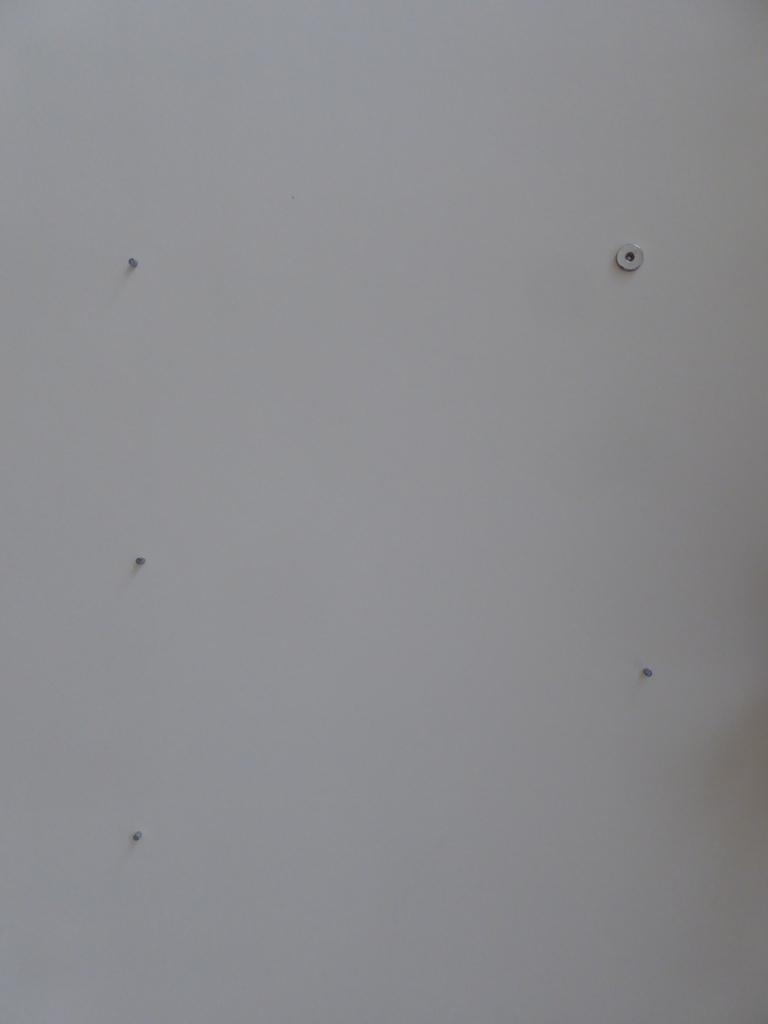
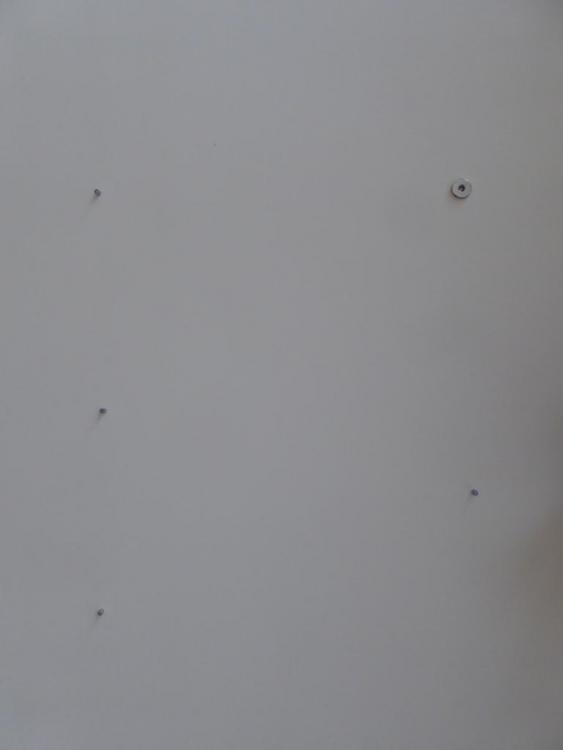
Just stuck some magnets on a wall as an illustration. The big magnet has a hole in the centre, which is just the right size for a pencil (if you want to mark the wall). The smaller magnets are showing the heads of the screws found by the larger magnet. Took me maybe 30 seconds to do this, and most of that was spent finding the first stud (others are easier as you can guess roughly where they will be):
-
Hard to beat a nice strong magnet. I have a reasonably OK stud finder, but I don't wholly trust it, as it can struggle a bit at times. A really strong magnet will reliably find plasterboard screws, and once you have found one of those you can be pretty certain there's a stud or batten behind it. I then use lots of small (around 5mm diameter) magnets to mark the position of every screw head I find. The result is a map on the wall of where the studs/battens are, with no pencil marks anywhere.
-
Do you think your supplier would be able to make some custom windows louvres? I've been hunting around, trying to find someone that can make something similar to the louvres that @ragg987 had made up, in this thread:
-
It's worth reiterating why I chose to buy a 9 kWh model, as an "upgrade" for our previous 5 kWh model, as I think it's a key issue that needs to be addressed. The situation we had with the Sunamp PV was that it was the only size unit available when we fitted it. Sunamp didn't make a bigger unit at that time, although they were developing the Sunamp Stack, that did offer the ability to increase the heat storage capacity. As it happens, 5 kWh was a good match for our daily needs, and also meant that the unit would reliably charge whenever there was any excess PV generation, or if the overnight off-peak boost was used. I chose to increase our heat storage capacity not to provide us with more hot water, but to be able to better utilise self-generation, by being able to store more self-generated energy on sunny days, so that this could be used if the following day was cloudy. Being able to store ~ 48 hours worth of heat means that we could ride out cloudy days, and not use the grid to boost the charge. Maximising the benefit from our PV generation was the aim, and not just my aim, either, I know of at least one other Sunamp customer who has made much the same decision as I did, for the same reason. At no time was I advised that increasing the capacity of the unit would possibly create a problem, because under-use could lead to it failing to charge. I'm convinced that, at the time I bought our unit, Sunamp were not aware of the potential problem that variable, or under, utilisation could create. I had all the documentation before I made a decision to buy, and there is nothing in any of it to highlight the "50% problem".
-
Yes, that would probably cause the same problem that we've been seeing. The key thing here is that running out of hot water is seen as being a major problem. My wife was exceptionally unhappy when her shower ran cold because of this issue, and no amount of persuasion by me is going to convince her that spending all this money on this new box of tricks was a good move!
-
I'm pretty sure that Sunamp were completely unaware of the potential problem if trying to "under-run" a higher capacity unit at the time I bought ours. Everything about the relationship I've had with Sunamp tells me that they would have been upfront and open with me had they suspected there might be a problem. They know that I've been a bit of an ambassador for their technology, and that I firmly believe that there are really worthwhile benefits from switching over from hot water storage to phase change material heat storage, so they would not have wished to risk that by not letting me know if they thought that the 50% discharge threshold issue was likely to cause a problem. I'm convinced that our use-case, where we normally discharge the Sunamp to about 45% or so, with that increasing to around 65% or more on some days, just had not be considered when the controller code was signed off for production. I know they test everything very thoroughly, so can only guess that our use-case was one that slipped through the net and just wasn't picked up on as a potential problem.