Jeremy Harris
-
Posts
26430 -
Joined
-
Last visited
-
Days Won
360
Everything posted by Jeremy Harris
-

Are B&Q getting better?
Jeremy Harris replied to Ferdinand's topic in General Self Build & DIY Discussion
I find B&Q a bit like the Curate's Egg, good in parts. If you know what you're buying, then they can be very good (were even better when they were still giving a universal 10% discount on Wednesdays). I've been pleasantly surprised at how well a cheap, own brand (really a no-name Chinese make) mitre saw has held up. On the other hand, I've bought some over-priced crap from them in the past, notably some rubbish plumbing fittings. On balance, I tend to go to Wickes now, as they seems to generally be better value, and because of the one-way system around that bit of the A36 in Salisbury means that I pretty much have to pop into Wickes before passing B&Q anyway. -
I opted to fit deep metal back boxes everywhere, really because my experience of using plastic boxes hasn't been great, plus there's a bit more room in metal boxes (handy where you have light switches wired loop in switch where you need room for wagos). I accept @ProDave's point though, the well-made plastic boxes are probably pretty good now, my prejudice is based on retrofit work on places we've owned years ago.
-
It should be with me next week, I believe. I'll swap the controller over as soon as it arrives, and with luck should be able to tell within a few days if it reliably goes into charge acceptance mode after we've used the shower in the morning. The existing controller would fail to charge around 30% of the time, so I need to test it for a few days to be reasonably confident that it works OK all the time.
-
You can mount stuff in a single cabinet, as long as it has adequate provision for separating the audio/data/SELV/ELV stuff (control signals, audio, etc) from the LV stuff (mains switchgear etc). This isn't that hard, as there are cabinets available that allow this fairly easily. IIRC, @jack has a single large cabinet that's divided, with the Loxone audio/data/SELV/ELV cables separated from the LV cables by internal trunking.
-
I have to say they have been trying hard to understand and sort things lately; a new controller is on its way to me that has a fix for the charge threshold issue. Interesting that the advert mentions optimising controls (my highlight) as this tends to suggest that they recognise that the control system isn't well optimised at the moment, something that's borne out by my recent correspondence over the charging issue. If the glitch with the way that charging is controlled is resolved then I have to say that I think the product will be very good. Since I've been resetting the controller every day it's worked flawlessly, and has been utilising excess PV generation perfectly, just as a hot water tank would, but with much lower losses.
-
I've went out with my late father in law out on a couple of bat surveys he was doing, back in the days when these were done by licensed volunteers, for no charge other than their petrol money. I ended up building a bat detector (still have it) as I found watching bats, and trying to identify the species, pretty interesting. I think the major problem is that, like a lot of planning-related surveys, it's turned into big business, with some of the companies involved being out to get as much cash out of applicants as possible, just because they know they can demand anything they like to line their pockets. The first plot we looked at needed an archaeological survey, and the first one dug a couple of large trenches across the site and found the (expected) foundations and floors of an old water mill. When we tried to get the likely costs of the archaeological work during the build pinned down, we were told it could be anything from a few thousands pounds to a few tens of thousands of pounds, depending on what was found. In addition, we were advised that the on-site archaeologist would have the authority to stop any work for an unlimited period of time should he spot anything of interest. We didn't go ahead with the purchase, largely for reasons related to a large boundary error, but the cost uncertainty surrounding the archaeological work was another factor. The annoying thing was that the county archaeologist was relaxed about it, saying that, in his view, the old mill wasn't of great significance, and shouldn't need much work, but we were (or would have been) beholden to the consultants that had undertaken the initial survey, as the planners were listening to them more than the county chap.
-
What does this even mean?
Jeremy Harris replied to canalsiderenovation's topic in Planning Permission
A friend of mine encountered this complete absence of understanding of ecology-related stuff when he applied for planning consent to build on a large area of his garden that had once been a commercial orchard. All the old fruit trees had long since expired and been removed, and the area of land was just a large, well-mown, lawn, and had been for years. He had an ecology report done, because the planners required it, which said much as would be expected for a large area of lawn, there was nothing of special interest there. However, the planners still had a record of the land having been an orchard in the distant past, so demanded a bat survey and also a badger survey (both completely pointless when you actually go and look at the land in question). He ended up wasting thousands of pounds on surveys, which held up his build for well over a year, simply because of the ignorance of the local authority and the insane advice from their own ecologist, who never once visited the site, but relied on very old maps in order to form his opinion. -
Grand Designs at Graven Hill starts tonight on Channel 4
Jeremy Harris replied to ProDave's topic in Property TV Programmes
I agree, it was a breath of fresh air compared to the usual GD formula. Got to admire both of them for getting really great houses at the end of their struggles, especially the lady on her own, as I think she just hadn't appreciated how much of a challenge self-building can be before they started. -
Grand Designs at Graven Hill starts tonight on Channel 4
Jeremy Harris replied to ProDave's topic in Property TV Programmes
There should be straps over the rafters, IMHO, to tie them tightly to the ridge beam ,not that this would have stopped the structural failure. Looks like the SE cocked up to me. -
Grand Designs at Graven Hill starts tonight on Channel 4
Jeremy Harris replied to ProDave's topic in Property TV Programmes
Seems to reinforce the point that Durisol needs bracing, from the blow outs so far. -
Interesting debate. I'm with @Ed Davies on this, in that PV seems to be a worthwhile investment here. Our PV system generates around twice as much energy per year as we use, and I'm about to add a battery storage system to make us even less grid dependent (I don't much like using the grid as a battery, which is what we do at the moment, in effect). My car has been charged at home almost entirely from self-generation for the past three or four weeks, and I think I can probably run it solely from our self-generated energy until about October, when the PV output will drop. The house is usually self-sufficient on most days by around 09:00 at the moment; even in the dull weather this morning we were grid neutral, with the Sunamp charging at a low rate and all the house background load being provided by PV. That continued, despite the cloud and rain, until about 17:00, when we started to import again. With the battery system installed the house should be grid-independent (in effect) from around the end of March until October each year, and then be running mainly on off-peak electricity through the winter. With the decrease in the cost of PV, which is directly related to it having been subsidised to kick start interest, it's now perfectly possible to install a PV system that will generate for around 20 years or more and recover its capital investment within about 6 to 8 years. I'd be the first to say that the government mismanaged the whole FITs fiasco, yet despite that it seems that we have achieved a significant level of uptake. Even in the dull weather today PV has supplied well over 25 GWh to the grid.
-
Did the fixings for the battens only screw to the Panelvent? I made sure that all our battens were carefully lined up so that they were ring shank nailed through the Panelvent into the underlying studs in the frame. This was made easier as MBC had marked the centreline of the studs with a white chalk line on the breather membrane. IIRC, we used 75mm ring shanks to nail the 50 x 25 battens in place, so allowing 12mm for the Panelvent there should be around 38mm of each nail that went into the underlying stud.
- 33 replies
-
- 2
-

-
- render
- renderboard
- (and 5 more)
-
The really big advantage, other than enhanced security, is that external blinds or shutters are really effective at reducing solar gain, whereas internal blinds are nowhere near as good, as the inner panes of glass heat up and work like big radiators.
-
I'd use the same build method for sure (also MBC, twin stud with blown cellulose), as the combination of good airtightness and insulation, plus the unforeseen benefit of really good acoustic insulation, makes for a really comfortable home. I'd not use the same window supplier, but would still go for aluclad 3G, but would spend a bit more on one of the better makes and fit solar reflective glass to reduce the solar gain in spring and autumn. I'd also fit external blinds to all the windows that get any sun, as that's probably the other major regret I have. I'd have argued more forcefully to be allowed to have a different external finish, as although we like the larch cladding it has been a bit problematic with noises as it heats up and cools down and with fasteners breaking/pulling out. It also seems to have attracted cluster flies, which are a bit of a nuisance in spring and autumn. I'd not opt to fit the relatively expensive Genvex MVHR, even though it's pretty good, as it's not as effective in cooling mode as I'd like. I think that a cheaper and simpler duct cooler plumbed to the ASHP would do as good a job, or perhaps better, and would be a bit quieter (the Genvex does make a gentle hum when its internal heat pump is running). Like @jack, I'd get a lighting designer involved with the lighting in the living room, kitchen and dining room, as my efforts are functional but not very inspiring. I wouldn't change the heating system at all, and we're absolutely fine with no heating in the bedrooms (it's just not needed at all, even in the coldest weather), but I would add low power electric underfloor heating in the bathrooms, just to take the chill off the stone flooring. Finally, I think I'd have just bitten the bullet and spent the big wedge of cash to get mains water and drainage in. The borehole is fine, but there is a bit of maintenance involved in keeping both it and the treatment plant working, and I think that, on balance, being connected to mains services is probably a better long term solution, especially as I get older.
-
Makita to Aldi/Lidl/Einhell Battey Adapter
Jeremy Harris replied to Onoff's topic in Tools & Equipment
I assumed that the badly drawn cells on the left were the battery pack. The pack is 2P, 5S, so has a two pairs of cells in parallel for each cell group, and five cell groups at a nominal 3.7 VDC in series, making 18.5 VDC. When fully charged the cell groups will be around 4.2 VDC, so the pack voltage will be around 21 VDC. The circuit shown looks odd, in as much as it's using an op amp that's over 50 years old now. I can remember building a voltage-controlled synthesiser in the early 1970's using 741s, and they were an old chip even then. I've no idea what the AC source V1 is, maybe it's related to whatever specific application this was designed for. -
Makita to Aldi/Lidl/Einhell Battey Adapter
Jeremy Harris replied to Onoff's topic in Tools & Equipment
One snag with that circuit is that the quiescent current of the 7812 and associated circuitry is high enough (~8 to 10mA) to discharge the pack when it's stored for any length of time, so you really need a way to disconnect the circuit from the battery pack. The existing monitoring circuit inside the pack only has a very small quiescent current (of the order of a few µA), yet that's enough to cause problems when packs are stored for any length of time without being charged first. -
Makita to Aldi/Lidl/Einhell Battey Adapter
Jeremy Harris replied to Onoff's topic in Tools & Equipment
Makita packs have a flawed (IMHO) protection scheme, which sets a parameter inside the pack that scraps the pack (makes it unable to be charged) when the cells get out of balance. The flaw is that the first cell pair inside the pack powers the battery management system inside the pack, so if a pack is discharged to the point where the first cell pair gets too low, the pack will flag a charge error. The BMS will tolerate two attempts to charge (using the Makita charger) and on the third attempt the pack will be a write off (but can be resurrected with a new circuit board). The key thing is that if you ever get a charging error with a Makita pack, then never try it in the charger again, but charge it at a low current using a power supply connected to the terminals on the pack. Once the pack is partially charged in this way it should charge OK on the Makita charger. If in doubt, then it's best to open the pack and measure the cell group voltages. If necessary, cell pair one can be charged on their own to bring them up to the same state of charge as the others, when all should be well (as long as there's no cell damage). -
Thanks, I'd not heard of these. The nails we used were galvanised ring shanks from NailFast, not the Paslode ones. One of the guys had a Paslode gun, the other had an Hitachi, but I can't see any difference in the way the nails are performing between the two (in general the Paslode nails are towards the right hand side of the boards and the Hitachi ones towards the left). One mistake I made a couple of years ago, was to replace some of the pulled out nails with screws that were both too hard and not that well protected against corrosion (the cheaper Screwfix silver "outdoor" ones). Several of these screws have broken under tension, again from board movement, and have been replaced with thicker shank screws.
-
I've had an air nailer for years; bought it second hand very cheaply and it's never once faltered. Just needs a bit of oil now and again. Gas nailers seem to be mainly a European thing, as when I was in the US every framer seemed to use an air nailer. The guys who nailed our cladding in place had a problem with cold gas cartridges, and one of them kept a spare cartridge tucked inside his pants to keep it warm....
-
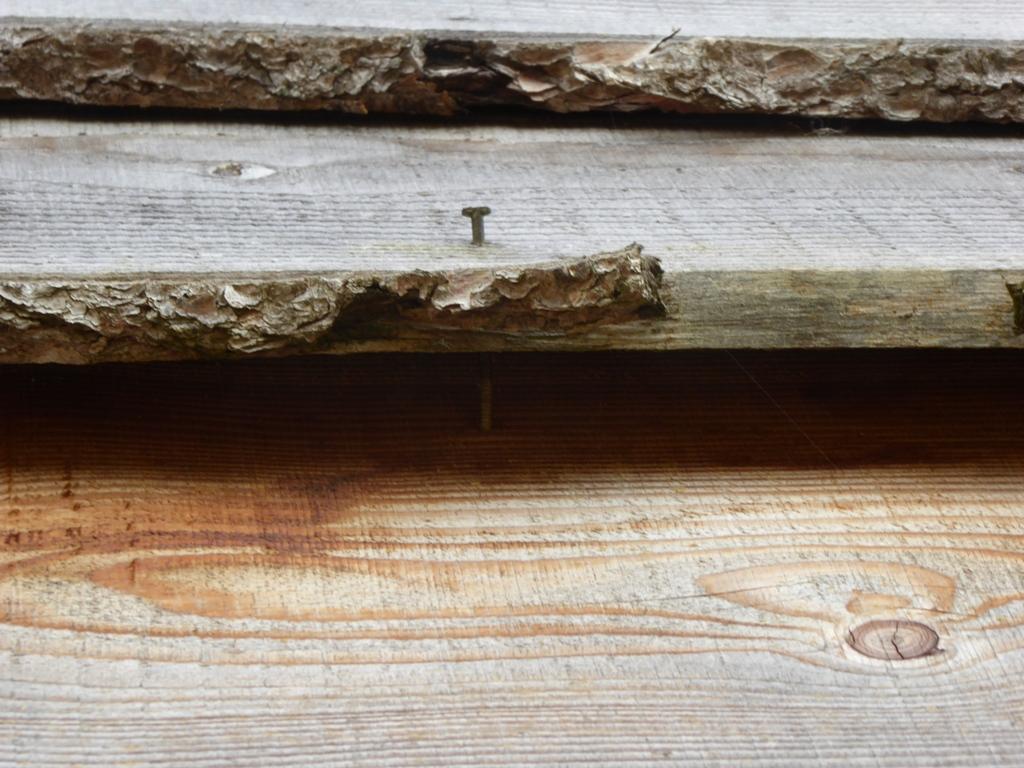
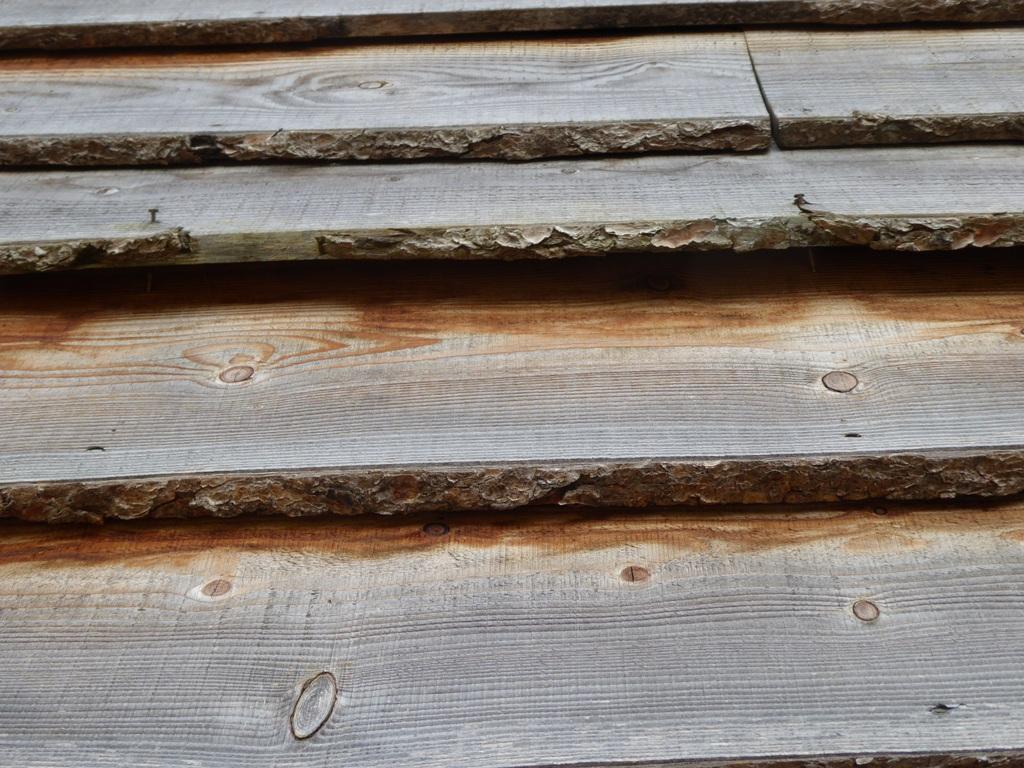
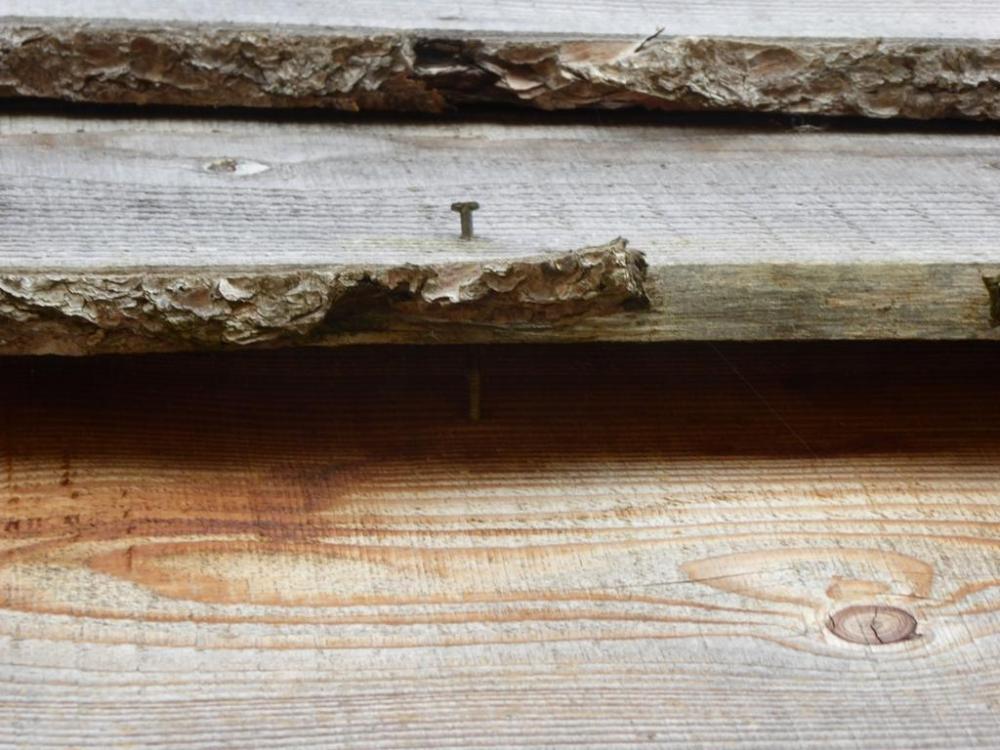
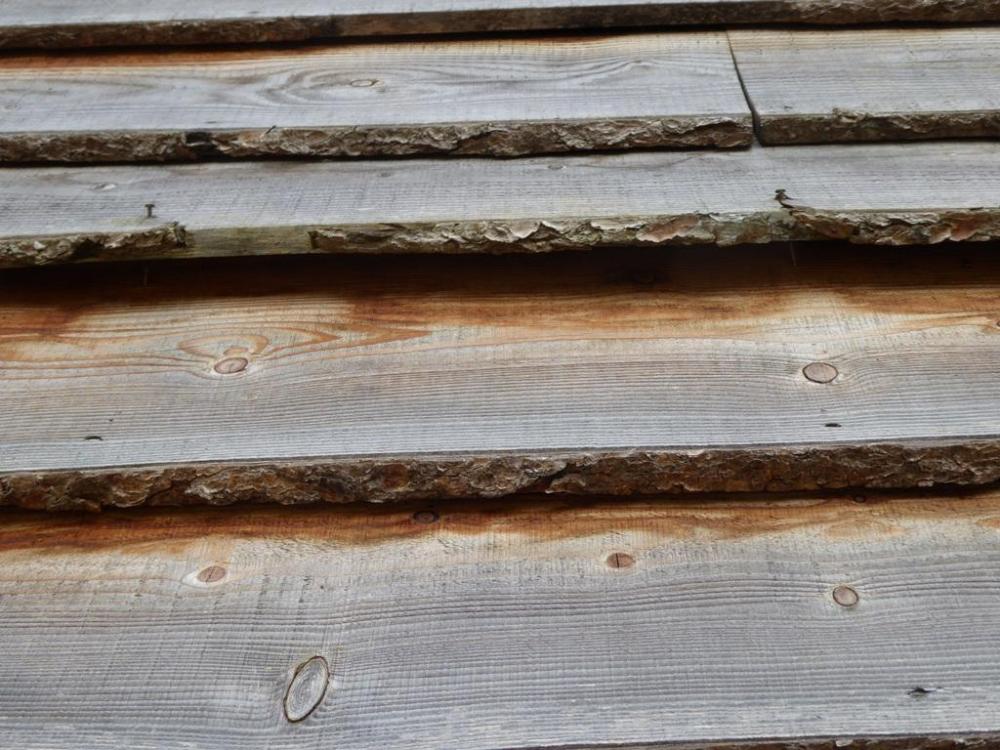
I've been regularly going around our cladding replacing ring shank nails that have been pulling out, just from movement of the wood, with screws. Here's two more that have worked their way out and need replacing:
-
I wondered why we had a drone flying around over our place earlier this week. Not that stealthy, though, as it made a hell of a lot of noise. On the topic of nicking stuff, we had a short presentation last night about the favourite method of stealing heating oil around here. Apparently the local thieves are using a pipe attached to a bit of scaffold pole that they heat up and use to melt a hole in locked plastic oil tanks to drain them.
-
Removal of Openreach equipment
Jeremy Harris replied to vivienz's topic in General Self Build & DIY Discussion
The problem I found was that the 'phone suppliers wouldn't engage with me until we had an address for the new line installation, and I wanted to put the ducting in whilst we were doing the ground works, so it ran under the slab and up into the house. None of the 'phone suppliers could deal with this, and referred me back to OpenReach, who gave me a stiff ignoring for months, as they viewed me as an end user. -
Support for self builders: Geberit's videos
Jeremy Harris replied to ToughButterCup's topic in General Construction Issues
I've probably fitted around a dozen toilets and cisterns over the years. None have been Gerberit. The five I've installed in the last ten years have all been built in to fitted cabinets, for the reasons @Big Jimbo gives; I prefer easy access to all the parts that may possibly need replacement. -
Removal of Openreach equipment
Jeremy Harris replied to vivienz's topic in General Self Build & DIY Discussion
I had a hell of a lot of trouble in trying to contact OpenReach. They aren't set up to talk to end users at all, so they have no easy to access means of communicating with the right people (really great for a communications company). In the end I found the email address for the nearest new connections team to us, and after months of being ignored I was eventually given the phone number for a local engineer. The local chap was great, he organised the free issue of duct, boxes, underground cable etc and we just installed it as per the usual rules for depth and separation from other services (telecoms cable ducts have to be separated from power cable ducts or cables). Your challenge will be finding the right person at OpenReach. Don't be surprised if you get ignored a fair bit, as OpenReach have a policy of ignoring end users, and they don't seem to deal with enough self-builders to be able to cope with the fact that an end user can also be a builder. Of all the utilities I dealt with, OpenReach were far and away the most difficult, and that's saying something, as the others aren't exactly easy to deal with. -
Makita to Aldi/Lidl/Einhell Battey Adapter
Jeremy Harris replied to Onoff's topic in Tools & Equipment
When I was racing a boat powered by a Makita lithium powered drill the battery packs got too hot to touch after a run. The Makita rep was at the event (I won a set of Makita tools) and confirmed there was no discharge protection, something that surprised me at the time. I can confirm that packs that I severely overheated (as in you needed gloves to get them off the drill) are still working fine now, some 6 years later.