jamieled
-
Posts
639 -
Joined
-
Last visited
-
Days Won
1
Everything posted by jamieled
-
You can get a budget quote from SSE to get a rough idea of cost first before getting a detailed quote if you need it: New electricity supplies - SSEN
-
Bit tough though.
-
Useful to know, ta. The buzzard was well cooked.
-
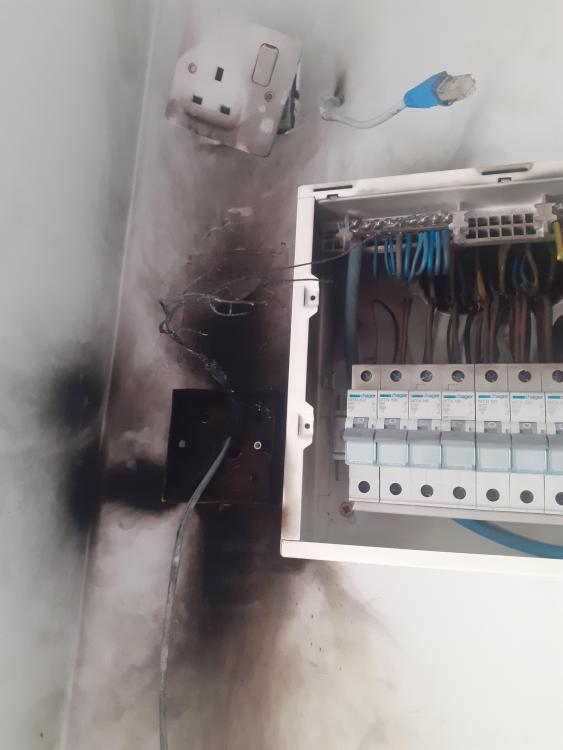
Don't have the before photie unfortunately. It was a bt socket that went bang. You can see the remains of it with the wire sticking out. A router was plugged in above. It was also beyond repair. The CU was remarkably intact inside - everything checked post bang. It did melt and warp adjacent to the bt socket so we had it replaced. This was not from a standard power cut/storm though. Buzzard flew into the transformer that serves the house from the overhead line. It was mostly stuff attached to bt sockets that got fried, according to the guy the DNO sent out he's seen a few similar instances.
-
It is something I would definitely consider, especially after this... (though I don't know for sure surge protection would have worked). Knackd a few electrical items but luckily anything expensive wasn't plugged in.
-
Yes, but think of it less like permission and more like registration. You do it after install. The paperwork is a doddle. The DNO need to know where there is generation on the network for safety, maintenance and ops reasons.
-
I guess it depends on the size of your system, but for me in the order of 10-20s!
-
Had the same problem for our test. Are you testing everything inside the house or just between manholes (couldn't figure out from your description). Do you have an mvhr system with condensate drain? Presumably no external high level vent pipe? Get someone in the bathrooms/near sinks while you try to raise the pressure and see if it's bubbling up through a trap. The shower trap and drain is often the problem as it is often the shallowest trap. I had to seal down our shower drain and even then the pressure would only get to about 40mm before it bubbled up through the trap. Fine for BC sign off though .
-
And insurance!
-
If by building warranty you mean building warrant then you don't need block on the outside. If you mean structural warranty then again, you can get one with exterior timber cladding on the timber frame.
-
Env regulators prefer there to be some dilution for direct discharge to surface water.
-
We have a 210l oso UVC with two immersions, so direct electric. Not on any funky tariffs. The PV diverts excess to it. So winter time we spend a bit on hot water. At the moment the cylinder is at temperature from pv diversion just after midday and we're then exporting electricity to the grid. So I'm still to figure out how we reduce that as we're already trying to manage cooking and washing machine use to coincide with pv generation.
-
Are you using the right 'matrix? There is a simple version for small developments.
-
As predicted, progress has been a bit slow. We've been working away on internal joinery/finishing and a bit of outdoor landscaping when the weather allows (in-between baby-management and working). We got our building warrant completion cert. and VAT reclaim back about a month ago which has also helped. Costs For reference, our finalised costs were just shy of £1300/sqm including all professional fees/admin, site setup, construction and fitting out costs. I think this is a fair reflection of the amount of work put in by us vs labour bought in. We had some fairly labour intensive jobs, such as trenching the water pipe ~300m through the woodland that, while they took us quite a while, we would have paid a lot of money (and likely had a lot more destruction) if we'd paid someone else to do it. We did spend quite a bit on labour for the groundworks/founds, framing, plasterboarding, electrics and plumbing, insulation and some finishing joinery. The bulk of the spend was prior to the significant materials price rises. Knocking all the labour costs out and it becomes possible to see where you get closer to £1000/sqm. It's been tricky enough juggling work, looking after small children and trying to finish building and so while reducing the costs might be feasible I hate to think what situation we might be in now if we had tried to do everything ourselves (add in the materials price rises recently and I'm also more relaxed about not drawing it out). The house We've now spent a good chunk of our first winter in the house. Our main heating is a woodburner, with a few direct electric radiators as a backup. We light the stove for a few hours in the evening most days when it's cold (say 0 and below) and every other day for an hour or so if it's milder (~5 degrees ish outside). We've used a small wood store's worth of timber. Despite a relatively poor airtightness test result compared to some others on here the house seems to hold heat well and is fairly comfortable. Finishing off We're now mostly in the realms of landscaping. We're not a massive fan of patio slabs, but wanted somewhere to sit outside. In the end we got hold of a load of broken bits of caithness sandstone, bought by the pallet from stonesource in Inverness. Quite heavy and time-consuming to work with but very solid and the variation in the stone gives a nice finish.
-
Smell coming from external sewage pipe occasionally
jamieled replied to mfmcdonagh's topic in Waste & Sewerage
The smell is likely hydrogen sulphide, produced from the breakdown of matter in sewer pipes. The pipes you show have seals in the fittings. Two initial observations: 1) I can't be 100% sure from the photos, but those pipes look like they are rated for underground use only, typically supported by bedding material. 2) In an arrangement like that, with an unsupported length of pipe, it's possible that the seal is either damaged through movement or the pipe is not sitting in the fitting cleanly leading to escaping air. This is possibly more likely to be noticed when you flush a loo as it will push air out through any gaps in the pipework. Two things you could consider. First is to try and air test the pipe work, this will let you know if there is a leak. It will depend on how easy access is up/downstream of the pipework. Secondly, you could replace the pipework with appropriately rated and supported external pipework. -
Owner-Builder looking to build our family home!
jamieled replied to AccidentalSkydiver's topic in Introduce Yourself
To give you a rough idea, I paid £70 ex VAT per 12 m length of 47 x 300mm JJI in 2019. Buying direct from James Jones will be difficult. A single lorry load is probably too little for them to bother about. They have a list of distributors on their website, I ended up using Pasquill as they were local to us in Inverness. If you need any additional engineered timber it might work out cheaper going through a distributor as they can get you everything you need in one go minimising delivery costs and might be more likely to give you decent prices with the volume. Buying smaller lengths or getting the whole thing pre-cut would be advantageous. Although we had a relatively spacious site, moving 12m lengths with a forkilft wasn't straightforward. Having said that, it would only work well if the frame was properly designed - our wasn't and while I got the roof JJI's pre-cut we ended up with a lot of wastage due to the incorrect positioning of a velux on a drawing. -
Paying tips to delivery drivers
jamieled replied to Omnibuswoman's topic in General Self Build & DIY Discussion
As we're in the arse end of nowhere I did make the odd cup of tea for the drivers who came a long distance. No tips though. -
I installed my own ground mounted PV system under G98 (16A limit). I used an electrician to wire up the panel strings to the inverter, the isolators and the AC cabling into the house isolator/CU/meter. They weren't MCS registered and I don't think they'd done a lot of PV work but didn't seem to think it overly complicated. The G98 form I had to fill in for the DNO (SSEN) asked for installer details. I just put down my name/address and added a comment that the electrical work was undertaken by a a qualified electrician (didn't specify who). They didn't query anything.
-
A wayleave question: Underground HV power cable
jamieled replied to ProDave's topic in Party Wall & Property Legal Issues
There are standard payments set but I don't know where to find them. We have a number of poles carrying a 33kv oh power line and we get a set amount per pole per year. It's basically chicken feed and given the choice I would undoubtedly try to avoid having any kit on land I owned. I doubt the DNO wants loads of bespoke agreements with different people. That said there may be leeway if you effectively own a ransom type strip. It's a complicated subject area and I can't claim to be highly knowledgeable about it. One thing I would mention is that when we were negotiating the wayleave with SSEN (it was an existing line with no wayleave when we bought the land) they were obliged to cover our costs for obtaining professional advice so we didn't get shafted. We were free to choose who we wanted to do this. If you do end up in discussion it would be worth considering this. -
A wayleave question: Underground HV power cable
jamieled replied to ProDave's topic in Party Wall & Property Legal Issues
Is this cable part of the wind farm development or does it relate to the DNO's connection to it (i.e. SSEN?). If it's the windfarm I don't think the developers have any statutory powers so they will aim to use money to persuade a landowner as they can't do much else. If it's SSEN, then they will try negotiation first, but can (theoretically) apply for a necessary wayleave or easement as they have statutory powers to do so. That is not their preferred approach though. -
@Rishard I would say we have a fairly simple form - rectangular box with a couple of lean-to's. There might be more on my blog here but if not happy to send photies. Used an insulated raft from AFT for the founds, then glulam for the sole plate. We bought the glulam and I joists as long lengths and cut them on site but you can also get them pre-cut (did this with the roof but it didn't work out quite as well as hoped).
-
I have!
-
You can only reclaim for materials incorporated into the build. They're right to charge it and you can't reclaim it.
-
rip-off delivery charge to Highlands.
jamieled replied to saveasteading's topic in Building Materials
I've managed without amazon for 5+ years here now, I've no intention of supporting the baldy man's space fantasy. For some suppliers/couriers it can work to get stuff delivered to an Inverness city address and then pick it up yourself when you're in town. It can often be faster as well compared to getting it delivered to the house. -
Traditional Timber Frame + Passivhaus
jamieled replied to Kingy's topic in Energy Efficient & Sustainable Design Concepts
I had a chat with this company who seemed to understand some of the issues, we went with a more contemporary framing approach in the end. Carpenter Oak Framed Buildings and Oak Framed Houses Having said that, a quick scan of their website suggests they wrap some frames in SIPS which may not be what you're looking for.