


jamieled
-
Posts
639 -
Joined
-
Last visited
-
Days Won
1
Everything posted by jamieled
-
I used HIS for most of my stuff and got reasonable prices (I think!). The big names such as TP, Jewsons, buildbase were a lot more expensive for most stuff though I did get my roofing from Jewsons as they were one of the few suppliers of the kind I was using. I tried timber outfits like Thornbridge, but they were more expensive than HIS so didn't bother with them much apart from when I was in a pickle and needed the odd length or two. Used woodstock for finishing timber. SIG for some insulation and plasterboard. JDP for drainage stuff. Stone source for some landscaping stone. For me one of the biggies was whether they would deliver, in what time frame and the cost. We are a bit out of Inverness and sometimes any apparent savings on materials were swallowed by delivery charges. I'm just getting my last lot of materials to finish and it's cheaper for me to get a haulage firm to pickup at 3 different suppliers than pay three sets of delivery charges.
-
Workshop: Advice wanted, and very much needed!
jamieled replied to Omnibuswoman's topic in Garages & Workshops
Have you looked at the online timber roof span calculators? They obviously come with a bit of a caveat around the assumed loads but if you know your roof makeup you should be able to adjust if necessary and it might give you the confidence in your roof strength/assumed timber size. Something like: https://www.timberbeamcalculator.co.uk/span-table/flat-roof-joists?load=1&class=C16 -
I'm pretty sure building regs require a hardwired carbon monoxide alarm within a certain distance of a solid fuel appliance (In scotland anyway). Ours has never gone off and we only have a direct air stove.
-
We've got one with just a direct air supply to the stove. Also have mvhr. Mvhr commissioned to ensure a bit of positive pressurisation (essentially supply fan speed higher than extract). No obvious smoke leakage when the stove door opens. Thinking about this a bit more, I was wondering to what extent this is a problem just for mvhr, or if it's just related to ventilation generally? As others have said, no house is 100% airtight, the mvhr replaces ventilation from trickle vents and leaks. I've been in older houses with no mvhr and in certain weather conditions the leakage from the stove is really obvious when you open the door, presumably to do with internal/external pressure difference. It's not exclusive to mvhr so the idea the stove needs to be mvhr compatible is a bit questionable. A high rated stove such as dibt might be required for passivehaus certification, but only to meet airtightness criteria.
-
Highland pump centre in Inverness are also useful for treatment kit and advice.
-
There's been a considerable hiatus in both blogging and building. Looking back, my last post on November 22 last year was explaining how we were finding it tricky to make progress and that my wife was due to give birth to twins in early Jan this year. Little did we know that about 24 hours after writing that post, said twins arrived 7 weeks early necessitating a fairly urgent trip to Glasgow, first for my other half and shortly after for me to be present at the birth. For medical reasons I won't go into here, we have only arrived back home about two weeks ago, a 5 month spell in hospital essentially curtailing all building work (not that it was ever going to be the priority even if things went smoothly). So I expect progress to be fairly slow now, but we have a relatively short list of tasks to completion, including sorting the parking and turning area, finishing the outside drains and completing the access ramp and level threshold platform for the front door. There are a fair few number of other jobs which are needed to properly finish the place, but those will have to wait a while and aren't essential. We're currently pondering a plan around our VAT reclaim. I'm intending to apply for a temp habitation certificate, partly because it might take us a while to get to completion. However, it's easy enough to buy and store any materials I might need to finish my final jobs now, so I'm tempted to try and use that certificate for my VAT reclaim. For anyone following this blog, you may remember a rather large electricity connection quote from SSE (which we paid). 18 months after connection, a cheque arrived in the post for a substantial sum, due to their final costs being a lot lower than quoted! Anyway, I took a quick few snaps this afternoon to liven up this post. I hope to try and get some better ones once we're more finished, and a future post will also consider our final costs.
-
I got most of my drainage stuff from jdp in inverness, including a couple of 600mm drain covers (one trafficable, one not).
-
We stick built using JJI's. There's not a huge difference to just using standard carcassing timber.
-
Dropping SSE cable into the ground
jamieled replied to Deacs's topic in General Self Build & DIY Discussion
I'd second the advice above re the duct. My experience was that they only sent a surveyor after the initial budget/indicative quote and I asked for a more detailed quote. You can't assume they will do what you want, they may have their own policies/procedures. If it's a wayleave then wouldn't you have a copy? SSE have form with regards to 'losing' wayleave agreements and as they aren't registered on the deeds (only an easement is I think) then you really need to find your own copy from either when you bought the place or when you agreed the wayleave -
Most decent joiners round here can fit windows. Having said that you're taking a slightly different approach to me as I'd use a joiner for all those tasks!
-
Is there any reason you're not asking the joiners to do it?
-
Yeah I reckon it might depend where you live. Stick building is definitely still commonplace up by us (north Scot). Pre fab timber frame companies are good at marketing whereas a stick framing joiner doesn't need to bother. Hence it tends to influence the perception of timber kits being the only way.
-
Thanks both
-
During the cold snap we ended up with the filter housings cracking (see below). Leaving aside the need to stop this happening again I need to plumb in the new filter housings. I'd previously plumbed everything in using compression fittings as I find it easier to work with. The housings have a 1" female thread. When I plumbed them before I only just got away without wrecking them. I used a brass 1" male compression connector into the plastic 1" female on the filter housings and I'm pretty sure it gubbed the thread but just managed to stay watertight. I now need to replace the whole housing (both black and blue bits). Is there a better way to do this which reduces the risk of wrecking the plastic thread on the filter housings or do I just need to be more careful?
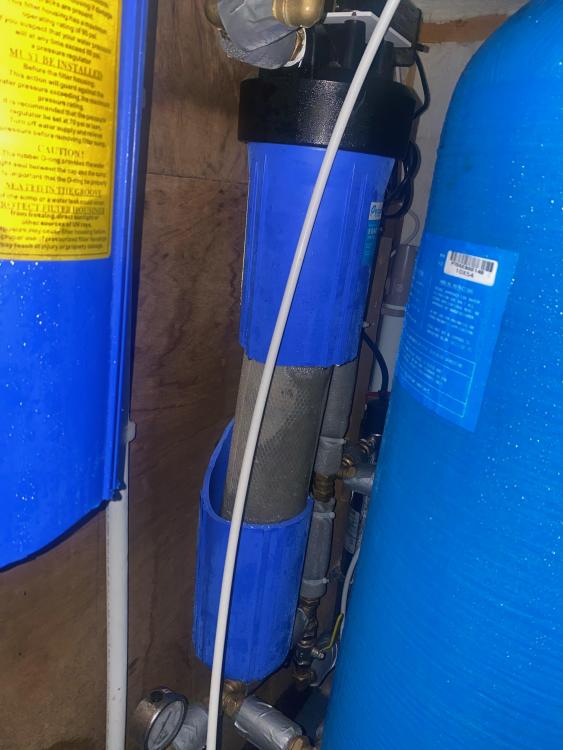
-
It would, though obviously how long it takes will be a bit dependent on how hard the ground is but I've dug bigger holes in a day. Presumably you have some idea from trial pits? The other thing to consider is the h+s aspect. If you're just employing two guys to dig a hole and you direct them you need to be mindful of the risk of one of them in there and the sides collapsing.
-
I can't claim to understand much about how the electricity market works. I wonder how the Hinkley C cfd strike price will influence this (if at all).
-
You can look at it in a couple of ways. There's a lot of unnecessary (but desirable stuff) in most builds that doesn't have any saving. SAP is a poor way of assessing savings. With PV you probably need to alter how you use a house a bit to maximise self use. SAP has no way of knowing how you actually use your house and therefore the numbers are a bit of a finger in the air. Finally it won't be worth it if the install is expensive. Buy the kit cheap, self install as much as you can and the it starts to look better financially. I suppose it also depends on where electricity prices are going.
-
@Jilly I think it's not quite right, I've tried to explain why below. 1) The principle is that your post-development drainage rate should not exceed the greenfield runoff rate for design events that are presumably agreed with the BCO. Unless I've misinterpreted your text above, you seem to have calculated the storage volume required using the greenfield runoff rate (i.e. you are trying to store all the greenfield runoff). There are two separate calcs you need - the greenfield and post development. You just need to store enough to that the post-development runoff rate does not exceed the greenfield. 2) QBAR is what's termed an index flood, usually with a nominal return period of about 2.3 years, not 100. There's usually a scaling factor applied to QBAR to get you to whatever return period you need such as 30,100. Note at this point you are only getting a peak flow rate. 3) You need to consider both the runoff rate and volume. QBAR (or the 100 year peak flow) is a peak flow rate, I don't think it's appropriate to apply it across a 6 hour window as that assumes that the peak flow is occurring constantly for 6 hours. In practice you'd expect something closer to a bell shaped graph of runoff, peaking somewhere in the middle. The pre and post development runoff rates are important because the difference between them tells you what volume of storage you need. 4) The 6 hour, 100 year event is referring to a rainfall event. It would be typical to simulate this, along with some losses to try and estimate a runoff curve. Do this for both pre and post development and you should be able to estimate the storage volume. I'd have thought the uksuds tool might do this and will take a look sometime.
-
I think that's just a matter of opinion though and highly dependent on what you are used to. Buildhub is not a good reflection of uk housing stock or in fact what is necessary or even comfortable as many people on here spend wads of cash on stuff they have a personal preference for but which you can comfortably live without. We're 3 beds at 136m2 and it's pretty roomy. I think 113m2 could give you a completely reasonable house if you're careful about thinking through the use of space and storage. If you can't do the thinking then the lazy option is to spend more on a bigger house as you can get away with it. 113m2 is still bigger than most 3 bed houses (irrespective of when they were built, not just new builds). As Russ says, it depends what's important to you. For us that was not having a mortgage paying for stuff like home automation or unnecessary space.
-
It may differ depending on the LA, but here they are separate functions, so notifying one will not have any bearing on the other. I may be wrong in my recollection but I'm not sure I needed to notify BC i had started, only when it came to the first inspection stage (foundations).
-
We have a rationel sliding door and I've not noticed it slowing down. I've not noticed it being a problem though and it does need to be firmly closed for the handle locking mechanism to work (seems to pull the door into its seals which I like as a feature and haven't come across before).
-
You're right, normally most water utilities quote on a minimum tap pressure of 1 - 2 bar. @nod 25ml/s seems low and an unusual way to spec, it would be worth questioning this.
-
Who's asking? Needs a bit more info to figure it out. Pipe length, driving head etc all affect flow rate.
-
Timber supply issues due to brexit
jamieled replied to Pocster's topic in General Self Build & DIY Discussion
In the uk we decided a while back that monoculture sitka was how we prefer our forestry to the extent that the silvicultural skills for growing decent oak are in short supply. Safe to say that given the time it takes to grow decent oak it will be a while before the situation resolves itself. -
Ah yes, sorry. Not sure about Scottish water as I'm on a private supply but others can probably help. I think the sepa registration is about £160.


