

Nickfromwales
-
Posts
31376 -
Joined
-
Last visited
-
Days Won
345
Everything posted by Nickfromwales
-

Recommendation of a plumber in Antrim/Ballymena area?
Nickfromwales replied to JamieM's topic in Ireland
An excerpt from the ERP guidelines update. Quote .... " The modulation of oil-fired boilers The major stumbling block is on the modulation of an oil-fired boiler. Generally speaking, certainly in the UK, a domestic oil-fired boiler typically has a fixed burner, a non-modulated burner. It simply cycles on and off when it reaches its required temperature. However in the current proposals, manufacturers would incur a penalty of 7% on the overall efficiency of the boiler. We consider this notion to be very unfair as we don't see any great difference in efficiency between an on/ off burner and a modulating burner. As a result we believe, a penalty which takes 7% off the efficiency of, for example, one of our oil-fired boiler will make it difficult, if not impossible, for oil-fired boiler to continue in the UK without changing to a modulating burner. A modulating burner would cost almost double the price of the present burner used in oil burners and also require an increase in controls complexity. All of which are relatively untried and tested so as a result we think it could signal the end of oil-fired boiler. In what is generally a price-sensitive market, the price of an oil-fired boiler would increase significantly, thereby reducing accessibility and meaning homeowners would probably be forced to look for other means of heating their homes." Delete his phone number. He clearly doesn't understand the problem. ( * ) There's no way you'll be able to run the Ufh direct via motorised valves and an UVC unless he proposed fitting a large, as in 300ltr, buffer tank. It's not about efficiency, it's about being matched to the heat load properly. Condensing is nothing to do with modulation, and it's modulation you'd need to lower the heat output to run the Ufh efficiently. As the boiler is basically on or off ( 100% of the heat capability or 0% of it ) then you need to use a TS or buffer to capture and hold the pulsed-in high grade heat so the Ufh can just gently draw what it needs and in the quantity it's needed. The use of a TS also means you can set the boiler flow temp and the TS stat accordingly to dictate ( near as damnit ) the return temp. That means you can optimise the efficiency of the boiler by staying in the ideal flow - return temp range to promote full condensing operation. ( * ) In the boiler manufacturers installation instructions ( MI's ) it'll actually say that you need to 'design out' any scenario which would result in the boiler 'short-cycling', one which the UVC and direct fed Ufh would instantly create . A poorly designed system could see you with no warranty as short cycling an oil boiler will seriously affect it's longevity, plus it'll be using a lot more oil. -
Dot and Dab vs adhesive for insulated plasterboard
Nickfromwales replied to AliG's topic in General Construction Issues
+ 1. Thought I'd replied to this, sorry. I drill holes the same size as the foam nozzle, 8-10" apart, and pump in the foam that way. I get some bits of gaffa tape to cover the holes immediately after withdrawing the foam gun to stop the foam from spewing back out and messing the board up. After 20 mins or so, I remove the tape and clean off any foam that's proud, then just scrim prior to plastering ( or leave if your putting coving up afterwards ). -
Timber frame company fined for fire and traffic offences
Nickfromwales replied to ProDave's topic in Housing Politics
That's a shiver down the spine for any self builder. Brings a certain validity to this thread, that's for sure. When I worked on the ships, one hard and fast rule was no hot works whatsoever for the last 60 mins prior to site being unmanned. Smouldering fires ( or fires caused by smouldering ) were the no.1 problem as most hot works caused heat instead of fire. This thread has a lot of value IMHO, and should make all self builders sit up and pay very close attention to the content, and subsequences of not observing them . -
@MikeSharp01 Any chance of that pic so we can round this off ? Curiosity is getting the better of me too cheers.
-
Flexible plaster or another solution?
Nickfromwales replied to Trw144's topic in Plastering & Rendering
Wouldn't buying that house have been so much easier ? -
Creaking and Crackling Floor/Ceiling noises
Nickfromwales replied to daiking's topic in General Construction Issues
What centres are the joists at? -
Frost stat on the oil boiler. Some kick in at 7oC and others at ~10oC. Is it an external boiler?
-
So if you blow into that does air come out of all the tappings? Stick your hand over the cold tapping and blow into the hot. If there's back pressure you know there is a coil. i genuinely don't know why they'd define those two tappings other than if they are a coil in / out. ?
-
Hot and cold in/ out ? I'm a bit stuck with that, is that a coil? Otherwise how is it defined? Each tapping should be installer definable.
-
Flexible plaster or another solution?
Nickfromwales replied to Trw144's topic in Plastering & Rendering
+ -
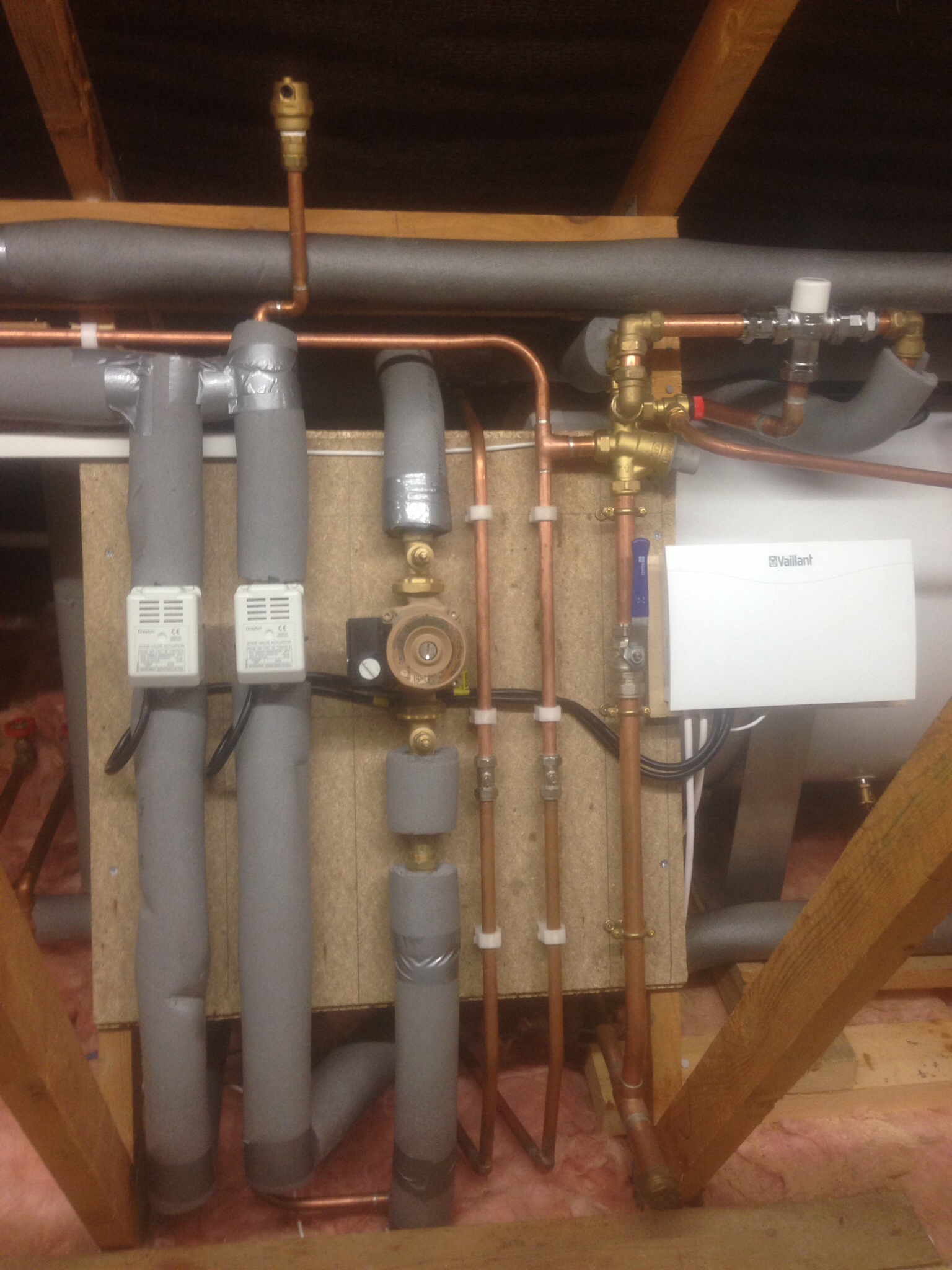
If you have a cold mains fed filling loop, then it has the potential to be left open by mistake / misadventure and then it is subject to that max static pressure. As I have never fitted an ashp, I don't know if these are dumb units which rely on a pressurisation kit to be retro fitted elsewhere accordingly, ( fill loop, pressure gauge, PRV and EV ). If the ashp is a dumb unit then you'll need to fit these additional components just to cover the known criteria ( water expands when it's gets heated / ev's fail and then cylinders pop if there's no PRV and so on ). Even without the G3 requirement ( which is iirc any volume of stored + pressurised ( sealed / unvented ) heated water of 15litres or more ) you'd need these components to comply with the basic physics and safety side. As per my last, I firmly believe your going to need G3 as your at or above 15 litres The filling loop left open / partially closed issue can be easily removed as your not supposed to leave the loop connected after filling up. The flexi hose on the filling loop has 'wing nut' like nuts at each end and rubber seals so it can be fitted and removed by hand ( tool free ) so it's not supposed to be there anyway. Discipline is your friend there. A failed immersion stat is the only thing here that's going to cause this cylinder to overheat and breach the working value of expansion of the EV so, as most have an operational stat + a manually resettable overheat stat that is a rare occurrence. Regardless of how slim the chance of both of those failing is, you must still, under G3, allow for that eventuality. That's why the regs exist. Example of the kits ( ready to go off the shelf ) Before I advise on the connections, does the cylinder have any coils or is it all one unified body of water. ?
-
@TerryE 's idea ( if I've got the right end of the stick ) is to store heat in the slab, with heat pulsed in from low tariff events from each 24 hr period of E10. That'll be achievable with a decent inline tubular heater, timed accordingly and governed by thermostatic control. So, heating sorted. Tiny outlay, and simpler than falling down when your pissed . For dhw, it seems the sunamp would suit you best. Maybe spend a few quid on the bigger unit ( 10kw? ) and then, again, you can pulse E10 in accordingly. Use the DIY Pv array to offset your vampire / parasitic loads in the daytime. After you break even on the outlay for the Pv you can then use the additional saved £££'s to start repaying for the sunamp. The most complicated part of that setup will be the button on your shower
-
Just buy a nice shower !!! You may get people from the caravan park sneaking in Sorry !
-
Isnt that a bit 'miserly' ? ( apologies for my subtlety ). After all the effort of making a low energy, comfortable home that's cheap to run, I'd like to decide how long I 'get' to shower. Sometimes I'll just let red hot water run over my shoulders for 10 mins or so after scrubbing the day away, and if the water ran out during that I'd flip. Can 20p worth of hot water really break a budget? If it came from excess Pv then......?
-
The cost of the heating system will be the least of your worries
-
Push button showers? Thermostatic mixers or electric ? Next thing, with E10, iirc, your not restricted to nighttime heating only as there are multiple low rate events per 24hrs
-
Flexible plaster or another solution?
Nickfromwales replied to Trw144's topic in Plastering & Rendering
What exactly is this? Balustrade or balcony / other. -
Flexible plaster or another solution?
Nickfromwales replied to Trw144's topic in Plastering & Rendering
You'll see the edges through the glass. Can it be viewed from the left of your drawing? Id use a chrome / stainless U channel to take the return against the glass. -
Flexible plaster or another solution?
Nickfromwales replied to Trw144's topic in Plastering & Rendering
And if the shit hits the fan use this stuff. -
Flexible plaster or another solution?
Nickfromwales replied to Trw144's topic in Plastering & Rendering
Can't you create a metal upstand in front of the glass and bond the PB to that so its isolated from movement. Allow 3-4mm gap and job done. . -
It's not that you didn't have enough, you just can't undo it even a 1/4 turn without having to re-ptfe and start again . Dont go nuts with the ptfe vs the last lot or you'll end up not getting any to go in.
-
Any lube will do tbh. As above, silicone grease does a top job too and I'll use that myself if I've run out of / can't find my Rocol. .
-
Dot and Dab vs adhesive for insulated plasterboard
Nickfromwales replied to AliG's topic in General Construction Issues
On my retrofits ( another 3 in the bag this week ) I always dab as normal but then go around the foot and head with high expansion foam, and loads of it. The head so convection heat travel is arrested, and the foot to help with the previous but to also beef the boards up a bit for skirting / knock-ability. -
Adjust the PRedV with the water flowing. . Turn a tap on very slowly ( flowing slowly ) and then the pressure will stay up and you'll be able to adjust in real time. Turn the tap off after each adjustment to then get the set static pressure. Adjust accordingly, repeating as necessary. Pressure on the street will rise and fall with neighbourhood occupancy so you'll see less morning and late afternoon / evening than say 10:30 or 22:30.
-
I feel like i don't know you anymore ?
