

Nickfromwales
-
Posts
31384 -
Joined
-
Last visited
-
Days Won
346
Everything posted by Nickfromwales
-
Ok, not good. It seems the boiler output temperature is governing the TS set temp. BAD. Its not anything to dial 999 for but basically if the boiler internal stat ever fails the TS will overheat until one of the safety measures cuts in. The cylinder stats tells the boiler to provide heat according to output / demand so it can replenish spent energy accordingly. Having the cock-stat ( he's a cock again now sorry ) dictating the TS temp is rough as it gets, and is just horrendous.
-
Corded then for sure. And only the fein if your minted. Id go DeWalt or Bosch but deffo Quick-change.
-
We'll worry about room stats and zoning once we can get some clarity on the key elements, like being able to run a bath lol.
-
Cool. Now, turn the highest cylinder stat ( 1 ) up to max. Does the boiler fire up?
-
Just try turning them slowly from minimum to maximum and then back to minimum. see if they click on the way back down or lowest setting. Quite important. Oops.
-
Ok, ill just add, if the ambient isn't low enough to allow the cylinder stats to have 'clicked' off, this won't work....its just popped into my head sorry. When you turned the cylinder stats down, did you hear a click as they switched off? My bad.
-
The boiler shouldn't fire if the 3 cylinder stats are turned down. If it does, we have a problem. Give it a whirl...
-
@PeterW ive nowt for the heatmiser....never fitted one.
-
Ok, good stuff. If you feel confident the boiler will only run when you turn the cock-clock back on then go for it in the order you feel best familiar with to achieve the 'test-fire'. 5 mins should suffice, just to be sure nothing else calls for heat and the system is definitely in standby. Then we go forward into the unknown.......
-
@JSHarris. Can you advise on any possible risks with bringing that 'softener' on line after so long please?
-
Everything off to start so we can find out if the cylinder stats ( 1,2 & 3 ) are doing what they're supposed to do. If the UFH will cool it down faster then knock the big boiler switch off and run the UFH until the TS gets to around 20oC. Then start the tests. ?
-
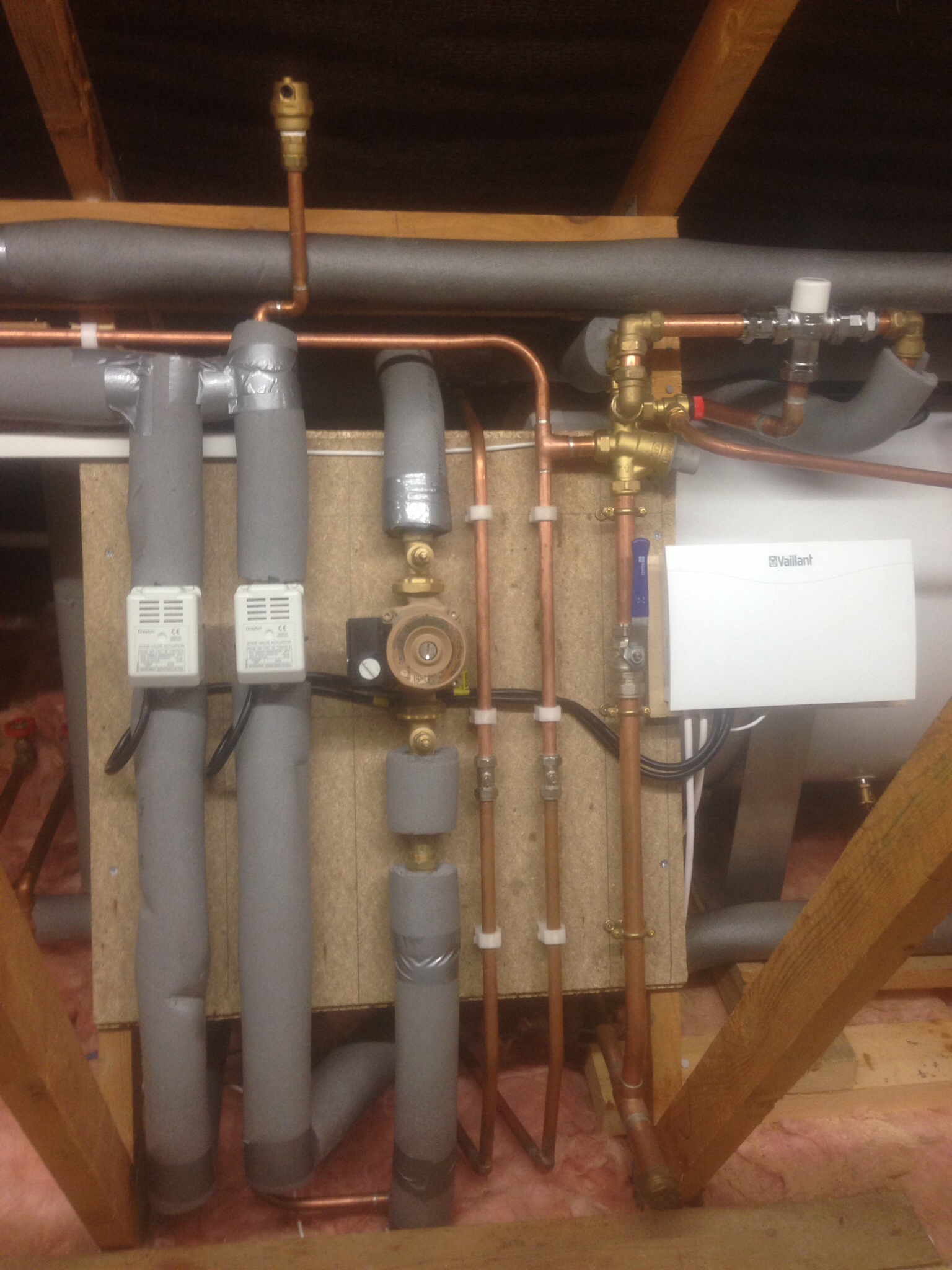
The green thing is the solar thermal circulator ( aka pump ) which pulls the hot water down from the panels and sends the cool water back up.
-
Are those two vertical lever taps ( left and right ) in line with the pipe now eh ? They're off in that pic. The bottom one ( centre ) should be still off as per that pic.
-
Black thing is a pump. Is there a serial / part number on the other bit you can read and post.
-

Paying on the spot : why I shouldn't.
Nickfromwales replied to ToughButterCup's topic in General Self Build & DIY Discussion
If there's a bug bear about getting them back, and they're diary is filling up, then book yourself in with them. The issue will be that your possibly not confident enough to adhere to the date yourself so then the buck is passed. You can't have your cake and eat it, and a lot of trades, espaecially my painter, need around 8-10 weeks notice or he just honestly and decently says "no, I can't do it sorry" which whilst being frustrating, is the right reply. Inadvertently cornering someone and making them feel obligated to tend to your needs is the worst thing I ever encounter, and I just say no now. Better to just do that than say you'll be there and not turn up, because then, if I do that, I'm the one getting the flack for it. Its quite erosive to have someone chase you when it suits them tbh, and I get it ALL the time. My favourites are the customers who ask for loads of extras to be done, and then complain that I havent stuck to my original completion date !?! ( or original price either !!!!!! ). Even after telling them up front that it'll cost £X more and add a few days / week to the original job they soon forget and it's back to he said she said. Winds me right up. I imagine it's as easy being a tradesmen as it is being a customer. Two sides to that coin for sure. -
Wall Mounted Basin - Tap Connection
Nickfromwales replied to Barney12's topic in Bathrooms, Ensuites & Wetrooms
The shower fixing kit is to 3/4" BSP anyway, so no good for a basin unless you bush them down to 1/2" Just use some of these 10mm x 1/2" adaptors and screw the flexes straight on. -
Log burner
Nickfromwales replied to jpinthehouse's topic in Mechanical Ventilation with Heat Recovery (MVHR)
Ok, sounds too small at 250l to me. What is the size of the house and number of occupants / bathrooms etc ? If your having an LPG boiler id make it a combi. If your not using space heating or the woodburner for a good 5 / 6 months of the year then why heat a big TS just to get some DHW? Horribly inefficient and quite crude imo. Use it for DHW preheat to the combi instead, if you haven't got 3 or more bathrooms. If your having solar PV then not so bad as it'll have some of the losses offset and provide a lot of the DHW too. Go sealed and pressurised, and lag all the pipework to death. Make sure all the heating circuits have 2-port motorised zone valves on them to stop convection heat flow when the heating isn't being used. -
I have the Makita 18v and its on its 3rd gearbox / head, but all changed FOC under Makitas no-quibble 3 year warranty. Id buy the Fein in a heartbeat, but its a bloody expensive machine if your not using it to make a living. Id say any of the Makita / Bosch / Dewalt 230volt corded offerings will serve you well. If I had to choose id probably go Dewalt or Bosch as my mates ones seem to have outlived my Makita.
-
For the testing, please make sure the boiler is on constant, not timed or set to the 3 x 2hour bursts etc so it can have a chance to work properly. The TS needs to be able to call on the boiler for heat and the boiler needs to be on and functioning to provide it on demand. Even a perfect working system won't perform adequately if its starved of heat ( which I think your system possibly has been with the 3 x 2 hr bursts etc ).
-
Its fine on frost setting as room stats like that dont typically switch on / off, just up or down. Read through and if your stuck on a particular point just post here and someone will guide you through if I dont see it for any reason. Ask plenty of questions and we can crack it sooner It doesn't matter if your repeating yourself, just ask until your confident enough to push on. Your get out of jail card is simply setting everything back to how you have it now. Take some photos on your phone for reference.
-
I think the HM system would have done it TBH, but hypothetical unless actually being able to make it work and show you. Just sounds like a) knowing it's connected right and b) being able to show you how to use it would be the way forward. So simple
-
First thing in the morning shut everything down so when you get home its cold. Then follow the start up process so we can see whats doing what. Note where / how everything is current set so you can go back to muddling through at the very least.
-
Yup More worrying its not giving any earth protection to whatever it services.
-
I'd seriously look at how many devastating floods I've had, and base my actions on that. +1 on the waterless trap, but only if its accessible so if it fails you can change it. Beware ninja slugs who can hold their breath underwater. ( I used to live in a basement bedsit, and there was a sump / drain in the kitchen which was like the M25 for slugs ). Tidy.
-
Yup. Who's been fiddling with that ?

