
Nickfromwales
-
Posts
31390 -
Joined
-
Last visited
-
Days Won
346
Everything posted by Nickfromwales
-
Those unions will wind out and go back in just fine. Use a PTFE tape like this to sort those deep thread valleys as PTFE tape will struggle. Bit of boss white on the internal thread ( not too much ) and don't over-tighten first time around. Pinch up later if they weep, but with just F&E there's not much more than 1 bar there I'm guessing. +1 on using the filter to dose via. Don't use the F&E as it's the most elongated method of dosing there is. If you're worried about that, drain the towel rad when the systems down and fill that with the cleaner. Is that connected to the single pipe atm? I forget lol it's been a bit of a journey
-
Re sizing the LLH, the thread says “temporary UFH buffer” . Make your mind up lol. ? Use that “for now”............and then go to a TS later. FYI 25kW will be ample as all you have to imagine is a 25kW boiler going flat out ( which you have already ) heating via high temp rads. You’ll be on lower temps at that stage but kW requirement will be equal to or less as you upgrade the fabric in / under each room ( progressively lol ). Can’t you get on this GHG stuff?
-
Yup. If the other one turns up, I'll punt it out into one of my installs for you. ?
-
Let us know at 04:00
-
The worse the EPC the more dollars you get. Farkin bonkers. The MCS installer will have to make recommendations for upgrading anything utterly ? and that having been done will be part of the MCS / RHI criteria. Does the OP know of any such requirements so as to be able to factor in the costs to do so? @Steve_ ?
-
?. I'll drop in mid December for a brew and to see how far you've got lol. ?
-
Clean it, flush it, fit a mag filter and stop worrying. I've seen these with Castrol GTX, flowing black, and they still work annoyingly well. Do the CH MOT and see what the water quality is like after a couple of weeks of running.
-
There's more than just the cost of the ASHP in such a quote. FWIW, I don't think that's overly expensive ( but others have DIY'd and may say differently ). You need the MCS to get RHI, so if getting a grant and RHI then what will you ACTUALLY have to part with?
-
Hope your back is in good condition, as that's a lot of mixing, hand-balling and levelling. Pics too please!! Oh, and make sure the slab is soaking wet with the primer / water mix before laying. I use a janitors mop and just keep hitting it until it appears saturated.
-
Yup. Lay off the pop before attempting to cut it. CT1 will do you proud if things go a bit astray.
-
Yes, a double dose of Sentinel will do a bit, but wont remove 35 years of corrosion. Deffo need a magnetic filter after poking the hornets nest though, as you don't want that ? getting into the UFH loops.
-
-
+1. The low temp passive raft won't see any adverse temps or swings so pointless going to the expense of flexible adhesive. It would cost a fortune by comparison. Errrrrrr......you have 40mm missing, so labour and cost is already a known in order to make that up somehow. SBR the slab and get it soaking wet prior to dropping a 10mm concrete slurry down, around 30mm thick ( so as to allow you to not have to employ laser precision when doing so ) and then make the difference up with the regular tile adhesive. TBH I would employ a screeder to get this to 40mm dead for you as this is going to be a labour intensive PITA to DIY over the whole area. Get the mix delivered and a guy to drop it for you, and then 10mm + finish product will be a breeze. 10mm is a very heavy bed though tbh, so if you get someone to drop this for you you could even get as close as 35mm and make the laying of the flag's less of a ball-ache. But then......a look-see on their website says; Larsen Professional Flexible Rapid Set+ Adhesive We recommend using Larsen Professional Flexible Rapid Set+ Adhesive with our flagstones. Professional Flexible Rapid Set+ is a specially formulated, fully flexible, S1 rated, fast setting, cement based adhesive. It is suitable for beds of 3-20mm, interior, exterior and wall applications. Professional Flexible Rapid Set+ is suitable for fixing most types of tiles and is recommended for fixing glass mosaic, porcelain, natural stone and large format tiles. It is recommended for use on more demanding substrates including heated screeds, over-boarded timber and swimming pools. Deformable Grout after 3 hours BS EN 12004 Type C2FS1 Grey and White Downloads Larsen Rapid Set Adhesive Datasheet So that's out of the window then. Flexible is the way forward from these chaps information?
-
Had one once, blamed the chef.......
-
FIGHT!!!
-
Keep asking them Some on here are a little less patient than others that's all........hoo-man nature etc etc. Panic yea not Barks are a lot worse than the bites.
-
Ok, then maybe an all in one Link if the outlet of the chrome trap will still be too high? This saves a lot of space in the cabinet too. FYI you can just cut a few turns off the one you linked, as long as you cut straight an flat. Done that plenty of times.
-
Not sure exactly what the solution is here, but would something like this help?
-
It's going to be much easier to accept that the bathroom UFH will ONLY run after the heating timeclock / room stat are on, as to run the bathroom UFH independently is going to be a huge waste of heat and over-complicated. No shit, Sherlock You been at the home-brew again? If the water / boiler are cold then the heating is off. No call for heat = nothing running, eg UFH pump not circulating It would only heat up IF you run the D/S heating, ( unless you revert to your above choice and go for a big buffer fed off its own zone valve ), but you'd still have a huge amount of accumulative / associated heat to shed from the boiler etc firing up and heating up the cylinder you have, so think twice about heating up a 115L tank just to heat a few litres of UFH loops. It is just a tube with 4 unions, so even simpler than Forrest Gump, Jenny. You'd connect the existing single pipe heating system 22mm feed to flow straight though it via 2 unions, and then connect your UFH flow and return to the other 2. A simple pocket stat in the LLH tells the UFH pump that the LLH is warm and then it can circulate warm water to the bathroom so no cold input ever. ( deep breath )......... when you looking at doing it as I'm pretty sure I still have that manifold plus actuators you can have for zilch.
-
Any need to keep the UFH and CH hydraulically separated? Do you have a mag filter and clean inhibited water in the system atm? Should have with the number of times you’ve dropped it. Will there be any instance when the bathroom UFH will need to run WITHOUT ANY other CH running? If not, that reduces the buffer size hugely as the rest of the system will form part of the buffers duty. Something like this will suffice if so. Roughly twice the size of a shoebox.
-
And repeat business when it conks out early from improper ( unnecessary ) use and needs parts / replacing . There is absolutely zero chance of an ASHP responding in time with the infrequent / short lived pockets of excess during a sunny / cloudy interval day. Also you can use the PV diversion controller as your duress boost too, giving you the recharge of the ASHP plus the electric input if / when you have very high demand ( house full of guests etc ).
-

UFH 8 zone Heatmiser System Under Floorboards
Nickfromwales replied to AshleyH's topic in Underfloor Heating
It appears not. I may make a call to see why and if it can be done with a little ‘engineering’.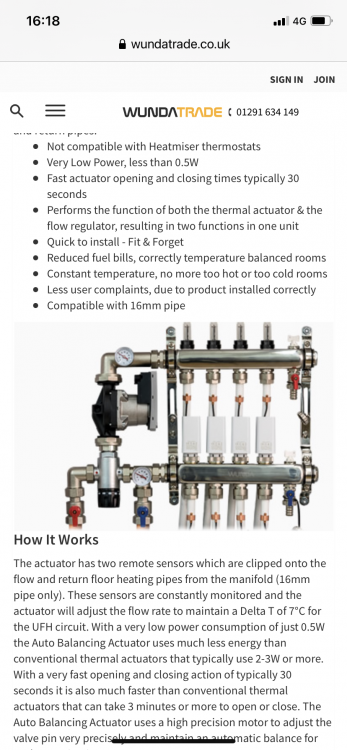
-
UFH 8 zone Heatmiser System Under Floorboards
Nickfromwales replied to AshleyH's topic in Underfloor Heating
Too much flow to a particular loop means another is possibly getting starved, as the former will be taking the lions share of the pump potential. Start the system from cold and balance only then, with all actuators open, and never any other way. This crude approach of balancing won’t solve the problem I’m afraid, as there are varying floor covering with differing characteristics of getting heat from the pipe to the room. Auto-balancing in real time will be the best you can hope for. Salus heads are the only way you can achieve this real time response. -
Pozi joists make 1st fix much easier than I-beams, but they’re not too much of a ball-ache ( if you own sharp hole saws and live drilling ). Can’t really think of a reason to go to I-beams vs posi’s TBH.
-
Yup. Then you can just have one external pipe that accepts anything and everything waste wise. You’d still need a rainwater down pipe though. You’re connected traps ( bath and basins ) turning into ? emitting crop sprayers every time the SF pumped out. Employ a plumber to tell you ?