
Nickfromwales
-
Posts
31390 -
Joined
-
Last visited
-
Days Won
346
Everything posted by Nickfromwales
-

Height of flush on concealed toilet
Nickfromwales replied to Mike_scotland's topic in General Plumbing
picture? -
Bathroom underfloor & towel rail wet or electric?
Nickfromwales replied to Tadpole's topic in Bathrooms, Ensuites & Wetrooms
With MVHR the towels tend to dry off without even turning on and heating the towel rads. My clients often remark at how well this happens and how effectively the MVHR removes the damp / humidity also. Those would be big towel rads though, so you'll need space for them that's all. I would deffo just go with the simplicity of electric UFH, which is what I routinely fit on each project. Wet UFH on such small circuits is a PITA to install, control, and would see the ASHP / boiler having to fire up just to keep these warm when perhaps the heating would not otherwise be coming on. It would also need a separate dedicated manifold and pump to give higher flow rates temperature than the UFH would typically see. That adds to fatigue of the heat source, so has less than obvious side effects to consider also. Those costs will buy an awful lot of electricity, outside of what your PV will be producing, so KISS here is a no brainer. Electric UTH and electric towel rads would be my recommendation here. -
Good points, indeed. Excavating slowly and carefully to expose the cable all the way to the boundary will identify what the position of the cable is, the available length, and the options for any required service alteration. If it can just be pulled out and reinstated on the outside of the front facing garage wall, without needing extending, then that would be my preference for sure, but we've boxed in and covered so many over the years I've lost count. Usually a metal shield of sorts was sufficient to offer mechanical protection, like a length of 5mm steel C channel or similar. Any service alterations I've ever needed from the electrical grid have been relatively simple to request / have executed, and were not that expensive tbh.
-
A bit like check * trade and others, where some sites even allow negative reviews to be removed and often places where bogus positive reviews can get added by friends and family etc, or even by the person / company themselves!! Pure revenue earners afaic. If your workmanship speaks for you that's often enough to keep you busy anyways. For completeness, I have never been on ANY company's "approved installer" list, ever, as I'm usually doing them a favour not the other way around...... Back in the day, when JSH and others installed their own Sunamp units and the sale team was ~2 blokes, SA didn't actually even have an approved installer list.
-
MVHR system in new build
Nickfromwales replied to deuce22's topic in Mechanical Ventilation with Heat Recovery (MVHR)
Yes, a manifold for each. The only thing missing from your line up would be the attenuators. The silver boxes in the image. I never do an MVHR install for a client without them tbh, as my focus is always on having a system which is inaudible on trickle rate and that starts with a design where such things are considered and factored in early on in the build process ( eg so the required plant space can be realised, as that is often under-estimated ). One such current project has needed the plant space increased to almost twice the original size allowed by the architect!! Nearly half the utility room had to be sacrificed or we wouldn't have got everything in. It still surprises me that self-builders ( and their architects ) will apply an allowance that they deem is 'sufficient' for plant space, and not engage earlier with an M&E consultant to get this fully understood before finalising plans. Having a mechanical system which is running 24/7/365 says it should have your undivided attention from the get-go, even more so when it is a system with the second largest bore distribution ducting after the soil pipework and may require penetrations through steels etc. I've also now started installing the Brink Air Comfort units too, which are supplied with either warm or cold water from the ASHP to give active post heating / cooling. These take up quit a bit of space though, but are a great companion to the Brink MVHR units. They're basically an intelligent FCU where the fans speeds get matched ( the Air Comfort has aits own integral fan to alleviate any stress on the MVHR unit fan which balances itself to the correct pressure / flow rates ) Nice bits of kit tbh. Attenuators on that install also. These installs really do need some thought and planning, but the results, as @TerryE's calcs demonstrate, can be very well worth the capital investment of such a system, purely in the knock-on costs they may negate eg not needing heating on 1st & 2nd floors because of the heat recovery element factored into the MVHR design. I'd rather spend money on a system that will save me buying fuel for heating, plus gives me an option to integrate cooling ( where an ASHP is present ), plus any money saved can be deducted from the supply and fit costs of the MVHR. Add to that the constant fresh air supply to all the rooms, 24/7, plus the ability to go mad with airtightness to vastly minimise ventilation heat loss, the biggest issue any dwelling would have, ( more so than having great levels of insulation ), as also stated above is a complete no-brainer.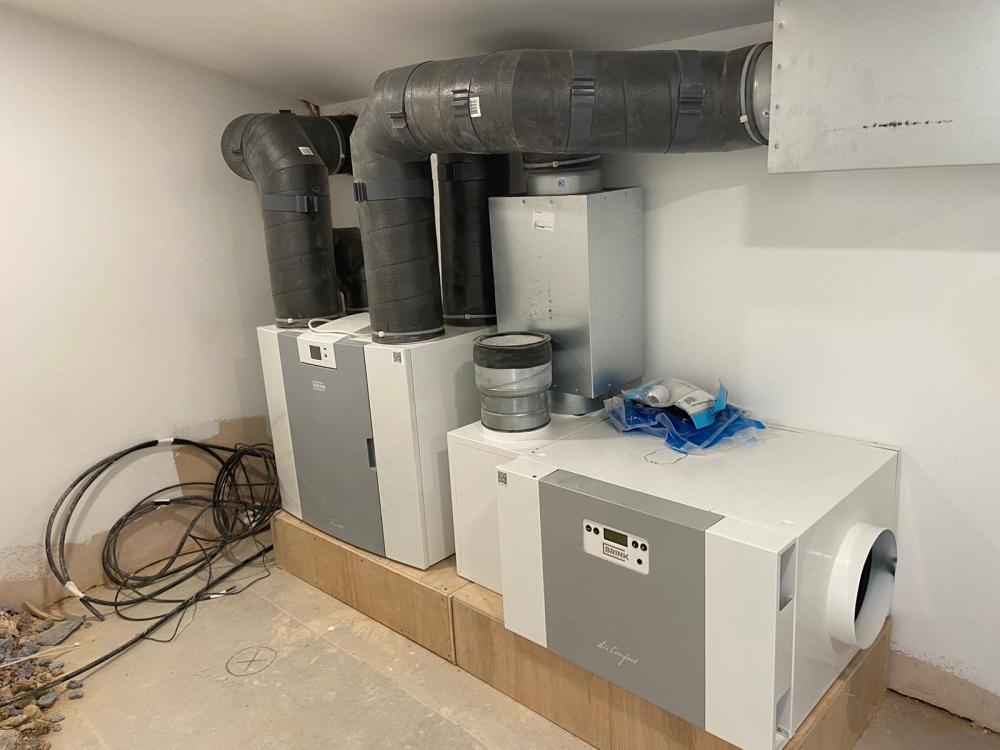
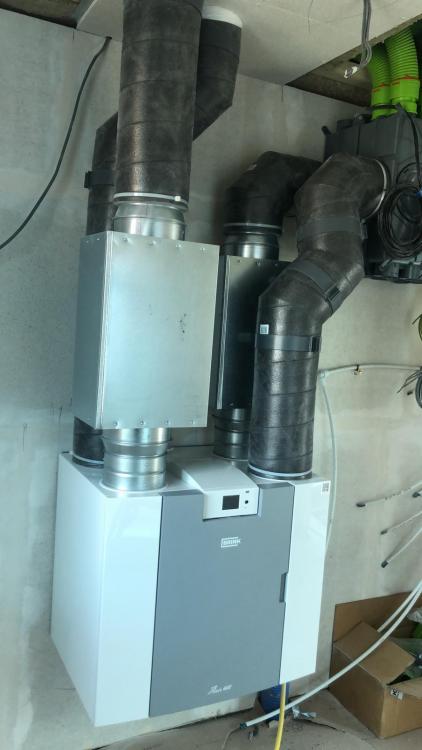
-
Sorry, my mistake! Yup. Trevor has never let me down. @lakelandfolk, Did you get the price off the website? You will do better if you contact him directly and see what he can do for you. Just mention my username and the forum and he should look after you.
-
IIRC @PeterW uses Gledhill a lot, but I've used Telford for as long as I can remember.
-
MVHR system in new build
Nickfromwales replied to deuce22's topic in Mechanical Ventilation with Heat Recovery (MVHR)
Brink Flair 400 would be suitable. Change of £2.5k. PH certified and very quiet / robust. I've had great feedback from clients we've fitted these for, and the guys at CVC Ltd have provided the units, associated materials and design support with excellent results every single time. Very quiet units, but we always fit silencers ( aka attenuators ) in every instance for near inaudible operation, often inaudible at trickle rate and only slightly notable during boost. -
Rigid vs semi rigid ducting?
Nickfromwales replied to SBMS's topic in Mechanical Ventilation with Heat Recovery (MVHR)
Digression is a popular pass-time here lol. BCO may well request acoustic attenuation between rooms and floors, so, as you say, its daft to leave it out as walking upstairs would otherwise convey a lot of unwanted noise to the lower floors. -
Rigid vs semi rigid ducting?
Nickfromwales replied to SBMS's topic in Mechanical Ventilation with Heat Recovery (MVHR)
Your commissioning agent should set the trickle rate accordingly, but you can then set the flow rate per setting. So say factory set position 1 may be 35%, but you can then alter that to 25% for eg after sign-off. Just buy cheap humidity and CO2 monitors and check you haven't dropped to low. -
Rigid vs semi rigid ducting?
Nickfromwales replied to SBMS's topic in Mechanical Ventilation with Heat Recovery (MVHR)
Intumescent fire hoods for lighting. They offer some acoustic benefits also, as they are fully encapsulating the fitting, plus the acoustic insulation can go over / all around them. -
MVHR system in new build
Nickfromwales replied to deuce22's topic in Mechanical Ventilation with Heat Recovery (MVHR)
The trickle ventilation, I believe, is being created by setting the skylights to be just ajar The 4 holes ( 2 per MVHR unit ) will be the pre-installed insulated ducts coming in to connect to the unit, perhaps? -
Its relatively safe to assume that's the rising incomer so the garage will have the head / meter and possibly also the CU together there as it's on the house wall.
-
If its already in a metal conduit, then it will be fine 'boxed in'. I'd just box it in in the corner of the room, so say a 125x125mm boxing in finished, and that will mark its location and make it a little safer imo. The metal conduit may need to be earthed, and bonded back to the CU when boxed in, but I'm not 100% sure. Others will comment soon enough. Either that or pay for a service alteration and drill through the wall at its base, ( core drill down at an angle from inside the garage to outside, excavating first so you don't daage the cable whilst drilling ), and have the cable puled in and run up the inside the garage on show instead.
-
We can talk you through it tbh. Have you tools and previous plumbing experience?
-
MVHR system in new build
Nickfromwales replied to deuce22's topic in Mechanical Ventilation with Heat Recovery (MVHR)
Plus the fact that humans tend to close trickle vents in the cold windy depths of winter......PPM levels of CO2 subsequently go through the roof, plus humidity, and then comes damp. It's a double-edged sword, where you build either to our dogshit British building regs and fit trickle vents, or go better and provoke a requirement for mechanical ventilation. All of my M&E clients who have MVHR all state that it is a very pleasant environment to live in. We engineer systems to be near silent also, but at £1500 you'd have a very cheap and nasty setup with a unit made from Chinesium. I pay more than that for just the bare units to be delivered, without any ducts etc. Budget for the £5k minimum for supply and fit for a 3 storey house, for a radial system. I'm not a fan of series run ducting because of the higher primary airflow rates and the noise from the attenuated valves closet to the unit. Also some have raised issues over cross-talk, the sounds transmitted from room to room via the interconnecting ducts. -
MVHR system in new build
Nickfromwales replied to deuce22's topic in Mechanical Ventilation with Heat Recovery (MVHR)
Recovered heat energy, not the electrical energy to run it If you would have been discharging huge volumes of heated air to atmosphere with regular extractor fans, you would be sucking in cold air to replace it. The HR element of MVHR would be preheating the incoming air with the otherwise wasted heat carried 'out'. Some systems can recovery up to 18oC of the 21oC that is 'leaving'. It's a significant energy saver basically. -
Unless you know what value that PRedV was commissioned / factory supplied at, I cannot comment on where the red pointer should reside. Pretty much what I said above so yes.
-
imist should be connecting to their own stopcock rising off the main, eg you should have the mains cold coming in and going to everything you have there atm, plus you should then also have a tee connection immediately PRIOR TO the existing stopcock feeding a lockable isolation tap, that then becomes the dedicated non-interruptible supply the mist system. No. It should be set to represent the pressure that the PRV restricts at, so basically it is a visual indicator that shows if the PRV has started 'passing' and needs servicing. If, for eg, it's a 3 bar PRV then move the red pointer to 3 bar and leave there. If the black pointer ever goes past the red, there is a problem.
-
Erm, no. The taped and filled joints are the only sensible option for this, with the tapes preventing the cracks coming through, and then filled to better blend one board into the next. As the boards are usually purchased in the smaller format to make them easier to handle ( good luck with 43kg's!! if you go 8x4 @12mm ) you'll have way more joints to manage, and a LOT of expensive waste product where you cut off and end up with square edges again. Butting these together and gluing will not be sympathetic to your type of walls, and trying to use FST and sand that out to an acceptable finish is just mind-blowing in terms of labour, repetition, and the astronomical amounts of dust that is created. From what I've seen, I strongly doubt you will be able install FC cheaper than PB and skim, unless you can live with a terrible looking painted and finished wall. PB and skim will give you a flawless finish with zero sanding and filling if the chosen 'spread' is a good 'un. We install strategic timber pattresses in walls where TVs / kitchen unis etc are being installed, and often plywood / OSB before PB in bathrooms so the shower and wall mounted items ( shower door etc ) plus accessories ( towel rails / loo roll holders etc ) can be retrospectively installed wherever you like. Other than that, there are plenty of good off-the-shelf solutions for affixing item to PB. Save the money on the FC and additional labour and finishing products and invest it into the labour for a plasterer. If your bill for labour only for plastering is £10k, how big is the house?!? The above info is from 1st hand experience where these were fitted to a service battened TF dwelling and 4" internal stud walls. The option for one individual was to abandon and revert to PB and skim, another stuck with FC and the FST and the job took forever, created a gargantuan amount of dust, and was not, after all that process, time, cost, a flawless finish at all.
-
Yup. Very handy when fitting in awkward spaces as the plumbing can be 'all front'. Remember to have sufficient space to get an immersion box spanner in and to be able to draw the full length of the immersion out for replacement. A 1hr job start to finish with an UVC, but a de-plumb / de-wire and palletised return-to-base for the entire unit with SA / thermino if their immersion fails.
-
The My Energy Eddi was specifically re-designed to work around the SA cold-start feature, where the heater element would initially pulse heat until it was up to a certain temp threshold to avoid damaging the PCM immediately surrounding the element, ( or nuisance tripping the manual overheat stat which was a popular repeat issue ). Once up to a certain temp the heating element would then latch for full uninterrupted charging. If a regular diversion controller was used, it just kept on switching off every time the heater stopped for each pulse as it assumed the heater was up to temp and no longer required input. I do not know if the cold start "feature" is still employed. SA always recommended the Eddi and it is a very good bit of kit. Nice comprehensive display, and once set up it's quite user-friendly. Recommended by many on here afaik. If you go for an UVC you could opt for a cheaper, dumber diversion controller, but some don't have the display / don't give much feedback. Choose which is best suited to how much feedback you'd like. I would deffo go dual immersion, with one set to max and receiving excess / diverted energy and the other on a basic timer so you have the option to 'over-charge' the UVC. Set the timer to heat ( selectively ) from the grid, storing only the minimum acceptable amount of DHW you need each day, and leave the deficit to be treated as a thermal battery accepting any excess. As stated, without seeing numbers, it's difficult to say if that would work immaculately, but you can get very close to 100% self-consumption with some thought ( and better understanding of your options ), but you don't want to end up like a steam locomotive driver, constantly twisting knobs and pulling levers to keep things in check. Keep asking questions!
-
@lakelandfolk Semd me a pm when you’re ready to purchase the UVC and I’ll make a call
-
Not at all. The benefit of dual immersion is that you can use one at 60oC to preheat at the 4/5 hours of octopus cheap rate, on a simple timer, and then have the second ( lower ) immersion set to 85oC and fed from PV excess. Any excess ( after the battery has topped up ) will just further ‘inflate’ the UVC, thus reducing the amount of grid power it consumes during the following overnight top up ( seasonal swings will affect how you manipulate this control ). During the depths of winter you could flip / flop between the two immersions to get more DHW per 4/5 hour charge and that will leave any solar free to help charge the batteries. Without your generation / consumption / export figures it is quite difficult to offer concrete solid answers / suggestions.
-
One such CEO is VERY active on a particular social media platform.........