

Nickfromwales
-
Posts
30353 -
Joined
-
Last visited
-
Days Won
297
Everything posted by Nickfromwales
-

Calculating number of clip rails for UFH
Nickfromwales replied to Conor's topic in Underfloor Heating
Are you laying serpentine or inverted ? I just laid 1.3km of pipe at 100mm c’s reverse / inverted ( snail ) and went through 250 m’s. It’s area rather than volume with you, but you’ll still do the 180 in or thereabouts. Boxes are available at x100 per box, so just get 2 boxes if I were you. They’re around a buck fifty a strip, so chicken feed, and recommend putting them at 800mm centres. Last thing you want is anything lifting ( floating ) during the pour. What are you fixing them down onto? -
You'll may also, then, benefit from some additional information re this DHW strategy. I have been routinely oversizing the DHW cylinder to create a larger 'cheap energy capacitor' which I have then designed around heating once a night at 5p/kwh and there then being enough DHW to get through a typical day without recharging. Options for interim recharge, where required out of off-peak times aka 'on demand' are; via immersion boost switch ( with a choice of 30 mins / 60 mins / 120 mins manual boost ) which I call "guest mode" or to set the immersion to boost midday where there is likely to be PV available, safe in the knowledge that the immersion will only call if the UVC is depleted and usually by not much ergo the UVC doesn't monopolise the PV production. Freezing ( or the need to defrost ( two very different things )) is a statement I made as assumed. It can be mitigated or minimised ( risk / cause ) with a bit of thought.
-
That strategy also extends the longevity of the HP, which is a strategy I adopt with my new clients, and also helps avoid any possible ‘freezing’ of the unit in the winter / adverse months. Off peak rates ( 5p/kwh ) can now be utilised quite advantageously and using that plus PV during summer sees the ASHP having a very easy ( therefore long ) life. Ive just done a couple of ASHP’s ( PV + Octopus GO! ) where we’ve not bothered with the wet circuit to the UVC at all. Helps a huge amount as both have cooling in the summer and I did not want the ASHP doing 180 degree turnarounds from cooling to heating for no ‘good’ reason.
-
You're probably scoring too heavily. Try one clean pass, contact from start to end, and one sharp snap to complete. After that, you're on a wet bed cutter.
-
?. “Probably?”
-
That’ll just be the tip of the iceberg, sadly.
-
All of the above. They all knew this would fail spectacularly in the event of a fire……
-
Just get a continuous rim diamond blade in a 4” grinder and chip away for 10 mins. Easy enough.
-
Are these the JA panels with micro inverters affixed? One less thing to buy ( other than the controller ) if so.
-
It differs from DNO to DNO, for no good reason. Some will accept written notification, but the last one we did ( 5.5kWp on single phase ) they asked to witness in person regardless. Also, you automatically provoke this when installing more than the obligatory ~4kWp as you then have to submit a full DNO application before installing, listing the equipment ergo to ask for limitations you’d need the correct equipment in the proposal.
-
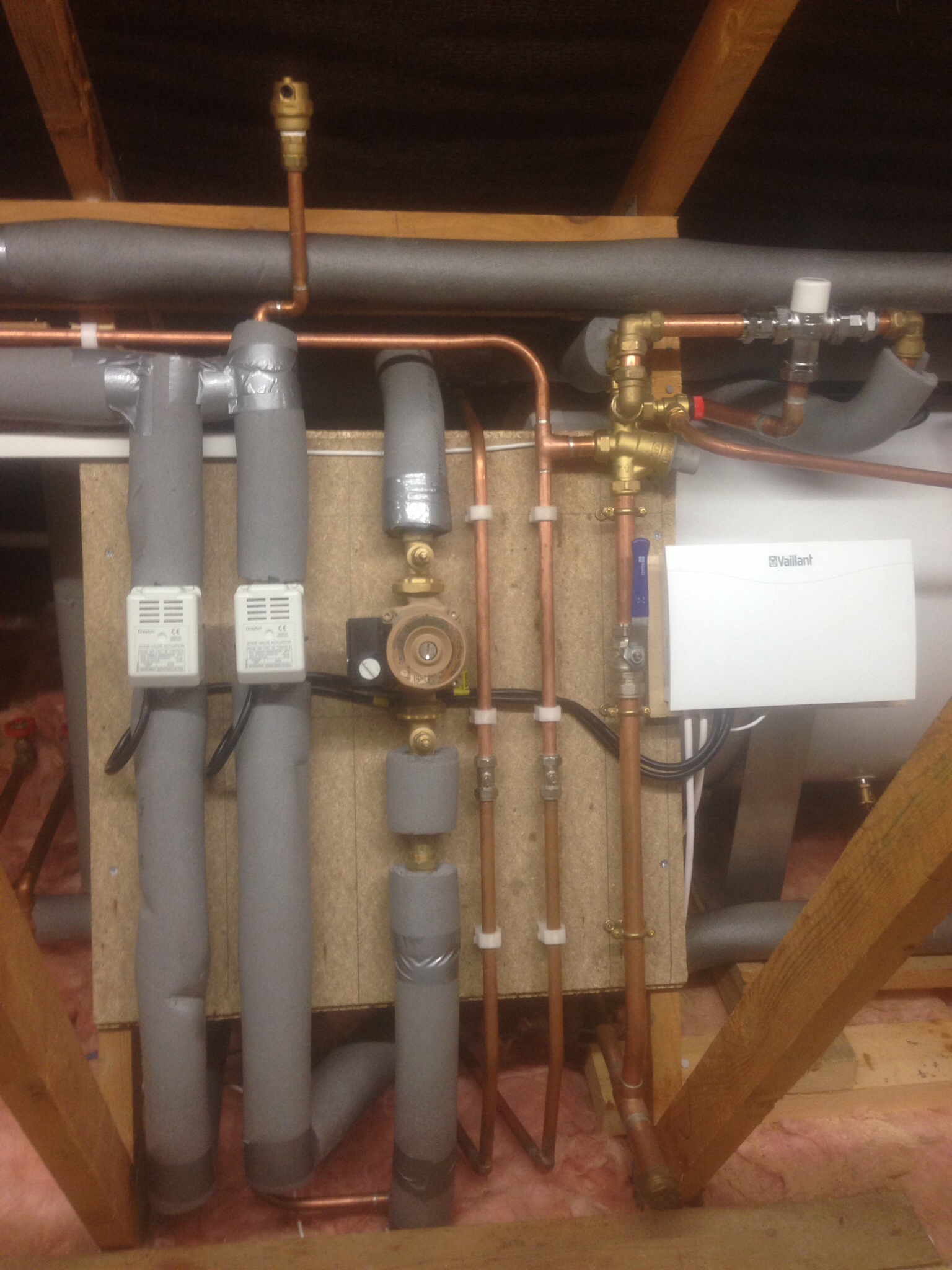
If you have at least one bypass radiator ( towel rad or back of airing cupboard ) plus each radiator has its own TRV, I would say there is a definite benefit to having the rad circuit left open, without a zone valve, so the UFH gains some additional system volume which should help with short-cycling when only one or two UFH zones are calling for heat. The UFH deffo needs a zone valve so the manifold and TMV don't act as a bypass for the radiator circuit, eg when the rads are selected on their own the UFH ZV stays shut. With 2 lots of heating and with them both adding their own percentages of bypass, I would seriously consider W-plan ( DHW priority ), unless this is an ASHP install which would give you that anyway. If it is an ASHP then you 100% need a 3-port ZV ( diverter, not mid-position ) or 3x 2-port to facilitate isolation for the heating circuits during the higher temp DHW cycle. What is the heat source?
-
Yes, by choosing one with Export Limitation software, but you still need to notify the DNO so they can come and witness this is operation / physical presence etc. OR, just fit DC batteries and then you do not need to inform the DNO, plus I see no reason why @MikeGrahamT21 cant add them to his FiT registered installation and mop up that eye-watering 75% export ?
-
Turn off both internal stopcocks and see if the tap still works. If it does, then it’s a rising main vs cold feed, so should really be dug out to a healthy bit of pipe and capped off with some fines around it to keep it safe from movement. In terms of a dead leg, the risk is minuscule as the fresh incoming ( chlorinated ) water will always pass this on its way to consumption. Do the above test first and then weigh up the pros and cons.
-
Have you checked the prices recently? They’ve gone up considerably. A similar size unvented cylinder will leave around £2k change in your back pocket.
-
None of this helped by vertical ventilation voids feeding fresh air as fast as the fire could suck it in
-
Is this an intermittent fault or a now permanent (albeit incorrect ) situation? Trying to narrow down a zone valve or stat issue. Doesn't sound like it's the ASHP at fault at a first glance.
-
Just saying hi, nothing to report yet!
Nickfromwales replied to lizardeatspaper's topic in Introduce Yourself
Which is exactly the right time to be asking a bucket-load of questions Welcome to a forum where such information, impartial, factual and honest, resides, ( warts 'n all ). -
The reference to adding more insulation was aimed at IWI ( internal wall insulation ) So basically applying say 30mm or more insulated plasterboards to the internal face of the dwelling, and then plastering over those. LINK EWI could also help but can be far more impactful.
-
Pedantic ones will quote 1 in 5, but if you can visually demonstrate adjoining SVP's or that the you are not the end of line or at the crest of the sewerage network you should get an agreement that the SVP is not necessary. But; No, we cannot. An AAV allows air in ( hence the name "air admittance" valve ), so these categorically will not and do not provide any such means of venting per-se. AAv's are only a requisite where the invert from a discharging SVP to the 'manhole' aka IC is above 1300mm. Below that, there is not even a requirement for the AAV.
-
What cables to use within a HA cabinet?
Nickfromwales replied to Hilldes's topic in Networks, AV, Security & Automation
Solid core cable needs particular 'kid gloves' when stripping and terminating, and I'd choose tri-rated in a heart-beat vs solid for rack / cabinet wiring. Also, why the obsession with twisted pairs? All of the rack cabinets I've made in my time have been populated with tri-rated or screened cables suited to their individual applications. Screens will provide RF / EMF control so what are you specifically looking to combat? If I have ever wanted to set out numerous looms to 'look pretty' and twisted pairs have been my choice, I've simply pulled 10m of the chosen 2x cores of stranded ( xmm2 ) cables and then tied the ends off and put the other ends into the chuck of my cordless drill, pulled them taut, and then slowly spun them into a twisted pair. If the connectors are vice clamps vs screw down rotary type, the need for boot-laces becomes one of personal preference vs necessity. -
Are other PIR manufacturers to be exempt from this question?
-
Blauberg vs Boulder
Nickfromwales replied to Bosi's topic in Mechanical Ventilation with Heat Recovery (MVHR)
Brink are PH certified, and not enough money to convince me that a compromise on something which potentially can save me annually on my heating costs would be such a good idea..... Longevity needs to be considered here also, in equal importance, as these units will be running 24/7/365. "Buy cheap, buy twice" eg not so cheap then after-all -
PH standards for all new builds? You'll be lucky to find insulation in half of the new stock being sold to first time buyers, fortified by over-stretched council / back-handed private BCO's signing off these builds in non-scrutinised batches of 10+ at a time from a single dwelling inspection. A heat pump would cut any heating bill in half ( minimum ) if a dwelling had any discernible level of attention to a fabric-first approach, with robust BCO monitoring. Whilst new buyers still rave over a nice shower cubicle and a cloakroom WC, the demand of the typical new build ( mass-produced ) buyer still doesn't drive such focus 'elsewhere' I'm afraid.
-
Only if no one else in the dwelling opens a tap / flushes a loo, and no appliances are using cold mains at the same time Otherwise your huge electric shower will shut down and you;ll have to select its lowest setting and suffer a shower akin to me peeing faster-than. That rule applies to any and all electric instantaneous heaters, which are largely over marketing-hyped utterly useless bags of shit. I will concede that if new builds receive a mandatory 3ph electricity supply, the 3ph Steibel Eltron 27 electric instant is an absolutely fantastic bit of kit. I'm seriously impressed by it. Its 1ph little brother is however completely pitiful on a good day in the peak of summer, and a complete waste of money and wall space in the depths of winter where it needs to dig deep to uplift colder incoming water temps to the same level. You do have to consider the sanity of some folk writing here 14oC "right now" = 9pm on a November night. Less gin, more tonic, eh? Probably renting @SteamyTea's conservatory and banished from making physical contact with the room stat ?
-
Real world passive house heating demand figures?
Nickfromwales replied to Smallholder's topic in Boffin's Corner
Architects can be dangerous things...... What they should say to you is to do the sums and get on top of the M&E coordination as early on as possible. It is such a holistic equation, made up from so many relative ( but often overlooked ) facets, that such a statement seems to be popular in buying these professionals all the insurance they need to survive without undertaking such ( or sometimes ANY ) due diligence. One 'eco friendly' chap had actually designed a heated floor to be sat on cold strip foundations without any thermal break...... Taking advice from anyone other than qualified M&E's, or testimonials from folk who have built, and then moved into, and are now living in such a dwelling is pretty dangerous practice and often costly. Another failed to specify a heat pump for a dwelling that had a mandatory requirement for NZEB certification as part of the PP! "Double the demand" is huge in PH terms. My 2 cents would be to stop taking advice from the architect as their approach is worryingly non-robust in this particular respect.

