
Nickfromwales
-
Posts
31387 -
Joined
-
Last visited
-
Days Won
346
Everything posted by Nickfromwales
-

Copper of Push Fit - Timber frame !
Nickfromwales replied to bob the builder 2's topic in General Plumbing
I always use Hep2O ( Hepworth by Wavin ) and use zero hidden joints. This is achieved by running multiple dedicated runs aka radial plumbing. A manifold for hot / cold resides at the hot water device with all of the isolation valves in one place vs at each outlet. Series plumbing uses a lot of joints so you can tee off the main pair of hot and cold pipes as they make their way from the hot water device, but this typically loses a lot of dynamic pressure / flow unless the start of the run is in a much bigger diameter. Causes a huge delay for getting hot water from basins etc at the end of the run, and is also very wasteful due to the amount of cold water that needs to be discharged before getting hot water there. I use copper and brass at the source, and Hep2O form distribution. -
You’ll thank yourself later. Cost of a months re t to find another contractor would soon pale into insignificance when retrospective repairs either stopped you moving in anyways, or cost several thousands to correct whilst you were living in it. Bite the bullet, not great news I know, but these guys are just crap.
-
Jointing and filling plasterboard
Nickfromwales replied to jen and mark's topic in Plastering & Rendering
Easifill is a finisher. The bulk of the work, including bedding in the tapes, needs the joint filler Get that as flat and smooth as possible and use Easifill to complete, sanding and adding more as required. Easifill goes off much quicker, so only mix up what you can use, making bigger mixes as you get used to using it / workable “open” time. -
Wasting your breath. Continuing with these clowns is a suicide mission. If you’re happy with these idiots then on your head be it sorry. You’re being given sound advice here, what you do with it is up to you. Pretty much why I instructed my clients in Leicester to sack their ‘builder’…… complete buffoons of an order of magnitude. Causing more harm than good, and covering it over hoping it wouldn’t get seen / discovered. Even staged ‘photo shoots’ for BCO then didn’t carry on with the same standards. Far from it.
-
That’s a bag of 💩. Stop them now and part ways immediately. This will NOT get better, only worse.
-
Weren’t you curious as to whether any improvements were made ( or the opposite ) since the primary test? I’m rectifying every defect / not great bit of taping / improving the AT detailing on my current clients PH build and I’m going to look meagrely to getting the final “as built” test done tbh, eg to see how we’ve improved things. 0.59 ACH when provisionally tested, but since then I’ve gone to the enth to rectify / improve this. That’s included having 2 pairs of large french doors taken out and re-fitted by a much better window company ( Simon Chadwick of SMC, great guys if anyone needs a nationwide window supplier / fitter ) so, now I can no longer see daylight through them!! Should be a good place to start, lol 1st general builder, since discharged, had not helped things at all. I’ve hopefully found and rectified all the damage his crack team of AT membrane assassins caused 🤞( through ignorance as well as what they KNEW they’d damaged, but then immediately tried to cover over and hide vs repair, ffs ), so am hoping to get this project down to 0.3 or thereabouts when done. Sub 0.3 I think would not be impossible. The challenge will be to retrospectively seal the house when the installed systems are in and the bathrooms and kitchens ( fouls and wastes etc ) and MVHR are fitted and functional. I expect I’ll use some drain ‘test balloons’ to seal the outgoing FW connections immediately after they leave the insulated raft foundation and appear at the first chambers, and just make some EPS bungs for the 200mm MVHR fresh / exhaust exit the exterior walls. Add to this; the whole frame has since been blown full of densely packed cellulose Warmcell, entire ground floor has been tiled and the adhesive now holds the wall to slab AT tapes firmly down ( there is a huge amount of linear meterage of that, and then add my 20+ penetrations for external lighting / sound / WAP / power etc, and curiosity is, as usual, eating me alive! Ergo, the second test is 100% happening……..even if it was NOT required My plan is to use the sticky clear membrane ( the one the AT crews use over the keyholes / duct ends etc ) to seal the windows / doors / keyholes etc ( from both the inside AND the outside so they cope with both the negative and positive blower cycles without coming detached ) for one specific ‘build fabric only’ test, and then quickly remove those for another ‘final / actual’ as built test. I’ll leave the wastes and MVHR plugged for that test as I really want to know I removed the obvious major issues from the poor initial window and door installations.
-
The airtightness test? Always done quite early on so you can find / get to / rectify leaks. Only then do you board and skim in every new passive build I’ve been coordinating.
-
If this is a lifetime solution then I’d keep the 400L CWS, add a 100L ( 50L useful capacity ) cold mains accumulator, pumped off that as required only, and fit a Steibel Eltron 3 phase 27kW instantaneous water heater. The Steibel is about the size of a shoe-box, just a bit longer, and is one of the most impressive bits of kit I’ve seen for a long time. I installed one for a client, in their annex / residence during their main build, and it is working very well indeed. Changes water temperature for duty too, so shower gets full wallop, basin tap gets a 1/3 and so on. You may be able to clear out that airing cupboard space and just fit a 300L accumulator and go passive off the mains, but we’d need the statistical info from the data logging first to be brave enough to discount bulk storage. You’d be at the mercy of electricity prices on demand, but the Steibel is nearly 100% efficient and you’d only ever heat the exact amount of water you used. The same single phase unit from the same supplier, I can piss faster than the hot water comes out of that btw.
-
Site security, getting robbed.
Nickfromwales replied to Russell griffiths's topic in General Self Build & DIY Discussion
My mates Vivaro got emptied the other day. 3mm hole made around the sliding door handle. Surgical precision, near zero damage, not even noticed until the penny dropped. Luckily not his whole collection in the van that time…….. -
https://wrcpartgcalculator.co.uk/Calculator.aspx I just grab figures from these types of examples. Few ‘inspectors’ ever cross examine or even check tbh. Just a box-ticking exorcise. Posts on here show typical l/per person/day. Google will point you to most common information, plus feedback from others here should fill the gaps.
-
LINK
-
90% done, only 90% left to do……
-
Just tell me that the band is temporary ;).
-
You need a minimum of 600-800mm of slack just to install the panel. When the panel is down, that slack cannot practically be anchored. Move on to the next item, this ones fine afaic.
-
It’s fine. Much better than the previous splat and stop arrangement If this is your first crack at soil pipe runs, then you’ve just beaten the “30 years in the game” fcuk-ups laid by my current clients ( now since discharged ) builder Looks like a first year apprentice laid them. Whilst hungover, then realised what a bag of shit it all was, and then hurriedly back-filled it all without informing the BCO ( as it first needed inspecting by them!?!? ). You’re doing very well. I’d put the 2x 15’s at the wall end, so the highest velocity pushes through those, and then the flow through the 45 & 135 will be far smoother.
-
Unless you specified conduit / other, which you’d have paid for, the norm / knee-jerk is what you have. Fwiw I won’t be doing anything more on my own install.
-
The cables have a degree of ‘mechanical protection’ from being behind the panels. No harm will come to them in actuality, and they’re well insulated and further mechanically protected by the outer sheath of the cable type. As said, you need slack to install them, and likewise for downstream service / repair. Stand down red alert afaic 👍
-
I’ll get my red marker pen ready……..👀
-
Nope. Leave well alone. The outlet of that replacement branch which would take a rodding / cleaning eye would be up against that rigid MVHR duct, so a pointless adaptation with worse results AFAIC.
-
Yup. Typically only available in the underground range. Get 2 as you’ll need to do the upstream one as well.
-
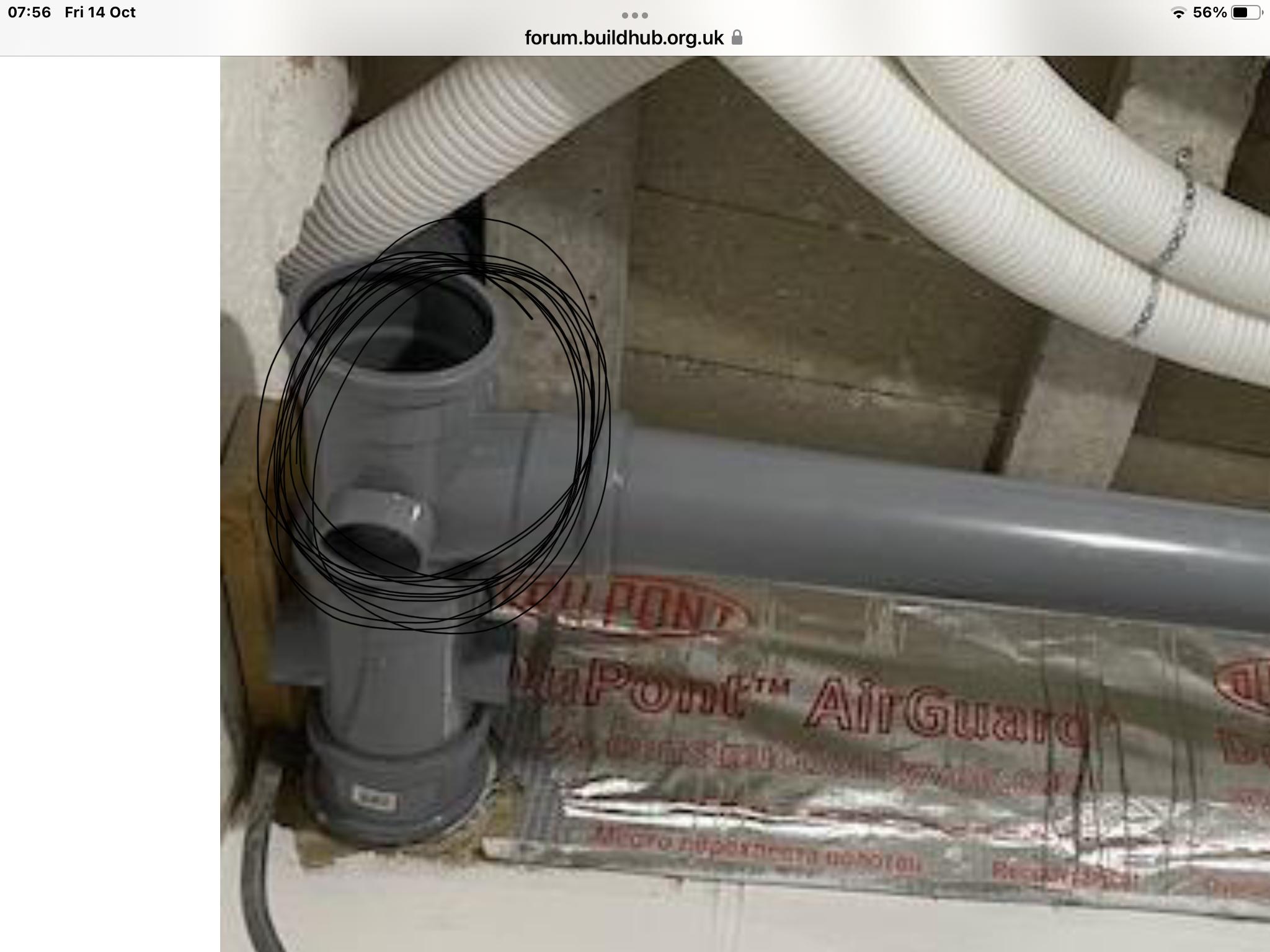
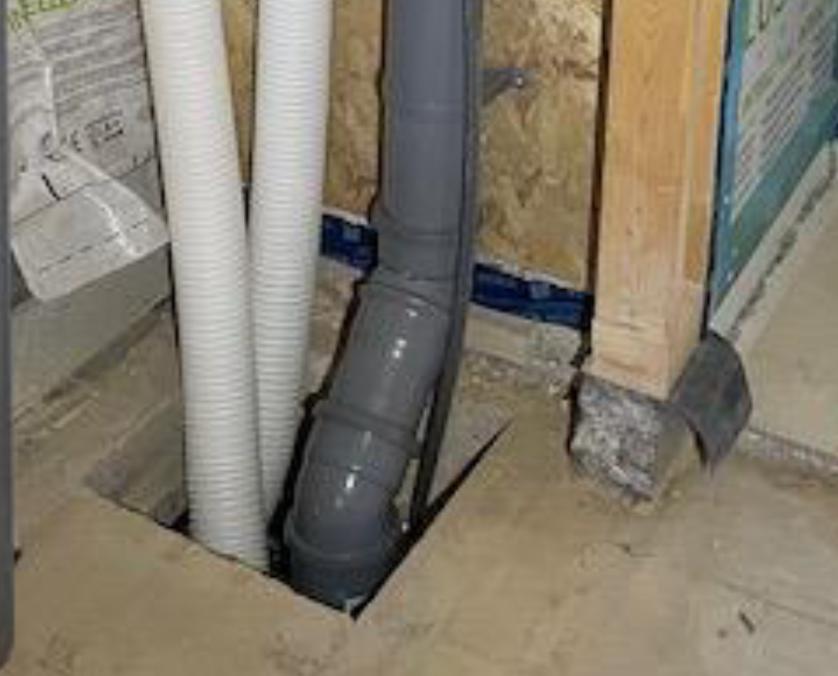
Yup. 135 is a Y branch 92.5 is a T branch. T branches are used in vertical pipework where gravity promotes direction of flow, Y branches everywhere else where velocity is the only thing keeping the brown dolphins moving as they should. Is this junction in a habitable room? If so, it’ll need a serious bit of sound deadening.
-
That one ideally needs to be the same, with a Y branch and a 45 going in to it. Edited as I was looking at the same pic twice lol. More coffee required……
-
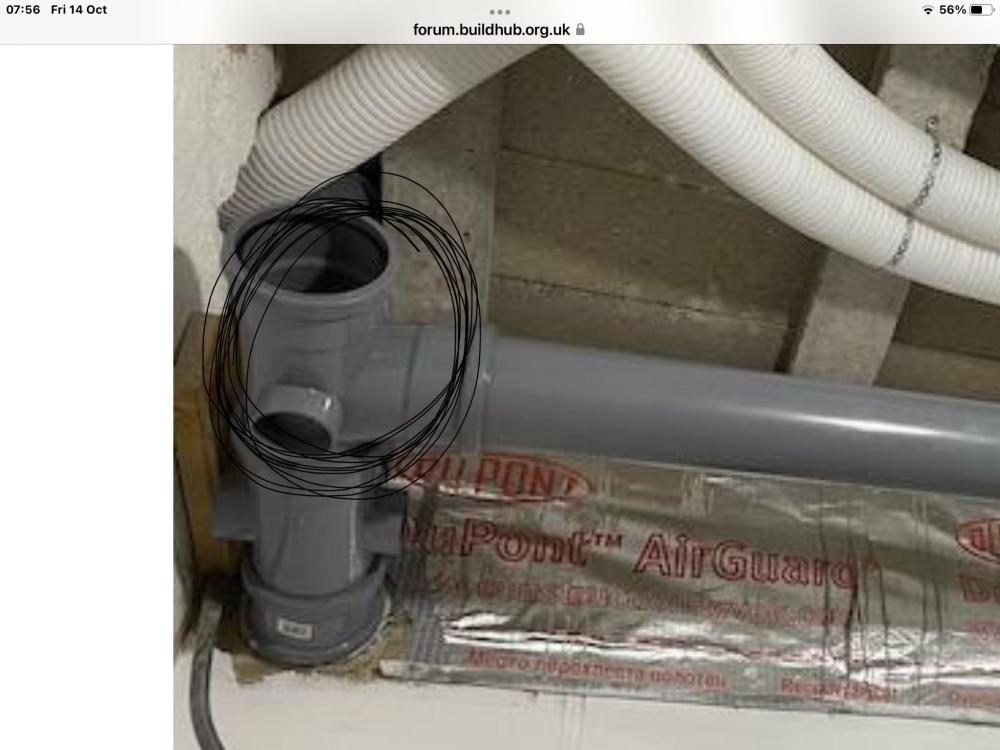
BCO will be happy it’s not a rest bend btw, as long as you fit a clip ( rubberised clamps ) immediately on the output of the branch, and another immediately behind it where it picks up the second incoming foul.
-
People!? It matters not one jot what colour it is…… It’s never going to be the first part of the guided tour when Auntie Mabel comes to visit with the twins ffs
-
Spot on. BCO will be plenty happy with it fitted internally, just can’t be outside above ground. @Thorfun Get over the mix / match of underground fittings as you’ll be needing some. That branch, the one tight against the basement wall, needs to be a Y branch not a T branch, with a 135o single socket 45 into it to collect the bottom of the ‘drop’ from above. That’ll put the brown dolphins and they’re associated paperwork travelling in the right direction for sure . You wont be able to change to a rest bend as you’ll still need the rear open socket from the Y branch to pick up the second incoming foul pipe.