
Nickfromwales
-
Posts
31384 -
Joined
-
Last visited
-
Days Won
346
Everything posted by Nickfromwales
-
That’s 1200mm deep x 1400mm wide total width which will take a cubicle 1200mm return x 1000mm in-fold door. I see no reason to heat that area, given it’s a 1st floor bathroom that will always be at or above ambient, but I have run UTH over them before (at the clients request (insistence)). Most say they barely ever bothered with it tbh, where it was a 1st floor bathroom.
-
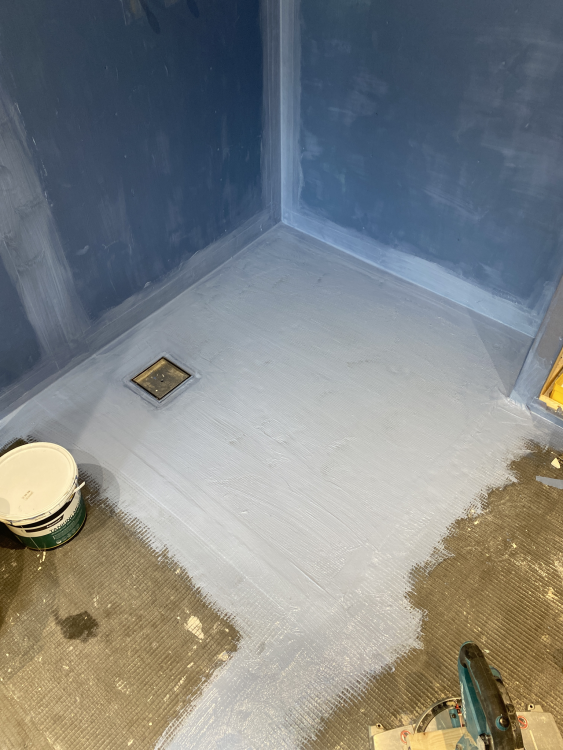
Hi. Most shower trays / wetroom formers are 22mm thick and cannot be 'cut into', however there are very few instances where I've run the electric UTH (under-tile heating) wire into the wet area, as there's very little point tbh. I'm actually installing a Wedi setup atm for a client, and have allowed for the main areas / circulation space to be serviced by the UTH but not the wet area. When the shower is running, you'll only need a couple of degrees to raise the floor (wet) area to where you perceive it as "comfortable" (that has a thousand definitions btw) so I doubt it is worth making this job such a PITA. There's a few solutions for the wet UFH in the bathroom, but I am a fan of (correctly installed) aluminium spreader plates. Then you just install 22mm P5 'weyroc' flooring with ply atop, and tile away. This isn't a very 'reactive' floor heating system as there is a lot for the heat to get through, hence it is very few instances where you see wet UFH in just a bathroom. The economics of just running that on its own for eg would not make much sense but with your circumstances it likely won't matter as you'll likely have the heating 'ticking over' vs on or off? You will defo need this to be on its own manifold with its own thermostatic valve, if there's not UFH elsewhere in the home? If that is the case, you can possibly get away with just having a pump and a TMV at the buffer tank sending tempered water direct to this individual 'zone', but we'd need much more info about the system to advise definitively. If you have this amount of renewable / lo-cost energy available, I'd make like easy and install UTH which you can run over any wetroom former etc. If you install the tiles over insulation tile boards as I am doing here, then the heat up time will be massively reduced and then it can just be timed for set-back operation, switching between comfort and economy temp to make it energy efficient.
-

Combining 3 phase and 1 phase systems?
Nickfromwales replied to Lemna gibba's topic in Photovoltaics (PV)
+1. They just don't want the hassle. Bin. -
A tile trim with an overlap?
Nickfromwales replied to JohnBishop's topic in Electrics - Kitchen & Bathroom
https://lilleytileandstone.co.uk/schluter-reno-t-transition-profile-select-colour-width-and-length.html?gclid=CjwKCAjw_aemBhBLEiwAT98FMqPfJcmP0Ikj5ma7v9dWF2HrtHFwxloj4JIQKJ7EicB3nMeQAl_n7xoCOWoQAvD_BwE#139=123&144=227&93=154 Any good? -
Just use it in a rotation fashion around the pipe, do not 'polish' linear to the run, as that make make lines vs the 'rings' that you want to create. I'd say it will be fine, but I would also say it would need a good 72hrs at low . mid . high pressure test, and to be filled and emptied (to stress and relax the joint a few times) so maybe set this up as the outside tap and use it a few times a day for a few days.
-
Joining flexible ducting
Nickfromwales replied to richo106's topic in Mechanical Ventilation with Heat Recovery (MVHR)
I've lost count of how many Ubbink systems I've now installed, with joints / couplers a plenty (large houses / convoluted runs / asshole builders with gas nailers damaging ducts etc) and the couplers are bombproof. Just use the coupler, no need whatsoever for the tape afaic. I've not taped any that I've installed, on the proviso that the duct is supported properly (mechanically fixed) and there is zero strain on the fitting. Crack on. ☝️👌 -
I didn't say it was easy just it is doable. It's not the size of the dog in the fight, it's the size of the fight in the dog
-
Can anyone recommend a SE near Peterborough?
Nickfromwales replied to Barny's topic in Building Regulations
Snap, lol. 😄 -
Can anyone recommend a SE near Peterborough?
Nickfromwales replied to Barny's topic in Building Regulations
I'm not sure, is the honest answer. If you have trees near to where your foundations / slab are going then you'd need to check with BCO for proximity. Tanners will very likely be able to advise / point you in the right direction. -
You can use the min input and output and put adjustable bend / 15 / 30 / 45o bends in and keep the same invert. It's usually only the branches that pick up the first few direct connections that will be affected, the downstream IC's can be in > out at the same invert. Agree on 1:100 being a tall ask of most groundworkers, but there are some good ones out there that will do this properly and successfully. I've had to run soil pipe literally horizontal and zero fall for up to 5m (in a straight line, no bends) and you'll be surprised at how well the momentum gets you "out of the sh*t". Not advising this of course, but I kept that arrow straight, zero depressions, and it works still to this day, 15+ years later (my mates parents house). THis was to get rid of a Saniflow that was constantly failing (due to "user error" most times), and I just got away with it. The pipe will need supports every 1200mm, made up of 6:1 concrete mix with 10mm aggregate, to create piers. This will allow you to level and flatten the pipe run perfectly. Use timbers driven into the ground to act as temporary 'brackets, every 1200mm, and then once dead on, you then fill with the concrete 500mm away from each timber bracket and leave to cure. Then remove the timbers and get to the pub. Be present for the back-filling and explain that this needs to be pea-shingle all the way back until you have 300mm of cover over the pipe. Can defo be done with excellent results, I've done enough to know, but you'll first have to ask your BCO if he will allow a deviation from 1:80 by you demonstrating that it works (functions) and explain the methodology and how you've mitigated against future depression with the higher frequency concrete piers and complete back-fill with shingle.
-
I recently designed a foundation like this for a client that used Nudura ICF. Ditch the old school 150mm sub deck, lose the screed, add a bit more insulation, and raise the 120-130mm constructional slab up to become your finished internal floor. This shows a near enough example, just has a different wall structure. The UFH pipes go into the concrete layer, so I recommend going slightly thicker with ground bearing infill slab to give some extra cover over the UFH pipes which get zip=tied to the reinforcement steel (re-bar). At 100mm this can get quite close to top of concrete, so the one I detailed had 120mm iirc, vs the 100mm. Gives a hell of a long 'thermal time constant' / energy store which you can almost heat once per night at cheap rate via ASHP for running costs down as low as a few pence/kWh. There are loads of examples of this being done here, so I suggest you do some searching on here before pushing any buttons, but your chosen method is not optimum for insulation, running costs, or practicality imho.
-
Can anyone recommend a SE near Peterborough?
Nickfromwales replied to Barny's topic in Building Regulations
This is a desktop procedure / service, so you won't go wrong using Tanners in Ireland. A good few on here have used them and were very happy afaik. https://tsd.ie/ -
What about cutting it elsewhere and only replacing a short section, joining these back together with a Hep coupler? There's zero compromise there, and these fittings are ultra-reliable. If Wavin support the use of the Euro fittings then of course go for it. If the pipe isn't coming out again then you just need to choose the most robust repair. Is the scratch constant, or have you found a section where it is possibly not an issue?
-
Anyone who wishes to play devils advocate is more than welcome to knock themselves out Fill yer boots. A ridiculous risk afaic, and I would NEVER do this in a clients house, or anywhere else tbh!!! Self builders can do what they like to themselves, at their own risk, I am a business that services clients so I do not have that 'luxury'. I cannot say to my customers "It seems OK today, hopefully tomorrow will be the same, fingers crossed". Why the hell someone would spend their life savings on a one-in-a-lifetime self build and take these risks is beyond my simple level of comprehension. It would save me time and money, make my business more profitable, so ask yourself why do I not do this? Zero skin off my nose, but so cheap and simple to make this utterly bombproof I just wouldn't even consider "the alternatives". Why not? Lack of employing a few hands to the pump? When installing 500m - 1000m long trace heating wires into ammunition lockers on board RFA naval vessels we often had up to 20 or more staff all appointed with a turn or a change in elevation, and the cables all went in without issue, 2 feet at a time. Offer friends and family free beer and a BBQ and get the thing changed! The pipe can be changed, just avoid the issue that scratched it in the first place. You can buy cheap flexible conduit / similar and that's how I avoid scratching these pipes on my jobs, by using the same section (5-10m long or more) to create a slide for the pipe.
-
I'll wrap this up for you, as I do not have capacity to recall all the insurance jobs I've been through and everything in between. Apologies if this is a little concise. A 'plumber' with 30+ years of experience, now working mostly in 7 figure properties (very few have a 1 or a 2 as the first digit) is telling you something is a very bad idea, stop questioning it . Ringing a manufacturer to ask if there's a problem with their fittings / or a way it's fitted...........surprise!! They said it's fine. That's because their competitors spout the same shart and they want the sale. If I am saying you can avoid this with 50p worth of copper pipe and you wish to seek advice elsewhere then of course that is your prerogative, so, for the last time (please) do not do what you're suggesting. End transmission
-
Yup. Bottom or front ‘weeps’ decides this. Can usually be dictated at the point of ordering but not all can accommodate the option.
-
A tile trim with an overlap?
Nickfromwales replied to JohnBishop's topic in Electrics - Kitchen & Bathroom
Google T shape tile trim Stuff like this comes up, so check with dimensions as to what is suitable. https://www.protilertools.co.uk/product/genesis-aluminium-formable-tile-in-stair-nosing-nfa-2-6m-length--multiple-choice-of-colour--?gclid=EAIaIQobChMI0a6czeSwgAMVuIBQBh3V9QJzEAQYASABEgKhAvD_BwE -
Yup. Micro-managing is the cause of a lot of unnecessary time loss, anxiety and cost. So many customers hung up on the blackest of all-black solar PV panels etc, and ask them what they have on the roof of their current house and they don't know the answer! I am fitting plaster-in MVHR diffusers for 2 current clients (specified in my turnkey project costs but not yet installed, I'll upload pics when done) and they'll look the dogs bollocks, but these are for low ceilings / vaulted ceilings in 1.5 storey homes etc and have been promoted just because they're "flush fitting" vs needed for aesthetics.
-
High. 150mm is very big, is this series run metal ducting? We normally use multiples of 92mm radial ducts, 2 per outlet / inlet wherever necessary. Much easier to integrate into a retrofit too, if this isn't a new build? What is you airtightness score / target also?
-
Modulation % of Riello
Nickfromwales replied to Post and beam's topic in Air Source Heat Pumps (ASHP)
Nope, lol. Possible change of location for offices is imminent, eg not at the home address. I did a trial run with a section of the man-shed (6mx3.6m) and the kids have managed to find their way in during teams meetings etc due to 'lifechanging problems' such as the Wi-Fi going down for 8 seconds or more or not being able to locate the last fun sized bag of skittles etc. For the type and size of the clients I am now dealing with, man needs peace and quiet to do my thing!! Will probably go ahead next summer but more to create a summer room / studio flat type of thing for guests, and the much needed roof space where I can install additional solar PV. -
You can’t drill holes in metal and pass mains cables through it, without installing an approved gland. I very much doubt drilling into a socket is permissible, plus you’ll need some for of cable grip also. Why don’t you use what I’ve linked? That has a front exit cable every point with a cord grip all in one. Drop in a 3A fuse and you’re done
-
Just a random grab. Cheaper if you shop about.
-
https://socketstore.co.uk/product/flat-aged-brass-switched-fused-spur-with-flex-outlet-black-switch-418048?srsltid=ASuE1wSQ2mkoyJwNvk4w4VS1bMA3ohRdpZlytGRJiqqkbH09csfgzqQixAI
-
Cheap way to prevent boiler cycling
Nickfromwales replied to Crunchynut's topic in Boilers & Hot Water Tanks
If this was the case, boiler MI's would stipulate this as a requisite at periodic service events. The nozzle will very likely never 'clog' due to the massive pressure of the oil entering it. -
You only pay for, and install insulation once, you pay your energy bills every 3 months for the rest of your life. Which dollars would you choose!