
Nickfromwales
-
Posts
31384 -
Joined
-
Last visited
-
Days Won
346
Everything posted by Nickfromwales
-
Hi Brendan. https://forum.buildhub.org.uk/forum/47-market-place/
-
It's unnecessary with a concrete pour afaic, but necessary with a Flocrete or liquid screed. Radon is down low with Kore and MBC, so doesn't need much more protection other than at the perimeter, where it is exposed for a while. The upper level of EPS becomes the 'sacrificial layer' and protects it.
-
Have a look here and watch the video https://www.mbctimberframe.co.uk/passive-house/passive-foundations/
-

Friction fit rockwool sagging between rafters
Nickfromwales replied to daunker's topic in Heat Insulation
As long as there's no gaps The caveat is that the use of a lower performing material requires more of it. Compacfoam or Marmox does the job well within a much thinner profile. Not hugely different in performance per-se, but it's uniform and can be 100% gap / void free so that adds (U) value -
Friction fit rockwool sagging between rafters
Nickfromwales replied to daunker's topic in Heat Insulation
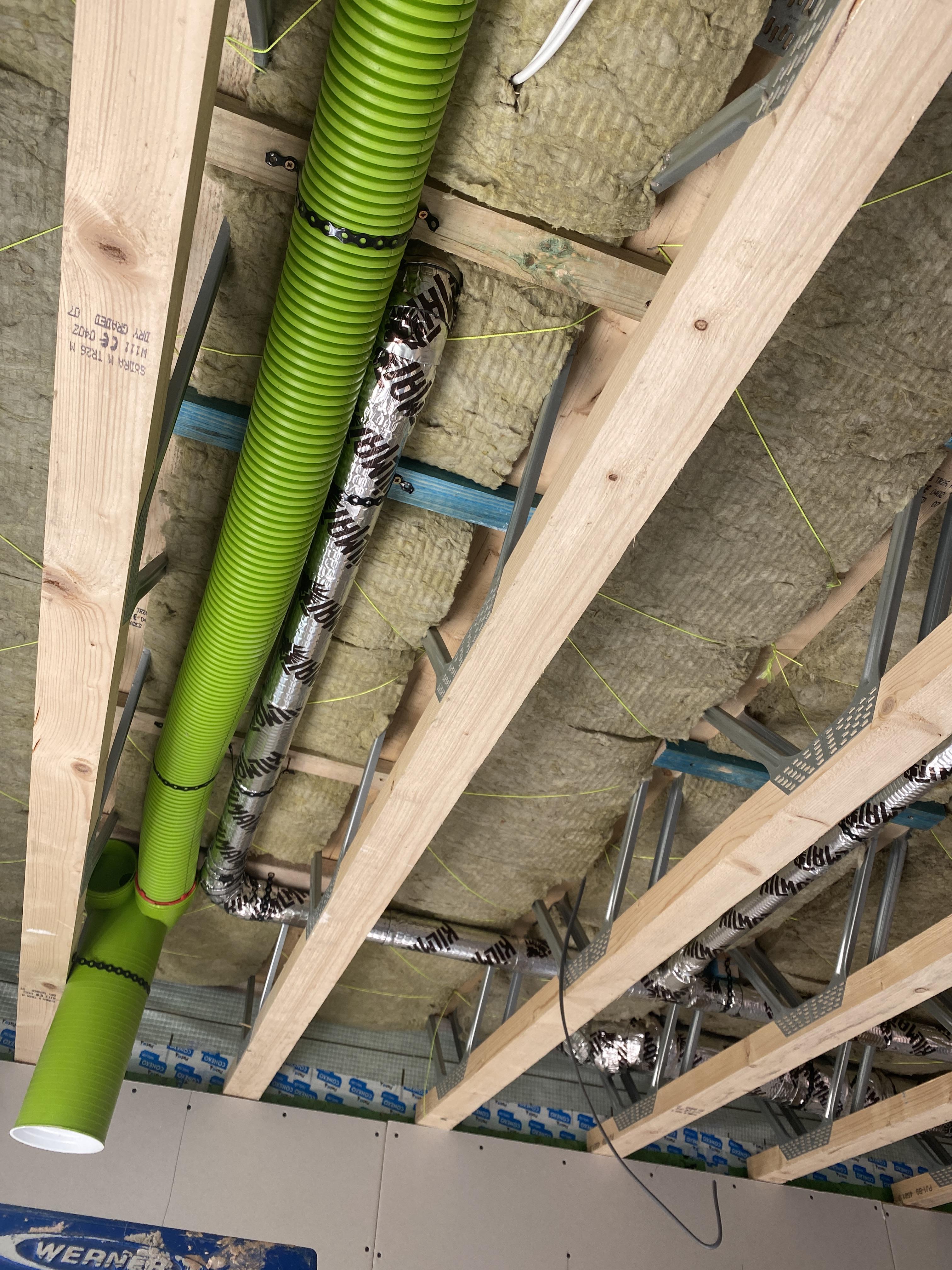
If you keep the insulation up high, the service voids are preserved. -
Friction fit rockwool sagging between rafters
Nickfromwales replied to daunker's topic in Heat Insulation
String is king!! Just use a heavy duty staple gun and away you go.
-
In an ideal world, that is Still wouldn't have mattered, other than the shift of onus. One pour started, then their pump failed, then they brought the reserve pump, and that failed. So the concrete got bucketed in by excavator. IIRC they finished around 01:00.
- 39 replies
-
- 1
-

-
- the windy roost
- icf
- (and 2 more)
-
Indeed, and I've just had this exact conversation with the PH architects on one of my current projects. I'ts down to whether this was impactful on the front facade or not, but blinds (external) would always be my 1st choice for ground floor at least. Overhangs can be a design feature and integrated early at the design stage, so both shoes fit tbh. The main point is, I dislike anything dictating window sizes when PHPP can be manipulated (rob Peter to pay Paul) to achieve a mutually beneficial outcome (manage 'issues' / retain larger windows to enjoy southern views etc), and I feel that PH often focusses too intensely on the dwelling and not so much on the occupants, who may be in residence for multiples of decades. The focus of my attention is always "client first", and then we look what issues that has created and then I 'engineer' my way out.
-
You could have "normal" sized windows in a certified PH, and apply solar reflective coating to manage that. The PH architect would likely push back, but so would then I. Sense would of course prevail.....
-
Friction fit rockwool sagging between rafters
Nickfromwales replied to daunker's topic in Heat Insulation
Indeed. Set a laser up each end and see if the line stays at the centre of each run. That's a quick way to see if you'll meander off course with fixings. Also needs a map making to avoid the few obstacles. Take LOTS of pics with tape measure in the shot -
Friction fit rockwool sagging between rafters
Nickfromwales replied to daunker's topic in Heat Insulation
I assume you're using 2x1 battens over the PIR? Or what is your plan for electrics to lights? Above insulation and dropped down / through? Penny washers and the PIR will be ample to hold the wool at bay, just use a couple more and sleep well. May be a good idea to foil tape the joins and foam the perimeter, to stop the fibres entering the air in that room. Not the nicest of stuff to have continuously feeding into the room. -
The one we did in Oxford was stop-beaded, plastered, painted and so on. Bathrooms in and done, kitchen fitted, M&E complete, and THEN the happy polish guy turned up with a van-load of pre-made & swung units. A couple of days and they were done, zero issue. You can design out any problem These guys slept on site, using packs of acoustic Rockwool as mattresses . That's what you call 'saving your digs money', but on a whole new level.
-
The threat of death works wonders. That or taking their mobile off them.
-
Is It Worth Insulating UHF Manifold Feeds/Returns
Nickfromwales replied to MortarThePoint's topic in Underfloor Heating
Add a strip of 11mm OSB to the beams, then plasterboard? Or stick with 13mm. At 35mm and within the heated envelope means this is neither here nor there tbh, just make sure you fully fill the voids where the pipes exit up high, to stop convection losses from the room to the attic. After that, I think you can relax. -
Be careful……you’ll hurt Persimmon’s feelings. 😂 @Thorfun can take it. Lol. Board over the large openings first, then keep the off-cuts for use elsewhere
-
Is It Worth Insulating UHF Manifold Feeds/Returns
Nickfromwales replied to MortarThePoint's topic in Underfloor Heating
I only use 9mm or 13mm in PH settings (9 on cold water and 13 on ‘hot’ heating / UFH) but I always use 25mm wall for DHW and DHW HRC. The grey stuff is cheap as chips so just fit 19mm and be above the standards. Remember that part L is a dogshit standard and nothing to ever be bragging about, hence the recommendation to go “overboard”. Once you’re at the price point of 9mm or 13mm, you may as well go to 19mm. I’ve been looking into insulation for my current Passiv Haus project (as PH standard has just tightened its belt also) and there’s extremely little in it between the black neoprene (Armafalex / Armacell) stuff and the grey (Climaflex ) stuff, to the point that for the significant cost difference it makes better sense to me to go one size thicker and stay with Climaflex. For DHW and DHW HRC runs I’ll stick to 25mm wall Climaflex and tape along the seams with the Armacell 3mm x 50mm adhesive ‘insulation tape’ for belt & braces. -
I'm on a job where the clients went "Amazon" for the irrigation and it hasn't gone too well. The spurs with the outlets on them all pop off so you lose the spray effect. I expect this could be managed with a pressure reducing valve, so maybe prepare to install one of those onto 2 flexis and then put that inline. Having raw cold mains pressure going into these is not a good idea Same as everything else, buy cheap buy twice.
-
That's plenty. 1:40 - 1:60 is max / min, but as long as it's downhill the BCO won't care....plus the fact that a 50mm pipe creates its own air-break means the water can discharge down the pipe at its own pace without affecting the rate that soap suds etc disappear down the shower drain.
-
Your plumbing has come along nicely, our young apprentice Looks good to me, just hard to see the actual fall of the long run? Have you put a laser / level on it end-to-end?
-
Exacta Mundo. 👌 A pattern develops....
-
It's horses for courses, simple as that. Private clientele who know zero about construction would be forced to use a PM. Not all PM's are any good. That cost is a set % of the gross build (project total) cost and can be utterly unfair and disproportionate, and can also be a 'risk'. That can be a 5 to 6-figure sum. With a company which provides a turnkey service (foundation, structure, insulation, airtightness, B-Regs, S.E. etc) there is an inbuilt opportunity, should you have chosen as well as is practicable, to save a huge chunk of the PM fees that would otherwise reside in your lap, be your responsibility, and would be utterly uninsurable against (most architects and PM's have a long list of exclusions and caveats stitched into their contracts to limit their liabilities) so the risk doesn't go away even if you It's down to trust, getting a "feel" for the customers or companies (the shoe goes onto either foot) and then you decide which is the better of the "2 evils". MBC is like a family run business, and they don't stray from what they excel at doing. They have a 'get in, get done, finish, move onto the next one' ethos, and I for one hold them in very high regard. Would I trust them with £100k of my own money? Yes. Would I trust them with the same sum of money if that relied on them having successfully imported a finished product from abroad to then pass on to me? No. The reason is, trust wouldn't be relevant, as there would be the additional weak link, a completely unknown 3rd party risk attached, a-la the Isotex debacle; a set of circumstances which would then be something that changes things way beyond my comfort zone. These are my own thoughts, and opinions, and not advice. But they do come from over 8 years of familiarity.
-
It does make a difference, even for a short run. Up to you what you want to do, but I say things for good reasons
-
It’s single wall pipe, vs the multi-layer. All ‘fit for purpose’ but if I posted you an off cut of the other you’d immediately see the difference. The bottom line is, this will be 10 bar capable and rarely see more than 1.5-2. I’d say you can sleep soundly tbh.
-
Plumber put together a thing … and I have concerns
Nickfromwales replied to mjsx's topic in Boilers & Hot Water Tanks
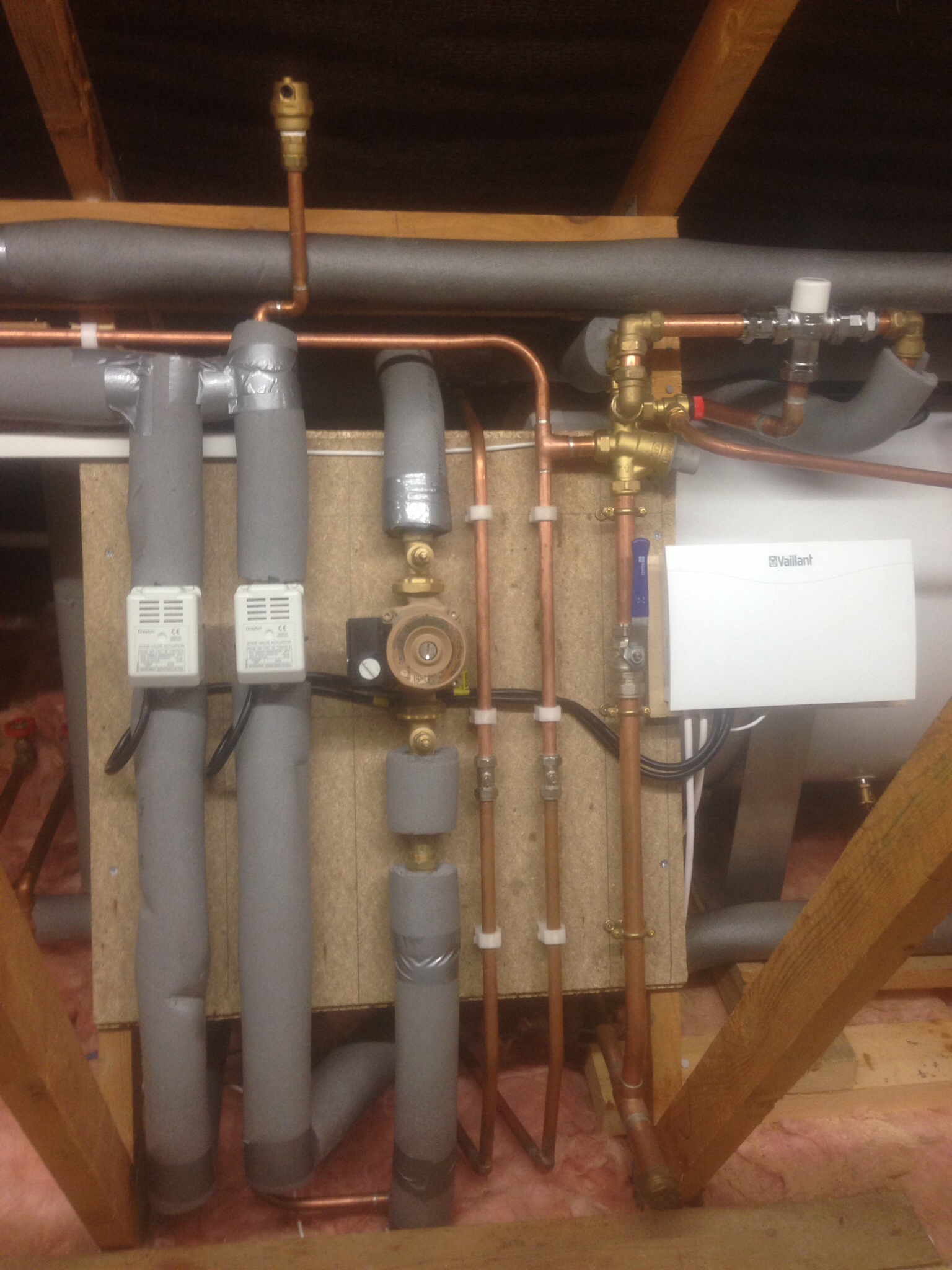
What is the silver valve on the hot outlet? Is it an isolation valve? Pic? -
Plumber put together a thing … and I have concerns
Nickfromwales replied to mjsx's topic in Boilers & Hot Water Tanks
You can see those, clearly, I’ve already looked at the pics closely. OP says they want to limp by, but they should t really be using this appliance as it’s (the gas burning appliance) not been installed to the manufacturers guidelines.