


Temp
-
Posts
10690 -
Joined
-
Last visited
-
Days Won
43
Everything posted by Temp
-
You are correct. If the floor level is high enough no need for the periscope type vents. There are straight through sleeves for air bricks.. https://www.manthorpebp.co.uk/wall-floor-ventilation/underfloor-ventilation/cavity-sleeve
-
The best way is to insert new deeper joists. These should rest on packing placed on walls each end. The packing should raise the new joists, 10-15mm or enough so that when they flex the don't touch the plasterboard in the middle. That reduces cracking of the ceiling below. The new joists should only be fixed to existing rafters at the ends where both are supported. The main problem with this approach is getting them into place in the loft.
-
Light coloured building sand - where can I get some near Brighton?
Temp replied to Mr Punter's topic in Building Materials
Colour looks pretty good for that brick. -
I believe the black ones are for low temperature use. I think you need the red high temperature type. But there is a whole lot more to it. There are rules on the separation between the flue and flammable materials such as insulation that will be in your flat roof. +1. You can DIY the job if you make a Building Control Application but sometimes the BCO asks for it to be inspected by a Hetas or Oftec engineer. If you get a Hetas or Oftec approved installer to do it they will self certify the work to Building Control for you. On Your drawing you show the flue terminating at ridge height. If it will be near the ridge I believe it must go 600mm above it. I'm not sure the picture of the stove on the tiles would comply. I believe there should be a step up of 12/15mm(?) to discourage rugs migrating too close to the stove. Eg the tiled area shouldn't be flush with the wood floor. Hard to tell from the photo if that's the case.
-
He clearly forgot or didn't know the void should be ventilated. Got to question what else he doesn't know or will forget.
-
When we built our place 15 years ago the tiler was very good and we let him get on with it. Very pleased with his work but he's gone back to the EU and I can't trace him. Where we have limestone/travertine he used a slightly rough textured/sandy grout that really suits the stone. Now looking to do another room and all the grout I've looked at in the tile shops are very smooth by comparison. The texture Im looking for is similar to that of BAL flex adhesive. Is it possible he used adhesive instead of grout or does sandy textured grout exist? Recommendations?
-
Because the slot is narrow you probably won't get anything in there big enough to block the drain pipe itself. Pressure washer in the slot will clear out dirt etc. You could also put put an access off to one side of the door. There channels with removable covers but I've found grit tends to cement the covers in place. You end up having to pressure wash out grit to get them back in position.
-
Keep plenty of spare slates and worry about it later.
-
There are types with screw covers for the terminals but I've not used this particular one.. https://www.amazon.co.uk/VARICART-Universal-Regulated-Switching-Transformer/dp/B07PQCW12T/ref=sr_1_2_sspa?crid=1SM01UGKXD772&keywords=24v%2Bled%2Bpower%2Bsupply&qid=1665726309&qu=eyJxc2MiOiI1LjMyIiwicXNhIjoiNC40NCIsInFzcCI6IjMuOTcifQ%3D%3D&sprefix=24v%2Bled%2Bpower%2Bsupply%2Caps%2C621&sr=8-2-spons&th=1 Or.. https://www.amazon.co.uk/Transformer-Supply-Driver-Adapter-2500mA/dp/B09QLSX7XM/ref=sxin_15_pa_sp_search_thematic_sspa?content-id=amzn1.sym.4126c873-2fc2-4af4-a461-de9124226761%3Aamzn1.sym.4126c873-2fc2-4af4-a461-de9124226761&crid=1SM01UGKXD772&cv_ct_cx=24v+led+power+supply&keywords=24v+led+power+supply&pd_rd_i=B09QLSX7XM&pd_rd_r=2199aac2-57bc-41a7-93cb-20aa88774f0e&pd_rd_w=mHhfY&pd_rd_wg=3Sase&pf_rd_p=4126c873-2fc2-4af4-a461-de9124226761&pf_rd_r=D17VH80WN2FRBCSZ6KPM&qid=1665726309&qu=eyJxc2MiOiI1LjMyIiwicXNhIjoiNC40NCIsInFzcCI6IjMuOTcifQ%3D%3D&sprefix=24v+led+power+supply%2Caps%2C621&sr=1-1-b75715df-0cbd-4312-a971-de5362256967-spons&psc=1
-
That type are meant to be fitted into another enclosure. I recently used a Meanwell LED power supply in an audio amplifier and it worked surprisingly well despite not being designed for that application. The one I used had a small hinged plastic cover over the mains terminals but it's not sufficient to protect consumers (only engineers that may have to debug the equipment with the lid off). Eg you shouldnt use one where ordinary people especially kids could get access without another enclosure.
-
+1 Ours came with a warning label stuck to the glass saying never to stand it on a hard surface such as tiles or concrete. Only takes a bit of grit to create a scratch that becomes a fracture point.
-
Fixing planning permission ( stopping the clock)
Temp replied to PXR5's topic in Planning Permission
The rules say once development has started planning permission is extended indefinitely (unless there is a condition requiring completion by date). But the definition of development starting isn't well defined. Most councils accept you have started a house if you have BCO approval to dig and fill foundations, and you do that. It might be possible to do less and to mitigate the risk by getting a certificate.... Near us PP for a wind farm was granted but it couldn't be built immediately because the grid needed upgrading. What they did was built the site entrance and some meters of the access road. They then applied for a certificate of lawfulness/lawful development to confirm that they could build the wind farm in say 5 years on the grounds work had been started. -
Looks like they make numerous different models. One I looked at briefly said it had "Smart battery charger design for optimized battery performance".
-
Excavation of rear garden: reported to the council
Temp replied to bmj1's topic in Planning Permission
+1 on the planning consultant. He will probably tell you what's likely to happen.. Typically when someone complains about a development the planners will investigate to see if Planning Permission is/was required. If its not required that will be the end of it. They will write to the objector and state that fact. If they decide it is required they may feel obliged to issue a Notice of intended enforcement. If you get one of those don't panic because they may just want you file a retrospective Planning Application to regularise the situation. Hopefully the Planning Officer will tell you what he thinks when he visits. Filing a planning application stops any enforcement action until its processed. Even if Planning Permission is refused you can appeal. -
Excavation of rear garden: reported to the council
Temp replied to bmj1's topic in Planning Permission
My guess is they are worried about your retaining walls. Building Control Approval isn't required for a retaining wall (surprisingly) unless it supports a building or neighbours building, but Building Control have powers to intervene if its unsafe. Do they have any buildings near the boundary? If so the Party Wall Act may apply. https://www.gov.uk/government/publications/preventing-and-resolving-disputes-in-relation-to-party-walls/the-party-wall-etc-act-1996-explanatory-booklet There is no penalty for not complying with the PWA but if an existing building or structure is/was damaged then not having complied might go against you if they took you to court. If there are no buildings nearby then I would take and date some photos showing they weren't there when the walls were built. -
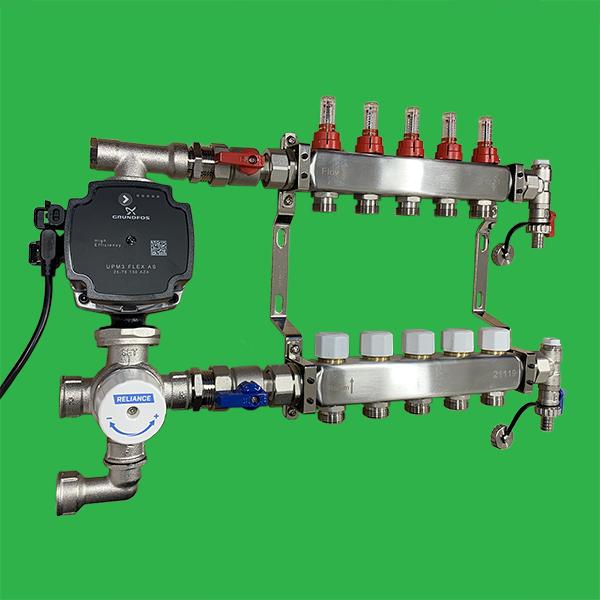
All the photos of Reliance manifolds I can find on the web show flow meters on the top flow rail and actuators on the bottom return rail. Example..
-
What's the inverter? Perhaps I can find a manual that gives more info on its capabilities.
-
That is what modern laptops and EV do.
-
No, about the refresh charge it actually says.. In other words the voltage should be set to whatever value (between 2.29 and 2.4V) produces a charging current of 19A (for 190Ah cells). Charging at the 10% rate used to be called a trickle charge. Theses days they give it names like a balancing charge, refresh charge, conditioning charge etc.
-
@Pta Would be good to have a photo of the pump end of each manifold. Eg Framed to show one actuator and one flow meter, the pump, the isolation valve and the mixer. Some parts like the pump and mixer may have arrows or letters on them like F and R. If these arent visible in the photos can you mark up the photos in MS paint or similar. Eg like this photo without the bottom cut off..
.thumb.jpg.cd36c5865d8da2a9f6fa47c86fd8fa31.jpg.0b7b69ef1b367ecdd894d34c632d51b0.jpg)
-
@Pta Can you confirm you have two manifolds? Somewhat confusingly... On one manifold you have a blue isolation valve for the actuators. On the other its red. Obviously the colour of the knob doesn't matter but..
-
Looks like he has two manifolds, one with actuators/flow at the top and one with the actuators/flow at the bottom.
-
The short answer is no. I've had a good read of the datasheet and they don't say anything about using cell voltage to limit charge time. eg It does not say you can simply charge them until the cell voltage reaches 2.4V (or any particular voltage). In fact it even has a warning that "Continuous charge at 2.40 volts/cell will significantly reduce the battery life". If you want a voltage that the cells can be charged at indefinitely without overcharging that would be the float voltage 2.29V but that won't fully charge the battery. What charger do you have and what are its capabilities ? Instead of using cell voltage they recommend using a BMS system that measures the energy withdrawn from the battery on load and puts back in about 103% of that amount. They describe two ways that can be done in section 2.3.. 1) Using a charger that measures the exact Ah being put into the battery. In this case it says the charger should output a constant 2.4V. Then while charging the charger/BMS should measure the energy put back in and when it reaches the 103% figure it should stop fast charging and switch to float charging or reconnect the load. In float charging mode the charger should output a constant 2.29V. 2) Using a charger limited to a current of 0.5C for a calculated time. The charger should output a constant voltage that depends on temperature as per figure 4. Once the calculated time has expired it should stop fast charging and switch to float charging or reconnect the load. In float charging mode the charger should output a constant 2.29V. The reason is that the cell voltage varies depending on the type and make of the cell, its age and temperature. Cell voltage can be used but its really not a great indicator unless you have manufacturers data which they haven't provided.
-
Try and find a decent energy monitor to measure the exact consumption. In the absence of data.. If we assumed a load of 500W for 4 hours that's 2kWh. At about 48V thats about 2000/48 = 42 Ah. What capacity are the batteries? The Powersafe 12V 170FS is a range of batteries with a capacity from 31Ah to 190Ah depending on the exact model. So they could be anywhere from totally empty to 75% full depending on the model. Clearly they aren't totally flat though. What does it say on the batteries?
-
Putting insulation between the rafters as well, effectively moves some of the rafter towards the cold side so a condensation risk analysis should be done. Not sure I understand that. Are they saying 150mm PIR and OSB is sufficiently vapour permeable? Or did they do a proper condensation risk analysis for you based on the proposed build up?


.thumb.jpg.cd36c5865d8da2a9f6fa47c86fd8fa31.jpg.0b7b69ef1b367ecdd894d34c632d51b0.jpg)