Temp
-
Posts
10690 -
Joined
-
Last visited
-
Days Won
43
Everything posted by Temp
-
Part M Building regs - access for disabled to front door
Temp replied to Happy Valley's topic in Building Regulations
We've had our level entrance some 15 years and would build one again even if it wasn't part of the regs. Much easier getting appliances into the house or anything on a sack trolly. Just this week our son broke an ankle playing rugby and is on crutches. So much easier for him going in and out to the car. -
Some self builders are partly filling studwork with PIR leaving a void for services. Seems insulation contractors don't think its wise to use PIR around ducts... https://www.constructionenquirer.com/2022/11/02/contractors-call-for-ban-on-indoor-use-of-pir-board/
-
Part M Building regs - access for disabled to front door
Temp replied to Happy Valley's topic in Building Regulations
Nope. Its a 12mm (or 15mm) step. This or similar sketches can be found on the web. -
I'd be surprised if any university that had built a house for the purposes of testing energy consumption and insulation etc hadn't done a pressure test on it at some point already.
-
You might have to change that door sill to meet Approved Document M. Get that sorted first. There is some risk of rain blowing onto the patio area. No problem with it being level with the door but where it meets the wall of the house you could put a 6" wide channel full of decorative stone to provide drainage and reduce splashing above the DPC. Something like this..

-
In our experience the drain doesn't need to be really big if the whole thing is raised up..

-
Injected foam in cavity walls is OK. There is/can be a problem if its sprayed onto the underside of roof tiles and rafters
-
If you could create an accurate computer model of the house right down to all the construction defects (holes) then I suppose you might be able to put it into a software wind tunnel (Computational Fluid Dynamics?) and try and calculate the ACH when pressurised. To do it you would have to know where all those defects are. For example one pathway might go like this.. Air might escape from a room into a ceiling void through an array of down lights. From that void it might escape into the cavity wall via holes around the ends of ceiling joists. Then it might flow up the cavity in the cavity wall into the loft, then across the loft to an eaves vent and finally the outside world. There might be hundreds of similarly complicated paths the air could take. There are people on this forum that worry about air getting in/out through the keyhole. Near impossible to build a computer model that detailed let alone simulate all the airflow pathways. All you can do is adopt good design and construction techniques and hope the builder follows them.
-
Solid floor cracked/ broken near skirting board
Temp replied to Monty2468's topic in General Flooring
I was thinking of this stuff but unfortunately £33 a roll. Might be cheaper elsewhere or someone might have the short length you need. https://www.toolstation.com/jg-speedfit-edge-strip/p74324 -
Solid floor cracked/ broken near skirting board
Temp replied to Monty2468's topic in General Flooring
Normally there is perimeter insulation. Probably get it at Screwfix or Toolstation. -
Solid floor cracked/ broken near skirting board
Temp replied to Monty2468's topic in General Flooring
Sounds ok to me. -
Have they told you how much? Back in 2014/5 the Government wanted to exempt small developments but councils went to court and won. The government was given the right to appeal in 2015 but I don't think they have done anything about it. Some councils charge 6 figure sume on large houses. Think the average is/was £15,000.
-
Yeah sorry I think you are right. Its less than 3 for MVHR. Ill edit my post.
-
I was in that position. Still took us over a year to get to get PP. Typical response times back in 2007 for us were around 4-6 weeks. eg You send them a set of plans and 4-6 weeks later they said no and gave brief reasons why. We would make changes and send in new plans, repeat. On one occasion we heard nothing then was told the conservation officer had quit and they had to recruit another one before we would get a reply! PS: I've since heard that the Planning Officer in my area isnt even full time now. He's shared with two other councils.
-
I think MVHR systems are designed to produce a target ACH (building regs use L/S) ignoring any provided by infiltration. On a calm day for example there could be very little. The 0.6 ACH figure is for Passive House standards. Less than 3.0 is the test when trying to decide if the house is even suitable for MVHR. I think if you are tasked with designing an MVHR system you will have to assume the house is suitable or ask if its already been tested? Was it done for a previous years project perhaps? If you need real world leakage rates.. I think measuring the actual ACH due to leaks in varying weather conditions involves using trace gasses. Not sure which trace gasses are used but you could inject one until it reaches a certain concentration, wait a few hours, remeasure the concentration and do the sums to work out how much air has got in to cause the measured dilution. Caution: Dont just use C02 without taking safety precautions. I believe its also possible to use humans.. You can measure the volume of a bedroom and estimate the C02 production of the people sleeping in it. Then by measuring the actual increase in C02 concentration overnight you can estimate the ACH. Ive not done the sums myself but google found .. https://protonsforbreakfast.wordpress.com/2021/06/06/estimating-rates-of-air-change-in-homes/
-
Guttering Design - open gutter end or downpipe?
Temp replied to Nick Laslett's topic in Rainwater, Guttering & SuDS
We have just about every combination on our house. Some dormers the rain just runs off the tiles onto the roof below but the larger ones have a gutter that runs it from left to right (in your picture) then has a short down pipe that deflects it out across the roof..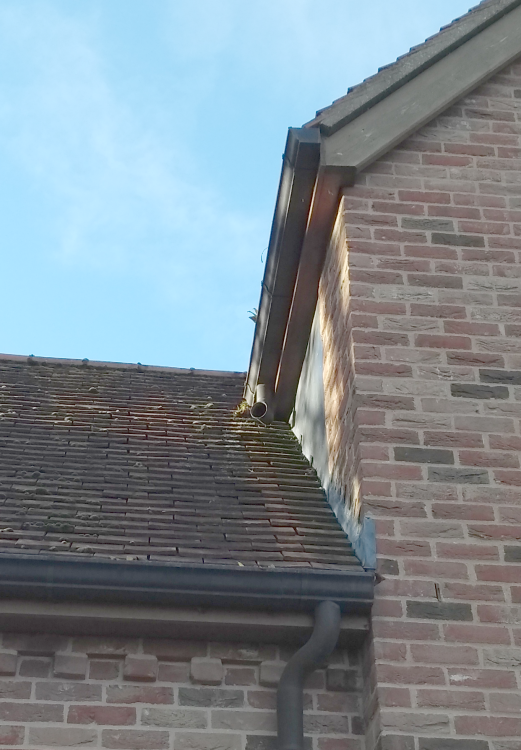
-
Storm water being run with Foul Water (old 1930's house)
Temp replied to revelation's topic in Building Regulations
Sorry its not clear to me what you want to do? Currently some rainwater downpipes go into the main sewer and some go to a soakaway. Which ones do you want to change and to what? -
If they reduce the fence to 1m to avoid having to make a planning application I suggest you keep climbing over it to preserve your access rights. You could even consider constructing a community building on the land as only the legal owner can evict you. Lot depends on how many there are of you and how much (lawful) aggrovation you can live with. If things get heated keep calm and call the police. They cannot help with the civil ownership issue but they will deal with potential breach of the peace. They might even persuade the fence owner to remove the fence to help prevent a breach of the peace if enough different people complain about the fence owners actions.
-
This really isn't something you should mess with. Get your installer involved.
-
Sometimes the planning system is just plain stupid.
Temp replied to ProDave's topic in Housing Politics
https://www.mirror.co.uk/news/uk-news/furious-mum-faces-20000-fine-28346851 Enforcement issued for painting door of listed building bright pink..
-
That might be my mistake.
-
I am reminded of a possible trick... Tell them you think you have found someone with old deeds that show they/you may own the land. Tell them that you will sell it to them for a nominal £1 to avoid getting reassessed for council tax (or some excuse). Put the offer in writing and tell them if they are interested to send you a letter or email accepting the offer so you can instruct your solicitor to do the paperwork. If they do write to you accepting immediately withdraw your offer. Keep the correspondence because in order to claim ownership in 10/12 years time they have to do so in the belief they own the land. Their offer to buy it from you would be evidence that wasnt the case.
-
Unfortunately the fence is his property so yes you could get charged with criminal damage if you take it down. The only other thing I can suggest is to see if you can find who owned the land way back before any houses were built. See if you can trace the owner forward as only they can evict a "squatter".
-
Google found this.. https://www.lawscot.org.uk/members/journal/issues/vol-66-issue-03/property-access-by-prescription-challenge-of-proof/#:~:text=In Scotland%2C the Prescription and,openly%2C peaceably and without judicial I would contact the council and Highways again them to check who they think owns the land. It might be they consider it to be part of the highway or land maintained at the public expense or some other public land. How high is the fence? Does it need planning permission?
-
Roof Trusses higher on one side by 20mm (not level)
Temp replied to connick159's topic in Roofing, Tiling & Slating
Sistering to the side of the truss is probably easiest. No need to cut tapers.