


le-cerveau
-
Posts
524 -
Joined
-
Last visited
Everything posted by le-cerveau
-
What you are looking at is very similar to my original plan, I then went to a stratified TS (discussion on EB about a year ago) and I am now going with a custom Sunamp stack with two different types of cell, the standard PCM58 cells which will be heated by the boiler and some PCM34 cells which will be heated by the ASHP. We are still working out the specifics as this is a custom build but as I have a good few months yet we will get there. It is probably a bit close to the wire for you but you may consider it, they are amenable to custom work, all be it at a cost!
-

Geberit to MVHR extraction
le-cerveau replied to Auchlossen's topic in Bathrooms, Ensuites & Wetrooms
From what I understand, most people doing this are plumbing it into the MVHR so there is permanent extract. If you are adding a separate fan then that is new territory and I suspect you will need to ensure that it does not extract too much! -
Geberit to MVHR extraction
le-cerveau replied to Auchlossen's topic in Bathrooms, Ensuites & Wetrooms
I looked at this and researched it extensively, including numerous enquires with Geberit. They don't sell the Y pipe separately, and as you say the current down pipe is welded in, however the cistern with the Y pipe in is only £10 dearer than the standard on, so if you plan ahead and fit the odour extract cistern without the electronic gubbins and then retrofit later. I know this doesn't solve your problem so I suspect the best (and safest) solution is to take the air out of the cistern, above the fill level (aka JSH) so as to not compromise the cistern. -
So, if you have the time and inclination, build one, move in, then build the other. Ensuring the one you want to live in is the second one!
-
@JamieM, the rough figure I was given (not specific) was in the region of £3000, I suspect it can be got for less.
-
Thought I would chip in, as I have the same problem. I (will) have Internorm doors and need a FD30 garage door, but am not willing to compromise on performance. No matter how I tried I could not find a descent U value FD-30, all options are just normal fire doors or treatments for doors (as long as they are wood) so a composite (high performance) door doesn't count. I am sure that the Internorm HT400 would be FD30 rated they just haven't tested it. Also I found spitfire doors, good U values and Fire Rated on the continent but not here. Apparently there just isn't the market for low U value fire Doors. My solution is that I will fit a fire curtain (or the main contractor will) on the house-garage door (door open in to house so curtain on garage side) for an example see the link below (others are available) http://www.coopersfire.com/ not the cheapest solution, but will comply with the regs!
-
Same for me , a great prompt. Fortunately Allerdale do not yet have a CIL policy so no charges, but I had to check. +1
-
How detailed do drawing need be for Planning?
le-cerveau replied to Gimp's topic in Planning Permission
I had the same a Mike (in my blog part 2) you can see the shading diagrams I did for the neighbours (overshadowing) and the final planning submission with the right to light ones to prove that we weren't overbearing. Even on those we only showed the differences between the buildings and not the actual building dimensions! -
How detailed do drawing need be for Planning?
le-cerveau replied to Gimp's topic in Planning Permission
For planning permission, keep it to as little as possible, as anything you put on the plan they will hold you to, but it if is only a drawing then you have that scalability/fudge factor on your side. You can see what my Architect pout in on my blog. The plans and elevations were had no measurements on apart from GIA, though we did have a topographic survey and superimposed the new house over the old one. Also the elevations showed the houses on either side for reference. If they as for them then you can supply them but don't offer them. -
Geberit to MVHR extraction
le-cerveau replied to Auchlossen's topic in Bathrooms, Ensuites & Wetrooms
@Auchlossen, what brand of MVHR ducting are you using? -
Price wise I am between £500 and £900 per m2 depending on window size, however that is with all the Internorm extras (powered blinds...) so it will massively skew the price, but £350 for a plain triple glazed window should be near the obtainable. I managed to fix my prices before the Internorm price rise.
-
MVHR extract in plant room?
le-cerveau replied to jamiehamy's topic in Mechanical Ventilation with Heat Recovery (MVHR)
Still finalizing my MVHR design but I also intend to extract from the plant room, why wouldn't you! -
We are going Internorm and initially we were having timber/ali for all rooms other than wet rooms which would be UPVC/ali (recommendation for moisture) but we changed to all UPVC/ali as it is cheaper, an in the long term easier on maintenance. There are internal wood effects available on some windows KF410, KV440 and KF200 depending on the style (full details in the latest catalogue) We are fitting KV440 home pure (we want the built in blind) throughout with one exception a KF410 studio as a high level in a build in wardrobe. The pricing is difficult to follow as I had a difference of around 13% between the KV440 and HV350, however as our windows have the I-tec shading (solar drive blinds) this will be skewing the difference. Also as my overall quote ends up with a 41% discount, so I take all window and door prices with a pinch of salt.
-
If you ask Panasonic enough questions they will give you access to the 'Pro Club' this then gives you all the technical documents, very useful in working out what the system is capable of and how to control it.
-
Geberit to MVHR extraction
le-cerveau replied to Auchlossen's topic in Bathrooms, Ensuites & Wetrooms
@Onoff, the pipe back to the cistern is for the Geberit odour extract system, that draws air through a charcoal filter, see picture below. I enquired with Geberit about getting the Y- branch on its own but apparently they are solvent welded into the cisterns, however the cistern with the pipework arrangement below is only £10 more than a standard one, just don't buy the electronic gubbins that goes in the flush plate.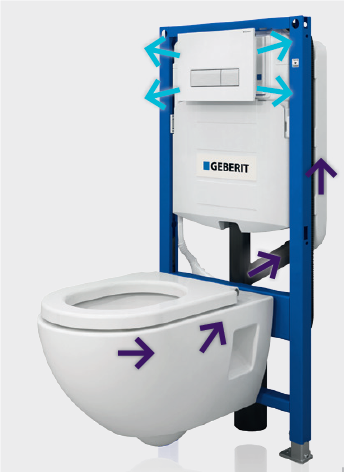
-
Anyone got a hamster
le-cerveau replied to dogman's topic in Mechanical Ventilation with Heat Recovery (MVHR)
There was a thread in eBuild close to this (Rodents in Ducting) talking about pulling/blowing cleaning balls through the ducting. The text is still viewable, but most of the links are broken and the pictures gone. http://www.ebuild.co.uk/topic/17948-rodents-in-the-ducting/ -
@readiescards you may not need to anti bacterially clean the ductwork but they will still gather dust, that is an inevitable fact of life no matter what you do, so there is some cleaning element to be done.
-
I have finally got round to putting the details in STROMA SAP and it came up with: Predicted EPC of EER 116 and CO2 115. The TER was 13.91, DER -11.5, FEE 40.56 and Reduction in CO2 emissions of 119.8%. I have attached the EPC and CSH reports: Rose Lane-Predicted EPC.PDF Rose Lane-CSH Report.pdf So it seams I was in the right ball park. Having all the details in PHPP made it easier to insert into the software.
-
I remember the post about adjusting the flow rate plenum/manifold and the fact the cleaning a inlet/exhaust plenum is easier that cleaning a manifold, however I was (personally) skeptical as it was a company stating this and they tend to push what they stock. (I can't find the post at the moment). I am skeptical as I am struggling to fins a company that can do the whole job for me as I require a flow rate far in excess of the domestic norms (building regs 475m2/h) and most can only cope with smaller systems and aren't prepared to look at doing the ducting and using a third party MVHR unit. (I know I am a cynic). In my mind wherever you have a flow restrictor you will generate noise (based on 20 years at sea living with forced ventilation) so if you do it at the plenum then that is where the noise is! The issue is with this type of system (non manifold) you are limited to your ability to balance it, stand fast iris restrictors in the pipework once on a single leg and I suspect they are relatively expensive. Cleaning is also a issue, I know from experience on how disruptive it is onboard Ship when we have the ducts cleaned, so if it is designed to allow cleaning, then you can get at the manifold to clean it relieving the previous problem.
-
Geberit to MVHR extraction
le-cerveau replied to Auchlossen's topic in Bathrooms, Ensuites & Wetrooms
@Auchslossen you have done what I am planning: With some alterations. Questions: how easy was it to separate the pipe coming out of the Y going up onto the cistern? I presume that is an 82-50mm Solvent weld reducer, 82mm external diameter? What ventilation pipework are you using? Thanks -
A few ASHP / UFH bits of information.
le-cerveau replied to ProDave's topic in Air Source Heat Pumps (ASHP)
Peter, I thought the idea was to run the house as one slab, irrespective of how many loops you have in the slab! This will then re-distribute the heat/cool around the house. So measuring each loop is interesting but you want to control the house from the manifold temp, or as Jeremy did the room temp. As I understand it you can't heat different parts of the hopes to different temps in a Passive type house situation, it just doesn't work as heat will migrate from the warmer parts to the cooler parts before it escapes into the outside environment. -
I think it has all been said but if you think of the basic physics. Heat loss is via the external surface area and 2 x 200L cylinders will have a far larger surface area than 1 x 400L cylinder so your heat emitter is far greater, before you look at the insulation levels etc. You are doubling up on penetrations into cylinders, more heat loss points and cost to install and maintain, it makes little sense to just put in 2 same size cylinders (unless you are running one as a low temp pre-heat fed from a low grade heat source like an ASHP). Go with the single bigger cylinder and then go for the minimum you can work with (that is a long complex calculation). As others have said I suspect your plumber has a ready supply of 200L cylinders and smaller boilers he is trying to use! Just work out the cylinder size you require (not what he has) and the boiler power needed (reheat speed) and go from there, however cylinder size and boiler power are linked as a more powerful boiler will mean you can get away with a smaller cylinder for your needs, so you then have to look at the lowest boiler draw (Heating with no DHW) and can your selected boiler modulate down to that?
-
If you are building in ICF, I presume that your floor will either be a well insulated slab or some other, in which case it does not matter as your internal walls are inside the thermal envelope, are they not! If it is on traditional, strip type, foundations then you have the issue, but then how are you insulating your ground floor from the outside world? And you have all the cold bridges at all the wall floor junctions.
-
I have worked on 2 principals, keeping the soil/waste locations as close together to minimize travel and also to minimize penetrations into the shell. That said I have kept it to 3 full size 110mm soil penetrations through the slab. Two are close together because of a ground floor wet room shower forcing a second one near the main stack. The third serves 2 en-suites and the kitchen. Soil.pdf
-
The numbers I listed are not the complete set, that would take forever to duplicate in the post, just some of the generic. I have all the values listed in the SAP 2012 guide. I will give some of the suggested ones a try. Thanks