


le-cerveau
-
Posts
524 -
Joined
-
Last visited
Everything posted by le-cerveau
-
I am not looking for room in room, just the best general sound insulation between all house rooms. The one issue with ICF internal walls is they will be 250mm thick plus plastering, whereas stud/block will be closer to 100mm. Stud work would be easier, particularly for electrical fit but then I would have to use the correct filling and boarding, so not sure of advantage over a traditional block wall?
-
My design is moving on and I now have an ICF supplier (wall and slab) (Econekt) and a Structural Engineer is working out all the details, which means I have 3-4 support posts (Steel) within the original internal wall structure, 2 x steel beams and 250mm thick Widespan planks to make up the first floor (8.6m spans). What this means is that all my internal walls can now be anything, ICF / Block / Stud, with no requirements for thermal insulation the question is what will provide me the best sound insulation?
-
Our project is similar: We are demolishing the existing bungalow and replacing it with a 2-storey house with a slightly larger (filling in the gaps) footprint, although we are not moving it much, just off the boundary. My blog has the planning battle details in it, but go for what you want, providing it isn't wildly out of character, even go slightly over so you that have a pre-determined compromise plan and the planners can be seen to have won something from you.
-

Wall vents for mvhr
le-cerveau replied to ProDave's topic in Mechanical Ventilation with Heat Recovery (MVHR)
Joining in with a similar question. My house will have a significant MVHR requirement, 419-423m2 Floor area (depending on the day I measure the plans) and a volume of approx 1300m3! That gives me a vent flow rate of 458 m3/h (UK Building Regs), even using 0.3 ACH it is nearly 400 m3/h so quite high. I am looking at a unit in the 700-900m3/h range so that it runs at around 50% normally and these come with 200-250mm terminals. All the terminals I have seen appear to max out at 180mm, without going commercial, although the MVHR unit will most likely be form the light commercial range. Do I look at the commercial range of terminals or split to 2 x domestic? I haven’t decided on roof or wall terminals yet and either is a possibility, NNW elevation would go through a gable wall ENE through the roof, prevailing wind SW. -
Thinking I could put a small buffer in instead of a LLH, to account for DHW calls when cooling and also reduce stop/start for the ASHP in cooling mode. I mean small buffer tank like the Vaillant 40L one they use with their ASHP.
-
politics I bumped into this today.....
le-cerveau replied to ToughButterCup's topic in Environmental Building Politics
Technically, the council official’s ace correct, they are there to stop the elected but ‘un-informed’ councillors from doing what they are not allowed to do! They need to update their building regulations or have a local by-law that enforces higher standards of building regulations. However I agree with the councillors on their wishes, they have just gone about it the wrong way, which, I am sorry to say, is typical of elected officials! -
My thoughts for hot water were that the boiler could cope if there is DHW whilst there is a cooling call as during the cooling season the DHW demand is lower (incoming cold is warmer) but nothing is set in stone so I could easily change the control strategy to prioritise hot water.
-
So here is my latest update of the system: A higher quality .pdf version: Heating-DHW-Design(2-port).pdf There is a lot but you can break it down into constituent parts by: 1. ignore the UFH manifolds and see the supply-flow to them. 2. Ignore the Cold water side. 3. MVHR pre-heater is just thinking aloud (probably won't happen). Some explanations: TMV 3 prevents the UFH drawing heat from the top of the TS unless the bottom is cool (ASHP failure....) TMV 4 allows the ASHP to provide the duct-cooler with 8C water but limits the UFH to about 18C. When warm (20C) water is circulating it will try and draw through the cold side (LLH), the alternative is all the way through the LLH, ASHP and TS (highly unlikely) I think it all makes sense and I am using just 4 motorized valves, the remainder and mechanical (on way) or thermo-mechanical (hopefully).
.thumb.jpg.6e3a47f3ac3e6aef8586e40d77db6c68.jpg)
-
Jeremy (my simple maths), Worst case heat load (PHPP) = 4057W Worst case ∆T (only 350m2 UFH pipe) = 1.27K 4.057kW = 4057 joules = 243420 joules/min Divide by 4200 = 57.957 Divide by ∆T of 1.27 = 45.63 l/min (based on floor ∆T). If I assume each pipe (200mm spacing) pushes out more heat that the floor itself and have a flow/return ∆T of 4K then it is 12.49 l/min. So you say a 4K ∆T on the coldest day is realistic that gives a flow rate of 12.5 l/min which is <1m/s using 20mm valves (both manifolds fed from one valve) for the TS/LLH (Low Loss Header) to the UFH. 9kW ASHP running at full power to TS/LLH through 20mm valve still in the 1-2 m/s range. I suspect I can stick with 20mm valves and will probably take your advice in using multiple 2-port ball valves.
-
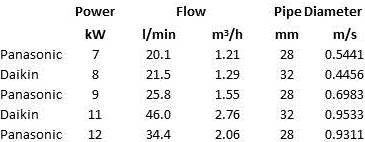
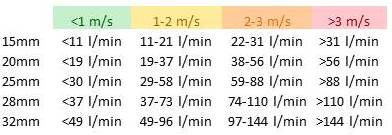
Jeremy, The 28 and 32mm was from the water out from the ASHP’s. The 2 manufacturers I am currently looking at have a 28mm (1-3/32”) or 32mm (1-1/4”) connection for water supply and return so I just went with that. That was agnostic of power or flow rate, 7-12 kW and 21.1 – 46.0 l/min max flow rate (interestingly the highest is for an 11kW version that also supports a 16kW unit). This gives me a flow rate (basic no account of pressure loses) of 0.44-0.95 m/s. (Calculations below) If I extend this to work out flows in various pipes I get: So it depends on the ASHP I use. My house need 4kW of heat (worst case) add in DHW pre-heat and a spare so it doesn’t run at full power (defrost issues) 8-9kW is probably more than enough so 25mm keeps me below 1 m/s and 20mm in the 1-2 m/s range, that reduces the price of my original Class VI valves to £108 and £83 but still expensive. I was trying to reduce the number of motorised valves but as you say 2-port valves are cheaper and more readily available. I also did some generic flow calculations to show volume range through various pipes at various velocities, may be useful to some people:

-
Update, I am getting nowhere with the 6-port valve suppliers (unsurprisingly) so will have to revert the design, however I have found a supplier of 3-port ball valves that are ANSI/FCI 70-2-2006 Class VI leak proof (the top rating) so should do. Downside cost, I will need a 28/32mm valve and a 20/25mm valve, these are £199 and £108 respectively (they are full bore) and I need the large one as I have one on the ASHP supply side so full flow required. Actuators will be another £200-£300 each, however a normal 32mm 3-port motorized (crappy, shoe/paddle) valve would be about £150 so in the grand scheme of things not a miles away, but probably worth paying for the ability to isolate the TS when cooling.
-
It was all going so well
le-cerveau replied to Triassic's topic in General Self Build & DIY Discussion
This is one of the reasons I remain with printed statements (provided it doesn't cost me), however I can print my statements from my online access, I have a color laser printer and the result is identical to the delivered one! -
It was all going so well
le-cerveau replied to Triassic's topic in General Self Build & DIY Discussion
Just finalising selling my flat to part fund the re-build and it has been delayed, should have completed tomorrow, but the purchaser hasn't transfer all his deposit funds to the solicitor so the solicitor can't get the mortgage funds until they have the deposit funds, I hold my breath. There is something to be said for the Scottish system of an "offer is legally binding"! -
Success, I challenged the quote stating that the lines down the side of the house were subject to a Wayleave and that I didn't really want them so I sent in a e-mail, politely requesting their removal: I need more details on the exact breakdown as you are talking about replacing lines as we are re-building our house too close to the lines. The lines in question that run down (and slightly over) the side of our property to a pole in our garden are subject to a Wayleave that I own. They do not supply our house but other properties (so are not my problem). If it is these wires and beyond that need replacing then that would be at your cost. I personally do not want the lines running down the garden and could (if so inclined) require them removed (removal of wayleave permission) but I am not at that stage at this point. I would be agreeable to you replacing the lines with new insulated ones which could be tied in with our re-build schedule quite easily, we get the building down you replace the lines before we start the re-build, or you could, if you so wished, re-route them down a more suitable direction. The house they feed, with one exception, are all on a different street and the others houses(later build) on that street are fed from a different direction. I have 2 copies of the wayleave (1960 and 1974) Document no 64/7184 and 64/11062 they are from the North Western Electricity Board Electricity Act of 1947, but are still in force as we receive the wayleave payment each year. The result ENWL will now pay for the diversion work and my quote has gone from 15K + VAT to 5K +VAT. Still not insignificant but a lot better.
- 13 replies
-
- 2
-

-
- 3-phase
- overhead lines
- (and 1 more)
-
Trw1444, the schematic (current) is on the previous post (link at top)
-
I have tried to google the price but was totally unable to find any info, without a Siemens account.
-
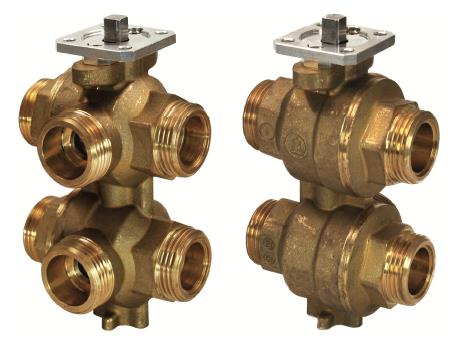
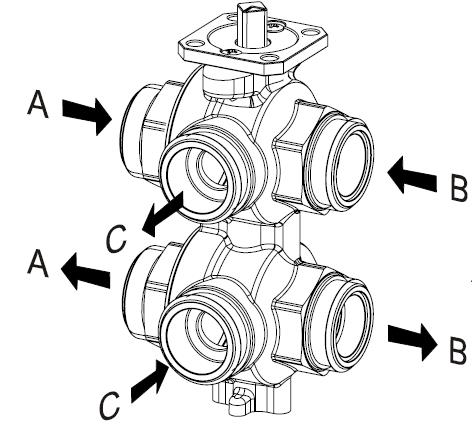
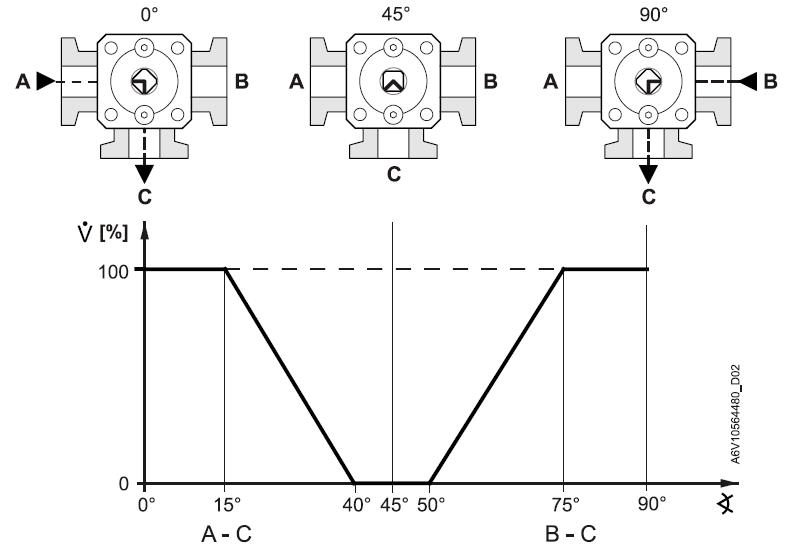
A follow on from my previous question: Has anybody had experience of these 6-port Ball valves? It is designed to switch a radiant panel between a heating source to a cooling source and I was considering using it in reverse to switch the ASHP between the 2 destinations in my design. I am considering it because it is a ball valve which completely isolates and can have equal flow between outputs: I would have to put in a bypass into the ASHP supply as it takes 80-90 seconds to change and has a dead (no flow point). This one is the Siemens VWG41.20-4.25-4.25 (20mm connection 4.25m3/h through each way)
-
Paddle or Shoe Valves? (Now Ball Valves)
le-cerveau replied to le-cerveau's topic in General Plumbing
Peter, Not overly worried about some seepage into the MVHR duct heater in heating mode as it will be a: minimal and b: of such a low temp as not to make a significant difference to the MVHR, but will consider isolation valve there also. As to the blending, the UFH only needs very low temp maybe 24C, I was pre blending to reduce heat takeout from the TS, I was considering losing the mixers from the manifolds (2 of 1 upstairs, 1 downstairs) but thought it would give me another layer of control (complication) to run the downstairs manifold slightly warmer than the upstairs (as heat naturally rises), I probably should lose one or the other, to reduce components. I still have time but the design is coming together. -
Paddle or Shoe Valves? (Now Ball Valves)
le-cerveau replied to le-cerveau's topic in General Plumbing
I have done a complete control re-design, reduced to 2 motorised valves by utilising the Hydraulic separator/Low Loss Header (LLH) as the bypass and then switched to 2-port valves with bypass valves to control the flow. The way I think it will work (not being a fluid dynamics expert) is a follows: House Calls for Heat: Valve 1 & 2 open. Water circulates round the UFH and through the TS (via mixing valve) to provide heat to house, the bypass valve prevents water flowing to the LLH. If the TS calls for heat it flows from the ASHP, again the bypass valve prevents heat going to the LLH. House at Temp: Valve 1 closed, Valve 2 open. Water continues to circulate, but Valve 1 is closed so the bypass valve open and water circulated through the LLH. The pump on the MVHR circuit will prevent water passing that way and the one-way valves at the ASHP prevent it short-circuiting through the TS and via the mixing valve. The TS can still call for heat as before. House calls for Cool: Valve 1 & 2 closed. Water circulates through the LLH as above, the ASHP runs in cooling mode and provides cool water to the LLH via the bypass valve, MVHR duct cooler can also be energised to provide some air cooling. TS call for heat is ignored due to NC relay opening on cool call. I have just shown the control elements for simplicity and which way the pumps work. (pdf version also available for clarity)Heating-DHW-Design(2-port)-Control.pdf How does my logic stack up?-Control.jpg.8ff8c41375a063d22d52cdcd81190607.jpg)
-
Paddle or Shoe Valves? (Now Ball Valves)
le-cerveau replied to le-cerveau's topic in General Plumbing
Minimum flow rate 12 l/min, max 46 l/min which is 2.76 m3/h so the ¾" (15mm) one would suffice but if I went this way I would probably go for 1" (20mm) valves to reduce flow pressure. -
Paddle or Shoe Valves? (Now Ball Valves)
le-cerveau replied to le-cerveau's topic in General Plumbing
They are available in ½", ¾" and 1" with a 12mm, 15mm and 20mm orifice respectively with a Kv (m3/h) of 8.6, 21 and 26. The valves I am currently looking at are by JP Fluid Control http://tameson.co.uk/electric-ball-valve/ So a 1" valve with a 20mm orifice has a Kv or 26 m3/h (straight) and 7.02 m3/h ('L' diversion) Definition Kv-value: Amount of flow (m3/hour) of water of 20°C in a valve with a pressure loss of 1 bar. The amount of flow of a fluid through a (solenoid) valve can easily be calculated with flow coefficient Kv. The Kv-value expresses the flow rate of water in m3/hour in a valve with a pressure loss of 1 bar and a temperature of 20°C. where: Q = flow rate of liquid (m3/hour) Kv = flow coefficient (m3/hour) SG = Specific Gravity (=1 for water) dp = pressure differential over the valve (bar) The manifolds have a max flow of 30 l/min which is 1.8 m3/h, so in theory the 3/4"(15mm) one with 21 m3/h / 5.67 m3/h would suffice. More food for thought. -
Paddle or Shoe Valves? (Now Ball Valves)
le-cerveau replied to le-cerveau's topic in General Plumbing
Update on Ball valve flow: Straight through the 'T' if is at full capacity but round the 'L' it is approximately 27%!!!!! so I guess it will be 2-port valves for me! Plumbing design update required! -
Paddle or Shoe Valves? (Now Ball Valves)
le-cerveau replied to le-cerveau's topic in General Plumbing
Peter, yes a hydraulic separator/Low Loss Header -
Paddle or Shoe Valves? (Now Ball Valves)
le-cerveau replied to le-cerveau's topic in General Plumbing
I need to look at the current layout and see how I can minimise (if possible) the number of valves. One problem is that the ASHP producers have driven me to include a hydraulic separator in the circuit when cooling, to separate the ASHP circulating pump and the 2 x UFH manifold pumps, also I have a duct cooler on the cooling side. I will have a think about it but nothing is set in stone yet, net event the TS type (or option for Buffer tank and TS). I think the key thing is I will be insisting on ball valves, and I will keep researching the 3-port option (with the manufacturers). -
Paddle or Shoe Valves? (Now Ball Valves)
le-cerveau replied to le-cerveau's topic in General Plumbing
So, I think I am convinced it should be ball valves! (simple answer) If a ball valve is available with decent 3-way flow would people recommend that that is a viable option, I am still keen to reduce the number of moving parts as far as possible, because with 2-port valves I double the number of motorised valves?
.jpg.278830018631087b75f4ae1c5dc7da56.jpg)