


Marvin
-
Posts
2389 -
Joined
-
Last visited
-
Days Won
3
Everything posted by Marvin
-
You feel this is not quite the right reason then?
-
Tricky one. I had discussions with Building inspector about flat roof and vpb under celotex. Inspector wouldn't agree not to install it, despite all edges/joins silver taped. I would ask Building inspector.
-

The 4 phases from Rainwater to flushing the loo
Marvin commented on Marvin's blog entry in Rainwater Harvesting
Fine filtering basics: https://www.cdc.gov/healthywater/global/household-water-treatment/sand-filtration.html Here is my adaption: So the pump pumps up to the top of the filter. The water drips through the diffuser (The bottom inch of a bucket with holes in it in my case) and runs through the barrel to the bottom pipe grid. The filling is a graded very fine sand (I used block kiln dried paving sand, then sharp sand, then grit, then sieved 20mm down stone into bigger and bigger layers until starting around the pipe grid with 20mm stones. The levels of all of the pipes in relation to the power of the main store pump, how fast it flows, and how fast the water passes through the filter bed is all critical. If the main store pump pumps the water in quicker than the filter will let it pass it will travel out the vent at the top. As it rises up the vent pipe more pressure is put on the filter to let the water pass and this may resolve the problem. However high up I installed a Tee which allows any excess to return to the main store via the overflows from the barrels. I brought the water level low so it was in the sand to try and stop the plastic barrel from splitting in a frost. The bottom pipe needs to rise so water is held in the sand. Most of the pipework I used is actually overflow pipe including the pipe grid, but the delivery pipe from the main store pump is plastic pipe. The barrel I used: https://www.diy.com/departments/ward-100l-slimline-water-butt/679230_BQ.prd?ds_rl=1272379&ds_rl=1272409&ds_rl=1272379&gclid=Cj0KCQjwlemWBhDUARIsAFp1rLUXvi2blwts9pdQr41OGdw5rsl3w2dI2rdvcebgBOq0ri9rHPDhGhEaAj82EALw_wcB&gclsrc=aw.ds&storeId=1163 Pipes all over the place... In order to get the pipes right I played with the levels by putting a really tall pipe as a vent and looked to see how high the water went. Secondly I reduced the amount of sand used which had no adverse effects. Once started the first water was brown but after about a week it went clear. My filter is also connected at the top to a water butt overflow so during the winter the excess water flows through the sand filter over fills the barrels and overflows into the main store to run into the soakaway when too much. I think this constant trickle through the winter is what has kept the system so well. Good luck. M -
The 4 phases from Rainwater to flushing the loo
Marvin commented on Marvin's blog entry in Rainwater Harvesting
Most stuff off the roof goes through gratings in 2 places and what is left is dead moss and bird poo. However, you are right that a gully with a grating at ground level would be better. The pipe layout between the properties make this choice not possible, but still a good idea (anyone who is considering setting something up!). Good idea. I didn't want to seal it off because of the chance of syphoning. Now I will have to lift the lid again....😧 Thanks for your thoughts. M -
Hi @ReedRichards Obviously its designed to use gravity. I have it horizontal.The internal flap sits almost vertically. Yes it could but I have no vertical pipe between the buffer tank and the 28mm tee. I think both could happen, the latter most unlikely, but neither reliably. Since installing the valve the hot water tank heat loss has greatly improved. However, the buffer tank now heats up due to the radiator pipes sitting in the hot loft, so another job to do.... M
-
The 4 phases from Rainwater to flushing the loo
Marvin commented on Marvin's blog entry in Rainwater Harvesting
Crates and liner for the shape, also crates designed to withstand side pressures. We had limited room. (Shape low and wide) Fine filter next thing to post. -
The 4 phases from Rainwater to flushing the loo
Marvin commented on Marvin's blog entry in Rainwater Harvesting
Diagram of the bulk water store design: Our store is below ground. I actually used a pond liner and soakaway crates below the patio. Here's looking down the access hole: Make sure the pump you need is capable of getting down the hole! The pump will need to be determined by the flow rate and head of water required. Missed on my diagram of the tank is the fine filter tank overflow pipe which goes FROM the filter down to the bulk tank. This was needed to let the air out of the head of the fine filter tank and also to let water back into the bulk tank if it is being pumped up faster than the filter can filter it. -
👍 Think your right. Good to check options first though.
-
You know the button is a dual flush?
-
You've taken the blue plastic plate away to see the pipes after that are ok??
-
Can you take a photo showing the flusher system?
-
When the button is pushed, does the other end of the plastic tube respond? When you take the tubes off the button and push the button is air forced out of the button tube connectors? I.e. is it the button, pipe or flusher not working?
-
6 bar pressure daytime to my house - do I need a PRV?
Marvin replied to Question's topic in General Plumbing
I always fit a PRV now adays. Why do you need more than 3 bar in your home? The pressure changed when the water companies needed to supply more water down the mains pipes leading to new houses. Faster flow = more water per minute at the end. And as @CAdam says more wear on parts with high pressure. -
Is polypipe UV stable or does it break down over time?
-
Concrete base and circular chamber big enough for accessing tank, access through floor to be able to remove tank when required, automatic sump pump incase of flooding, tanking to walls... Yes it can be done, just like your spectacular gates, but it might take a while with a hole open that SHMBO might object to/fall down.
-
Hmm.. all sort of issues to overcome. Obiviously possible, but undermining foundations giving rise to heave would be my first concern, then drainage, then....
-
Hmm... the less you heat, then, the more money you save. My tank has 200mm of Supersoft and a box around it. (Carrying out alterations at the moment....)
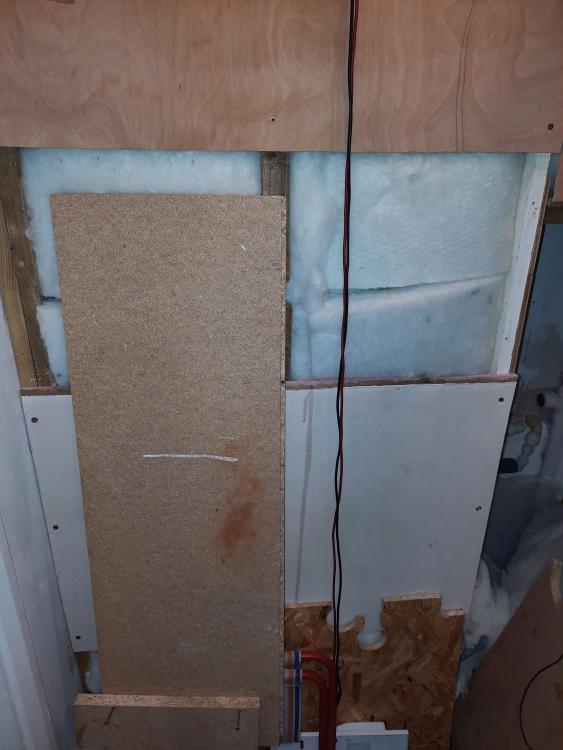
-
Lots of different choices... IMHO I would install the option to divert all the heat into one tank when in winter and there is less solar energy, otherwise you end up with lots and lots of lukewarm water. (trust me I know)😧 Again, I would first work out how much hot water is going to be used a day. No point spending loads of money insulating tanks and in the summer the tanks leak warmth which is not welcome in the building. (or perhaps it is, if the tank is in your bathroom!??)
-
MVHR 'Reverse' Operation
Marvin replied to MJNewton's topic in Mechanical Ventilation with Heat Recovery (MVHR)
The 40C+ heat in our loft caused the inlet air temp to increase dramatically. I am working on shortening the inlet pipe and increasing the insulation on it. Secondly I am ready to instal 2 thermally controlled fans to extract the heat from the loft once I can work up there. We will see what difference that makes.. -
https://www.resol.de › 48005...PDF DeltaSol® BS Plus - Resol
-
London flat renovation - Am I being totally ripped off?
Marvin replied to Hattie's topic in House Extensions & Conservatories
Also are the prices estimates or quotations? ( a quotation a non fluctuating price for the works or an estimate that allows the price to change.) -
London flat renovation - Am I being totally ripped off?
Marvin replied to Hattie's topic in House Extensions & Conservatories
Hi @Hattie In my humble opinion.... To me, @bmj1 suggestion sounds like the least complicated and gives you the most control. You could deal with the mess one step at a time: Agree and recieve the money from the insurance company. Add that to your build fund figure, deduct 20% from the total for contingencies, and now you have the budget you need to use to be able to do all the work and EVERYTHING associated with the work that has not already been paid for. If you can obtain quotes for the full cost of the works that total less than the budget figure then your in the right area. If the total eats into the 20% contingency then you have to be very careful about additional costs. One of the easiest ways to over spend is by making changes as you go along. Know as much as you can about what you want. Good luck M -
The 4 phases from Rainwater to flushing the loo
Marvin commented on Marvin's blog entry in Rainwater Harvesting
Pictures of our Catch pit: This is just our installation. You could use a plastic water butt, with the right pipe entries, by the side of the downpipe but remember to protect against frost. Note that the inlets are at the normal water level to avoid water dropping too far and agitating the sediment at the bottom. Lift the lid and... Central branch fitting inlets both angled. Please not the chamber is empty and would normally have water full to the bottom of the outlet pipe. The catch pit works entirely by gravity. The size of the pipes has to be able to take the potential amount of water coming from the source. No use using a 32mm pipe if your supply is a 75mm down pipe!!! Different angle: You can see by the black tidemark on the left hand pipe the normal level of the water. The position of our catch pit is basically along an uninterrupted pipe between the down pipe and the soakaway. This ensures that any rainwater will pass through the catch pit and then the store before entering the soakaway. Unlike water butt fillers that you usually see attached to down pipes, once full, the store continues to receive fresh water and the excess goes into the soakaway. -
We use 4 phases from rainwater to flushing the loo with it and they are: Collecting, separating and storing in bulk tank. Fine filtering and storing in barrel. filling the gravity tank in the loft Filling the cistern This is not the only system that is possible but one that works with our property limitations. This design and its controls take into account freezing conditions. We use two 12V pumps run from batteries and PV. Here is our system: We were limited for space and you can use gravity to your advantage Here is the design of the catch pit: A circular chamber with a flat base side entry pipes angled to make the inflowing water circulate around the edges. A Tee set vertically with the branch horizontal. Construction details could be concrete slab and engineering brick sides with manhole cover and frame like ours. Needs to either be under the ground or drained before frosts if using a plastic tank. Ours was 900 internal diameter, really the bigger the more sediment settles, but this is for about 200m2 catchment area. If your going for smaller I would go for as tall as deep as you can. The separated water goes directly into your bulk storage ready for further filtering. Ours has just been cleaned out and I will take photos tomorrow. M
-
Evert time I think I have the answer another alternative comes up👍👍👍


