


Marvin
-
Posts
2389 -
Joined
-
Last visited
-
Days Won
3
Everything posted by Marvin
-

How to decide between ASHP or Gas boiler for New Build
Marvin replied to Meabh's topic in Air Source Heat Pumps (ASHP)
Hi @Meabh Lots of good stuff above... As you are building new you could choose either the gas or the ASHP route. As @JohnMo says the zoning could be tricky. But not only for heating but also for cooling (if your using an ASHP) and the MVHR system. @ProDave hits the nail on the head about peak heating demand. I designed our home to heat to 23C when the outside temp is -8C - four degrees below the lowest temp here in the last 10 years. Also I put as much PV on the roof as possible. - great advice if your going for PV in my book, especially if have a Solic 200,an ASHP and/or EV (Electric Vehicle) We have AIM (Airtightness Insulation, MVHR) and APE (ASHP, PV, EV). AIM works well as a group, and I think that's where your at. I have a different opinion than some about using PV. APE also works well as a group. We use the PV to heat the hot water 205 storage tank using a Solic 200. When the ASHP is not needed for heating or cooling we turn it off as on standby it uses about 93Watts an hour, which is more per day than we would use to heat the hot water using the Solic 200. We have had hot water by this method for weeks now. Also it stops the need for the cooling ASHP to suddenly change tack and heat the hot water when cooling the home on a hot day. As @Carrerahill says most of the UK housing stock fails to achieve a suitable standard for ASHP ( poor AIM levels). Good luck M There have been many discussion on Build hub about ASHP installations and I am of the opinion that from an installation point of view they are more technical than a gas boiler with regard to positioning the various items and they are more complicated to programme and fine tune for each individual property than a gas boiler. That being said we are happy. Our EV is at home most of the time and we have charged it up fully buying the power about 5 times this year. Most of the time we use a little mains or no mains at all when charging. When home and not full we plug in the car and through the use of CT clamps and relays we slow charge the car when the PV is producing over 3kW. We estimated that our PV power costs about 10 pence per kWh assuming it all lasts 7 years. We achieve about 4 miles per kilowatt. -
Steel post installation design. Help needed
Marvin replied to Marvin's topic in Landscaping, Decking & Patios
Hi @CarrerahillThanks for your info. I did think of moisture problems, that's why I was thinking of filling using a foam gun. No air inside no moisture inside? I did think of drainage at the bottom, However I was concerned with the water table.- No rain here for 7 weeks and the soil at 1.2m down is very damp. Would it rise up the steel box when the water table rose again....? -
Steel post installation design. Help needed
Marvin replied to Marvin's topic in Landscaping, Decking & Patios
Yes I do the same. 👍 -
Steel post installation design. Help needed
Marvin replied to Marvin's topic in Landscaping, Decking & Patios
Hi @Conor, Thanks. External metal all to be painted. Below ground. Good idea about the bitimous based paint. I will use it below ground. -
Steel post installation design. Help needed
Marvin replied to Marvin's topic in Landscaping, Decking & Patios
Thanks yes not structural. Has Postcrete the same density as concrete (i.e. not porous)? Would it be best to let the concrete rise up in the box steel or cap the bottom off? -
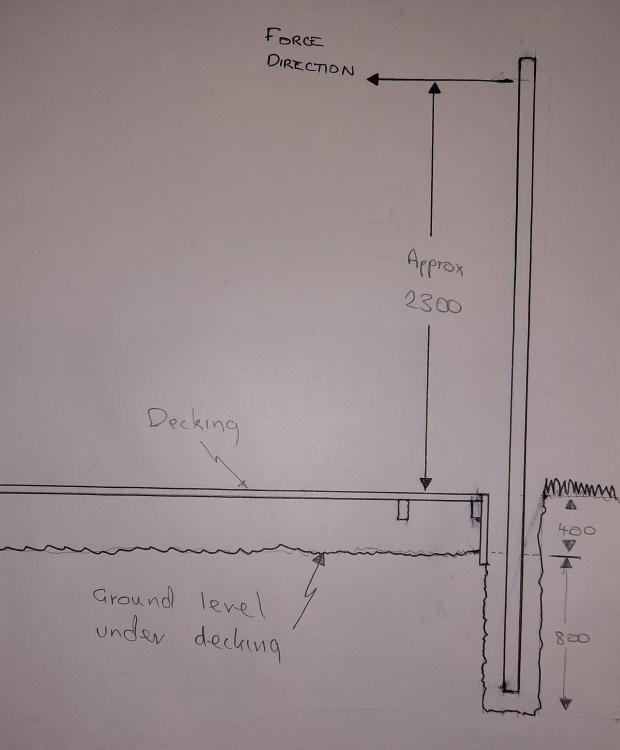
I have to fit two 3mm bare steel 80mm by 80mm box posts into the ground. There is no room for a base plate and bolts to fix them to a lump of concrete so I am going to treat them like fence posts. As the first 400mm down in the hole is unstable due to decking etc I have dug a hole 1200mm deep to take the posts. I am going to use Postcrete The posts will stand about 2400mm above the hole and have a horizontal force of about 60kg at about 2700mm above the solid ground. What are the best options to avoid the post rusting when its in the ground. Obviously painting the outside and covering the top. Paint the inside? Foam fill the inside? Concrete the inside? Cap the top and bottom? Vent the top to let humidity out but no rain in? Wrap the bottom in plastic but make sure no water can seep between the plastic and the metal? Suggestions please.
-
SWMBO said the same.
-
Sleeved and non-sleeved plugs
Marvin replied to Adsibob's topic in Regulations, Training & Qualifications
I suppose the question is, assuming that the unfused plugs are supplied with a 6amp fuse in the consumer unit, will 240 volts at 6 amps injure a person? -
Sleeved and non-sleeved plugs
Marvin replied to Adsibob's topic in Regulations, Training & Qualifications
I can't see what your missing. -
My neighbour has a bungalow with a feed and expansion (F&E) tank at the top of his loft. It was completely cleaned out a few month ago (it had black gunge in it). About 2 months later the overflow started dripping. On inspecting the tank it was "mould growth" that stopped the ball valve from working. I think this time it was white mould but I will check with him. What is causing the mould? How can it be stopped? Details: Typical vented central heating system with radiators and oil boiler. Hot water pump, 3 port valve and hot water tank (HWT) in loft! Water treated with inhibitor Standard size F&E tank. Don't think the tank has a proper lid but it does have minimum insulation. My guesses: Pump pumping so hard that water running out of expansion pipe and going down feed pipe causing the tank to become a Radiator. Inadequately vented loft causing a breeding ground for growth and suitable warmth for growth. Feed pipe installed causing heat to rises into F&E tank Port valve, and pump (and HWT which has no where else to go in the bungalow) shouldn't be in the loft. (I would never put a HWT in a loft!) Has anyone come across this before, and if so what did you do?
-
How does your garden grow?
Marvin replied to recoveringbuilder's topic in Landscaping, Decking & Patios
How long have you had your numeracy problem or double vision? -
How does your garden grow?
Marvin replied to recoveringbuilder's topic in Landscaping, Decking & Patios
I presume you got your taste buds shot off in a war.... -
Hi @Nickfromwales Just out of interest, our ASHP manual specifies an MCB/RCBO but a Type C Would your comments above still apply? M
-
Yes the above average intelligence number is any number above 100 on a propper test.
-
Or you don't, or you do understand @SteamyTea clever witticism, and I just fell for your one.
-
Confounding an EPC Surveyor (Historic Interest)
Marvin replied to memnoch's topic in General Self Build & DIY Discussion
Yup. We had to drill hole into wall. However I don't see why a temperature sensor won't do the job on a hot or cold day. They use them to tell you when it isn't there!!!! -
ASHP, Just an outdoor fridge ?
Marvin replied to Post and beam's topic in Air Source Heat Pumps (ASHP)
My one is a reverse reverse refrigerator as it is producing heat on the outside and cool on the inside at the moment. -
RCBO's all the time for me.
-
What energy rating is your HW cylinder?
Marvin replied to Adsibob's topic in Boilers & Hot Water Tanks
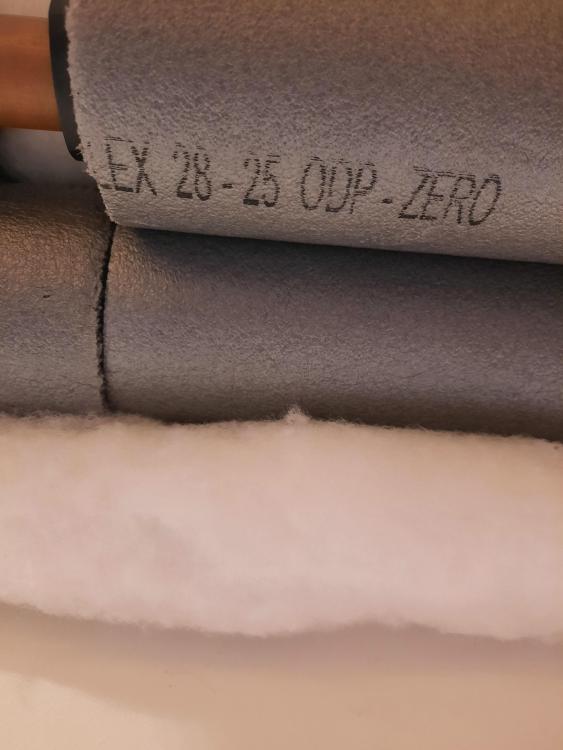
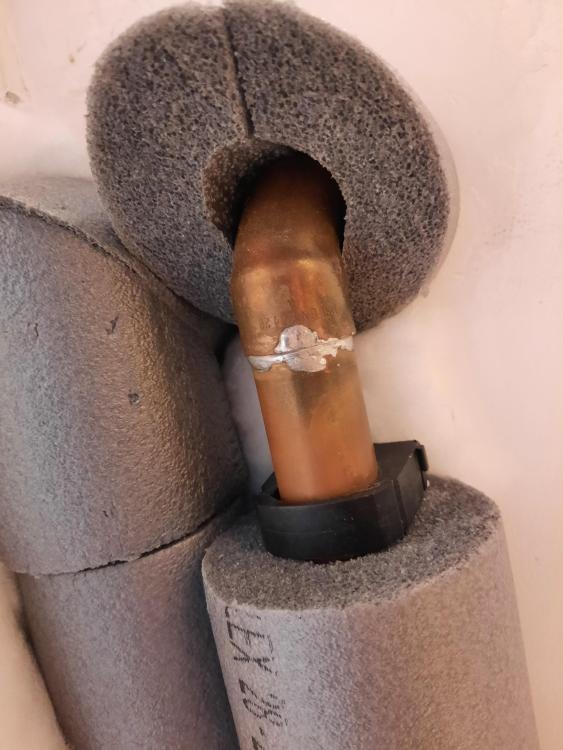
If the pipework is not subject to very high temperatures and not external, for me, climaflex was the best option. I bought it as thick as I could get on the pipes for any hot pipes. I set my pipes away from the wall to allow for this.Cuts easily with a hacksaw. Mitre the corners. Don't leave any gaps. It will shrink a bit over time so buy spare. Mine went about 10mm a metre. I used 25mm wall thickness on my 28mm pipe. This thickness is not cheap.....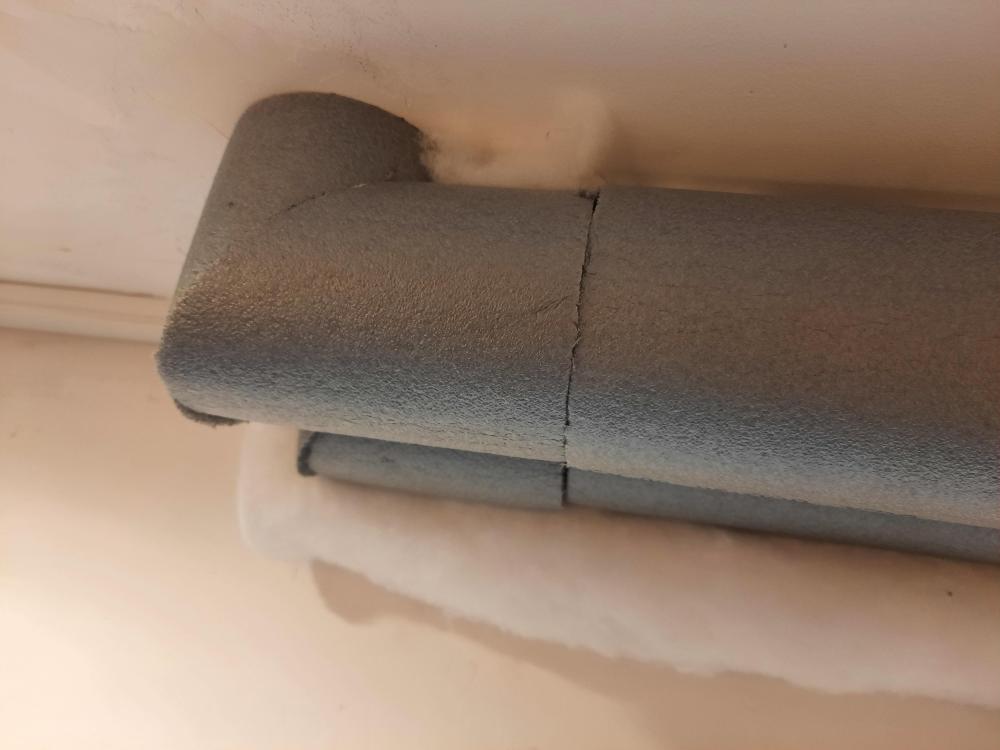
-
What energy rating is your HW cylinder?
Marvin replied to Adsibob's topic in Boilers & Hot Water Tanks
Hi @Radian , your quite right, meant the other ones... -
What energy rating is your HW cylinder?
Marvin replied to Adsibob's topic in Boilers & Hot Water Tanks
Hi @Adsibob A further thought... Going the simple way of jackets, you can put as many as you like around and on top of the tank, so long as you don't cover cables or immersion covers (leaving a clear flow of air to the immersion metal caps) If the tank is in the corner of a room and there are no cables in the area you can just fill all the gap no problem. The jackets are just loft insulation stuff wrapped in a plastic covering. You can condense them to squeeze them into gaps. if you fill the gap between the tank and the wall the thermal resistance of the heat coming out of your tank will now include the makeup of the wall so even better. (mine purposely had PIR installed in the wall for that reason). For clarity, the insulation's thermal resistance is measured by it resistance to temperature change and its thickness, however, as I understand it, squeezing two 100mm thicknesses into a 100mm gap will not make it twice as resistant because , as I understand it, the air gaps between the fibres are what cause it to resist thermal change. Definitely where possible wrap as much around as possible, squeeze thinner where no alternative, and you'll definetly save money in the long run. -
What energy rating is your HW cylinder?
Marvin replied to Adsibob's topic in Boilers & Hot Water Tanks
Hi @Adsibob You can always just chuck a jacket on, as long as you avoid the electric cable and immersion covers. My tank is a simple indirect one, and by the sounds of it yours sounds more complicated. what is it? It's unusual to drain down a tank to replace a thermostat. My buffer tank has pockets in which the probes fit in to. These pockets are a copper or brass tube which separates the space in the pocket from the water so no need to drain down. The electric cable supplying high energy to an emersion will heat up when there is demand and the heat in the cable needs to dissipate which it will not if encased in insulation. -
What energy rating is your HW cylinder?
Marvin replied to Adsibob's topic in Boilers & Hot Water Tanks
Hi @Spacey73 Depends on what is driving your decision: Installation cost, space, running cost, demand...... Also depends on what your other sources of heat are.... It's the winter you want to be thinking about. Are you considering a 300ltr tank because of the amount of hot water you use or thinking of using it as a heat sump. Also in winter how much PV power are you expecting to have excess of to use heating the water? The conundrum here is you could end up with only enough PV power to have a huge tank of tepid water, and so end up using other power to bring it up to temperature What is the average kWh you expect to produce on each day in January? We have 5.12kW PV and we produced about 6kWh a day in January, HOWEVER, your amount would depend on the panel slope, the angle in relation to the sun's zenith, the shading by objects and the location and so on. Hi @Adsibob Here is my 205ltr tank: PIR in room walls, supersoft around tank, 6mm ply on frame to encase the lot. HOWEVER! Any thermostat in the insulation will need to be digital. If I have it right, this type of immersion heater thermostat relies on a bimetallic switch which relies on a typical room temperature to work: so incasing it in insulation means it will not work. (I'm sure someone will correct me if I'm wrong) I have used one of these to switch a 20amp relay to turn on the hot water immersion: Note the type of sensor: As you can see only the sensor enters the insulated area: Secondly I removed the immersion heater thermostat because that would be effected by the insulation similarly. AND All power cables in the insulation will need to be ducted. Good luck. M


-
Hi @Joe-90 A diplomatic answer further up from@jack What a mess we are in! The whole "how best to heat my property" relies on so many factors and 1 size does NOT fit all. We have no mains gas and had an LPG boiler. We replaced it with an ASHP and prefer the ASHP set up. However. We completed AIM and APE on our refurbishment making the property suitable for a small ASHP. AIM is Airtightness, Insulation and, Mechanical ventilation. APE is ASHP, PV and EV. Finally, and this is the most important bit IMHO, before we started out we completed thermal loss calculations and the property design and heating installations were completed using this info so we had a good idea what would work. ( Including info on the local climate and solar gain) So an ASHP system may not work for you but it also may. Good luck M
-
Drywall adhesive is usually used. I hope mechanical fixings are not required because I have never used them for the purpose of fixing the boards on a wall. I usually cut the board to size after first fix services,slap the adhesive on the wall, squeeze the board on the dabs of adhesive and prop up using wedges on the floor. I usually use a spirit level to tap the board flat and vertical. Good luck M





