
ProDave
-
Posts
30861 -
Joined
-
Last visited
-
Days Won
427
Everything posted by ProDave
-
Kevin McCloud 8% Investment Bond
ProDave replied to Ferdinand's topic in General Self Build & DIY Discussion
AER= ANNUAL Equivalent rate, so they are expecting 8% each year or 40% over the term (not allowing for compounding) Why am I suspicious of this? Icelandic bank anyone? -
Inserting an Extra Floor in a Double Height Space?
ProDave replied to Ferdinand's topic in General Construction Issues
What I was getting at with TF was at your proposed future floor height, build in a horizontal ring beam of 8 by 2 timber. That can be plasterboarded over for now as it would be flush with the wall. Later on, cut away the plasterboard and fit the floor on joist hangers fitted to this horizontal 8 by 2. -
Inserting an Extra Floor in a Double Height Space?
ProDave replied to Ferdinand's topic in General Construction Issues
This does not sound to dissimilar to what we are doing. Upstairs is a warm roof with vaulted ceilings. In one (daughters) bedrom it is being kept open as a full height space, then with a mezanine floor above the small bedroom. Our own bedroom has a higher than normal ceiling height of about 2.8 metres so is then closed off to give us some loft space, while the area above the landing and bathroom has a normal 2.4 metre ceiling and a larger loft space you can almost stand up in. So translating this to your scenareo, I think you are meaning a double height space that you can later put a floor in to create an upstairs? Just make sure you build in something substantial to fix joists to when you are ready. -
this is very true of our situation. We are downsizing from a 5 bedroom to 3 bedroom house. The new house will no doubt be worth less than the old larger house. But the lack of a buyer for our old house might mean eventually we have to lower the price to sell it. Then we get dangerously close to the situation where the old house sells for less than it has cost us to build the new one. A point I WILL NOT cross. I maintain that in the present market up here, a self builder would be doing very well indeed if they could just sell their newly built house for what it has cost them to build it.
-
Ducting within an ICF block: anybody tried it?
ProDave replied to ToughButterCup's topic in Insulated Concrete Formwork (ICF)
Are you not having an internal battened service void for cables? if not, why not? -
Did your SE not notice the tree? I ask, because we are building close to Willow Trees, which everyone will tell you are the worst. Our SE came to the site twice, and I dug 3 test pits for him down to about 2 metres deep, so he could assess the ground conditions. The only things he seemed to stipulate were that we dug down to the predominant sandy clay sub soil, and he specified a strong C35 concrete mix for the foundations and a heavy duty reinforcing mesh in the foundations. By the time I had stripped the organic top soil off the whole house site, and then dug the strip foundations, we were down to between 1.5 and 2 metres deep, but really the trenches from the stripped level were not that deep at all. building control just came and looked and said go ahead with the pour, because all they needed to know about the site, including the trees, was on the drawings. I have to say, I was surprised how few tree roots we encountered, and those we did find were tiny, but then the willow trees grow on the banks of a burn so let me guess where they might get most of their water from?
-
Was a structural engineer involved in the design? Was it full plans approval? was the tree shown on the BC drawings? P.S imho nothing wrong with a suspended timber floor, that was my choice.
-
Best approach for heating and hot water
ProDave replied to Pocster's topic in Central Heating (Radiators)
I am not a fan of electric boilers. I just do not "see the point" If you are going to heat by direct electricity then a panel heater is far far simpler. the only "reason" for an electric boiler is radiators look better than panel heaters and you can call it "central heating" in all other respects individual panel heaters will do the job just as well. if you really must go direct electric (rather than storage, with it's own set of "issues" I would only consider it on an Economy 10 tariff If you look at the cheap rate times for E10 you get a few hours in the morning, morning warm up taken care of at cheap rate. A few cheap hours in the early afternoon, the "come home from work" warm up at cheap rate. It then just leaves the early evening at peak rate, when having a really well insulated house would help minimise what you have to use at that time. -
I shall watch this topic very carefully as it's close to my heart. I strongly suspect by the time I have an EPC and the cash to buy solar PV panels, the FIT will no longer exist (it's already at a rate hardly worth paying the "MCS premium" for) In that case I am now thinking of DIY installed non FIT solar PV so that means ensuring near 100% self usage. So battery storage seems pretty essential. Two things bug me about packaged systems, firstly the battery life, and secondly, the details of how it operates. I am strongly minded to build a DIY system so I can program the algorithm about when and how it decides to charge and discharge the batteries, and have the ability to tweak that to suit our needs. But also, I really want to use some "fit and forget" batteries which keeps pointing towards NiFe (WWII submarine battery technology) but to buy them new they are expensive, something i am hoping will change.
-
Hi and welcome (back) Glad you managed to find our new home. Hopefully this one will last as the way it is set up is as a collective, so not at the whim of one person to close it if he has had enough. Start a post and tell us more about where you got to, with pictures, we like pictures. I sympathies 100% about selling your old house. we have been on the market 2 years now. Still plodding along slowly with a small pot of money, trying to concentrate on all the jobs that cost little but take a long time.
-
Safe zones are 150mm in from a corner and 150mm down from the ceiling, then horizontally or vertically from each accessory. If you stick to BC switch and socket heights, then I like to leave a gap in the battens at 450mm and 1150mm from floor level. That gives you the option to run cables horizontally from sockets and (less likely) horizontally from a light switch, without having to bother drilling holes in the battens. No you can't run cables along at skirting board height (though plenty do, but where do the nails holding the skirting board go?. Oops.) Just run cables round the room from socket to socket, then up to the ceiling void where you can't continue that route for whatever reason.
-
Cheap, Thermally Efficient Non-Structural Wall Detail
ProDave replied to Nick's topic in General Construction Issues
Never tried different thicknesses. Personally I think it's best to stick to one so you just buy a big pile of it and don't worry about running out of one size. Are you saying yo want ply directly behind the plasterboard to "fix" things to? Your electrican will hate you for that. I would not do that personally but I do see the point in putting something behind the PB just where you are expecting to hang something heavy, e.g flat screen tv (but I have never yet failed to fix one just by finding the studs to screw into) P.S re earthwool vs pumped in insulation. I was originally going to have the pumped in stuff, but that was a job that needed doing by A.N.Other. I then looked a bit deeper. Earthwool was half the price of the pumped in stuff, and was a DIY job, and gives virtually the same U value overall . Having done it now (well 90% of it, still working on it) I love the fact I am able to fill then board each section and it's all done. No need to get someone in to pump in the stuff which due to a few peculiarities in my build would have been a logistical nightmare to get it all done in one go. -
Cheap, Thermally Efficient Non-Structural Wall Detail
ProDave replied to Nick's topic in General Construction Issues
My 2 pence worth in no particular order. On the inside you NEED a service void (please tell me you were not planning to run cables in the insulation through the JJI's) So inside out: Plasterboard 25mm by 50mm battens vertically following each JJI this gives a service void inside the sealed envelope for cables etc. Use thicker battens where you want to run pipes. Vapour control / air tightness membrane so the whole of the building is sealed on the inside OSB (cheaper than ply usually) only needs to be say 9mm JJI joists filled with insulation. Knauf Earthwool Frametherm 35 is a lot nicer to work with. 9mm OSB again it does not need to be thick, it's not for racking strength (your steel frame provided that) just to hold the insulation in. Breathable membrane Counter battens You usually need vertical and horizontal battens to give free air flow. battens cladding Arguably you could forget the inner OSB layer. A house near me that I am wiring shortly has JJI joists filled with Frametherm batts, then just the air tightness membrane (helping to) hold the batts in, battens then plasterboard, but I think personally a solid layer to keep the insulation in place is a better solution. -
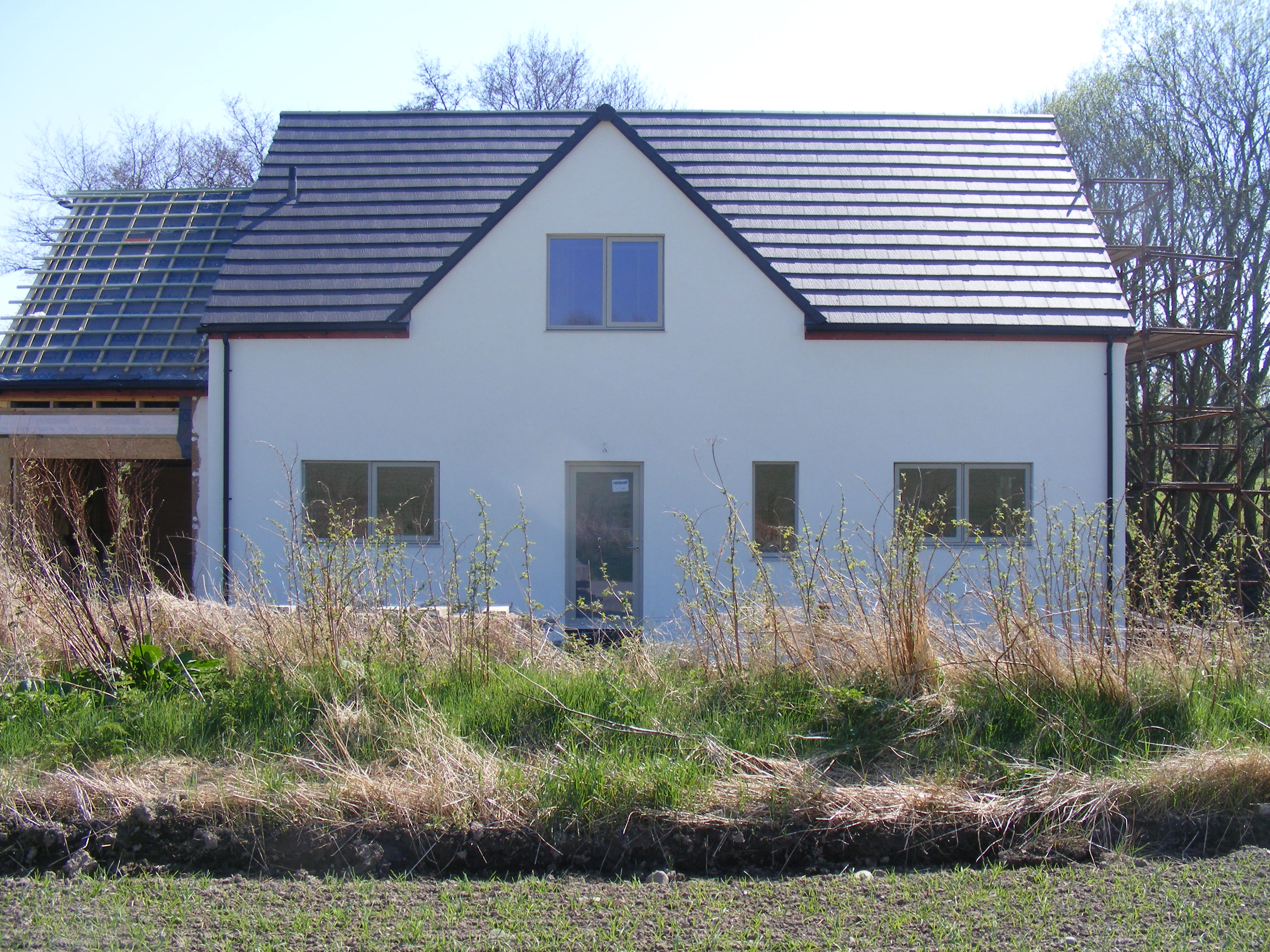
You know some remarkable people. In between working, it has taken me a year to roof and clad the exterior of my house on my own, install the drainage and landscape the site. Only in December did I start on the interior. Very minimum of another year but I expect the money to run out before then so I will then have a wait until early 2018 before some funds become available (unless of course by some miracle someone buys our present house)
-
A friend of mine started a steading (barn for the southerners) conversion in 2005. It quickly became a knock down and rebuild. It is still not finished thought they have been living in it for many years as they gradually add bits. I understand he has had some issues with BC over the length of time it is taking.
-
Hutting revival (Guardian article)
ProDave replied to Crofter's topic in General Self Build & DIY Discussion
Definitely yes. The alternative is a tent and probably no toilet (who packed the shovel?). We backpacked the Cumbrian way and definitely the best nights were the wild camp nights. We find AirB&B a bit disappointing. We listed on there the beginning of last year. Deathly silence. then a spate of bookings in August, followed by a return to deathly silence. Booking.com does MUCH better for us. -
That graph shows what I had long suspected, that we entered a housing recession in 2008/9 and we are STILL in that housing recession.
-
I'm over his time limit already and I have little more than an empty shell, so I won't be applying. Let me guess, this is aimed at the "daytime tv" market?
-
Interest rates and inflation have been so low now for so long it has become accepted as "normal" But with that comes it's own set of problems. I grew up in an era when interest rates of 10% were normal, and inflation was not far behind that. So when I took on a maximum mortgage to buy my first house it was a struggle to start with as morgage payments were over half my take home pay. But it was only a few years before inflation linked pay rises made that a much smaller percentage of my take home pay, and enabled me to take on a bigger mortgage to move up to a better house. If I had been starting out today in this low inflation climate, a mortgage that started as s struggle would remain a struggle for a longer time, and the prospect of borrowing more to move up would be much less likely. Of course now later in life when I have done with mortgages and stuff, I wold love higher interest rates so I can earn something from savings. All this goes to show what a blunt instrument adjusting interest rates to control the economy is. In fact thinking back I think raising interest rates to slow the economy was just a completely futile exercise. I desperately want some house price inflation here so that someone might actually think my house is worth what the surveyor said it was worth 2 years ago. If you believe what you see on tv about house price rises, it should now be worth 10% more than the surveyor told me 2 years ago, so I had better put the price up then?
-
Yes I guess so. If there is any chance you might want to convert the garage, then put the footings under the door, but I just saw it as a waste of time and concrete.
-
Building control were happy with me not continuing the foundations under the garage door opening. They did mention if ever I converted it I would have to dig up that bit of floor and pour foundations but I am 100% sure I will never want to do that.
-
I think it was a D5 I drove down under, but I can't find a picture of it. Yes that's it, two brakes and two clutches, to turn left, you pull on the lever to brake the left hand track.
-
This is me on a "proper" roller. At my BIL's farm in Queensland a few years ago. That re defines the meaning of "shake rattle and roll" It was the most weird thing to drive. It was basically controlled with a hand throttle (that kept adjusting itself) with a decelerator peddle if you want to slow down. Mind it was nowhere near as weird to drive as the buldozer......

-
Hi and welcome to the forum. It sounds s very interesting project. Why not start a blog here to document your progress? Glad you found us in our new home.
-
Was this a ride on roller? I thought you were talking about a push along.

