
ProDave
-
Posts
30682 -
Joined
-
Last visited
-
Days Won
424
Everything posted by ProDave
-
Most of those are reasonable figures. Planning can be a lot less if you do it yourself. Do you NEED soil samples etc? I didn't. Services can be anywhere from £100 upwards, you won't know that until you find the site. Phone is usually free. Mobile home, we bought a good one for £4500 and as it came from a dealer that included delivery. If you budget is tight then you can get a (probably) watertight old one for £1000 An old cheap second static caravan might be a better bet as a site office / storage than a container.
-
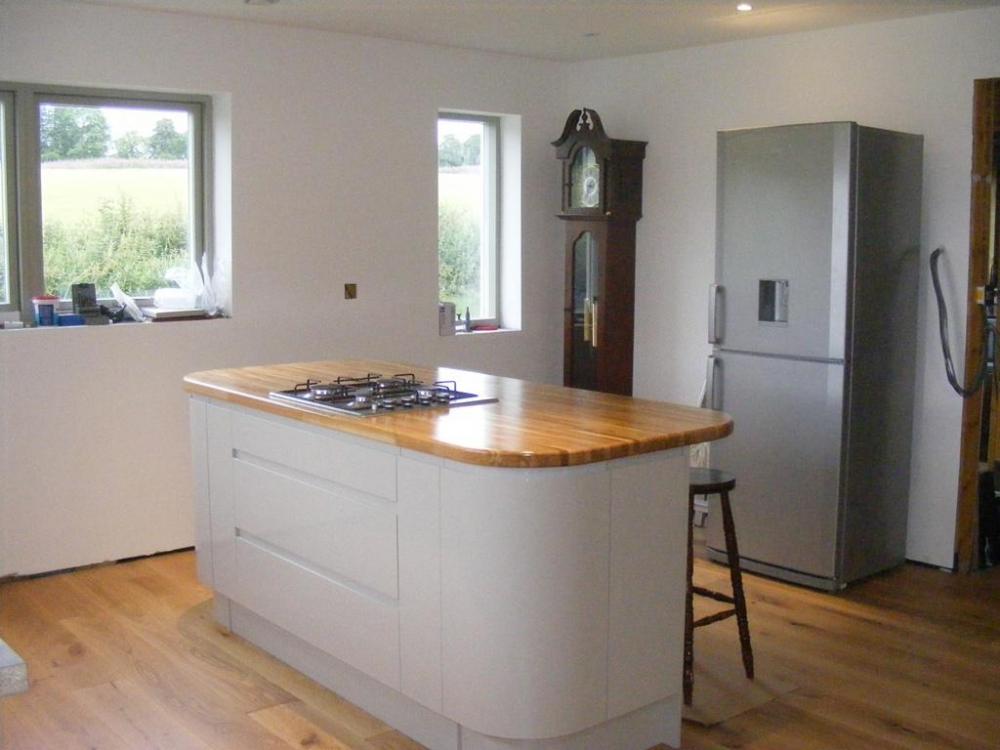
We have a (Howdens) Oak worktop on the kitchen island. I didn't oil it, but varnished it, with the better option 2 pack varnish that Howdens sell, but I forgot to note the actual make of the varnish. 2 coats on the underside, and 3 coats on the top, applied by roller. Nothing stains it, not even red wine, everything just wipes off. I do avoid putting hot things on it.
-

Best £35 spent so far.
ProDave replied to epsilonGreedy's topic in General Self Build & DIY Discussion
In a previous house, we built an extension and moved the front door to the extension. the old front door got bricked up and a window put in. That left a large, 6" or more thick, cast in place door step to remove. Whilst pondering how to break it up, one day some guys turned up outside to dig a hole in the road, complete with a pnenumatic road breaker. A quiet word with them and a £20 note, and 10 minutes later my step was reduced to a pile of manageable lumps of concrete to dispose of. The next door neighbour came storming out to find out why her house was vibrating. -
I would not expect the drip bar to solve the problems. When it is blowing a hoolie and the rain is lashing against my Rationel door, the rain dripping off the drip bar just gets blown straight into the gap as if the drip bar were not present. It is 100% reliant on the seals, and they are not perfect. For an exposed door like this I would in future choose an outward opening door, but that comes with a different problem, hang on tight to it when you open it!!!!
-
2 way light switching would have solved that. Our layout with the stairs in the middle of the house works well, it means our bedroom is one side of the stairwell and our daughters bedroom the other, so well separated from a noise point of view.
-
Have you looked at ebay? I have one of the Mistubishi / Kingspan units that were doing the rounds a couple of years ago, I still bought all the ducting from BPC which cost about twice the cost of the mvhr unit.
-
Storage heaters are in fact very simple devices. They contain a load of bricks that store heat. Inside the stack of bricks are a number of electric heating elements. The electric feed to the storage heaters is fed via some form of tine switch so the electricity supply to the heaters is only on at night when it is charges at the cheap rate. So at night the electricity heats the bricks. It does this until the cheap rate ends and turns off, or the bricks reach a certain temperature, in which case an electrical thermostat (the right hand knob) turns them off. During the day, the electricity to the heaters is off and all they are doing is letting out the stored heat in a controlled manner. This is controlled with the left hand know that opens or closes the flap to allow heat out, or not. That flap should automatically be closed during the overnight charging.
-
I see no mention in the 2013 regs which is what I am working to. If there is, my bathroom won't comply. There is a 150cm diameter or 140 by 180 eleipse circulation space requirement in a kitchen.
-
If getting an electrician, tell hime to check the tiny heater (a wire wound resistor) that sits right under the bimetalic strip that operates the flap. Oh and make sure your folk are turning the boost knob all the way down before they go to bed. That should shut the flat even id the little heater is dead.
-
Where are you? Here in the Highlands that would be considered entirely normal.
-
The only thing that makes a bathroom "accessible" is having the prescribed "activity space" in front of the bath, shower, basin and WC. I planned the layout of ours by cutting out large bits of cardboard of the required size for each activity space and laying them on the ground,. Also things like the door must not swing over an activity space etc which might mean outward opening.
-
Or one or more of the heating elements has failed. There are up to 4 heating elements in a storage heater depending on it's size and if one has failed, that part of the core won't be heated. A competent electrician should be able to test them.
-
Anything "supply and fit" on a new build house should be rated at 0% by the supplier, so they are correct you have to go back to the supplier and tell them they should have rated it at 0% and you want the over paid VAT returned from them.
-
As I tried to explain, it is a local "heater" (a wire wound resistor) that heats up and closes a bimetalic strip to shut the flap during charging. If that resistor has goen open circuit then the flap may not close during charging.
-
What are the invoices for?
-
Forget that faffing about. New toilet as cheap as you can find in one of the sheds. Why is the back stained? do you have a problem with the water supply?
-
Although they are more expensive, I believe most of the new storage heaters also have real time convector heaters, so I suspect the confort will be better and maintain a better temperature, but probably at a higher running cost. If you don't stay with storage heaters you have to question whether remaining on an off peak tariff is right for you as you will be paying more for the daytime rate. An alternative which I think is better is switch to economy 10. That gives you I think 3 off peak periods totalling 10 hours in the day, with a useful early afternoon period, so you are not asking the storage heaters to store heat for so long, so less chance of them running out of heat. If you just want to fix what you have, look on ebay for identical heaters. I did this for one of our rental properties, the ones we had were very tatty looking. So I bought some on ebay, and got the seller to ship the heaters but not the bricks that go in them. I used the bricks from the old heaters. No point paying loads to ship the heavy bit that you don't need. I had first tried to buy some new ones without bricks, but nobody would sell them without.
-
My understanding from some of the claims that were rejected, is spending on the build had ceased some time before the claim. I suspect that if you have a steady stream of receipts up to the point of submitting the claim that you should be okay or at least will have a damned good case to appeal. I would argue (cough) that you had to pay council tax because the council insisted, even though the house was not complete and you had not moved in.
-
Replacing an entire course of bricks
ProDave replied to Student's topic in Bricklaying, Blockwork & Mortar
I always thought slate was the bees knees of damp proof courses. At least that is what the surveyor told me when I bought our previous 1930's house. I suspect the bricks on top of the slate may have been laid dry? And mud has got in through being covered. I would start by pressure washing a short section, let it dry out and have a good look. My experience was a slate DPC that was bridged with soil and hence causing damp issues, once cleared and left to dry out, no further damp problems occurred. -
When my builders turned up to start work, they requested a copy of my employers liability insurance (included with my self build policy)
-
The trouble now is all new heaters have to comply with LOT20 (google it) which forces them to have complicated controls to make them "more efficient" The price of new LOT20 compliant storage heaters is not cheap. I fitted a LOT20 panel heater for a customer earlier in the year. A week later I removed it as the customer could not live with it's silly foibles. I then had to search ebay for a "new old stock" non LOT20 heater which she is delighted with. The old, basic storage heaters however should be repairable. If it is just the flap not closing, that should be easy to fix. If it is not something obvious mechanical broken, then there is a "heater" (a wire wound resistor) to give some local heat to the bimetalic strip that controls the flap, to force it to close while the heater is being charged. Lastly, there are a lot of people who do not understand how to use storage heaters. The "boost" control should be left turned down to minimum most of the time in a domestic setting, only turning it up in the evening if you are getting short of heat.
-
Both our last house and this one have a thermostat per room. Definitely in the last house we could turn down the unused rooms and they really would stay cooler, providing you kept the door shut. Have you considered DIYing your own UFH. The material costs are really not that much, a manifold, a coil of pipe or 2, and some controls.
-
Attaching beam to restricted corner post
ProDave replied to Bengm's topic in Landscaping, Decking & Patios
Could you assemble the deck remotely, so that corner detail is screwed together first, and then you lift that corner of the deck, complete with the post into it's hole and concrete it in. Alternatively is there enough access to drill through the post and the joists and bolt them with long bolts and nuts, with the nuts on the outside? i,e is there enough room to slide a nut into place and get a spanner on it? -
The thing is, a Sun Amp is a technical product. It needs thought as to how you heat it, be that electric, boiler etc. Correctly chosen and installed it is a good product. I see MASSIVE scope here for a poor choice of product, poorly installed, and poor performance. I see massive scope for a lot of unhappy customers and what was a good product being tarnished as "over priced rubbish" Will they still be selling direct or via skilled installers as they are at the moment? It seems the ASA are pretty toothless if the complaints keep being upheld. All they seem able to do is stop a particular advert being repeated if found to be misleading, so they just make another slightly different advert that gets aired for a while until the next complaints are upheld. For "repeat offenders" the ASA need the power to pre vet all adverts before they are allowed to be aired.
-
2 properties can share the same tank. I know of 5 houses sharing one large tank not far from here. The issue you are going to have is getting this approved by building control. There is a set forula to work out how many people (PE) you house has to be designed for based on the number of bedrooms. The tank must be capable of processing the PE of both houses combined. That is the easy bit. BC may accept the tank as is for that, or may demand a new one with a known rating. There is then another formula for determining the area of the infiltration field, that again depends upon the PE but also the percolation rate of the ground. That bit will almost certainly be unknown unless there are any old plans that state the area of the infiltration field. This I expect will cause more issues with building control. Worst case is you need a new tank and you need to dig up and re lay the infiltration field to a known size. This will not be a pleasant task as the ground will by now be heavily contaminated. Is there enough land to fit a new tank and infiltration field just for your new house and leave the old tank for the neighbours and remaining their responsibility? If fitting a new tank, make it a treatment plant, not just a septic tank.