
ProDave
-
Posts
30683 -
Joined
-
Last visited
-
Days Won
424
Everything posted by ProDave
-
Have a word with @pocster about walk on glazing.
-
So if it's just 2 story, putting in a new wall fan is no different to an upstairs bathroom in a normal house, so perfectly doable and that is probably your easiest option.
-

Network cabinet: ideas?
ProDave replied to ToughButterCup's topic in Networks, AV, Security & Automation
What do you people with network cabinets and patch panels actually plug into the hard wired network? I have just 3 things on the wired network: The printer, my desktop PC, and my Raspberry Pi music box. Those just plug into 3 ethernet ports on the broadband router. I guess if I ever find anything else I need to plug into a wired network I could add a switch, but it would be a small one mounted on the shelf next to the router, not a 19" cabinet. This is a genuine question. I installed a lot of network cabling on a "just in case" and because it was so easy and cheap at first fix, but so far, the only bit of buried in the wall network cable in use is the one up to my desktop pc in my office. -
You could always put some walk on glazing on the landing above the front door. I think I know where some might be for sale.
-
Land required: real world examples
ProDave replied to eandg's topic in Ground Source Heat Pumps (GSHP)
One of the things that put me off was the sheer volume of earth to move, and the logistics (which on our site would have been tight) of where to put the excavated soil while you lay the pipes before you put it back. And then, much of that land was where services, drain pipes etc would then be laid, so you would be trying to lay other services over soil that had been disturbed, hoping it had been compacted properly and would not settle more. -
Your link did not work, try this https://www.edwardes.co.uk/products/hager-ada145g-45a-30ma-b-curve-rcbo-type-a-ac-and-pulsating-dc-sensitive- What is your concern with that?
-
So I am guessing the bottom switch fuse is the off peak feed feeding the bottom heater? So that's where you need to look, at the bottom heater. Turn the switch fuse off, take the cover off. You should see a thermostat. There will be a (often VERY tiny) overheat trip. If it has popped out, try pushing it in and see if it clicks. Otherwise you need some test gear.
-
Why is the top switch fuse feeding the time switch turned off? What test equipment do you have e.g a multimeter?
-
That looks like the immersion heater to me (which will have a thermostat in it) Being that high up the tank, there are probably 2 of them. Is this direct or indirect, i.e. is the immersion heater(s) the only thing heating it?
-
So the only way to get from the master, to the other bedrooms, would be descend half a flight and go back up again?
-
Land required: real world examples
ProDave replied to eandg's topic in Ground Source Heat Pumps (GSHP)
We have a 1/3 acre plot. Some of that is "cut off" by a burn. So on the house side of the plot we have about 1/4 acre. I was originally going to use a GSHP until I realised it would need almost all the garden. I had my own digger at the time so it would just have been my time, but it would have been a lot of work. Then I realised the cost of the slinky pipe, manifolds and antifreeze to go in it, would far exceed the cost of the actual GSHP unit. It was at that point I decided the huge extra costs would never be paid for by the slightly higher efficiency, so I decided on an Air Source Heat Pump instead. -
I can see a heat recovery system working for a shower. All the time you are showering, cold water will be coming in, so the waste heat can be recovered either directly to the showers cold feed, or to the cold feed into the HW storage system. But a bath? Chances are while the waste bath water is going down the drain, there are no taps in use anywhere, so what is going to take the recovered heat away and to where?
-
25mm battens are plenty for most things. That's what most of our house has. A 25mm batten plus 12.5mm plasterboard is perfect depth for a 35mm electrical back box, and enough room to get 15mm copper pipes (kitchen tap hot and cold drop) I used 45mm battens only in the utility room where I wanted more room for 22mm copper piping.
-
Capital gains tax
ProDave replied to Joe Naughton's topic in Self Build VAT, Community Infrastructure Levy (CIL), S106 & Tax
CGT simply takes the value when you bought it and the value when you sold it and draws a straight line between the 2 and assumes it has made a steady gain of so much per year and calculates on that. As you personal CGT allowance is over £10K in each year, and that doubles to over £20K if the property is jointly owned, then it is unlikely to be an issue for you unless it sits there empty for some time. It is a pain that you have to declare it on your tax return so you have to prepare all the calculations, even if it ends up with nothing due. Our previous house has been let for over 2 years now, and even with the new rules of no lettings relief and reduced PRR any capital gain due so far would be less than our personal CGT allowance so nothing would be payable. Yet. -
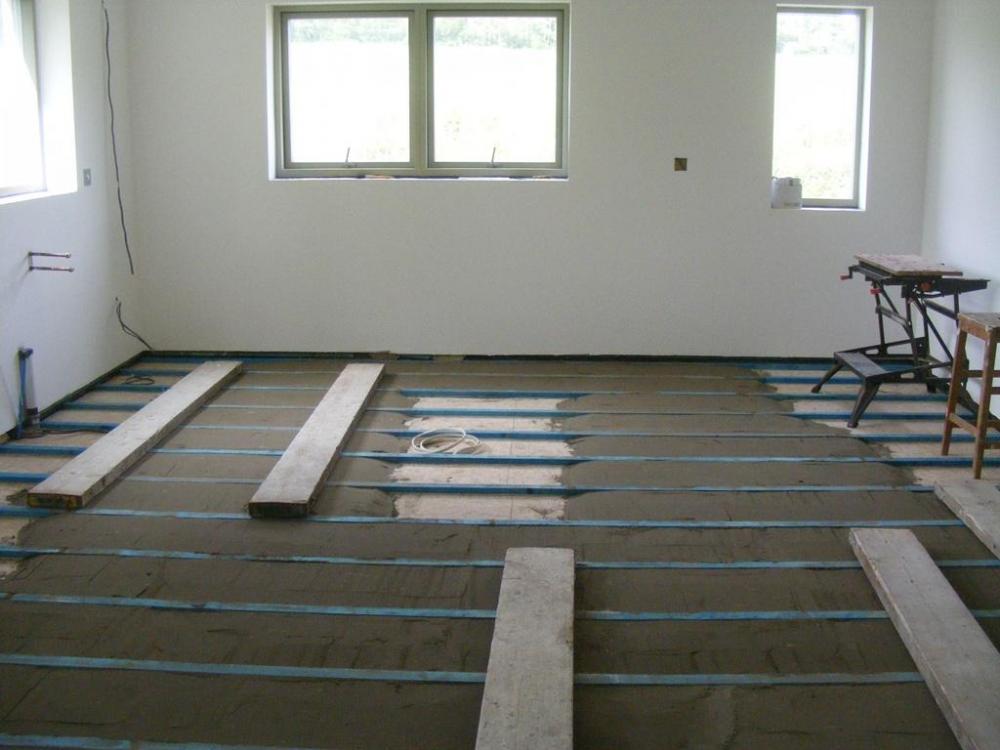
I don't have UFH pipes under the kitchen units, Fridge freezer, island, stove, or the corner where the pantry is going. The heating works just fine, no "cold corners" Here is my kitchen floor. Kitchen units and stove at the left, Island in the middle, and pantry and freezer to the right.
-
It looks a totally bizarre setup to me. If I am understanding it correctly, the user needs to know exactly how it works and manipulate 6 individual switches to make it work? By all means fit a heat recovery device to the shower waste to pre heat the cold water feeding into the shower, but I would not want something like that. Okay for a boat perhaps where you only have a limited supply of stored water.
-
I am not putting too much thought into the design just yet until I know for certain that is his chosen insulation. Yes I would put the cables in PVC conduit, but that won't stop the need for derating. What really puts me off that is you need to be damned sure you have everything exactly where you want it at first fix time, which will be earlier in the build than the service void method. I have tried to tell him there is nothing stopping him using Icynene without any cables, and then still battening to form a service void.
-
Design for temporary garage door blank in OSB panels.
ProDave replied to epsilonGreedy's topic in Doors & Door Frames
I have had the window appertures of my sun room boarded over with untreated 11mm OSB for nearly 5 years now, They have swelled at the edges but are still pretty solid. They won't be fit for anything other than scrap when they come down, but for semi long term protection they are doing well. -
Worst DIY product ever sold has to be those "DIY Outside Tap kits" that use a washing machine hose to connect out to the tap. I have uses sealing strip similar to the OP to seal the door to the garage and it has not come unstuck yet.
-
I have a customer considering insulating his new build with Icynene spray insulation. So we started talking about wiring and service voids etc. "Oh no there is no service void, you first fix before they spray the insulation." Fine I say, but you will have to apply derating because the cables will end up encased in insulation. Not the case says he, The Icynene rep says not. Digging around their website finds this document http://www.uksprayfoam.co.uk/wp-content/uploads/Icynene-electrical-Wiring.pdf Where it says wires encased in their insulation "will not cause the wire temperature to exceed safety limits" I say sod that, as the electrical designer I will have to derate the cables which may end up with larger size cabling being used. Are they giving bad advice? Interresting to know what others who used Icynene (or similar) did? Did they do as they say, or did your electrian raise concerns and fit larger cables?
-
Working platform suggestions - internal blockwork
ProDave replied to Digmixfill's topic in Tools & Equipment
Yes, well at least mine do. I think the whole point about planks and trestles is they are for low working heights so the dangers are not as acute as say a high scaffold tower without a handrail. -
It will be interesting to see the tenure. Leasehold is rare in Scotland. When we owned a flat, we owned a share of the freehold upon which the flat sat, shared equally with (in our case) the one flat above us. "Common parts" like the foundations and roof were repairable at the equal expense of both joint owners. Had I had forgotten about high rise vents. Never fitted one but I understand the principle. Though how you ensure bits don't drop as you are coring through I don't know.
-
I would be 99% certain that one does not have an inverter. I am pretty sure we discussed that model before and a previous advert had a picture of the electronics with a big motor start capacitor. The disadvantage of direct drive is the compressor is working all or nothing. So it will likely be noisier, will have a high start up current which your DNO won't like and may cause a noticable dip to your lighting when it starts, and it won't be able to modulate it's output temperature as well. I would keep looking until you find one that is definitely inverter drive and says so. Bargains do come up from time to time.
-
Working platform suggestions - internal blockwork
ProDave replied to Digmixfill's topic in Tools & Equipment
Something as simple as planks and trestles would do that. -
Avoid those. Even if they work they probably won't for long when water gets in and then the action of frost.