

ProDave
-
Posts
30688 -
Joined
-
Last visited
-
Days Won
424
Everything posted by ProDave
-
If you have a water course available then what you would need is a waste treatment plant, not a septic tank. Just about everyone on here would recommend one of the ones that work by using an air blower to aerate the contents, such as the Bio Pure, Conder, Vortex or Graff and you would typically pay about £2000 for a treatment plant plus instalation. You would have to run your proposal past building control and you would need a discharge permit from the Environment Agency. You would not be the first to choose a treatment plant because the cost of a mains connection is too high, and imho discharge to a watercourse is just about the simplest sollution possible.
-
 This is why for temporary accommodations, a static caravan is SO much easier, and probably a lot cheaper.
 -
socket positioning and Part M
ProDave replied to jfb's topic in Regulations, Training & Qualifications
Yes you can. Some electricians joke that the way things are going, it won't be long before all sockets and light switches are at 800mm. -
Buy with a tracker mortgage then move to a self-build?
ProDave replied to Daisychain's topic in Self Build Mortgages
As above, I would be surprised of you can get anything other than a trivial value mortgage on a prefab. -
Fill it but use proper dry lining joint filler, not something from a tube.
-
I am not sure what is going on in the "dining" bit? Is that an L shaped island with breakfast bar seating, plus a small dining table next to it? Too much in one space? Agreed change that door to the vestibule to a slider. Personally I would change the door to the downstairs bathroom to opening inwards (after sign off of course) Then rather than face to face sofas that make no sense, a dining table in one bottom corner and a sofa in the other bottom corner, and a more conventional rectangular island with the seating along the bottom edge in the plan facing the kitchen window. P.S I know that is only an architects plan, but you can't have a dishwasher under the sink bowl.
-
Electric Meter first?, MPANs and Registered address - Grrr
ProDave replied to BotusBuild's topic in Electrics - Other
I have posted this several times, here is mine I used a pair of boxes as some DNO's get shirty about stuff in "their" box. I really must take another photo with the outgoing cables to the house connected. those are just the cables to the caravan and shed connected to the CU. the house connects to the two switch fuses. the smaller one is not in use and was future proofing in case I wanted an off peak supply. Sometimes the meter guy will connect the tails if they are ready. Often up here, as SSE supply meters with built in isolators, they don't and leave that for the electrician. I have never know the DNO ask for any certification so if you are competent I don't see why you could not wire yours yourself. Building control will expect an EIC for the house install in Scotland and probably a part P sign off in England and Wales. There are a lot of quirks and inconsistencies in what the DNO and meter guys will or will not do. I was present on a supply move once (from temporary box into the house) and the DNO guy thought he would be helpful and move the meter while he was at it. 2 hours later when the meter guy turned up he gave me a right bollocking and I still don't think he believed me when I said it was the DNO guy wot moved your meter.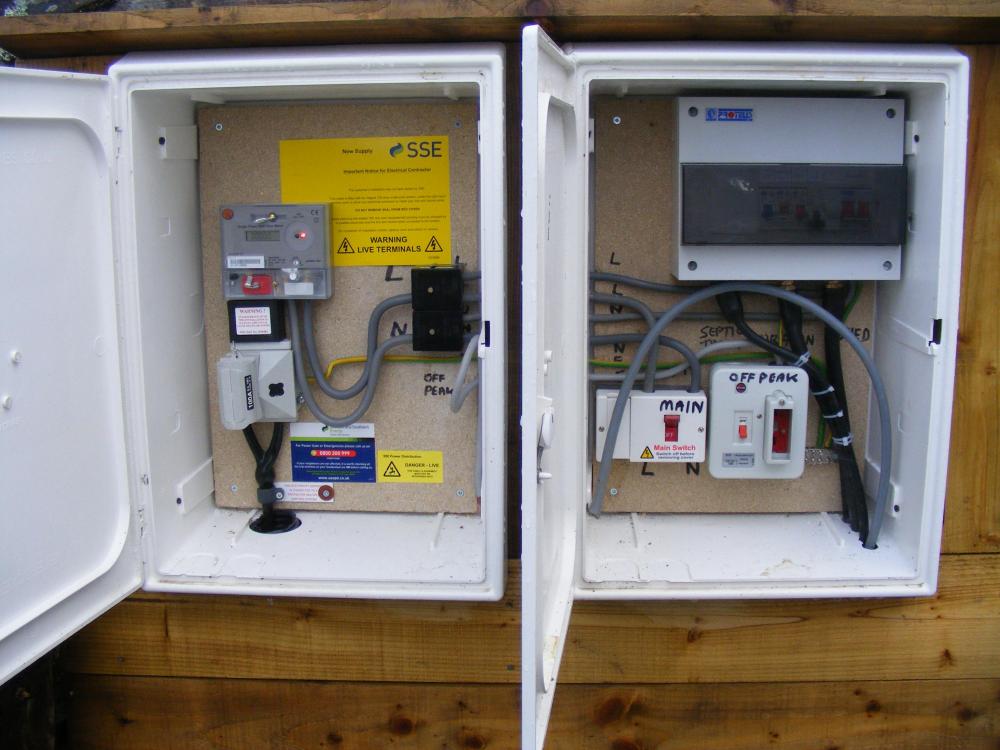
-
It is usually possible to convert the central heating circuit to a sealed system with an expansion vessel, though it is not unusual to find a few unknown leaks when you do this. To get rid of the hot water header tank needs an unvented cylinder, again with the correct pressure reducing valves, expansion vessel and safety blow off valves and their drain.
-
Vaillant high(er) temperature ASHP?
ProDave replied to Nick1c's topic in Air Source Heat Pumps (ASHP)
I tried the cooling function on my ASHP last summer. On the LG you just trigger it by activating the cooling thermostat input and it starts up in cooling mode. Because I had not provisioned for cooling, I had to set the heating programmer to come on, then go and turn up all the room thermostats to bring the UFH on, and then it circulated cool water through the UFH. It seemed to work without issue but of course it did nothing to cool upstairs which is where it was too hot. To implement it properly would mean an additional motorised valve to pass the chilled water to a fan coil unit or 2 upstairs and activate the cooling input from a cooling room thermostat. I stalled when I found fan coil units were hard to source and seemingly expensive for a heat exchanger and a fan in a box. The best I could do was about £100 from China from alibaba but I never got around to ordering one. Something I may still do if summer heat becomes more of an issue. -
How close are the two WC's? Someone will be along to mention the potential "swap contents" issue when you flush one of them.
-
And then the ransom strip WOULD be a BIG issue.
-
underfloor heating Engineered flooring subfloor with wet UFH
ProDave replied to SLinds's topic in Introduce Yourself
So that will want 18mm ply then as a structural floor if the joists are 400mm centres. If 600mm centres that will need to be 22mm. -
Vaillant high(er) temperature ASHP?
ProDave replied to Nick1c's topic in Air Source Heat Pumps (ASHP)
The main thing using the same piping for cooling is watch out for condensation. If i ever implement cooling properly for my LG unit, it will be via a fan coil unit or 2 in the upstairs bedrooms, so extra insulated pipework and an extra motorised valve, and alterations to the control wiring. -
Devils advocate. Putting a door <2000mm on the bottom step would make the stairs non compliant. (need 20000mm headroom) Why not put the door at the top of the flight of steps?
-
So 4kWh battery storage for £3k Lets assume an ideal world of unlimited spare solar pv otherwise going to waste. So your batteries let you capture and use 4kWh per day or about 50p per day. So about £182 per year. That will take 16 years to recoup the £3K outlay. What state will the batteries be in by then? The real payback will be way longer because there will be plenty of days when there simply is not enough surplus solar pv to fully charge the batteries or not enough evening demand to fully discharge them. So once more, the economies of battery storage are not there yet.
-
underfloor heating Engineered flooring subfloor with wet UFH
ProDave replied to SLinds's topic in Introduce Yourself
I used 20mm thick engineered oak over battens at 400mm centres. Can the OP confirm how the floor is made? "Parquet" to me means lots of individual pieces laid in a pattern, so cannot possibly be structural and needs to be laid on something. If you mean is is an engineered structural board made to look like parquet then I suggest you look harder for something that can span on it's own as a structural floor. -
Does it not just mean "Solar PV" as opposed to wind, hydro etc?
-
You need proper legal advice on exactly what the right of access says. If it grants your plot a right of access that may also apply to another plot created by a split. If they were canny, they would have worded it as a right of access for one dwellinghouse, in which case you will have to start negotiating.
-
Yes we have the downstairs loo in the utility. I admit it is not to everyones taste but it works. In our case I could not see an easy way to make them separate rooms with separate entrances without taking up a lot more space. A future option should we need it would be divide the room in two make one half a downstairs bathroom. If we did that, you would pass through the utility room to get to that bathroom.
-
Vaillant high(er) temperature ASHP?
ProDave replied to Nick1c's topic in Air Source Heat Pumps (ASHP)
PV goes through an INVERTER to turn it into 230v ac sycnchronised with the mains frequency and phase so anything in the house can use it. A PV diverter is a separate device that detects if more power is being generated than the house is using (so power is being exported to the grid) and instead sends some power to the immersion heater so no or little power is exported. You can't sent power from a PV diverter directly to anything elecronic as it is genearlly bursts of power pulse width modulated. but what you can di is what I do, in the summer I time the ASHP so it does not come on to heat the hot water until mid morning, when there is a high probability of there being a decent amount of pv generation, so it is more likely it will use PV generated power and import less or none from the grid. -
We did 18 months in a 28 square metre static caravan. It was only doable because we had the shell of the house for the washing machine etc and for storage, and a second toilet. You would have to live a very frugal "not doing much" lifestyle to survive long term in such a small space. I take my hat off to people that can live aboard on a small yacht permanently. Oddly enough one of the tings i was SO glad to get when we moved into the house was a decent sized tv, but more importantly decent surround sound for the tv and to set up the decent hifi again with decent speakers, things that there were simply not room for in the caravan. 18 months of "tinny" music was about all I could stand. I had forgotten that the audio frequency range went lower than 100Hz.
-
pictures?
-
I think you are right to be skeptical. My DIY installed system cost £1500 and based on saving me £250 worth of electricity each year has a payback time of 6 years. I would be impressed if you can get a system professionally installed for under £3k and you would be looking at a 10 year payback or longer. Only you can decide what is worth it.
-
There's quite a few on ebay https://www.ebay.co.uk/sch/i.html?_from=R40&_trksid=m570.l1313&_nkw=tiny+house&_sacat=0 At typically £1000 per square metre I don't see them as better value than the house we are building.
-
Thinking this further, there would need to be a change in the law. Presently a residential park home is constrained to units that comply with the caravan act, which limits them to certain dimensions, particularly single storey with a maximum ceiling height of 3 metres. Some of these tiny home designs seem to have 2 storeys but often with very limited headroom. They would not comply with the caravan act so can't even be put on a residential park site, but neither would they comply with building regulations if you got PP for them as a normal home.


