ProDave
-
Posts
30688 -
Joined
-
Last visited
-
Days Won
424
Everything posted by ProDave
-
I would suggest something like paving slabs on top of your frame as the hearth. Cheap and some are quite good looking. Line the 2 walls into the corner with some cement type tile board stood off slightly on spacers and tile them with ordinary wall tiles. Get an IR thermometer and on first burn see how hot the adjacent wall surfaces get and add more protection if anything looks to be getting a little too warm. I forget the exact measurements but the hearth is supposed to extend about 400mm in front of the stove.
-
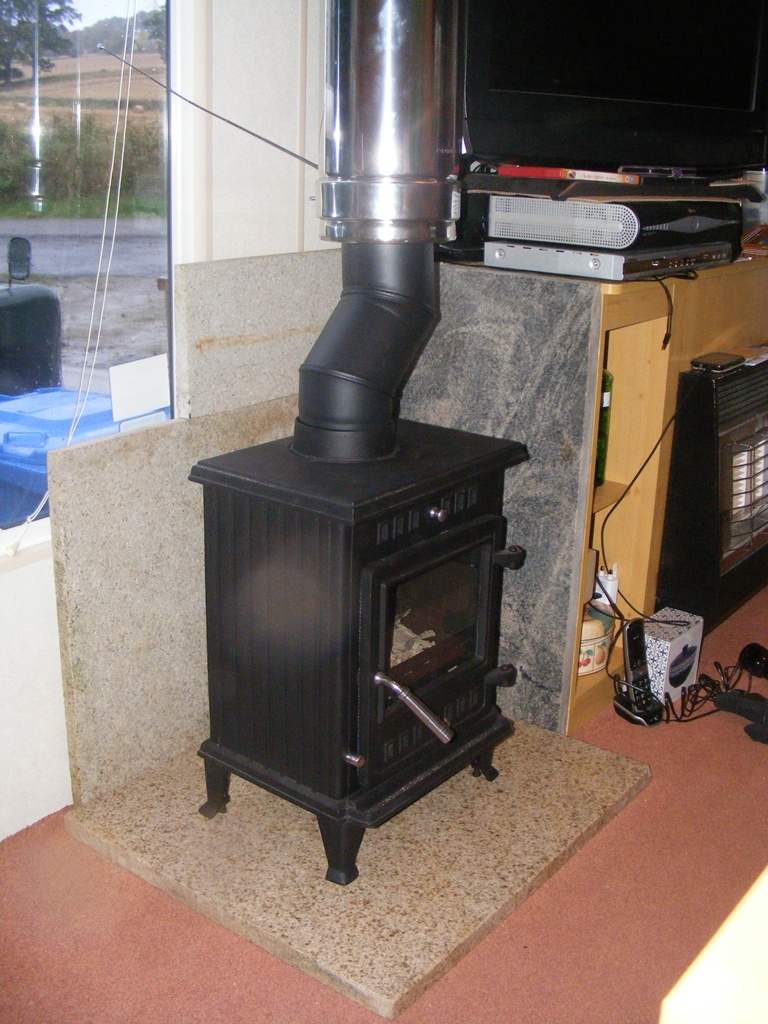
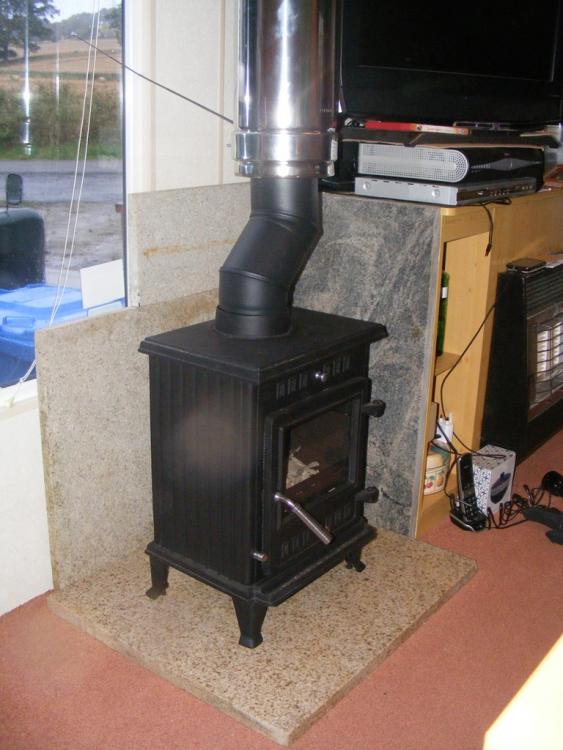
This is the one I fitted in our static caravan It does NOT comply with building regs, it was just something I did the best I could. The hearth does not extend far enough in front of the stove for a start. We used to keep a cheap tough mat in front of it to protect the carpet. The stone sides and back are to protect the timber cupboard and plywood wall covering, and there is an air gap behind both bits of stone, not easy to see in the photos. These were some offcuts of stone worktop I got from freecycle years ago in the principle they might come in handy some day. This was a very cheap stove from the internet, not one I would use in a proper house, but it served us well and we managed not to set fire to the caravan.
-
11 hours towing the snail only stopping for fuel and comfort breaks.
-
Remove decorative ceiling joists for vaulted ceiling
ProDave replied to tvrulesme's topic in General Structural Issues
That is only a ridge board at the top, so you WILL need to retain the "ceiling" height beams that span wall to wall. They stop the roof sagging and pushing the walls outwards. A structural engineer might be able to come up with a scheme where some are removed and some remain, but you would not want to try anything like that without professional input. -
Lightweights. Try doing Oxford to Inverness in one journey towing a caravan.
-
If that is a major factor in your choice of unit, take a minute to think why. When I was doing my system I had much the same debate, and a learned forum member concluded that if you have treated mains water and if you have an unvented hot water tank, then there really is no risk of legionnaires as the water treatment plant will have eliminated any that might have been present and there is no way win an unvented tank for anything to enter. Hence I heat mu UVC to 48 degrees with the ASHP and the only time it gets any hotter is when there is surplus PV generation diverted to the immersion heater.
-
Design / costs for a shepherd's hut or moveable 'bothy'...
ProDave replied to Grian's topic in New House & Self Build Design
I think the theory is the stilts it sits on are not part of the building. He discussed it with his BC and agreed if you got a big enough crane and a big enough low loader, you could pick the whole thing up in one piece and put it on the low loader. The low loader would never get up the slope and out of the gate but that didn't seem to bother anyone. -
Design / costs for a shepherd's hut or moveable 'bothy'...
ProDave replied to Grian's topic in New House & Self Build Design
Take a read of this blog He did it all himself, design and build. That is a build complying with the definition of a "caravan" so only needed building control for the drainage connection. -
Care to post the make and model of stove and if you know it a link to the installation manual?
-
The important thing is what does the stove manufacturer say? There are two important things, the first is what hearth does it need. If it is small as you say and sits right on the floor with no storage space underneath, then it will require a constructional hearth, which is basically a big thick slab of cast concrete. But if it has a storage space or other void at the bottom and the manufacturer certifies the bottom will never exceed 100 degrees then it only needs a 12mm hearth which may be a slab of stone, glass or even tiles if thick enough. The second thing is what the manufacturer says is the minimum "distance to combustible materials" from the sides and back of the stove. That dictates where it stands how far from the walls.
-
Planning oopsie. Retro fit drain channel?
ProDave replied to Build2022's topic in Party Wall & Property Legal Issues
If it were me I would ignore it and do nothing. If a buyer is going to make a fuss because of a path like that, they are not the buyer you want. If that is all that is wrong with the house then that is good and it should sell easily. I would read the "hard standing" question as have you made additional vehicle parking space and answer no. -
Note the direction of rotation of the NEW fan. Then temporarily re connect the OLD (you don't need to mount it in the unit) and note it's direction of rotation. I bet they are opposite. Do that test and let us know. Also, take a photo of the PCB from the other end so we can see the writing on the board next to the fan connectors.
-
New build floorplans - opinions welcome
ProDave replied to Indy's topic in New House & Self Build Design
No problem. An mvhr input vent at the dining end of the room, and am mvhr extract vent at the cooking end. Recirculating cooker hood with carbon filters will take care of most of the smells. -
ufh Advice required for the correct settings for UFH
ProDave replied to ChantalA's topic in Underfloor Heating
Re gas consumption. Simple laws of physics, if the boiler is burning and heating water it must be going somewhere. If the house is only just reaching your target temperature, then it won't be wasting massive amounts of gas. There are probably some savings to be had by optimising temperatures and improving efficiency, but probably not massive savings. What it the context here? Old house? New house, have you just bought it and this was what the previous owner had etc etc. Frankly bottled gas would be my last choice for heating, an oil boiler would have been a better bet perhaps? -
1930's Upper Villa Thermal Improvement Suggestion
ProDave replied to Ramaya's topic in Heat Insulation
What is an "upper villa"? A flat or maisonette? General pictures of building and which bit is yours? -
ufh Advice required for the correct settings for UFH
ProDave replied to ChantalA's topic in Underfloor Heating
Can you post a picture of the UFH manifolds including close ups of any valves dials or controls? Is this bottled gas as you are using the unusual measure of Kg of gas used? -
I don't have time to be "nice" with them, they are rodents, pest and cause damage. Find a length of old drain pipe, lay it along the ground behind the ASHP and put a tray of rat poison in the middle of the drain pipe (the pipe is to stop larger animals getting at it)
-
An interesing address database / mapping website.
ProDave replied to ProDave's topic in General Self Build & DIY Discussion
I have just found the UK wide site to search this new UPRN database https://www.findmyaddress.co.uk/search -
I was looking at something altogether cheaper than that. Like PV itself, it needs to be cheap to be viable.
-
I have often thought about such a system, but it won't be off the peg parts and it won't be a job for an electrician, more a job for an electronics boffin. In my case I have a home made PV dump controller based on an Arduino. so I would add to that to turn on a charger when there is surplus to charge the batteries. The same Arduino might as well turn on a grid tie inverter to discharge the batteries when import is detected. The only bit of that I had not solved was an off the shelf grid tie inverter that lets you set the output power. It is the cost of batteries that has stopped me experimenting with this.
-
You can build a small single storey building under the "caravan" regulations. To legally be a caravan it does not need to be on wheels but needs to me moveable in some way that can include picking it up with a crane and lifting it onto a low loader. Such a building is exempt from building control except for any drainage system that it is connected to. It might still need planning permission, that is separate.
-
I assume you are talking about render on the outside not plaster? This is surprisingly common around here to see this done but I wonder how it works properly. The bottom of it is below the DPC and so will be prone to getting tamp from the ground and bridging the DPC. I had exactly this on a previous 1930;s house. The walls had "rising damp" in several places, completely cured by removing the lower render and terminating it with a bell cast just above the DPC and leaving the lower brick exposed. So I do wonder what troubles are being stored up for the future if you do take the render all the way to the ground.
-
The big one for me is mice can chew through them. Ask my neighbour who had 2 leaks and 3 bits of ceiling down before he caught the mouse. Of course make your house air tight and mice won't get in. And the previous static caravan, could not stand our high water pressure and a lot of the plastic push fit fittings started bursting.
-
1: A monoblock ASHP puts the noise making bit outside. For some strange reason this bothers some people but I would rather have it outside than in. 2: GLUE and SCREW the F out of your floor boards and they won't squeak or creak. 3: Pipes need to be free to expand and contract. What you describe is usually where pipes are in a slot under the floor and are tight, so they can't just expand quietly, the expand a bit, winding up like a spring then go "click" as there is enough force to nudge them along a bit.
-
Yes. Move in. If the builder grumps, tell him the alternative is you might go bankrupt and HE might not get paid. This is the best solution for everybody including him.