
Stones
-
Posts
3761 -
Joined
-
Last visited
-
Days Won
23
Everything posted by Stones
-
Another +1 for Rationel from ADW. I did get a price from Russell Timbertech and went and had a look at their showroom. Price wise they were initially the same as ADW, but ADW were prepared to negotiate whereas Russell Timbertech wouldn't budge price wise. What Russell Timbertech could do was provide a natural timber finish inside (Rationel only offered a painted finish), with the option of oak if you wanted to pay the premium. From what I saw in both showrooms the Rationel windows had a slightly better paint finish.
-
@Jenjen I've built 6 houses over the last 20 years and have financed them in both of the ways you're thinking about. I would say both have pros and cons. Stay in your current house - potentially limited in what you can borrow on existing terms (if the lender allows it at all), you may also be restricted in what potential lenders will allow in terms of a new self build mortgage i.e. looking at your total outlays and affordability - gone are the days when you could borrow 12 times your earnings (as I did at one point before it all went bang). You also have to think about what happens if you cannot sell your house or get what you hope for - this can be very stressful. Plus side is you get to live in your own comfortable home through the build. Sell up prior to building - your fortunate in that you have the cash to buy the plot, so worst case could secure that, get all your ducks in a row whilst selling your house. Once the house is away, you fund the build through the equity released and new mortgage route. Positive are you know where you are finance wise, don't have the stress of an unsold house hanging over you, and should comfortably be able to borrow given you own the plot and have a chunk of cash. Downside is you end up in temporary accommodation ranging from a static caravan to a luxury pad at £000's a month. What level of discomfort you are prepared to put up with is a decision you have to think about. Living in grotty accommodation isn't fun... Best advice I can give is think about what compromises to your current lifestyle you are willing to make, how much stress would you be comfortable with, and think carefully about how much you want to spend - do you for example really need to build a 5 bedroom 4 bathroom mansion if its just the two of you. Maximising value doesn't always mean building the biggest house you can.
-

Ceiling height for open-plan room
Stones replied to Dreadnaught's topic in New House & Self Build Design
Our main room is 9m x 5m covering the dining area and lounge. The ceiling is vaulted to a height of 4.8m. The feeling of space that a high ceiling gives is very noticeable, and in many ways preferable to a larger floor area with lower ceiling. In a previous house we had a room that was 6m x 7m which you entered by descending 4 steps. Ceiling height was 2400 but it felt very oppressive. Simply put the scale of the room didn't match the floorspace. I would advise going as high as you possibly can. -
The Mitsubishi has on board metering accessed via the FTC5 controller.
-
The tale of the sale of our old house
Stones replied to Jeremy Harris's topic in General Self Build & DIY Discussion
? -
The tale of the sale of our old house
Stones replied to Jeremy Harris's topic in General Self Build & DIY Discussion
@JSHarris Can you not just give the Iresa details? This would allow the ball to start rolling whilst you try and get the relevant info from Octopus? I can't imagine the conveyancers will either know about Iresa or do anything with the information other than pass it on to the buyer. -
Highland must be quite relaxed! Neither Perth or Kinross, nor Orkney would accept percolation test result done by me, insisting on an engineer or similar. Damned annoying as its not difficult following the procedure, just a little time consuming.
-
My fault for missing the 'mechanical' bit!
-
Certainly worth thinking about. If you think about it in terms of what your insurance excess would be if there was a leak, perhaps not a bad investment?
-
I've just updated my blog which details our cross ventilation cooling strategy. It does work, but only because the ambient temperature is lower and there is usually always some kind of breeze to assist with air flow.
-
In Part 22, I detailed my decision making process in relation to my choice of a pre-plumb Mitsubishi Ecodan 8.5kW ASHP based DHW and heating system. I now have a full set of data covering 12 months so can provide figures in respect of how the system, and our house has performed. My baseline requirement was to maintain 21.5C in the house 24/7 throughout the heating season (October to April), and a supply of DHW water that would allow multiple showers to be drawn off without a drop in the temperature of water delivered at the tap. The Mitsubishi FTC5 master controller / thermostat is set to 21C, and is located in the hall next to the vestibule. DHW is set to and stored at 50C. Over the 12 months March 2017 – March 2018, heating COP ranged between a February low of 3.3 to an October high of 4.6 over the course of the heating season, with an overall SPF of 3.7 DHW COP ranged between a February low of 2 to a summer high of 2.5, with an overall SPF of 2.3 Based on a kWh electricity unit price (inc standing charge) of 12.3p, I paid 3.32p per kWh of delivered heat, and 5.34p per kWh of DHW (inc losses). It should be noted that DHW cylinder losses do slightly reduce my heating demand, albeit at a higher cost than if delivered via UFH. For a reminder of our layout: In winter, with a set temperature of 21C, the house sits at a comfortable even temperature, the main living section of the house tends to sit at 21.5C, the 2nd and 3rd bedrooms at 21C and the master bedroom at 20.5C. I suspect that the slightly lower temperature in our bedroom is due to the fact I set the MVHR vent at a higher supply rate than the other bedrooms. This would tally with my experience of doing the same in our last house. The two biggest factors that impact on our heating demand are wind speed and solar gain. In modelling our heating requirement, I took both into account, along with incidental and household gains. The weather data set was based on a combination of met office and local home weather station information. Our average wind speeds are significantly higher than elsewhere in the country, and combined with the effect of storm force wind speeds (which we get a fair bit of) we do have a higher heat demand when compared to the same house being located in a sheltered inland area. The impact of wind speed, and the differential in pressure it causes is illustrated here: http://www.wanz.co.nz/ConversionChart A doubling of wind speed sees the pressure increase by a factor of four. Average winter wind speeds of 15-20mph (which equates to the standard air pressure test) are common if not the norm here. Average storm wind speeds of 40-50mph gusting to 70-80mph are also common. The impact of the pressure differential that such wind speeds cause was illustrated to me during the build whilst I was decorating. Having masked off the windows with polythene it was noticeable that when wind speed exceeded 40mph, the polythene would inflate on the windward side of the house, and be sucked onto the glass on the leeward side. Whilst we’re not aware of any drafts and the house isn’t any way uncomfortable, looking at the daily heating requirement when wind speeds are high, you can see an increase in the amount of energy used. Part of that will be air leakage (as evidenced by the effect of pressure differential on the windows) part is the unbalancing of the MVHR (gusting wind from a particular direction can cause the fans to struggle), and part is the lack of solar gain on such stormy days. In terms of solar gain, the vast majority of any gain manifests in the public areas. In winter this provides a useful uplift in internal temperatures. Depending on how clear it is, and how long the sun is out, the uplift sometimes compares to having a WBS stove on and really is quite pleasant. More generally, with mixed winter weather, the gain is less noticeable in terms of a temperature spike, but does have the benefit of reducing our heating energy use. In summer, the gain can be significant and does require a cooling strategy. Without any active cooling, the house has at times risen to 25C in the public areas and 24C in the bedrooms. Alongside the MVHR summer bypass (set to activate when extract air is 22C or more) we cool the house down to a more comfortable 22C using cross ventilation, opening windows / taking account of the prevailing breeze. We also have a velux window upstairs, which when opened in combination with a downstairs window, creates a chimney effect that is very effective in exhausting hot air. The biggest downside in using cross ventilation is that it doesn’t work when the ambient temperature is high (not a very common), nor when there isn’t a breeze (again, not very common). You also have to factor in the unexpected as we had to recently as our neighbour undertook ground works, which created vast clouds of dust in the dry weather. Opening windows simply wasn’t possible on those days. Overall the predicted impact of solar gain is as I modelled it using data from the following two sites: https://www.susdesign.com/ http://re.jrc.ec.europa.eu/pvgis/apps4/pvest.php PVGIS provided daily average data, and from susdesign I was able to work out a peak solar gain multiplier to determine what the maximum likely amount of solar gain would be on a clear, cloudless day. Modelling solar gain for both heating and cooling requirement was a very worthwhile exercise as I was able to determine what our worst case requirements were for both, and what strategies would work. I’m fortunate in that the prevailing weather conditions here mean cross ventilation is a viable and workable strategy to deal with overheating. I am however in no doubt that had we built our house in a sheltered location in a warmer part of the country, that we would have a very real overheating problem and would have to use a very different strategy, most likely combining solar films on windows and active cooling. I do have the option of actively cooling my house using our ASHP, via the UFH and if I wanted by retrofitting a duct cooler into the MVHR system, although haven’t felt the need to do so yet. One plus point of the Mitsubishi Ecodan ASHP is that activating cooling is simple (changing a dip switch setting to enable the master controller). All in all, I’m very happy with the way the house is performing in terms of retaining heat and providing a comfortable environment in both winter and summer. The performance and running costs to date are certainly more than satisfactory. Of particular value to us is having sufficient heating capacity to deal with spikes in heating demand (resulting from especially stormy weather) as and when needed, without having to resort to auxiliary heaters or peak rate top up, and the simplicity of use of the master control system. Whilst I could if I so wished set flow temperatures and heating curves, the onboard auto / adaptive program requires one user input – internal set temperature, and the controller works out the lowest temperature way of delivering it. Whilst I had a very good idea of what our heating curve should look like, using the auto / adaptive mode saved a lot of trial and error, and having monitored flow temperatures, have not seen them exceed 32C. For those not comfortable with developing their own programming or control systems, this is a very big plus. Having looked at a variety of options, I concluded that an ASHP would be the most cost effective solution (even after taking into account the cost of replacing the outdoor unit after 10 years) to meeting our requirements, and 12 months on, I have absolutely no doubt that I selected the right system for our requirements. Whilst I have no hesitation in recommending the ASHP system I have, it is important to recognise that low energy or passive type builds really do need to be modelled and individual requirements identified to determine what type of heating, cooling and DHW provision is required.
-
ASHP 101, how does a reversible heat pump work?
Stones replied to Dreadnaught's topic in Air Source Heat Pumps (ASHP)
@JSHarris What size is the unit you bought, and can you post a picture? @Dreadnaught In the end I decided to see how the house performed without fitting a duct heater / cooler as it would be easy enough to retrofit as a second zone on our pre-plumb ASHP system. I'm just drafting a blog entry at the moment covering how the system has performed over the course of 12 months. Should be able to post it later today or tomorrow morning. -
ASHP 101, how does a reversible heat pump work?
Stones replied to Dreadnaught's topic in Air Source Heat Pumps (ASHP)
When I looked at fitting a wet duct heater / cooler, there were two problems. The first was the limited air flow in an MVHR system, and the second was the size of duct heater / cooler you would have to fit to get any meaningful heating / cooling. At best I found I was only going to be able to deliver around 0.5kWh worth of cooling (or heating) through the MVHR (based on the flow temps I would be working with from the ASHP). https://www.systemair.com/en-GB/UK/Products/Product-selector/Fans1/ Has a useful calculator that allows you to play around with input criteria - target air temp, air flow rate, flow temps etc to determine the size of unit you would need and how much kWh it will deliver. @JSHarris What size of duct cooler have you got? More discussion here: -
@newhome we sold our last house which HD n exhaust air heat pump fitted without difficulty. Virtually every new build here in Orkney has an ASHP, be it A2A or A2W - doesn't seem to have slowed a fast paced market. You should be eligible for an interest free loan to install renewables (MCS install) the beauty of it is you use the RHI income to pay off the loan. Should be info on the EST (Scotland) website.
-
LG Therma V mono block Air Source Heat Pump
Stones replied to ProDave's topic in Air Source Heat Pumps (ASHP)
@ProDave our system (albeit it was an out the box preplumb system) is controlled entirely via the supplied master controller / thermostat. We have additional thermostats in the bedroom which activate actuators on the UFH manifold so we can shut off the heating in those rooms. Otherwise the house temp is centrally set and the system operates quite happily by itself to maintain the set room and DHW. Obviously you would have to wire for pumps and valves etc as required, but may still be worth considering the supplied controller rather than adding something else in? -
As those who have read my blog know, I have an 8.5kW Mitsubishi Ecodan and 300 litre preplumb cylinder with UFH, 155m2 slab, no buffer, no PV. I will in the next few weeks be posting on my blog in respect of how the DHW and heating have performed over the course of 12 months. DHW over the course of the year, COP of 2.3, a bit higher in summer, lower in winter. Heating COP of 3.5 No short cycling on the heat pump. Plenty of DHW capacity and fast recovery - despite continuous drawing off of DHW we have not experienced DHW running out or going cool. I did a cost comparison before deciding on the ASHP set up, including Sunamp and PV, but ASHP came out on top taking into account capital, running, service and replacement costs into account. I'll go into more detail in due course, but thought it worthwhile highlighting that an ASHP is a good solution and works well for us.
-
I've just built a couple of timber planters. I lined one with some EPDM roofing membrane (pond liner in effect) and the other with DPM I retrieved from the skip when the house was being built, large drainage holes at the bottom. Both perfectly good for lining.
-
No, clear satin.
-
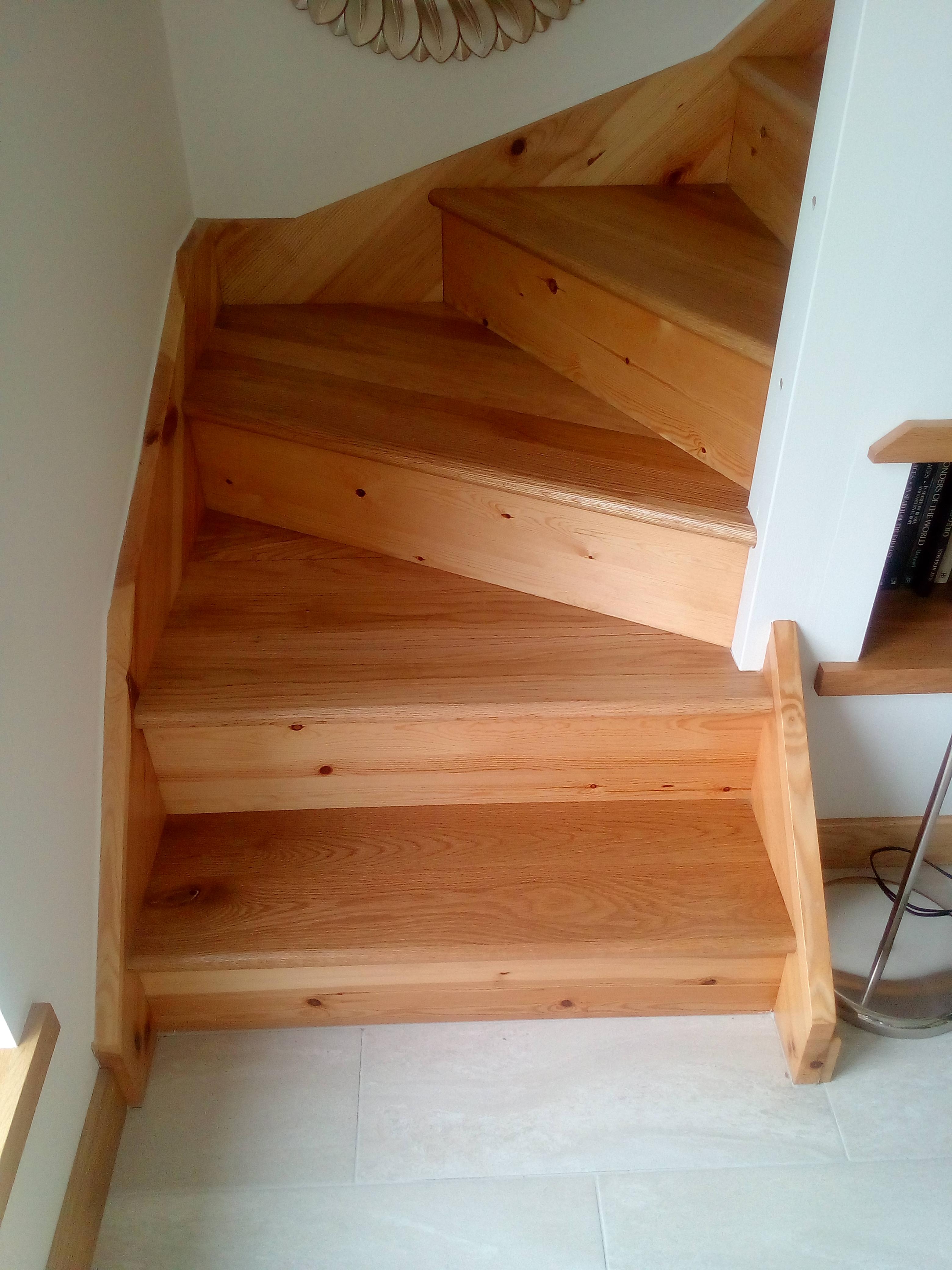
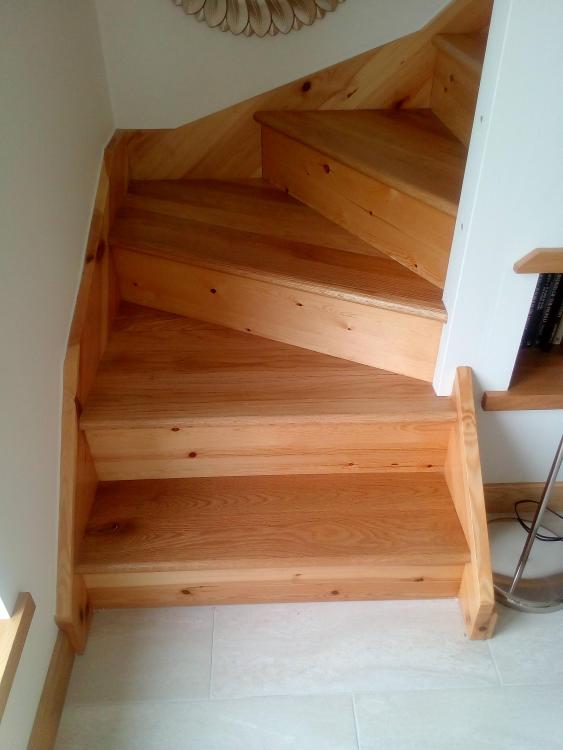
We have a mixed timber stair, oiled with Osmo. Oak treads softwood stringers and risers. Looks surprisingly good.
- 95 replies
-
- 1
-

-
- stairs
- homemade stairs
- (and 2 more)
-
Plan C, leave aircrete walls naked for a winter?
Stones replied to epsilonGreedy's topic in Brick & Block
Of the house we have built, 5 were TF and our current ICF. I must admit to being an ICF convert, but I think that's because I used an outstanding contractor who really knew his stuff and paid a lot of attention to detail, and that ICF is really well suited to the weather conditions where I live. My previous TF builds, in particular the last one which used an injection filled wall panel, were all erected quickly. We did suffer on one TF build, having completed all our excavation and foundation work in the dry, it started raining the day the frame went up and didn't stop until 6 weeks later when the slate roof was on and finished. Even though the frame and sarking boards were covered with membrane, the frame got very wet and it was a real struggle to get it dried out. -
Presumably any prospective buyer would factor in whether or not a boiler had been serviced or not in making their offer. When we sold our last house our heat pump hadn't been 'serviced' officially but I was able to show the buyer all of the checks that formed part of a 'service'. he was happy and the solicitors weren't interested.
-
Back to Buildloan (groan)
Stones commented on curlewhouse's blog entry in Sips and stones may break my bones...
Had exactly the same with AOL many years ago. Notified them of my intention to quit the contract by the required number of days, by their preferred method and got email confirmation back from them. As a matter of course I cancelled my direct debit. A month or so later, a late payment demand from AOL who I was no longer contracted to. Emailed them a copy of their acknowledgement and heard nothing more until a letter from a debt collector arrived! A bit of research and sent them a holding letter saying I was in dispute with AOL (they cannot proceed with any action in those circumstances). Two weeks later another letter from a different debt agency (presumably the 'debt' had been sold on. Another holding letter and complaint to AOL who eventually acknowledged they were at fault and would cancel the outstanding debt. No apology, nothing. Customer service at its best! -
The ones I used were supplied with spring clips to hold the unit in position.
-
Schedule 1 of The Town and Country Planning (General Permitted Development) (Scotland) Order 1992 / Schedule 2 of The Town and Country Planning (General Permitted Development) Order 1995 both refer to paragraphs 2 - 10 of the First Schedule of the Caravan Sites and Control of Development Act 1960, which details the permitted use of land as a caravan site where a caravan site licence is not required (to obtain a caravan site licence, you require planning permission). http://www.legislation.gov.uk/ukpga/Eliz2/8-9/62 Paragraph 9 states Building and engineering sites Subject to the provisions of paragraph 13 of this Schedule, a site licence shall not be required for the use as a caravan site of land which forms part of, or adjoins, land on which building or engineering operations are being carried out (being operations for the carrying out of which permission under Part III of the Act of 1947 has, if required, been granted) if that use is for the accommodation of a person or persons employed in connection with the said operations. Many people believe that this paragraph means they can live on site with their families. For those individuals who are employed in connection with the relevant building operations that may be true, but the paragraph does not cover family members not employed in that process, children being a good example. Whilst it may be the case that individual Planning Authorities are more relaxed about their interpretation of this paragraph, and individual circumstances will differ, the only way to be sure that you can permanently reside on site is to obtain planning permission. The most straightforward way of doing so is to include provision of the static caravan in your main planning application.
-
@deuce22 one thing to perhaps be wary of when using family and friends to do work for you, is that there is a cost. Perhaps not up front, but at some point those family members and friends will want the favour repaid. If you're happy working on that basis and having to repay time to someone else long after your project is finished, fine, but one way or another you will pay for your build. As to what m2 cost is achievable, as others have said, there are so many factors that can influence the final figure. Our first and second self builds were very simple and commercial, i.e. the spec was a bit better than a major developer but not hugely, and consequently, the saving against market value was quite significant, but as we progressed down the self build route (6 in total) we have chosen to spend that saving to achieve a much higher standard of finish, fittings, fixtures and a design that is optimised for the way we want to live, rather than a developers bottom line.