Bramco
-
Posts
796 -
Joined
-
Last visited
-
Days Won
1
Everything posted by Bramco
-
Dual immersion UVC DHW tank with ASHP coil?
Bramco replied to Bramco's topic in Boilers & Hot Water Tanks
Thanks @ProDave@dpmiller I think I've found one as standard though - Worcester Bosch indirect - but only on the larger tanks - 250l and 300l. See image below. The only issue might be the coil - does the coil need to be longer/have a greater surface area for ASHPs over standard boilers? Simon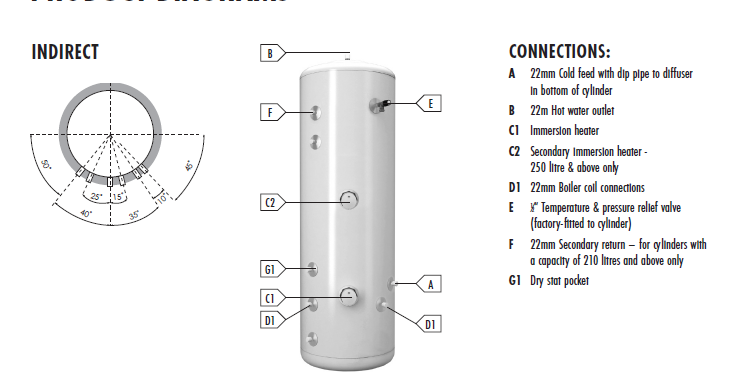
-
Hi, I'm sure I read a post some time ago about companies that do bespoke DHW tanks. I think we might need one... We will have solar PV with diversion and need a tank with 2 immersions, so that we can divert into the middle immersion first and then when that has taken all it can to an immersion in the bottom of the tank. If I look at the direct tanks with 2 immersions, they are all configured like this. We intend to try and manage with Solar PV diversion and cheap rate electricity for the UFH and DHW but may need to install an ASHP in the future. The ASHP tanks all seem to have the bottom immersion above the coil for the ASHP and some have them at least halfway up the tank which would be useless for the diversion scenario above. None of the cylinder suppliers seem to cater for what we need. I'm sure I've read somewhere on here about a companies that can do bespoke cylinders but I can't find the thread. Any help/pointers, much appreciated. Simon
-
NEST is a good system but it's an 'intelligent' one. So can 'learn' what it thinks you need in terms of control. The way it learns is pre-programmed, so if the learning algorithm doesn't suit your heating setup then it will work against what you are trying to achieve. I don't think they work well with ASHPs for example. Having said that, your system is much like a system based on a gas boiler - you can turn the heating element on and off as much as you like/need, so it should be OK. We're going to use a couple of simple thermostats on our system to control 2 zones. Simon
-
We're more of a 'damn I wish I knew then what I know now'. We'd handle things very differently from the start if we did it again. With the current build there's lots that we could have done better. But at our time of life, we're not starting another one..... Simon
-
If they agree a fixed price then OK. But I'd still ask for the shipping etc. cost breakdown and check it. We've bought sanitary ware, taps etc. from Reuter in Germany in the past. MUCH cheaper even when we were in the EU. But of course they no longer ship here. We were planning to have all the stuff for the new house sent to our son in Holland and pick it up when we're across there in a month or so. But we've chickened out.... don't fancy the hassle of a customs strip search. However the taps we wanted won't be in stock in the UK until late May which would be too late, so we have ordered the taps from Reuter for delivery in Holland. This will be below the £350 each of goods you are allowed to bring in as a traveller on the Eurostar. Think we'll still hide them though.... Simon
-
Ours found that there might be bats around because there were a couple of clefts at the end of branches lopped off a tree - which must be a pretty poor home for a bat.... This was for a new build, not a demolition or renovation job. Planning set 2 conditions - there needs to be a couple of bat boxes. Also, 'Prior to the installation of security lighting details of any such lighting shall be submitted to and approved in writing by the Borough Council, together with a lux plot of the estimated illuminance.' When we put in the application to discharge the conditions, we simply said we wouldn't be installing security lighting - result, condition discharged! ? So don't worry about a condition like that because it can be circumvented.... ;-D Simon
-
Help me ter fix this please.....
Bramco replied to ToughButterCup's topic in General Self Build & DIY Discussion
We had this on a rental property - the only solution we came up with was to sack off the door and fix a larger surface mounted door over the box. Seemed to work and looks like a proper box. I'd send a link but we had someone do it for us. But the new door surround is bevelled so the door stands off the surface a bit. I guess it's screwed through the new frame into the surrounding brickwork. Simon -
is very slippy in icy conditions....
-
Local resin bound guy near us told me the other day that the price of resin has doubled in the last year.... If you go this route, make sure the pebbles have zero iron in them. Any iron content can rust which causes the pebbles to swell and the whole thing to break up. There's been a few round here that have had to be ripped up under warranty and replaced. Simon
-
I’m confused about ubiquiti
Bramco replied to Adsibob's topic in Networks, AV, Security & Automation
Same here re speed - although 'apparently' we're too far away in the new build for them to be 'arsed' to run a cable through the duct we've installed ? But on the reset time - if you've switched off wifi as @PeterW said, we find it reboots in no time. So it seems the wifi functionality is what takes the time to reboot. In the current house we run 3 Google mesh routers which happily hops through two 9 inch brick walls into the extension. Simon -
MVHR ducting routes...
Bramco replied to BartW's topic in Mechanical Ventilation with Heat Recovery (MVHR)
Just lifted the upper floor and ridge. But don't tell anyone ? ? Simon -
MVHR ducting routes...
Bramco replied to BartW's topic in Mechanical Ventilation with Heat Recovery (MVHR)
Another approach is to ask the TF supplier to add 3 inches to the height of the ground floor and put in a suspended ceiling. Our TF supplier did this at no cost. This means the ducts can all go under the steels etc. Simon -
It's hard to get a sensible answer from them - we've tried. Each of them is tied to a manufacturer in some way, so the answer always comes out as - you need a xxx (fill in the manufacturer name and model.). We've also had MCS companies that won't quote until they've charged us for a heat loss analysis, even though we have a full M+E tender document with that analysis. In fact, we commissioned a comparison between 2G and 3G windows to work out if 3G would be worth the extra investment, so have all the info needed. Quotes vary a lot and if you take out the material costs (it's easy to find prices on the web) then there is a massive markup for the 'MCS' bit against a plumber simply doing the install without the 'MCS' bit. Simon
-
What are the best ways to save money ahead of a demolition
Bramco replied to LaCurandera's topic in Demolition
We saved a fortune in disposal fees for the earth taken out for the foundations. Local farmer was very pleased to take it away to level the verge on the road down to the farm. We paid for the grass seed to reseed it. Bargain. Simon -
The Economics of our SunAmps
Bramco commented on TerryE's blog entry in The House at the Bottom of the Garden
On that front, our plumber said don't worry about recycling pump for anything under 12m. Fortunately ours aren't. ? Simon -
An Overview of my House Heating and Controls 4 years on
Bramco commented on TerryE's blog entry in The House at the Bottom of the Garden
I've also been over things carefully and helped whenever I can but........ I have a contract with a company to do a highly specced job. I don't expect to have to provide the QC on the job myself - surely they should have all those procedures in place. So I shouldn't have to be doing these things. As for analysing what's gone wrong and identifying the root cause and fix - well that's not my responsibility - but it ended up being that - mainly 'cos the QC person was a ........ Apologies but he really was. We were in a site meeting with my son and the QC person was just staring out of the window. When asked what he was looking at, he said 'Oh, that sign on the fence, I'd not noticed that before.' But now I've hijacked an excellent post on experiences with alternative heating strategies, so let's just agree that if you are going into this kind of thing, you need to already be an expert, or have done one before to have the experience to say 'Whoaaaa stop right there.....' I will try to remember to come back to this post with our experiences in a year or so's time. Hopefully not cold...... Simon -
An Overview of my House Heating and Controls 4 years on
Bramco commented on TerryE's blog entry in The House at the Bottom of the Garden
Hi Terry, ours is only 1000m and we have 260m2 of space but only half of the build is 2 storey, so a lot of ground floor and not much 1st floor. We're in the same village but not on top of the build, so we were only there once or twice a day. Agree though the guys are very hard working. I think we had assumed that MBC would have the required QC in place for the erection. For example the cowboy 1st crew from the subcontractors managed to get the sole plates out. The knock on effect of this has been massive as you can imagine. I would have expected MBC having laid the slab, to also want to set out the sole plates to make sure everything was in the right place. As it transpired, the MBC QC chappie turned up late in the 1st week, didn't do any serious checks, just walked round and did a bit of nitpicking and then didn't come back for another 10 days. The impact of the sole plate issue wasn't noticed until my son and I started to do some checking because of other issues. Long story short, I would insist on MBC setting out the sole plates - it's a THE interface between the slab as poured and the panels to be delivered from the factory. Yes, I've used these on our Heat Bank with an ESP8266 board reporting through to and open energy monitor system. Very easy to set up and we'll use the again in the new house. We're also planning to do this, although I was thinking of doing it only on sunny days to redistribute the solar gain. Doing it on a timer is much simpler - so thanks for the tip. Again, when you think things through, this is obvious - although the plumber from our main contractor insists we'll need zones for every part of the house - don't want to fall out with the guy and the cost of a few extra thermostats isn't great, so we may install them but ignore them.... Thanks again for documenting your experience it has been very helpful. Simon -
An Overview of my House Heating and Controls 4 years on
Bramco commented on TerryE's blog entry in The House at the Bottom of the Garden
Great call - thanks for the tip. One more thing to add to the things to check for when we're implementing our system. Simon -
An Overview of my House Heating and Controls 4 years on
Bramco commented on TerryE's blog entry in The House at the Bottom of the Garden
@TerryE Just given you a thanks! That's thanks for jogging my memory about the way you have implemented your system. We've been planning to do the same and I've recently been talking to the main contractors plumber who is having a hard time understanding that the slab is the heat bank. Our build is also an MBC TF and slab to very high insulation levels. we haven't had the airtightness test done yet, roofing is turning out to be a bit of a nightmare but that's a different story. It's 250m2 with a maximum heat requirement (mid winter -4C outside) of just over 5kW. There's 12 UFH loops in the slab with a total length of just over 1000m. Our plan is, like other on here, to suck it and see with respect to heating and install Willis heaters or equivalent and forget about an ASHP until we've worked out how things perform. We were planning to run our build as 2 main zones. There's a single storey vaulted kitchen/dining/lounge and attached to that by a flat roofed utility, is a 2 storey section with the hall, snug, plant room and 3 bedrooms. So we'd run the 2 main sections as 2 zones. I was planning to ensure that we had temperature sensors throughout the build, so one or two in the single storey section, then, the hall, snug, master bedroom (downstairs), the landing and the 2 bedrooms upstairs. Then we could average those readings to get three temperatures; the single storey section and the ground floor and 1st floor of the 2 storey section. Then for the UFH, one sensor on the return to see how the heat is being taken up so to speak. You seem to have gone the other way round and had sensors on flow and return for all the UFH loops and only 1 sensor for the ambient temperature in the house. I can see that sensors on flow and return for the UFH would enable you to balance the loops but surely they are then redundant? One final point on MBC - any TF supplier can be brought down by the crews that do the actual build. The first crew (subcontractors) on our site were so slap dash that it's taken an age to iron out the fallout from their screw ups. I should emphasise that these were subcontractors, so not MBC folks and the company in question no longer does contract work for MBC. MBC have either fixed everything, or will do so at the airtightness stage but it's caused us a heck of a lot of stress, not to mention the time needed to analyse why things aren't as they should be, explain to MBC what the root cause of the issues were and agree remedial work. And then the delays. I think you and others may have contracted at a golden time for MBC while some of us more recently have suffered from their growth pains... We're still happy overall I should add and I would recommend MBC to anyone wanting to go down the TF route. Finally - thanks for documenting in detail the systems you've put in place as well as your experiences with them. It's incredibly helpful. (When does the book come out?) Simon -
I do too but I've always put this down to wearing contact lenses - I'm sure the lenses can cause glare close to the eye somehow. Years ago when we lived in Sheffield we used to go to the Crucible which had thousands of very bright tiny lights on the ceiling. I used to have to hold my hand over my eyes to stop the glare. In the current house we have some rooms without any overhead light, only standard lamps and lamps on side tables etc. - from my eyes perspective, this provides lighting that is much more restful. Simon
-
Here's another comparison table - quite useful -> https://www.boilerguide.co.uk/air-source/best-air-source-heat-pump-manufacturers. (Not sure if this has been updated recently though.) And something from a supplier (I think), so less independent -> https://www.theecoexperts.co.uk/air-source-heat-pumps/reviews Simon
-
We have a big kitchen/dining/living space with vaulted ceilings and have specified a hidden led strip along the wall/ceiling join that will throw light upwards. We'll also make this dimmable in sections, so the kitchen space, the dining space and the living space. There'll also be 3 dimmable pendants over the kitchen island. We'll add some floor lamps in the living space. You have to get the housings for the leds in place before plastering of course. Simon
-
No idea where that list came from but our outline permission and another one along the lane in the Green Belt didn't have any of those. And to be honest some of them seem irrelevant to a small plot for residential development. Take a look at some outline planning permissions in your area - do they have any of those surveys/statements? My guess is none of them have, so crack on and apply. Simon Edit PS - you could spend way more than £100k on that list!!!!
-
What is the best type of Ceramic tile for the Kitchen?
Bramco replied to cbk's topic in Floor Tiles & Tiling
Wall mount is the way forward.... Simon -
What is the best type of Ceramic tile for the Kitchen?
Bramco replied to cbk's topic in Floor Tiles & Tiling
We've had 9mm tiles from B&Q in our kitchen for 10 years. 600x600. Not sure why you'd be worried by wear and tear and cracking? Porcelain tiles are pretty indestructible once they are down. More's to the point, what colour? And how mottled? Kitchens get loads of crap dropped on the floor, so make sure that crumbs won't show until there's a snow drift of them.... Mottled is good. Also go dark, this means dark grouting. You can wash the greb off a tile but not the grouting. Light coloured grouting soon looks... well, grebby... We've got 2 possible tiles for our new build currently in the old kitchen, just sat there, seeing what they look like with splats of stuff, crumbs etc. Might spill some red wine tonight while I'm frying to see what they look like. Simon