


Carrerahill
-
Posts
2132 -
Joined
-
Last visited
-
Days Won
10
Everything posted by Carrerahill
-
I think a whole house feed in the garage would be a good idea if that is where you plan on bringing in the services. Looking at it I think I would create a mains feed in, then have a ground and first split off with 2 more separate isolators, for the sake of another say £15 you then have cold water isolation to ground and first - probably come in handy when you start your build maybe getting a bathroom fired up without full plumbing yet being complete or the kitchen sink etc. Another option I quite like is the manifold option, however, it makes sense to have the hot and cold together so I am not sure where you intend on putting your DHW source? If you split it by floor you could have your kitchen, utility and shower room all tied in nicely via fairly simple run, then the first floor feed straight up into the floor void, into the en-suites and baths with another nice simple run across the floor. I would also put in motorised isolation valves for each floor, but that is just me and part of my plan to automate the house with "Holiday Mode" which includes, among heating and electrical and lighting modes the isolation of water systems - may seem mad but I think it makes sense.
-
Flue quote - please take a look
Carrerahill replied to Pocster's topic in Stoves, Fires & Fireplaces
This is a fairly good video which shows the whole process (if I recall correctly). -
Flue quote - please take a look
Carrerahill replied to Pocster's topic in Stoves, Fires & Fireplaces
Just thinking, what sort of property are you in? Can you get onto your roof safely enough? Could you do most of the work? In Scotland you can do it yourself anyway, I know it is different for you guys (although if I lived in England and it was my property I would install it myself anyway), I'd do a better job than a "pro" firm that installs stoves around here. Bloody cowboys they are and clueless. Since my stove was installed I have had it out once to sort a cracked board (ended up going for Everbuild 500°C plaster) and reinstalled it all, it's a skoosh to install it and if you understand the principles and best practise you would be fine. I paid a guy as it ticked off a big list of things and saved me going up onto our roof, which I didn't fancy truthfully. If I was going to do it again I would DIY it for sure, only thing I may do is pay someone to pull in the liner. Another option would be to prepare it all and have the guy come in and literally fit the liner and connect it to the stove. -
Flue quote - please take a look
Carrerahill replied to Pocster's topic in Stoves, Fires & Fireplaces
Total rip off. Where are you? Friend had a stove installed for £2200 including the stove, liner the works. Guy is fully HETAS registered pucka guy. My installer took £1500 and I supplied the stove, he had to break out the old fireplace to expose builders box, clean chimney, fit 904-316 liner (around 7.5m of it), line the builders box, fit a register plate, fit sandstone hearth, black metal bezel and a chunky oak mantle, chimney back filled with vermiculite and cowl fitted. -
What a mess that is in, paint and dust over it all, bloody hole in the wall with wires shoved through! Madness! If there are bits missing as per the engineers observations and assuming they are from the contractor who supplied/installed this, then I would suggest they should be looking into it. Do you know a neighbour well enough to go and have a look at theirs?
-
I need to pick a kitchen, recommendations welcome!
Carrerahill replied to Carrerahill's topic in Kitchen Units & Worktops
This! -
I need to pick a kitchen, recommendations welcome!
Carrerahill replied to Carrerahill's topic in Kitchen Units & Worktops
Thank you. As in: https://www.diy-kitchens.com/ Do you have one of these in your house? -
You speak of the installer, what about the manufacturer? Would they send out a rep or technical guy to confirm the windows are not right and put that in writing. Why can the installer not fix them? Are they installed out of square or pinched or stretched out of shape causing leaks? Where do they leak from? Can you identify the root cause of the leaks? You speak of an expert but you may be surprised that really you could produce a written document listing all the issues. If I bought a bath tub and it didn't hold water I suspect that a report explaining it didn't hold water from myself would, sorry, hold water! However, if the issue was at a coupling installed by a plumber then you need to ascertain did the plumber stuff it or is the fitting faulty. This may take a bit more knowledge to confirm where the fault lies and yes you may need expert help. I'd write it up like a professional snagging document - just list each issue and give it a number - then write a conclusion listing any possible causes for these leaks, however, do not shoot yourself in the foot, for example, if the windows were squint, don't mention that the windows have been pulled badly out of square, if you did this they might claim your window openings were squint and the installers had to work with the poor openings they had. So make sure if this does appear to be the case, that you word it such that they cannot turn it on you, you could say that packers have been used of incorrect thicknesses or something.
-
Easy one really, now the kitchen building is ready for a kitchen I am keen to crack on, there is a plethora of manufacturers and I guess I could just go and find a couple of manufactures and get some quotes but I'd like a steer. I have experience of Howdens, Ikea and Wren. I fitted a Howdens kitchen into a garage, we also have Howdens stuff into the office kitchen, seems OK, there is the cheaper end of the range and I get that that stuff isn't great and more of a contractor special, fine, longevity, well from what I have seen so far it seems good, both occasions it was the high gloss slab doors/drawers. I used low rise Ikea cabinets to built a custom home office with oak tops, I have been pleased with this, it looks very smart, custom fitted into the corner of the room, but it's not getting wet (maybe a tea cup ring!) and it's not being clonked and clunked in a kitchen - they seemed OK but not sure if they are up to family kitchen use - the drawers do seem to have a bit more lateral movement that I would like - I don't like the side rail construction of them either, they have a metal lower section then a gap then a metal rail from front to back, I know my kitchen drawers, and realistically, stuff would fall out the sides! Wren, my brother had Wren installed in his kitchen, I was around a lot during the build as he was on holiday when it went in and I was to oversee and PM the joiners in his absence, I liked it, seems like solid stuff, however I believe as a business they are a shower and their own installers are a joke but I would not be using their people. Many people have commented that they are expensive, however, so is a Miele oven, but your buying quality and I like quality. What I am not sure of, is just because they are a good brand with prices which reflect this, or are they overpriced mass produced middle of the road? So - does the above reflect what others think, are they all really much of a muchness and we get too carried away about names, like motor oil!
-
Timber and brick exterior wall construction
Carrerahill replied to Moonshine's topic in Timber Frame
Anything up to about 3 storey is often TF in Scotland for domestic buildings - they built some flats near our offices last year and when I drove past they brought back memories of Canada as everything out there is just big timber and OSB clad structures wrapped in Tyvek. That is what these looked like, then they rattled up a facing brick skin. If I was building my forever home it would probably be block cavity or something similar. Our extension is TF with external block skin and 19mm dash finish, so the external leaf is the weather protector really. Before the block work was up our extension was fully wind and water tight, windows and doors in etc. the outer skin is just a jacket and offers very little by way of support to the timber structure when it is built. I have no issue with timber frame, if it is done well, TF got bad press mainly from the big house builders who use that matchstick wood in prefab panels. I saw some roof trusses on the back of a wagon just before Christmas and I pointed them out to my wife, our roof spans were smaller yet our timber was 2x8 these things looked to be about a 40mm x 75mm so not quite 2x3 - but it just square sawn stuff - it just looks like matchsticks to me. I assume they buy this timber direct as no merchant or even shed ever stocks the sort of wood they are using or perhaps they self mill - don't know. What I do know is I was in a SIPS factory a year or two ago and they have proper 2x4/6/8/9/10 and the stuff looked bloody solid. They also ensured all timber was below 10% moisture content before they used it, idea being that they wanted all the shrinkage etc. to have taken place before they build. Our brick layer told me about a row of houses he worked on for one of the mid-sized house builders, they rattled the frames up, soaking wet, brick skin went on immediately after and the houses were fitted out and about 3 months later they got a call to say that some lintels had moved, they went in and the timber frame had shrunk so much that the doors and windows had all shifted and doors wouldn't open and close as they were being crushed! So it is practises like this that give a bad name to a construction method. I actually monitored the shrinkage in our TF and even had some allowances calculated into it to allow for shrinkage - all in all I think it worked out very well as after the roof membrane and battens went on, but before it was fully wrapped and windows etc. put in it had time for the whole lot to dry out in the warm summer we had. I understand that most programs would not allow for this but we had other site work to get on with, concrete pours and new walls and things so the TF got a chance to settle and I am hoping this will give it the best start in life. -
Are you keeping your wires within prescribed areas and immediately horizontal or vertical of any switch or socket? I am not trying to be that annoying twit that just pokes, I only ask as the top image shows a wire but no apparent outlet/device to give someone the indication a wire may be present. Photograph everything before you sheet over (or are we too late for that?). I even wrote on sheets as I installed them the distances from walls, and plotted out danger zones. When it comes to installing the kitchen in particular I will lightly re-plot these out across the whole kitchen double checked with a wire finder so that there is no excuse for hitting a wire! For testing, there are various tests from very basic to more advanced. As a starter do basic continuity test, as said above, Wago the wires together at one end, and bell them out at the other. This can test for breaks and shorts, but not for a nail or screw which has penetrated a single core and no other.
-
How much???? Is that just looking online at merchants or phoning, or even better going in and smiling nicely and asking for a price? We paid £4.55 a sheet for GTEC 12.5mm Tapered. At £7 a sheet I wouldn't be so gungho with it! How many sheets do you need? I'll sell you some at £6.0 a sheet but you must collect!
-
Heads Up! Ordering from Germany.
Carrerahill replied to ToughButterCup's topic in General Construction Issues
Mad eh? Good on you, got me thinking about my kitchen appliances now! If it is worth myself and some friends driving about a 1000mile round trip to get some wine occasionally from France, then I suspect bigger ticket items would be the same! -
What I do not like about that flashing is that the flashing sits on the peak of the tiles and looking at the tile exposed below it looks like the tile has been cut to fit, thus any water sitting high on the peak can get blown over the peak and may then pass over the tile and start its journey into your house. Looking at that, assuming roof is otherwise good and will be in service for some time yet, I would remove the lead and form a new wider piece which can be beaten down into the trough of the tile so that any water needs to be blown up onto the peak first before it can leak down. I also like the hidden valley types but that would take a lot more work and messing to install and if you are fed up of projects you may not want to do that! I know I am late to this party but just my thoughts without having read other posters replies.
-
Regarding electrics and plumbing that depends on what you need and where. If I had laid my floor first I would have had ridiculous electrical and plumbing routes not to mention a near impossible waste pipe route.
-
It is a mix from room to room to be honest, but we have a similar issue with some of them and I did note the reveals were getting close at some points. Another option may be for you to trim your tape back? If it was me I would pack out a little, board it, then use a fresh blade and cut down the tape at an inward angle, then by the time you FST and a bead of silicone/caulk etc. down the seam (as FST/Gypsum etc. always crack at interfaces to wood/uPVC etc.) you will hide any light mark to the window frame. Alternatively if you lightly score the tape will it tear cleanly along the score?
- 78 replies
-
- 2
-

-
- dry lining
- fermacell
- (and 1 more)
-
As I type this my plasterers are working on our build, I finished the reveals on Monday morning about 02:00! We were using plasterboard but the principle is the same, 11mm OSB packers to float the board over the window brackets, sealed to the window frame then PB over the top, plasterers did all the reveals and small bits first, I think they just ran their trowel in and also were using a small end-handled trowel which basically looks like a mini trowel with a cranked handle on one end so that as much as 6-8 inches of it could be slipped into tight spaces, the reveals looks great. For painting, I am sure I will manage, masking tape may come in handy!
-
OK having seen the rest of the images and read your additional info and as mentioned by someone else above, the blockage could not have been backing up too high or else your ground floor pan would have overflowed. If you knock the soil pipe in the loft, or even try to slightly lift it by hand does it feel heavy like that whole horizontal section is full? I think if if that was me I would get a piece of garden hose (perhaps a bit you are happy to bin afterwards) and some gloves on and shove it down the access point and round that bend from the loft. If it doesn't clear by the time you get to the horizontal section (i.e. passed via the 2 No. 45°'s) then I would abandon ship there and try it from outside. Get the camera on the tripod first.
-
Looking at that arrangement I am surprised where the blockage appears to be! You said your system backed up at one point and was never the same, did it back up that pipe much? Is it possible that a very high water level let waste gather high up in the pipe, say that horizontal section and allowed it to set up a bit like poo-concrete? Another thought, is the blockage much further down, like outside on the vertical and in fact that whole section it backed up? If it slowly drains away, how many flushes until it backs up again?
-
FD30 doors and MVHR: a contradiction?
Carrerahill replied to ToughButterCup's topic in Doors & Door Frames
Thanks, I have just ordered a Shelly 1 and a 1PM. -
FD30 doors and MVHR: a contradiction?
Carrerahill replied to ToughButterCup's topic in Doors & Door Frames
Perfect, what I wanted to know - I have not issue with using the net, I just want redundancy so that I am not relying on a cloud server to control my house. I also note it will run on 12V, so I could even use it within a car. So I can have it connected to the net, but if the connection goes down it will still run it's schedule which is good to know, so where is that web server hosted, within the actual Shelly - if I have multiple does that mean they essentially act standalone albeit linked up when they are on the wifi? They are far cheaper than the commercial systems (Casambi is really meant for lighting but they are £60 each) so makes it more affordable for just playing around too. So which version are you using there? I see on Amazon a "Shelly 1PM Wi-Fi Relay Switch Watt-o-meter - that one? I see you can have temp triggers and all sorts, so what sensors do you hook them up with or do they have built in temp sensors, humidity? I think I will buy myself a Christmas present (another one!). I'll keep digging, someone no doubt has videos on YouTube. I guess you can customise the interface so one could be MVHR, some for lighting, some for heating and skin up the buttons so that it looks like a polished controls interface? -
FD30 doors and MVHR: a contradiction?
Carrerahill replied to ToughButterCup's topic in Doors & Door Frames
I have just been looking at these, the one thing I am interested on is where is the program held? Take for example Casmabi lighting controls, they use a bluetooth mesh network and are controlled by a device with bluetooth basically. Offices that I have seen Casambi used for lighting control have iPad's mounted into special wall mount cases, so you have essentially a very powerful control faceplate, you can have as many as you want and those trusted in the office can even have the pin and control the lights from their tablet or phone. But the scene program is on the device, so if you were to have no internet Casambi would continue to work. I have a couple of WiFi sockets and if they lose wifi that is it, I have lost control and the program is held on a cloud so they won't even do what they are meant to do until wifi is restored, so what I am looking for is something like the Shelly complete with power meter and whatnot, but is less internet reliant. -
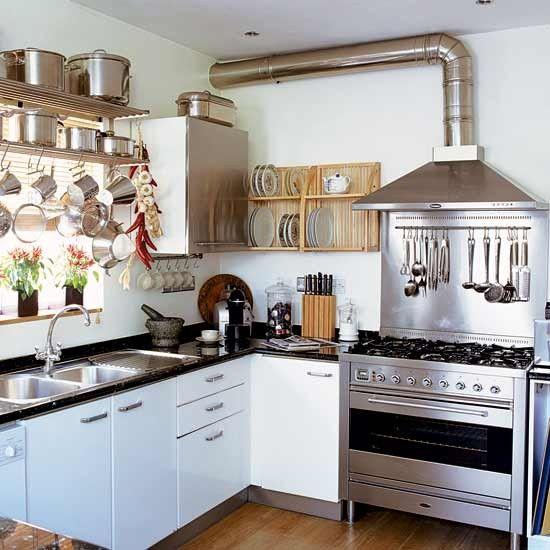
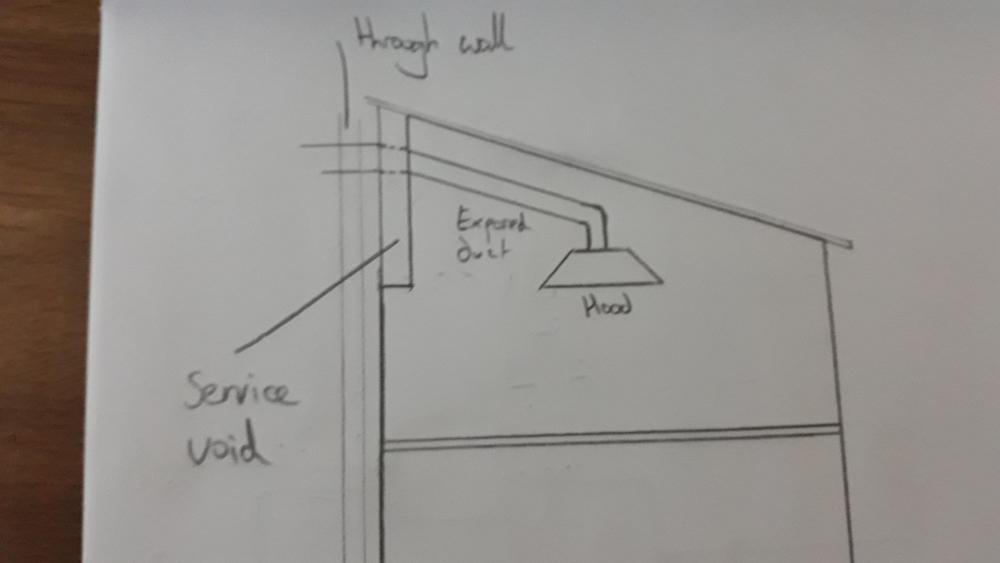
Hi all. As part of my first fix I need to bottom out the cooker hood, I have already included a piece of soil pipe through the wall when it was built which ends in the service void for now, slightly pitched to the exterior. The service void, which the duct will need to pass through will be plaster boarded over on Thursday/Friday and plasterer is booked for the 3rd of Jan so I need to bottom it out really before Christmas so I can order any bits now. I attach a sketch of the situation, idea is, obviously, hood above the hob, I can get the stainless duct I want and even the bend with the same pitch as the ceiling so the duct can sit parallel to the ceiling and it will go up via the service void to the outside. My thoughts were either, inline fan in the void, so the hood is just that, a hood, or a hood with the motor built in and just push the extract up the duct and out. I am tempted to have it custom fabricated and then I will incorporate a control and lighting but obviously off the shelf stuff would be easier. I can find images of what I want, but struggling to find who actually does something that would work, and not really being a cooker hood aficionado I am not entirely sure of the usual connections etc. Do the external venting hoods simply have a 4" (?) spigot for connection to various ducts etc, condensate drain somewhere? See attached a sketch and 2 images showing the idea of what we are going for. One option I have is to simply extend the piece of soil pipe out through the, yet to be installed, plasterboard and leave it sticking out then when it comes to duct install and hood etc. then I just need to get the duct up to the pipe and probably incorporate a small stainless flange to clean off the edge. Down side to this option is that I then lose the opportunity to put an inline fan into the void before PB goes up, but then, do I want a fan in a void, probably not as I don't want an access hatch which would then be the stupid design of a fan boxed into a void - bad plan! I suppose if I went down the self fab route then I could get the hood made up then have a good quality fan incorporated into the hood so all the M&E is incorporated into the hood which can be serviced easily. So if anyone who has recently had cause to procure and spec up a hood, what did you do, how did you do it and who did you use. Thanks

-
Looking at that I would just count them, I got bored after about 9 but then it is not my roof and I have no interest in knowing, but if it was, I'd probably have had them counted by now. The tile could also be a Redland Renown.
-
I have noticed this, for example a 100m drum of 4.0mm T&E list price in CEF is about £1000.00 but they always discount it - obviously! I think it is so they can rip of government organisations or something.

