


Gus Potter
-
Posts
2383 -
Joined
-
Last visited
-
Days Won
34
Everything posted by Gus Potter
-
Hi Jodie. That's a start posting part of a drawing.. but unfortunately it does not tell all. The piles do appear quite close to the boundary and your house is say 3.0m away from the piles roughly. Ideally I (and probably a lot of the folk on BH that know about this stuff) would like to see all the drawings and info that you have available, even up to and including the BC drawings submitted. If you do post try and edit out anything that identifies you or the site address. See later! The small screen shot raises more questions. Were the steel encased piles to be bored or driven initially? How far apart are the piles? Is it your house that is shown to the left.. and is your house on piles say.. do you know what kind of founds your house has.. you probably do. It will take a bit of effort to get to the bottom of this. Much will depend on how determined you are. In a lot of claims situations, say relating to new builds the developer / builder gives you the run around first. Then the insurer that handles the warranty does the same. This way they cut the claims down by more than half I think just by attrition. Also they know that most home owners don't have say an SE in the family who will work probono so they get canned as can't afford to fight winable claims or take the risk. One fly in their ointment here is Build Hub. Now in my experience once you get over the attrition hurdle the opposition start to take things seriously and will look at the evidence on the table, not too seriously at first as they have a lot of tricks up their sleeves. There are a number of strategies but one approach is to understand: 1/ First how your house was build and the ground under. How it has moved about as it's aged.... often houses settle a bit. You may have family photos with the house in the background.. easy to date and they tend to record any trees you may have for example in the garden... for anothe rday but trees are important and need to bee considered / ruled out. 2/ Look at what founds should have been built next door. Understand what the design intent was behind that. 3/ Look at what they have done in so far as you know..could be correspondance / what you have seen and experienced and so on. 4/ Work out what risks may be applicable to your house as a consequence of what they have done next door. Has the risk increased by them changing the design. 5/ If they have gone deep then they may have loaded your soil basically without permission.. which has the potential to induce further settlement of your house. I'll stop there but firstly don't panic, try and sleep well. Often an outcome could be that if you get them partly over a barrel and start running up the costs and professional fees on their side (which is a tactic I use. I work for myself so it's a bit David and Goliath.. but there are often ways to get results) a negotiation takes place. With a fair wind (if you can detemine you have been compromised) then they may offer you an indemnity policy, cover your professional fees and send you an Xmas hamper. Mind you if they have loaded your ground or caused it to swell / behave in a different way and badly breached the principles of the PWA then you could make hay and give them a very rough ride! In that case a bit more than an Xmas hamper will be required. Keep on good terms if you can with the folk next door as they may have little clue that the builder, surveyor any SE may have got them into hot water. If that is the case then they will often be as equally concerned as you are. The builder has probably charged them more! You may find them to be an ally rather than an adversory. It could be that if you win they win also? Just to finish. I use my own name but in your case please don't identify youself or your site as it could compromise any case you may have. @ Jodie keep your head up!
-
First house, first renovation, 1930's semi.
Gus Potter replied to Phillymclee's topic in Introduce Yourself
That's just the start.. BH is a mine of information and practical advice. I still keep my hands on the tools and have learnt loads myself on BH. Lots of folk on BH are at the cutting edge of innovation, design and have worn the teeshirt! I have got a bit stuck myself at times and folk here have pitched in to help me. Enjoy, review what is here on BH, trust you own judgement. -
Hiya. Excuse the spelling / grammer as I'm off duty. Yes there are folk on BH that know about this stuff... but unfortunately you'll have to provide a lot more info to get targeted technical advise for free on BH. It's up to you.. if you feel able to provide sanitised copies of the party wall surveyors report, associated drawings.. or not. That is a major deviation and that should have been recorded and signed off by the PW surveyor. This can give rise to general soil swell.. who decided to do this? What kind of piles were used? Do you know? Ok there has been a nuisance in terms of noise.. let that lie for now.. but has this caused consolidation / swelling of the soil that can impact on you house? Do you have any record photos (dillapidations survey) of before the work started. The surveyor should have these if afforded access to your property. Did they ask to access your property and did you allow them to do so? If not they could be on a bit.. of a sticky wicket! You have my support. It is horrible. Nice try from them! The ground acceleration is only one factor.. much depends on the soil type as this impacts on the neighbouring buildings in terms of later soil behavoir as it can introduce extra residual stress that can manifest later when the building moves about between winter and summer say. It can be the straw that breaks the camels back. Also just where did they measure this vibration, who witnessed it and when were their instruments last calibated and certified. I smell.. Their first arguement is that to avoid immediate structural damage the accelearation needs to be generally less than say 15mm/s but that is only one part of the equation. help ma boab so they proudly announced that the vibration was 7.0mm/s.. to one decimal place.. my baldy head.. Think of this in terms of an earthquake...sudden and passes quickly but your house did not fall down right away. But what about the longer term impact that said vibration has on the soil that your house sits on. This is also material. You could be forgiven for smelling manure and I think you know this but can't put technical terms to it.. this stuff is not common bedtime reading. What kind of piles did they use, what kind of soil do you have.. if they have gone down 20m you probably have a sensitive / soft / swell prone soil. Their SE may have wanted to get down to something hard.. your house may be floating on a crust of clay say like load of houses in the south of the UK. Now next door they pile to death and upset everything on the otherside of the boundary. You can now see evidence that the work next door may have caused damage to your house. All houses move about from winter to summer but you rightly identify what long term damage could result. My own thoughts are: 1/ Yes it has been a nightmare for you. 2/ Choice 1.. get ripped right into them and demonstrate the surveyor and contractor have been negligent. This will cost a lot and be very stressful. You'll need money to do this.. while you may be correct on the technical arguement you'll need to be able to show that you have suffered a loss legally to stand a good chance of getting financial compensation. Get photo of this as we can then talk about soil liquifaction! It may be a clear winner for you but again it is a major undertaking to take on these folk. For this to occur then there must have been much more vibration than they are claiming? 3/ Do nothing and make sure you keep your home insurance up to date. Unfortunalety the piling industry and some surveyors work on a "who dares win basis" I does my head in as an SE and folk like you end up suffering. 4/ Record everything you can and wait. I would love to be able to say.. here is how you fix this but I can't as don't have enough info and am aware that the stress levels can go through the roof if you take on this fight.
-
Please do but a few general comments from me. For all @haythorn_1 photo is massively helpfull. Big caveat but it looks like the roof loads are carried by the walls at the sides (standard girder truss arrangement for a peen end). I'm assuming the first floor loads are also carried by other elements and thus don't load the structure above the windows. You seem to have what is akin to a bit of light walling (even if mansard tiled the extra load is not large in comparison to roof and floor loads )above the windows and that is it. Now what kind of windows are you installing? Are they timber, say hardwood, aluminium or pvc. Each different types are able to support loads from above if you beef up the mullions or use bay poles. If hardwood you can just thicken every second the mullion often, a lot of hard wood conservatory companies adopt this principle..and no special lintels required.. good for mitigating thermal bridging. With aluminium you can use a stiffening vertical plate. Pvc windows take a bit more effort as plastic bends like fury. Some bespoke Catnic lintels may cost you £ 2.0k delivered.. they pull your trousers down! Get an SE and pay £300.00 for a consultation and say another £500.00 for a specification.. even if a little more you'll save money on the materials and labour costs etc.
-
First house, first renovation, 1930's semi.
Gus Potter replied to Phillymclee's topic in Introduce Yourself
Brilliant. Well done. We have somethings in common! I spent the first 20 years, running a building contracting business, went to Uni and after spent some time in an SE consultancy and a bit of time with a "steel company" I now work for myself, 8 years doing that.. time flies! Now as an SE / Architectural designer myself it's a massive learing curve as what gets designed in an SE consulting office does not always reflect real buildability, cost effective design and so on. You'll be able to see youself that in the office the Client design fee often does not allow you to do your job properly... to translate the SE principles into something buildable and cost effective and have time to think to let you do a good job. Yes that is no surprise. But you have a good backgound which will serve you well. Old houses tend not to be square.. the skill and work when drafting and doing SE design is to recognise what is important and what is not. Think about it this way.. the job you do has probably given you the skills to be able to teach yourself. You have a grasp of the theory, trust your own judgement and go for it. You'll get loads of practical help here on BH. If you get stuck technically there are a few SE's, highly experienced Civil Engineers kicking about on BH who will help you. There are plenty other folk on BH that know about.. well everything, plumbing, heating, insulation, Architecture.. BH is a huge friendly resource. All the best and keep posting. -
Hi Adam. Can you post a few photos as that would help a lot. In the attic.. so we can see how the roof is constructed, the external elevations all round and how the house sits in the garden, the garden size and where the boundaries are. Maybe you kept the selling agents floor plan when you bought the house? At the moment it's so open ended that its hard to make meaningful comment that might help you. You should have a title plan.. the deeds.. sanitize that so you can't be identified and post it. That is a helpful comment. For attic conversions the design fees tend to be heafty. It may seem like a small job but some of the attic conversions I do require a huge amount of my Architectural, SE design and detailing time . I wear two hats.. I'm an SE primarily but also do the Architectural design side of things. In terms of Architectural and SE design fees these can amount to 15 -25% of the project value to get all the design work and detailing done and the LA / BC approvals. On a good day you may get this down to 10- 12% if what you are doing is simple. That said, a good experienced designer can save you a pile of cash. One week of labour for a good joiner (chippie) comes in at £1.0 to 1.2K a week! so please bear that in mind. Also a good design will have access to Contractors that they work with on a regular basis that they can trust not to rip you off. Now it may be that you want to go back and see if it is more economic to extend at ground floor level.. this gives you raw extra square footage that will also increase the value of the house.. often more than an attic conversion on a pro rata basis.. remember you often need a stair so you take a step back before you can go forward.
-
I kind of agree but the timing is important. I would be inclined to nuance it a bit. There is probably a bit of history to this and that needs to be understood first. Without having all the facts my inclination is, as I said earlier, to take heat out the situation. Unfortunately I do get involved in dispute work from time to time, I don't do ambulance chasing but will put my heart and sole into helping folk where I can when they get stuck through not fault of their own. In terms of stategy @farang I suspect this may have been cooking up for a while? Let them send their guy / doll etc to have a look and see what they say.. strangely you may hear nothing more or suddenly find they want to make friends with you. Their representative may find something badly wrong with that they have done on their side of the boundary and advise them not to throw stones at you! I have seen this before were neighbours think they have a rub.. they get themselves worked up into a fankle (a Scottish term for a state of frenzy where we don't think clearly) and don't realise how the real world works until it is too late.. then it is hard for them to back down. Often to sort this out you need someone experienced in resolving things rather than a pile of letters after their name. Ideally you want someone who is street wise, has life experience, who has the ability to be hard nosed that will fight your corner with a soft personable outer shell. Often in cases like this I like to see just what the opposition has in the tank first, look for they don't say rather than what they do say. No point in getting your own SE at the moment until you see what they are complaining about and the technical argument they are putting forward to support their case.
-
A few general comments on posts all worth a good read and consideration. Mine are: 1/ Do your best to take the heat out of things. 2/ Allow access for your neighbours representative to take all round photographs. State that you want to avoid any escalation of call it a "misunderstanding / communication breakdown" rather than a dispute. Don't use the word dispute or other verbage that suggests a big barny.. use words like you want to "alleviate" their concerns (excuse my spelling / grammer !) I'm not being soft here.. just say this ended up in court.. any aggressive language you use at this early stage could come back to bite you. 3/ Don't ask for their representatives credentials at this stage as it will just get their back up. If for example they breach the data protection act for example then there will trouble for them later. Just go with the flow for now credential wise. I do a bit of dispute work from time to time.. at the end of the day its that facts of the matter that you can prove by calculation and reference to design codes and other literature for example. Await their report.. if its a load of bollocks then plenty time to rip it to death later. Sometimes you need to give folk enough rope to hang themselves on! 4/ Be amenable and agree a time for a visit from the neighbours representative. But state that you also want access to their property on the same day for you to take photographs and a short video. In other words watch what their rep does and replicate on their side.. the video is important as your camera may be a bit "wobbly" and may wander a bit.. record your information and sent it to your neighbour's rep and an independant person on the same day. This is arguably fair. But most importantly is the technical approach to resolving a problem like this.. you want photographic evidence from both sides of the wall on the same day, with the same weather conditions and so on. 5/ Do NOT share any photographs / drawings / local authority permissions etc relating to any construction work you have carried out at this stage. 6/ Ask their representative when they think thier report will be avialable. That's all for now best of luck from my end.
-
I've had a read through this thread and what is apparent to me is that a lot of folk are focusing on the detail and not appreciating just what they are doing. The main reason I think this is that folk just don't have a grasp of the basics and some think they can get a free lunch. Do your best to understand how the different types of roof work. Flk are using software that provides a nice number..and a pretty picture.. big mistake! Have you set your perimeter area for example? Have you allowed for noggings / SE requirements? you won't have as unless you have a complete model you can't. Even then a model is just a model... common sense and engineering judgement must always prevail. If you have an extension the detailing of the interfaces are critical.. that is where water gas will get in. You can't detail this unless you understand the basics of the diffferent types of roof construction. Some are trying to save money by not paying a professional.. but to do this well you need to go through a learning curve.. and put a lot of effort into it. Please folks..spend a bit of time learning about how the different types of roof work fundamentally before you try and be clever. Go for the simple stupid and see if you can get all the interfaces to work.. then refine your detail and value engineer. This is where I think folks are getting it wrong... a lot of folk are jumping the gun and looking for shortcuts. Self building / extending is hard work and there is no free lunch these days if you want to actually build what you have designed and are paying for. Always think... can I get the builder to actually do this on site and how much will they charge me.. always design for the simple stupid that a local builder can actually "make it happen" on site. With my SE hat on now. Often flat warm roofs are a godsend as if they are simple we can transfer loads of wind load to them which can save a pile of cash.. avoids goal posts for wind loading say if you have big areas of glass. Firring pieces for example and their fixings can be problematic if the main roof structural diaphragm is above. The way I do it is to say.. what kind of roof may work in principle.., pitched or flat say. Then look at the interfaces.. how do I still ventilate a roof I may be tying into? what Architectural envelope do I have to work to (usually the depth of the roof)... and what are my SE requirements. This takes a bit of experience.. I know what the different roof depths are conceptually.. warm, cold.. don't forget inverted roofs (can be an elegant solution).. its an iterative process. I'm always thinking like a good Architect also should.. can I make my design SE stable so I don't get stuffed later on when the builders costs come in. Have I dealt with the cold bridges in the most pragmatic way. How do I design so it is buildable by a local builder with off the shelf materials and components.
-
Who ultimately decides and how can I know upfront?
Gus Potter replied to flanagaj's topic in Planning Permission
It not really possible to comment meaningfully without knowing and being able to see the surrounding streetscape and all round views. This is an essential key to the planning decision making process. Both options are expensive to stabalise SE wise.. so expect some additional cost here. Option 1 will probably cost more SE wise as you have a huge glass area and that end of the building will need to be stiff so it doesn't crack all that glass. Option 2 is akin to Brutalist Architecture. Wish you luck getting that past the planners. There may be an arguement for this so would love to hear if your Architect is thinking along these lines with a modern twist, use of up to date and durable and quality materials. I have chosen my words carefully as the terms used.. you'll find in much of the planning guidance when they talk about sustainablility. -
Concrete screws for cladding batons ?
Gus Potter replied to Firsttimer's topic in Insulated Concrete Formwork (ICF)
There will be a way of fixing this.. 9 times out of 10 at least. What cladding do you want to fix? Is it timber or a cement based material or something else? It all starts with the weight of the cladding. Next is where are you in the country and what is the site altitude as we need to consider if there is any onerous wind loading that could peel the cladding away at the corners of the building say. I may sound a bit.. odd.. but all this info is essential to maintaining your cladding warranty and making the building perform say for 50 years. To design the fixings I would start with the cladding weight and the wind load. From this I calculate the tension and bending force in the fixing. I then find a fixing that will do what I want it to do. Now from time to time depending on the timber strapping arrangement and how the cladding is mounted I may use heavier fixings at larger spacings to carry the weight of the cladding and other ones that take less work to install elsewhere and these are just designed to resist the wind loads. I would fix into the concrete and not the web. The web is plastic and not suitable technically for this application. Aim for the large concrete area which is easy to hit. You need more fixings around say openings.. aiming for the web is not practicable. Also fixing into plastic has implications in terms of fire protection as the fixings heat up. Post a sketch and some extra info if you can. ! -
Write to the planners and ask them.. Did they do a "report of handling" that identifies the material considerations when granting the current permission? Lucky for you you have made a material start! First though why does your Architect think it needs a fresh application rather than an amendment?
-
That is good design. You use every tool in your designers box to suit the build and play to the Clients strengths. Often the "old schoool" methods work very well.
-
Hiya. I'll start with a general over view for folk on BH. Simplistically the warm roof works by keeping the structural members on the warm side of the insulation thus they are protected from condensation. On top of the structural joists we put a layer of say OSB and on top a good vapour barrier (Alutrix 600 is one) and that stops moist air from getting into the insulation layer, condensing and causing problems. This has many benefits in that we can run services and put in down lighters etc all on the warm side without having to seal stuff up against moisture. We can construct the walls by stopping moisisture from getting in and condensing in the wrong place.. we call this the dew point. Where the dew point is most likely to occur we can ventilate or similar. Say in a standard TF wall. @Sunil237 too right there is a cold bridge but also we need to control the vapour transfer at the transition between the wall and the warm roof. While it is technically posssible to mitigate by theoretical detailing ( drawing stuff) it is not buildable in real life unless you want to pay thousands extra.. no builder I know is interested and you probably can't afford it. Your Architect will duck this big time unless they are able to take a pragmatic view, recognise that there is no ideal solution and design something that is a good compromise and buildable at reasonable cost. I've shared the detail below for solid roof joists.. part of my IP property (yes it is mine as this is from basic maths design principles and also includes the rest of the structural behavoir) but what I can say is that every job is different. For pozi joists you could use a good air tight foam around the webs and flanges. Folks don't pinch it or you'll get into trouble but by all means use it to give you ideas. The detail below is based on pragmatic design, experience and knowledge of how each room in the house is going to be used and the structural design. The below will sort out the worst of the cold bridges but not all, it is buildable at reasonable cost. Hope this helps a bit and gives you ideas. The main thing is not to get too hung up on mitigating every cold bridge.. just do what you can and beef up the insulation levels where it is easy and cost effective to do so. The above should stop any really nasty cold bits which would result in say a line of mould on the wall or movement in the finishes due to significant moisture variations which can cause unsightly cracks in the internal painted walls and so on.
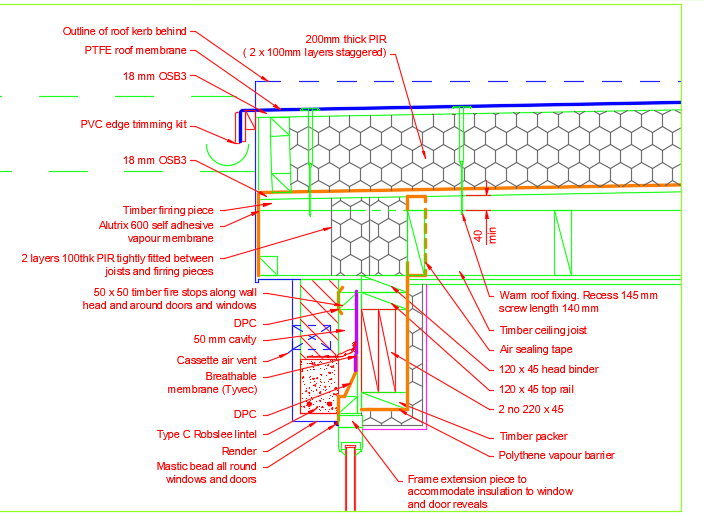
-
Top comment. One of the builders that I work with came round today and we were talking about not getting our own house finished. His wife has said to him.. if you don't pull your finger out then I'll do it. He said.. my wife is a better trades person than I and bloody handy on the tools! I need to finish it to avoid embaressment! (excuse the spelling) That's a good photo Nod showing the shrinkage crack adjacent to the stair and what a decoupling matt actually looks like.. it lets Buildhubbers see what can be expected without drama. Bit of tecky stuff for all. Very roughly screeds and concrete slabs that are cement based (even with additives) go through a journey after they are placed. In the first 24 to 48 hours they undergo what is called plastic shrinkage and this tails off after a bit. But this induces residual stress that does not go away. All the chemicals are interacting and bonding and this causes movement that we call this plastic shirinkage. Next you have drying shrinkage and this is the thing we are interested most in when doing UF and say tiling on top say. If it was my own house I would want to heat the slab up to the working temperature in the winter. While at the moment you may not see any cracks the slab could be in tension and a bit of extra heat will cause a sudden opening of a crack.. probably one you can't see from the plastic shrinkage. In my own mind if you just put a matt over the cracks you will just shift the movement elsewhere. Also the matt is quite thick so you'll need to make up the levels which could cost a fair bit on adhesive etc? Can you not just fit the kitchen and install the floor finishes later or do you you have free standing and mobile units? I never used to use a matt until I tried my luck on a suspended timber frame floor with UF between the joists and got stung! Big crack right up the middle of the public bathroom tiled floor.. that lined up with the bog pan.. it was the first thing you saw when you sat down for a "rest". At least it was my own self build.. but if that had been for a Client! In the past we used smaller tiles and they were a bit more forgiving. I have these large format ones in parts of my house. They are expensive and not easily replaced thus followed @nod advice. Yes a tiling matt is a heat barrier.. but as I have said before a lot of this stuff is about compromise.. we like rugs on the floor which insulate the UF.. pragmatism needs to prevail.
-
Party wall agreement when neighbour is AirBnB
Gus Potter replied to BonaVista's topic in Party Wall & Property Legal Issues
That is a good appoach keep things low key and friendly if you can. I'll make no further comment as no expert on PWA if you are in England. If in Scotland then I know a bit more. Will be interestng to see what other folk think. -
Concrete screws for cladding batons ?
Gus Potter replied to Firsttimer's topic in Insulated Concrete Formwork (ICF)
What type of cladding are you fixing.. can you do us a wee sketch of what you are thinking about doing? -
Concrete screws for cladding batons ?
Gus Potter replied to Firsttimer's topic in Insulated Concrete Formwork (ICF)
So would I after say 3 months once the insulation has compressed / suffered from creep.. then you lose the friction that intialally makes it seem solid. Also if using timber battens the timber shrinks and that too further reduces the friction resistance. After that you are relying on the bending capacity of the fixing alone.. -
Although folk on BH may disagree, SE's and Architect's often work on quite a tight business model, especially if they employ folk. I offer from time to time offer a service where folk pay me for an intial SE consultation. But as I used to be a building contractor in my last life this turns in to a general over view. This starts off with a phone call and a general chat, I ask a few questions but mostly try to listen, then I identify what initial info we need to make some basic decisions. I try and explain why we need to do things and answer any questions you have.. the objective is to inform you as much as I can and give you the tools to make your own decisions. Part of this process allows me gauge how knowledgeable your are and where you may need help. You can cover a huge scope in a couple of hours on the phone. My approach is to say up front.. here is my hourly rate for; general advice, a supportive chat and advice on the process of selecting other advisors / designers and how you put together a document that specifies what you think you need and importantly where you think you may need help. At the end of the day I always make sure that folk feel they have got value for money, usually this results in over all savings and that justifies my fee. What I do is different but it does work for some Clients and me. Try if you can to find an experierienced SE who will spend a couple of hours chewing the fat with you.
-
Concrete screws for cladding batons ?
Gus Potter replied to Firsttimer's topic in Insulated Concrete Formwork (ICF)
Not quite sure how you want to set this up but have a look here: https://www.ejot.co.uk/Building-Fasteners/Products/ETICS-Anchors-/c/ETICS_ANCHORS -
Mention to them and ask for their views.
-
I appologise.. I should have used different language. The proximity to the boundary is one big key. Please check that this has no structural implication as the roof may have been designed as a diaphragm thus making a hole in it for a Velux may not be the best thing. But later you could if you fail to comply with the rest of the regs. I rest my case.
-
Yes.. but they have lost their shirt and by the time they called me in it was a bit too late. This is much more complex than you realise. The design loads are often increased, the steels coroded.. then you add openings.. large area of glass for example that are sensitive to movement. Often we want an old building to move as freely as possible. Archaeology, flood risk can cause major design challenges that can massivly impact on your budget. For me I love this stuff as it is a big challenge.. gathering together what you know with the site information, fitting the jigsaw together and adapting the design to suit.. often we go back to first principles.. the SE stuff feeds into the Archaelogy.. the flooding.. it's fascinating.. and then you have to get that to work with a budget and still keep the Architectural design concept. The best advice I can give is to go though each of your design team and look for the most experienced with the broadest knowledge. Then see if they are excited about your project. This does not have to be the most qualified person on paper. Then ask.. will they fight my corner and pull the rest of the design team into place. You are the Client thus the big decisions will always rest with you.. but you need a good "wingman" that is invested in you and the project. In terms of design cost expect to pay more up front.. as the design progresses you can easily realise £20- 30k plus savings on a 450k refurb or the like that will basically pay for most of the desing cost. Skimp now on the design fees and you will regret. well you may not.. often folk just blame the cost over run on the poor builder who has got to sort out crap and unrealistic design on site.
-
Float or glue engineered flooring over chipboard with UFH
Gus Potter replied to gOBO81's topic in Wood & Laminate Flooring
Agree with Nick here.. but.. Here lies the problem as I mentioned in my earlier posts. In my own case you just don't get to have you cake and eat it. Designing stuff is my day job so its easier for me to get my head around it. I recognised that I have a big open plan floor that extends over different substructures that all move about differentially quite a lot. To compensate I over designed the UF in terms of pipe spacing close to the exposed perimeter of the building. The thermal conductivy is not as efficient when retrofitting to timber joists with screed / insulation between . Each different element, concrete slab / suspended floor has got its own UF pipe loop so I could muck about with it.. cool parts if need be and so on. However the extended part of the house is exposed to the weather. In the concrete slab near the big bits of external glazing I decreased the pipe spacing. The timber suspended floor has little exposed perimeter and thus it needs less "poke" from the UF. At the end of the day I use my own engineering judgement (how materials behave) and past experience ( have done a few UF self builds / extensions) to put something together that works well. Could I prove this by calculation.. no chance without expending some 5- 10 k design effort producing some meaningless thermal model. I also pinched design principles from some of the industrial building I've designed over the years so this gave me confidence. In summary.. I would put together your requirements and ask all the folk that need to contribute to the design.. look at their fine print.. and you may eventually conclude that with say a refurb / extension you need to take some extra risk as each supplier will put so many caveats on things you can't make them all meet in the middle. I mitigated this by practical and common sense design and some careful but practical drawing detailing. -
We're featuring on Grand Designs next week 🎥
Gus Potter replied to thefoxesmaltings's topic in Property TV Programmes
Wishing you all the best for the transmission. Help ma boab as they say in parts of the UK. In all seriousness I think you have gone a good way towards being as open as you can, a thank you from me.


