


Gus Potter
-
Posts
2383 -
Joined
-
Last visited
-
Days Won
34
Everything posted by Gus Potter
-
Frameless Glass Balasturade and Building Control
Gus Potter replied to murat's topic in Windows & Glazing
Get an SE to design this properly. That is a long span for a quasi cantilevered glass. I think you know you are trying to find a way to bypass the ethos of the building regs. Stick you hand in your pocket and do it safely. Yeees I know you are maybe trying to stick to a budget.. but I think about the family you may later sell the house to. Now that is a bold concept! Remember though that the door frame has to transfer the balcony load to the structural frame. I smell shite mate! -
This is something I look at even in Scotland. An area of glazing facing south to south west can increase the room temperature fiendishly in a well insulated structure. Now I've made my simplistic and practical design approach to UFH many times on BH. I'm doing a design at the moment and warning the Client about over heating and the costs of mitigating that. It's old sckool stuff but we have a thing called a North Light roof window. This was commonly adopted in 1950 -1960's drawing offices where you want indirect light / maximum light in the winter.. hence it was called a North Light window. In profile the roof looks like the cutting edge of a wood saw blade. Over the last couple of decades I've seen this drive for open plan spaces. But they are noisy not least. In some ways, it's like fashion clothes design. While there will always be a desire for a bit of open plan space I think the massive ones will go out of fashion.. mainly driven by the rest of the clothes / lifestyle industry. What that means is that we will have smaller rooms that need to be lit in traditional ways which can potentially mitigate some of the overheating issues.
-
For all I've attached a handy design guide (old but still provides inspiration) to trussed rafters. Page three has all the shapes of common types that can help at the concept design stage. It's well worth a look at as it will familiarise you with the terms that say MBC, Pasquills etc use. It is a mine of information with good diagrams. @marshian.. So glad you have taken note of my dramatic laymans guide and found some inspiration. From time to time I use a bit of drama and real life examples as Engineering etc should be fun! On the face of and taking your calcs at face value this leaves about 25kg (the BS design load) less your 16.2 kg = 8.8 kg distributed load per square meter. That includes you standing and moving about. Do you treat that as a point load or not.. I'll leave it up to you to decided for now. Just because you had a certain amount of load on the trusses before does not mean you can use this as a benchmark. You have to understand what the original design loads were. You also have to know about the different design codes. Are you working to the Eurocodes or the BS. In your case your trusses are probably designed to the BS code. Ok but if something goes wrong then it is your neck on the line don't forget. As before I've attached an old design guide from Wolf Systems that has the BS truss loadings on page 4. Have a read of this for your own piece of mind. You may want to review you calcs.. if you need to make changes then don't be embarrassed about it.. this is part of the normal design review process. Trussed-Rafter-Tech-Manual Wolf.pdf
-
Self building.
-
Yes but you would normally have clayboard on one or both sides of the founds as well. Each case needs to be deisgned for the site ground conditions.
-
First fix of point-to-point plumbing PEX
Gus Potter replied to CurvedHalo's topic in General Plumbing
Good points from all. But the houses you all seem to be talking about have more than one bathroom. For all self builders that just have a small house the above probably does not apply to you. -
My SE is recommending I do NOT embed the UFH in the insulated slab...
Gus Potter replied to zzPaulzz's topic in Foundations
Hey Nick you know I'm a bit of a philistine, old skooool. Below is part of my temporary UF manifold I knock up 4 -5 years ago or say (yes compression fittings and so on)! Still working. Also I designed my first UFH system 30 years ago and have done a few other designs since then. I look after a big house (500 m sq) that has 16 dia pipe. It makes maintenance harder and more expensive. Folks. Stick to British standard 15 dia pipe. Yes you'll get less flow in the pipe.. but see in a few years time when you come to look at the maintenance costs.. you may think.. that philistine Gus had a point! 17 mm dia.. I just smell shite.. sell it cheep and bump up the part replacement costs. Folks.. a good plumber will cost you £250 to £300 a day maybe plus vat. Now if they have to get in the van to find 17mm dia replacement parts they are going to charge you for their time in addition. Just to lay this on a bit thick.. for the unwary. My wife likes to put a rug on the floor which insulates it. We also have some big furniture that traps the heat from the UFH. UFH needs to be designed with a broad brush approach and pragmatically to compensate for how we may change our life style. For the unwary.. say a valuer comes round to your house and asks.. does your heating perform if we have big furniture and want to lay down some rugs? That could be a bit of a bummer? They may also ask if you have a maintenance contract and if so the quarterly cost. I can tell you from experience that you can get UF to work with a 15 dia BS compatible pipe. In fact now that the insulation regs have got more stringent the challenge is less than it was before. As an aside.. a larger dia pipe delivers the heat in a more concentrated way.. now look at the acceptable temp range of say an engineered wood flooring! You actually have a better chance of meeting the flooring guarentee requirements with a 15 dia pipe at closer centres than a larger dia pipe. For all UFH comes with challenges! From time to time you just can't meets all the manufacturer's requirements and you just have to take in informed view.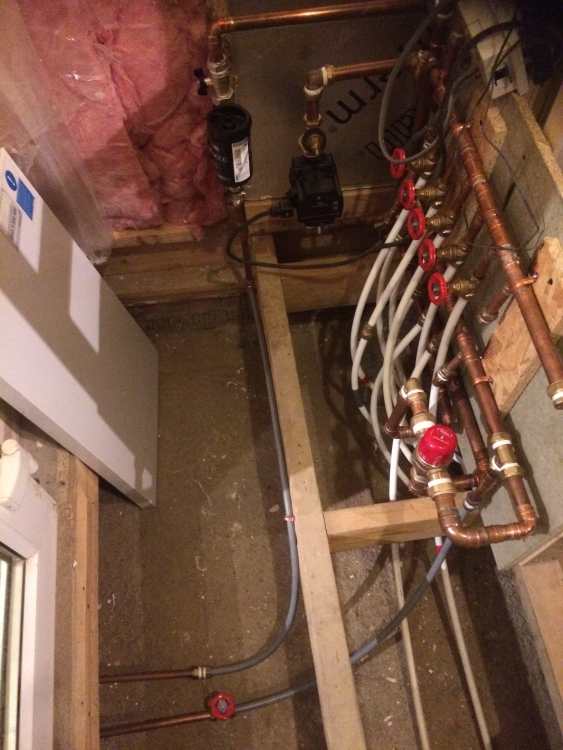
-
My SE is recommending I do NOT embed the UFH in the insulated slab...
Gus Potter replied to zzPaulzz's topic in Foundations
Yes they are a good personable team. In fact I'm working with them on a project. I also have found Hilliard and his team very approachable and willing to engage to date. My outline SE brief from the Client is to coordinate a Hilliard basement design with a superstructure. In some ways my brief is to act as the overall supervising Engineer for the project. I'll spot check say 10% of Hilliard's calcs and make sure their stuff makes sense in terms of overall stability and performance.. everyone has a boss / someone watching over.. even Tanners! For all .. Nick mentions a " passive raft" this tends to be a structrual concrete slab and by my previous post you would expect that to have no movement joints. But you can also do passive house design with a direct ground bearing slab on insulation and this would often have movement joints. We make these thin as we can with minimal anticrack reinforcement or use concrete with fibres to control the cracking.. @saveasteading has implemented this approach. @Nickfromwales I think we are both singing from the same hymn sheet here.. practical and buildable design! -
Have replied. I do this as a day job but feel free to PM me and will be happy to spend a bit of time having a chat with you on the phone. Have included my tel number in the survey response. Text me first as as I oten filter my calls. All the best. I know that geting hard info / evidence for a PHD is challenging to say the least.
-
My SE is recommending I do NOT embed the UFH in the insulated slab...
Gus Potter replied to zzPaulzz's topic in Foundations
Hope this helps a bit. The following is general but this is the way I do it... the following is simplistic and I mess about later on technically..to value Engineer where I can.. but roughly.. If you want to cast your UF into the structural slab (think of a structural slab like a wide reinforced concrete beam.. you don't put movement joints in a beam). By definition this would be a continuous slab with no crack /movement joints. To design a structural slab for strength, shear and deflection etc I would take the effective structural depth as being to the underside of the UF pipes. The bit above that is neglected... just like a screed. But in this case you just cast the slab to the full depth. If you have say a ground bearing slab with movement joints then each bay gets it's own UF loop that does not cross the joints. UFH design is much based on common sense and past experience. To my mind there are too many folk that are trying to make wet UF seem like an exact science. This I can tell you from forty years experience.. it is NOT!.. well it may be for the first year or on a calculation sheet (if you get really lucky) but after that when the controls start playing up and no one has a clue about the design philosophy / how to operate and maintain it. Then you actually need to look at how the stuff gets installed on site which can blow any theory out the water any way! In the heat of battle on site I would challenge most folk to stick to drawings! Cut yourself some slack. There is no point in paying for a UF design you can't deliver practically on site. I see this all the time... folk just waste their money. I'm a massive fan of UFH and have put these systems into my own self builds and renovations. But I always go for the simple stupid.. like they do often in Nordic Countries. Now simple stupid does not mean the system is uncontrollable. But it needs the home owner to be aware of how their house warms and cools,that is you weather compensation! @zzPaulzz Go back and have another chat with your SE. It seems like you are working at cross purposes. -
how to discern which walls are load bearing?
Gus Potter replied to apricotandpearjam's topic in Building Regulations
Good to see you being innovative. With my SE hat on when making alterations to flats I always ask to see the flat below not least and if mid floor the ones above. That means gaining approved access. Two main reasons are: 1/ I want to get some record photos of the condition and any cracks. This helps protects you not least. 2/ I want to check if any in unrecorded (illegal) alterations have been made that the council etc may hold not record of. This happens a lot! In summary you need to know what has been going on down below and in cases flats above if a mid floor flat. To explain a bit.. often "non" load bearing walls can be taken out on the floors below and your higher up flat may be serving to provide sideways and wind restraint restraint to the external walls say. If you remove another floor's worth of sideways / wind restraint that can be very dangerous. My advice is don't buy a flat hoping you'll make money by knocking out walls. If you really want to do it then you should stump up the cash for an SE BEFORE you buy. -
Good post Kelvin.
-
I'll try as best I can. The capital letter "N" denontes Newtons (Isaac Newton the man). In this case it is the compressive strength of the block in Newtons per square mm. Now for all.. the compressive strength of the block is not the compressive of flexural ( often used for wind loading that bends the wall sideways or floor joist loads that are applied outwith the centre of gravity of the masonry leaf) strength of the wall.. this block strength gets reduced a lot depending on a number of factors; the mortar strength, the dimensions of the block, what the wall loads are.. both vertical and sideways (lateral load) and so on. Now when we look at aerated concrete blocks. Simplistically they are like aero chocolate bars. The more air voids the better the thermal performance. You can see this if you look at the data sheets for the blocks. The better insulating blocks tend to be lighter in weight. This means that there is less "concrete" to carry the loads... in other words the more insulating a block is the less density it often has and thus a corresponding reduction in strength. Now if you are fixing into a block you want to have more dense material so the Rawl plug etc can expand against solid material. For most fixings to work they need solid material.. not air bubbles. There is no free lunch here... you seek thermal performance but when you come to fixing design.. life becomes harder and exponentially more complex.
-
To my mind you are hoping you get a good brickie that can execute all this properly..and for that you will need to pay for a professional brickie @Canski may be able to give you some realistic rates. To be frank you'll need to stand over them all day long as fitting insulation properly into a masonry cavity is like buying a second hand car! Give it a miss unless you have the time! Fitting the any kitchen units for example is the least of your worries. A safer bet is to go for a TF which you can inspect, the air tightness and so on. Mind you if you have the capability to build this yourself then go for it. The big secret is to take care of your aerated blocks and condition them on site.
-
Thanks for the compliment, I'll take as one as you have not ripped me to death! That said the following is a bit loose for the reasons I've previously stated. Please excuse the spelling and grammer as I'm just "musing" One way of explaining this for all on BH. There are two facets to building a house. First is the construction phase. In this phase we don't want anyone to get hurt within or outwith the site, we don't want to have a fire say (that could also spread to neighbouring buildings) that will hurt folk / cause property damage. That is common sense.. but I've stated it for ease of writing. We need to separate the above posts into two distinct systems. The first is the long term fire protection, needs to last 50- 60 years, the second is during the construction phase.. which we are talking about here. It is easy to confuse the two. Call the construction phase temporary works. Now we as designers take into account, buildability for example, site constraints and how we are going to erect say a timber frame safely. @Lnp I think once you look into this you'll manage to navigate. I suspect you have not engaged a professional designer as yet that can help you? A word of advice.. you can potentially tie yourself in knots here trying to do this off your own batt.. do you want to do that? To put this into context.. It's taken me at least 20 years to even learn enough about this subject to enable me to make a reasonable general comment! In a previous post I mentioned tying of the TF frame.. this is not stuff anyone that is a busy self builder can be expected to know. Now for a bit of drama.. most folk know that if you stick up a TF next to a nursing home you should manage that risk.. an open TF can burn like fury, especially if the floors are loaded up with PIR and chipboard! These are basically a Guy Fawkes bonfire if the fire construction risk is not managed properly. In recognition of this construction phase we use different criteria and risk analyses methods. This is a cracking question! I think it will add to the cost on occasion.. say a tall TF next to a high risk building. If you are doing a TF extension on close to a boundary then yes technically it adds risk. More risk = more cost. But we must first identify what the risk of fire is and the consequences that follow @Kelvin .. but someone asked about how will Heb Homes continue to sell. MBC are another example. It's all doable.. but I think more transparency is going to be required. I know this may sound a bit bizarre but it is things like this that could force designers to start talking to each other for the benefit of the self builder. I've been around for about 40 years in the TF / self build / Contractor market. During that time eveyone has further specialised in what they do. This specialism has resulted in what we call a loss of tacit knowledege (in old money it was what your granny taught you..that is why bridges are collapsing in Spain etc. .the current generation think they are reinventing the wheel but have no real perception of risk )... @SteamyTea @MikeSharp01 comments welcome. There over time has been this passing of liability that does the self builder no good. In some ways folk on BH are conditioned into getting itemised prices for each element of the design and build. But it's like building a motorbike by buying each part from China.. the sum of the parts costs more than a new bike! I welcome the new regs that are coming on stream.. they are starting to force designers to collaborate, design safely and bring the cost down to you (BH folks) as the end user. Now. on first glance you may think that this is going to make self build cost more. I am hopefull that this will reduce cost as the new regs will force more transparency in terms of pricing. Yes self building has become a lot more complex and time consuming but there is still money to be made and the opportinity to build you dream home! Yes I'm more of a glass half full kind of person! Oh to finish. Great to see @Jeremy Harris back. I know he as asked for no PM's. Jeremy.. I'm a massive fan and thank you. I've learnt a lot from you so ta.
-
Has anyone used https://www.buildingregs4plans.co.uk/ ?
Gus Potter replied to flanagaj's topic in Building Regulations
Call out for a washing machine repair £35.00 min. Two hours say to run a couple of cycles, say all in £100.00 Someone who knows about design (who will spend many hours putting this all together and listening to your brief) that you have staked you savings and mortgage on for £150.00 quid? -
What a cracking question! Talk about putting folk on the spot! Forgive me if I don't deal with some detail or give a definitive answer. One main reason is I use my own name and while my PI insurance covers me to write on a public forum (give unpaid advice).. it's not open ended. I make some comment later that may help the self builder / folk extending say. It's good guidance. The following is some general comment for discussion purposes only. The guidance adds to / provides a methodology to support some of the things we have been doing for a long time anyway. The recent changes in the regs formalise this and aim to hold folk to account for their design, contractor to their duties and say the duty of a self builder, even someone doing and extension in timber frame. I support anything that will keep folk safe. The document is a guidance document. Many of the clauses in the Buildings regs, British Standards, Eurocodes, product manufacturer's guidance / data etc are.. guidance. But if you choose not to follow this and something goes wrong then you can find yourself on a sticky wicket as the onus falls on you, as often you need to prove that what you have done is equal to or better than the guidance. There are times when SE's need to go back to first principles and develop stuff from scratch. This crops up a lot when renovating, upgrading old buildings and say converting farm buildings to domestic use. You get funny sized cavities / flexible steel frames / old mortar and all sorts. Generally once we get into the "higher risk" building category.. could be a flamible house next door, a TF of say 3 storeys or more, close to an old folks home, a block of flats, a fuel station etc then the bells start ringing. At the concept design stage we would pick this sort of thing up.. good designers spot this kind of thing. To go back a bit let's look at what we are trying to achieve. The following list is not comprehensive and I've tried to put things in some kind of sensible order. 1/ We want everyone who works on the site or attends site to go home safely at the end of the day. It's basic Health and Safety stuff. Everyone on site needs to know what to do and where the exits are if a fire breaks out. This includes anyone working on scaffolding / mast climbers or the like. There is plenty information readily available on this from the HSE and other knowledge bases. One key point more applicable now is that a Client should aside enough in their budget to enable a contractor to comply with the current HSE regs and stipulations from the designer regarding say construction sequence. It's always been there under CDM but hidden to some extent from the domestic Client ( self builder / extender) For all on BH. When getting prices from builders it's worth getting them to itemise out a sum for safety complicance on site. This lets eveyone see that you are taking safety seriously from the outset. 2/ OK say there is a fire and everyone is off site safely. The fire brigade turn up. They need to be kept safe also. You can't have a structure suddenly collapsing on them. Now we are getting into the design / planning of the method of construction and sequence. As a designer when faced with this I would introduce this at an early stage to a Client.. this is usually an expansion of the explanation about fire boundary conditions that apply post completion. See my previousish posts. 3/ OK say we want to do a self build in TF that during contruction poses a risk to a neighbouring building? The Building regs talk about fire boundary conditions.. you can have one even if there is no house next door! Most of the time we know that the construction phase is relatively short cf the common 50 year design life of a house and can see if there is a structure next door or know if one is planned during the construction phase. 4/ Well we can look at the STA guidance for fire during the construction phase, refer to other stuff we are aware of and importanly apply common sense. Then find that we either can't have a TF under the STA guidance or it is going to become too costly to do a self build of say 2 storeys. 5/ Now we need to go back an look at the risks of the particular project. No project is without risk so what can we do? 6/ For me I look at how could a fire start. Again much of this is covered in the HSE regs and guidance on fire safety on site. But basics are no smoking, no hot work, no using a grinder that causes sparks.. no hot site lighting and managing material handling / storage that can add to the fire load (the fuel for a fire) the basic stuff. I look at my design.. Have I / will design something that adds risk? What is not so well covered is site security (your location) and the way you conduct your personal business! A few years ago we had a big problem up my neck of the woods with the criminal fraternity washing money in site security. Bills were not paid and a lot of TFs went on fire at the weekend / at night. Mind you the poor spark got the blame some of the time for dodgy site security electrics! A big risk is theft from containers. Folk use burning gear to cut the container open.. keep your container away from the house if you can. 7/ If we can't get the risk down enough (say 24 hour site security, a fire watch at critical times etc) we may then say let's put up a few TF panels and get the brick cladding up straight away to fire stop level. We may need to get some cross walls in to act as lateral support to the external walls and worst case provide some temporary protection. In summary it's about looking at the risks and mitigating them to an acceptable level. The question is what is acceptable! For me part of the foundation of acceptible is a Client that will engage / discuss, that is my starting point, rather than just "seeing me" as an unwanted expense, a route to getting BC approval and then going off an going their own thing.. the new regs are intended to put a stop to this in some ways. Some may say it's jobs for the boys! But if you get you designer in early and just talk through the job it can lead to lots of other savings and ideas that can easily offset the professional design fee. To exagerate to make a point. In item (2) I point out that we don't want the structure to collapse on the fire brigade. The structure is connected to the foundations and these can provide rotational support to a wall subject to fire @saveasteading has written lots about encastre support / wall and steel frame base fixity and you can find out more about this if you look at his posts. So now we talk about your founds / floor joist span, type etc etc.. and this leads to holistic design and cost savings. Some clouds have a silver lining even if you have to stump up a bit more cash at the outset in terms of design fees. Over my working life I've seen two fatalites and one serious injury on site (loss of a limb). Two were preventable, one was a freek of nature to some extent. I myself got briefly trapped in a tight solum space when I was a young builder (before I became an SE) and set fire to the floor above when using a gas plumbing torch.. I could see the flames above and that rapid crawl to get out stays with me to this day, worst still there were kids in the house so it was just not myself I was looking after! Uncontrolled fire is an awful thing. That's it for now @LnP
-
Welcome to the land of BH! It's doable! Ah! If it's any help I do this as a day job. The poor performance, basic lack of knowledge about the construction / design industry, professional standards in terms of communication from say Planners and BC is astounding at times. In mitigation they are starved of funds so there is no time for them to learn these basic skills. And the liabilities are big! My PI (Professional Indemnity) insurer has a long list of questions about just what I'm designing in terms of fire protection. They need to understand how much risk I'm taking on and their exposure. In general BC officers just don't hold the required PI cover these days. Many Architect's are nervious.. and rightly so as fire protection is linked to structural design. It might kind of work like this for Heb Homes. But they may be able to shed more light on this. It works for me. Here is a rough summary of the things we need to think about when building something near a boundary. In Scotland / kind of rest of UK. If something is closer than 1.0m from the boundary we need to stop flames and sparks from jumping over the boundary and setting light to the house next door. We call this fire integrity. For example if you have steel cladding then if the seams of the panels come apart then sparks and flames come out which can jump the boundary. Another part is what we call "fire resistance. Here we want to stop the wall from heating up so it radiates heat, like an electric fire too close to the bed. The fire intergrity and resistance are then combined to give you the overall fire rating of say a wall. That's a rough summary. If more than 1.0 m it gets easier in terms of complaince. Some structural design stuff relating to fire: The easy way to explain (laymans terms) this is that we need to make sure the structure is protected enough so you can get out if a fire starts. Hence the 15 min and 30 min you see. But we also need to make sure the structure does not fall on the Fire Brigade. Many of these folk have lost their lives trying to protect badly designed properties and industrial buildings. Here lies one big issue. There is no standard detail for this. I do a lot of refurbs / conversions etc and and many of these are timber frame / light weight construction. I adopt this approach as often I get to reuse existing founds and so on. When adding an extra storey to a building I often look at how much load I can remove first and then see what I can add back in without having to say strengthen the existing founds. But this leads to odd sized cavities (we are building off an old cavity wall maybe) that we need to ventilate. But we also need to fire protect the wall panels.. often called fire stopping. It the cavity is fairly normal 50 - 60mm I may use an intumescent fire stop strip like say TENMAT which gives me the ventilation but also stops fire spread. But this has limitations. If the cavity is say 145mm then we need to block a bit of that off ( say with good solid timber ) but still keep enough ventilation for day to day perfomance. I'm just touching on some of the complexity. BC just can't give you this kind of advice / take liability for the amount of money you are probably paying them.
-
Well done pletty to mull over here! Will try and respond once have had time to digest.
-
Yes. As Engineers we are always seeking out new ideas. @Kelvin et al. On the AI stuff. But I'm going to give AI a hammering if I have the will to live. Folk are getting carried away with this. For me it's just another IT ( computer development) that we will get used to. As an SE it may make the calculations more speady.. maybe format our reports a bit better. But having been involved in developing software that other SE's use..I've learnt that any software has it's limitations. The basic rule of new software is let's get it out there and we will sort out the bugs later. No shit folks I have been there and worn the tee shirt! Buy the time you sort out all the bugs the world lhas moved on and the investment is lost! AI will be limited by the (expletive deleted)wits that are involved in teaching it. These will tend to be young folk that have litle to no life experience. Itis potentially dangerous but they said the same about Elvis! The main stream media are making a big song and dance about this.. but to give the young folk credit they can smell shite just the same as us us older folk!
-
I admire your intelect, range of knowledge, what you teach and explain. Your command of English blows me away. You have a gift of being able to distill complex subjects into laymans terms. I've just learnt a new word not least. Thank you. If you are ever up in Weegie land then let me know.
-
Rotate the image +90 degrees. i.e clockwise. The pole plate is the ~ 50 x 50 mm timber that locks the rafter to the ceiling joist. The simplicity of this connection is remarkable but this is not taught at university... and you won't find this in standard text books. What you will find is plenty Architects / builders and other historical types talking about this but few actually know how it works @ETC fancy a go? Just kidding you.. The primary forces are the gravity loads, wind uplift, timber shrinkage and creep. Now you live in France.. so you'll have some of these stunning winding stone stair cases that seem to be supported by sky hooks. We know they work and why qualitatively.. like the pole plate above... but if you get some twat from your approval authority that says.. lets see some calcs. It is very difficu to prove it by calculation. Even when you can you find that many old buldings and their structural membesr can't meet the moderns design loadings. When this happens we as SE's need to delve deep in our basic maths, we have a look at probalility and risk of over stress. and all the while folk are slagging us off and not willing to pay for us keeping their kids safe? I've got some high end soiftware that does finite element analysis.. it could maybe come close but it could take me about a week to set up the model.. then I need to verify that my model is rational, then explain to some (expletive deleted)wit in the council what it is all about. I would not do this for less than 7.5k... UK pounds. Now imagine if I sent this stuff to your local French Authority. They would / may do one of two things. The smart folk would say.. let's see how the Scots guy is modelling this and the conditions / assumptions he is making in his model. they would use it as a CPD excercise all at your expense.. the rest would say.. we don't like Jocks so "^ let them have intercourse" Still happy to give you a bit of advice though but as you can see from the above I'm a bit of a pragmatist.
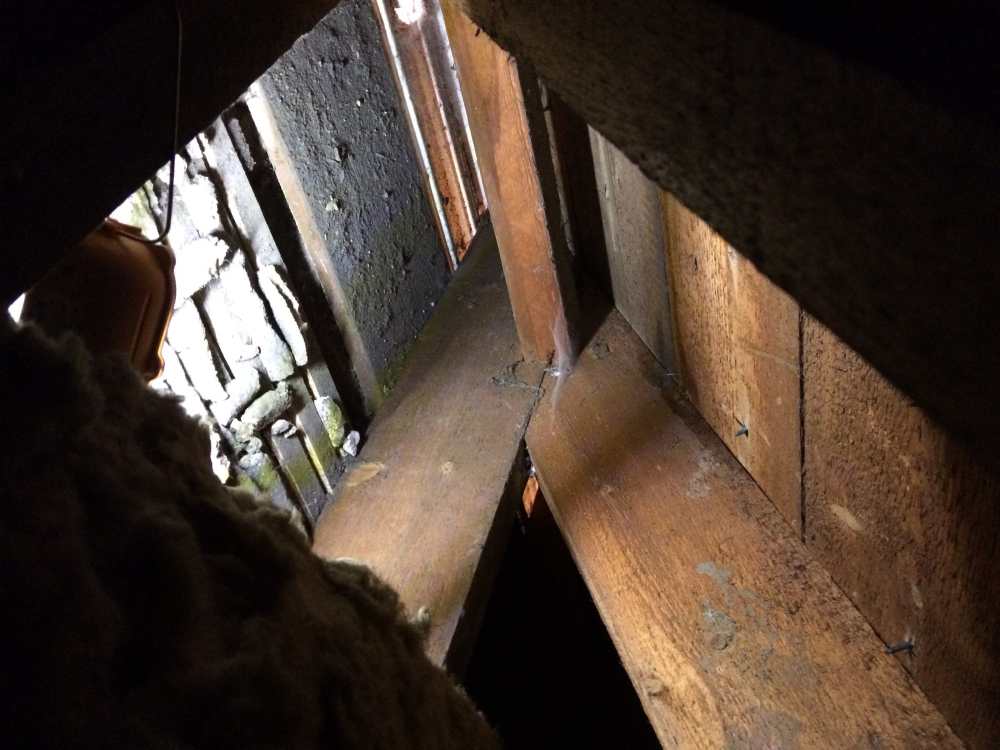
-
I agree. It's a good appoach to let sleeping dogs lie. The existing roof will likely be restraining the existing wall heads. Often in the Uk we used what is called a pole plate roof. Here there is a timber runner that locks the rafter base to the ceiling joist. I'll dig out a photo, not tonight but later if of any interest. The more you mess with an existing roof the more risk that it will move. If you have a period property then you get no prizes for cracking the walls! Now this may not apply to you but many old walls rely on having a good amount of compressive load from above. Sometimes we can "unload" an old wall and we think that will be good for it.. but in fact it can be very bad! At first glance this is counter intuitive but the compressive load keeps the say soft lime mortar in compression. Masonry walls perfom well if they are subject to reasonable compression. In laymans terms this helps keep the joints tight., and by default water resistant. I could show you the maths but lets stick to concept ideas for now.
-
I do a good few attic conversions in my day job. Some require a bit of ecclectic engineering / design and that often drives the viability in terms of cost. Many Architect's just don't have the SE knowledge to excecute this at an effective cost. I'm surprised that you have to go through and Architect's studio. I carry £2.0m PI insurance but most of the Architect's / domestic light industrial Architectural designers carry less than a £ 1.0m as a day to day working policy. This reflects the responsibility that SE's carry to be blunt! To be fair I have a big tool box of stuff I've learnt over the years . I know when I have a good chance of sistering joists, when I need steels, can I use cold formed steel, glulam beams, can I plate up the existing roof joist connections with plywood and glue.. can I just shift a bit of load elsewhere in an old roof to make it work? will it be ok just as it is! But here we need to look at how an old roof is made. Is it a true cut roof or does it rely on nails that may have corroded? It's not just the structure per say.. often you have drainage requirements that has to be weaved about the structural members. I wear two hat so I'm an SE and Architectural Designer. But.. I also collabrate with Architects where I just do the SE stuff for them. What they do is to say.. hey Gus.. I want to do this project.. can you have a look over it and see where you can save some cash..squeeze in the stair case so they can then go back to the Client and say.. our SE has had a look at this and we think we can do x, y and z Arcitecturally and here is how we are going to make the savings to pay for it. This can mean getting a traditional joiner that has been on their books for a long time and the Architect wins the job on their access to the right contractor and SE. Now here is a small example. In a traditional roof you have some vertical struts. In Scotland we call them soldiers. These struts are commonly 1/3 checked. The check acts in direct bearing..timber to timber the other part has commonly three nails only that stops the rafter lifting up. In other words this simple joint is more comlex than it seems at first glance. One part of the joist resists wind uplift ( the nails) the other say downwards snow load. Once you are aware of how a checked roof joint works you can begin to appreciate how skilled the joiners were. That's it for now.
-
You are paying the fee. There are plenty SE's about that take the view .. pay me a fair days rate, recognise my skills and craft. I run my business not on price but on my skills. For all on BH you'll be happy to pay £250 and hour to your lawer but get an upset tummy if your SE charges you 80 - 100 an hour.. but your lawer is not going to save you say a week on site for a couple of men that will run up a bill of 1.5k a week? An Architect with 40 years experience behind them will save you piles of cash too! If they can't then get rid and come to me @ETC About every month I have someone that declines one of my briefs. The reason.. I can get an SE for half the price.. but I know that the builder is going to rip the absolute pish out them.. I also see some of my competitors SE desings.. and sometimes they are downright dangerous! Yes the beams say in themselves may take the loads but the buildability / sequancing can't be realised at an affordable cost...and that makes their design dangerous! They know it, they know I know.. and they shite their pants when I get called into to inspect their design! cause I'm a builder come gamekeeper! Scottish SER scheme.. story for another day.. but maybe that is the police policing themseves? Surely not! Does that mean that Scottsh SE's are better than Irish or English SE's? Funnily the Scottish SER Scheme is an English registered limited company.. the smell of roses is overwhelming! @Garald Spend some time finding the right SE for you, don't go for the cheepest, find an honest broker, go for the one that will deliver what you need



