IanR
-
Posts
1841 -
Joined
-
Days Won
6
Everything posted by IanR
-
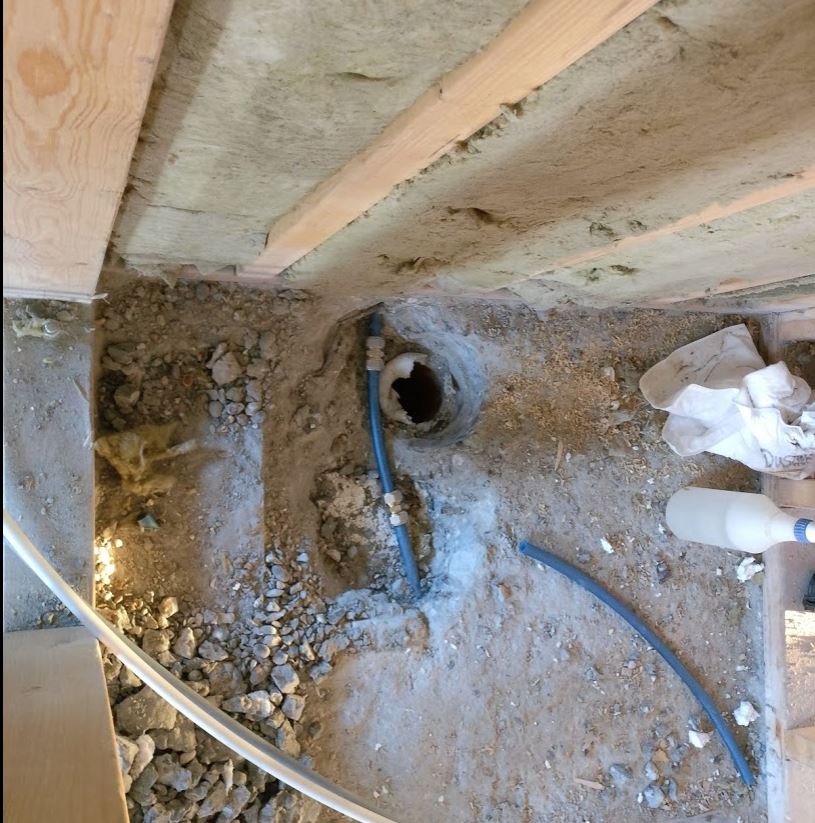
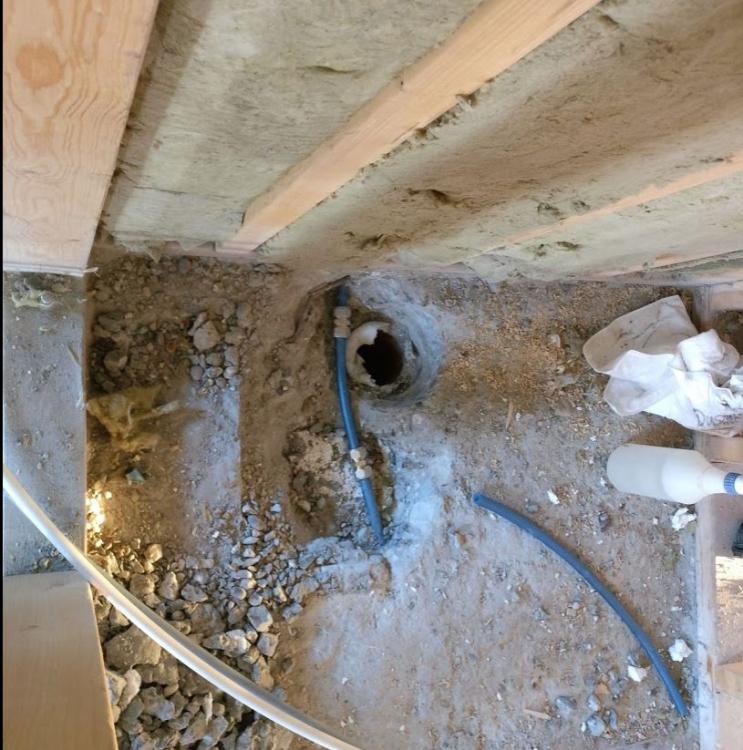
I thought I knew where all my pipes were...apparently I'm not able to keep track of 2.5km of pipe: I'm sure it wasn't laid that close to a shower drain, but that's where it ended up. In truth it was an easy fix...but your heart sinks when you notice the manifold pressure has dropped to zero.
-
Back to the OP. Is there a Main Sewer nearby? The House on the same plot - where does that connect to? If it's economical to connect to the Main Sewer that should be your base line cost, and only go with a treatment plant if it saves you money (including annual maintenance). I didn't have the option as there is no main sewer in the road. I'm also on heavy clay, so it was unlikely that a leach field site would work. However I was lucky with the gradient of the site and that I had a surface water ditch running away from the corner of the property, adjacent to the perfect location for a treatment plant. If you work within the "General Binding Rules", you avoid needing a discharge permit from the Environmental Agency. Not that a permit would be difficult to obtain, I believe you just need to prove that a leach field would not work for your ground conditions. Or if a leach field would work then you don't need a permit anyway. Here's the rules: https://www.gov.uk/permits-you-need-for-septic-tanks/general-binding-rules
-
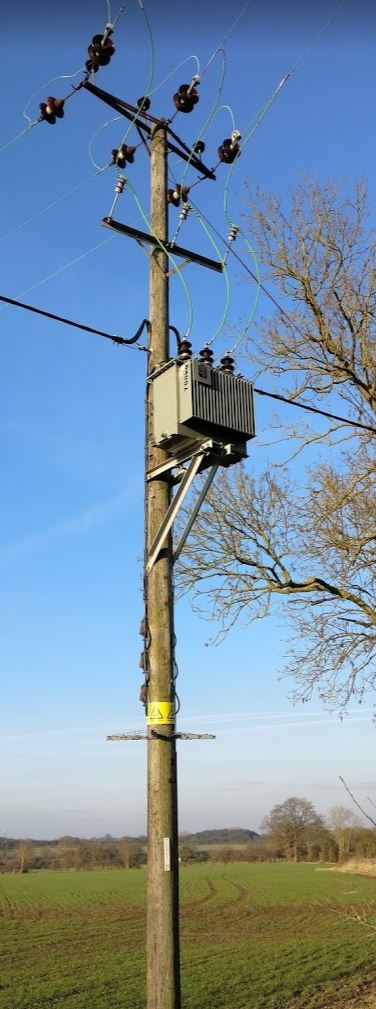
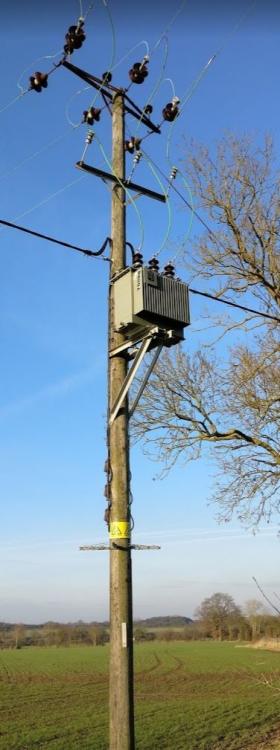
I needed new connections to my Barn Conversion, to split it away from the original supplies to the Farm. UK Power Networks made sure I paid for a new Transformer even though I could demonstrate that our Farm and two neighbouring Farms supplied by the same Transformer were not using anything like the power they consumed 10 years ago. Even to add 20kVA single phase supply for my property they wanted the transformer upgrade, so I went with 100kVA 3 phase and it made no difference to the price. The Transformer was £3.5K, but the overall connection was £8.5K including the 130m of underground cable pulled through a trench that I dug. Here's my Transformer, I feel I own it!
-
Welcome D_T, looking forward to seeing details of your build to achieve those U Values. You mention CLT and Larsen Truss, where is each of them being used? or is it a composite of the two systems? (I may not have the understanding of each that I thought I did)
-
But wouldn't the same inexperienced person make the same mistake if they drew it in 2D. ie. is it not the level of experience at fault, rather than whether they chose to draw it in 2D or model it in 3D?
-
But why would you use a tolerance that wasn't achievable by the manufacturing process. That would be a rooky mistake made at the 2D level. 3D is modelled at nominal, tolerances are added as embellishments to the 2D drawing.
-
I find that quite a peculiar statement. In most industries even when a product is modelled in 3D, 2D drawings then have to be created (from the 3D) to cascade the info to down stream users. There are few industries that exist from concept to manufacture in 3D only. (although both automotive and aerospace are trying their hardest to develop the tools to facilitate it) The use of 3D just depends on whether there is a process benefit. In volume production, investing in 3D to resolve as many of the issues without actually having to physically build something is a no-brainer. In construction, especially a one-off self-build, it's questionable how much is worth doing in 3D to find and resolve issues, versus have the builder resolve them on site when they materialise.
-
That makes things much simpler!
- 25 replies
-
- 1
-

-
- barn
- conversion
- (and 1 more)
-
It does, and if you plan to do both builds yourself you have more to think about regards getting them both CIL exempt, recovering VAT and mitigating Capital Gain
-
If your Planning is for a "Change of Use", or "Conversion" then that won't allow a knock-down and rebuild. Councils will often monitor how much of the original building will still be present in the converted building. The reason for this is that in general agricultural buildings are in a rural setting and outside defined settlements, so the planning policy will be against development. However, there is a contradicting policy that allows the re-use of redundant agricultural buildings, when they are suitable for conversion, deemed to be in a "sustainable" location, and there development will not be over-bearing on the rural setting. If the planning has been granted for the re-use of a redundant building, you can't then knock it down and rebuild. So, it depends on what you have planning for.
-
Welcome MrsB Potentially an interesting build. Are the pre-commencement conditions discharged, and if not do you know the costs for achieving this? As it's a Change of Use from Agricultural there's likely a contamination condition, which may be simple to discharge, unless the site walk-over high lights any contamination risks and then it could start to get costly. How about CIL? Has the local council signed up for the Community Infrastructure Levy, and if so who's responsible for paying it, you or the seller. The Barn may be exempt if it has been used for its lawful purpose for at least 6 months in the last 3 years, but this needs to be understood. If not you may be able to get self-builders exemption, there's a recent post on the forum that links to all the rules. With regards being structurally viable, part of the planning application will likely have included a structural engineers report to confirm this. Most Councils wouldn't allow a Change of Use on a Barn that wasn't structurally capable of the conversion. But, this will have been commissioned by the person that submitted the planning application so may be a little biased.
- 25 replies
-
- 1
-
-
- barn
- conversion
- (and 1 more)
-
Sounds like Rob's been able to help. You're welcome.
-
Willkommen! [that's just about all I can remember from the 4 years I spent in Köln]
-

Timber Frame, Passive Slab Build - Costings for Seperate Elements
IanR replied to Nick's topic in Costing & Estimating
There's a few companies offering an I-Joist structure, although only one I'm aware of that offers a package with a Passive Slab (or insulated strip foundations) which are who I used - Touchwood Homes. To save on typing, I made a few comments in this thread regarding my experience: My build is complicated by being a barn conversion with an existing steel frame, but I found, from the various different suppliers I got to quote, the I-Joist Structure was slightly less expensive than the twin-stud option, but required a slightly more complex periphery detail on the slab to achieve the same "cold-bridge" free junction at this point. In truth, there is a simple slab solution for the I-Joist that gets ~95% there. It does require a level of accuracy on the slab that general ground workers do not build to and as I was choosing to use local ground workers I went for the more complex option that allowed a little more tolerance on it's sizing. With so many factors effecting cost you're best going out to all the companies and getting them to quote. -
I'm thinking you need some professional support. A bit of basic googling suggests your planned internal drainage should be part of a multi-system approach to protecting the structure from water ingress. On its own it may be insufficient for building control. If other systems have been specified and employed then the risk of water ingress may be so low that there may be a better position for the membrane.
-
Slab with insulation above and and then screed on top is pretty standard. I assume the advice you had for using foam glass would be relating to a sole plate for any load bearing walls. The PIR insulation under the screed is non-load bearing, so can't go underneath any load bearing walls. If you have load bearing walls then you could use foam glass to reduce the cold bridge at the floor junction. No need to "stick" the insulation to the slab. I'm concerned something is being missed. Who specified the insulation under the slab, but tanking and drain channels above/within the slab? Is there any other drainage specified under the slab insulation, within the sub-base? Is it possible the drainage within the slab is belt and braces and will only be called into effect if there is a failure somewhere?
-
No, more like no. 1 on the sheet you linked to. Slab Membrane (tanking) Insulation (120mm - 200mm PIR) and form the channel at perimeter 75mm screed with UFH over the top of insulation and channel. Then male sure the channel drains well to a sump and keep the sump clear. I think I'd want a couple of pumps for redundancy to protect from pump failure.
-
No, with membrane beneath the insulation, the insulation would avoid you heating up the ground water and sub-base. If the slab is already in then I would have thought you need to insulate above the slab, on top of the membrane.
-
I did caveat my comment with "for me". I'd not seen this sort of detail before. In the OP you mention insulated slab, and to me if water is breaching the insulation it's going to negate it. ie. water at ground temp will get passed the the insulation and on to the underside of your screed with the UFH pipes in, so you end up warming up the ground water.
-
Neither of your sections show (for me) a viable floor. Are you expecting moisture to breach your slab and insulation (or is insulation between slab and screed) and therefore require draining from between the slap top and screed? Have you got the original engineering drawings of the "suggested" slab. Are you sure your "drainage channel" should not be running within the sub-base below the slab?
-
To be honest, I'm not clear on what you mean by this. Do you have a section that shows how it should be, preferably showing the floor/wall junction.
-
Is any part of your proposed foot print (now or in the future if you plan to add garages, outbuildings etc.) within the drainage path of the field and the ditches it drains to. If so then you should consider running land drains around the periphery of the area you wish to protect, and then on to a ditch at the lowest point on your property. The drains need to go at least 500mm deeper than you foundation. My current build is a change of use from Agricultural and there's about 2 acres or so of field that is higher than my foot print, which is in the path to the ditch it drains to. There wasn't much sign of surface water draining across and around the Barns I'm converting, but when we dug the trenches for the land drains I was shocked at how much water was moving through seams in the clay, below the surface. The field itself hasn't had any drainage work done to it in the last 25 years, but was moled at that time, and before that has much older clay land drainage. It all still seems to be pretty effective at draining the land and there's a significant amount of water that drains to the ditch below my Barns after the rain. I'm very glad I'm diverting it around my new foundation.
-
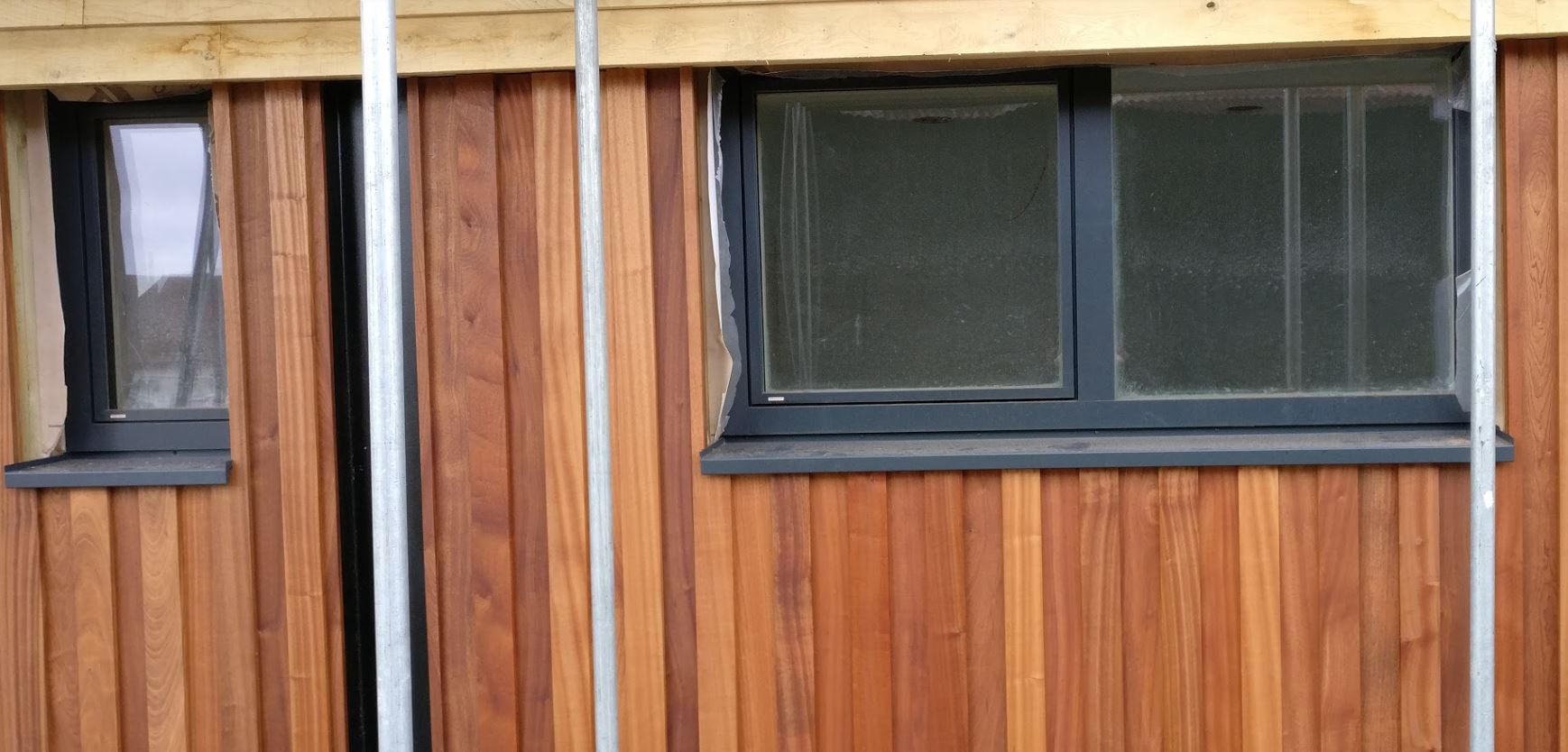
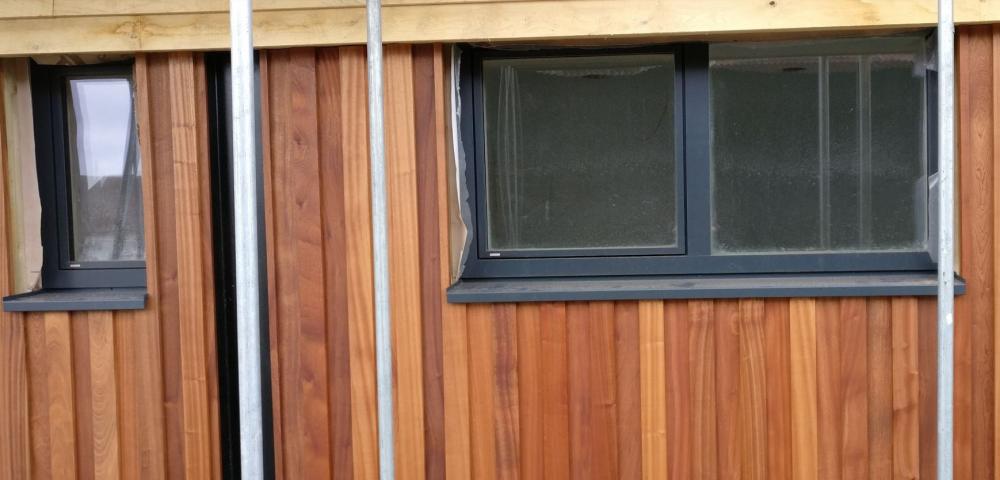
Also not the best pic, and reveals unfinished including missing posts: Both windows with same detailing at each end,
-
I've got similar cladding in 144mm/94mm boards and took the second option. Every opening has the same board set-out, and every opening is symm opp about its centre. I couldn't have lived it being random and different. Mostly achieved by adjusting spacing, occasionally had to rip boards down slightly to a narrower section. The spacing changes do not notice at all.
-
The Studio range is around 6% more than the equivalent Pure from Memory. But the Studio is not available in the 210 range, only the 310. The difference between 210 and 310 being a bit more insulating foam behind the cladding on the sash giving a slightly better U Value. Functionally and performancewise, there's not much difference between the Pure 310 and Studio 310. You are just paying a small premium for the flush profile giving the more contemporary look. Although the Pure is pretty contemporary in my view.