


JohnMo
-
Posts
13292 -
Joined
-
Last visited
-
Days Won
200
Everything posted by JohnMo
-

Storage combi or UVC choices for new build
JohnMo replied to ruggers's topic in Boilers & Hot Water Tanks
Atag manual has all the numbers, snapshot attached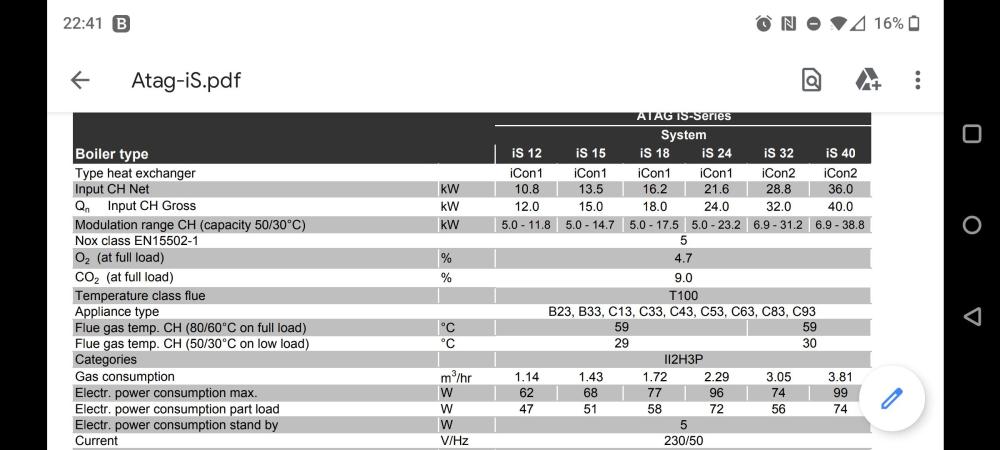
-
I used https://www.itstechnologies.shop
-
De centralised unit for retrofit?
JohnMo replied to hotnuts21's topic in Mechanical Ventilation with Heat Recovery (MVHR)
I didn't go decentralised in the end, but did install two units instead of one. A small and a large unit. The small one does the two bedrooms and two en-suites. I only have to boost the small one when we use the shower. -
Storage combi or UVC choices for new build
JohnMo replied to ruggers's topic in Boilers & Hot Water Tanks
First reason for a cylinder was to enable PV diverter and offset DHW and possibly heating/ adding to CH. Future plan is to also add solar thermal. Thermal panel currently sat in garage waiting to be installed. The buffer when in CH mode only gets heated to about 30 to 35, so heat loss is negligible, but it hot enough to pre heat water going to combi for DHW. Reason for combi was hot water on demand, without having to store hot water and the associated heat loss. To get everything to work sounds easy, but has taken a couple of revisions to get to it function efficiently. -
This arrival tells you all about the heater etc. https://buildequinox.com/news/?id=4711
-
As I said loads of entries ago, the heater is stop liquid refrigerant forming in the lube oil. If you could or did disable the heater, you would be buying a new compressor quite quickly. The only way to stop this load is to switch the unit off at the mains. When the unit restarts it will go through a heat up period to ensure the refrigerant is expelled from the lube oil before starting the compressor. If you are using 5kWh a day on standby, while waiting to heat DHW, you may as just switch it off and use your immersion.
-
Min flow rates may be important for some combi boilers, but for anything else, min flow rates don't make much difference.
-
De centralised unit for retrofit?
JohnMo replied to hotnuts21's topic in Mechanical Ventilation with Heat Recovery (MVHR)
Deal directly. I did my own design, as there system didn't give the 0.5 ACH required without adding a third unit, for a new build in Scotland, so became cost prohibitive. -
De centralised unit for retrofit?
JohnMo replied to hotnuts21's topic in Mechanical Ventilation with Heat Recovery (MVHR)
The other similar option is Fresh-R. When I was looking, they looked better flows and price. This is the scheme they quoted for me. House is 190m2.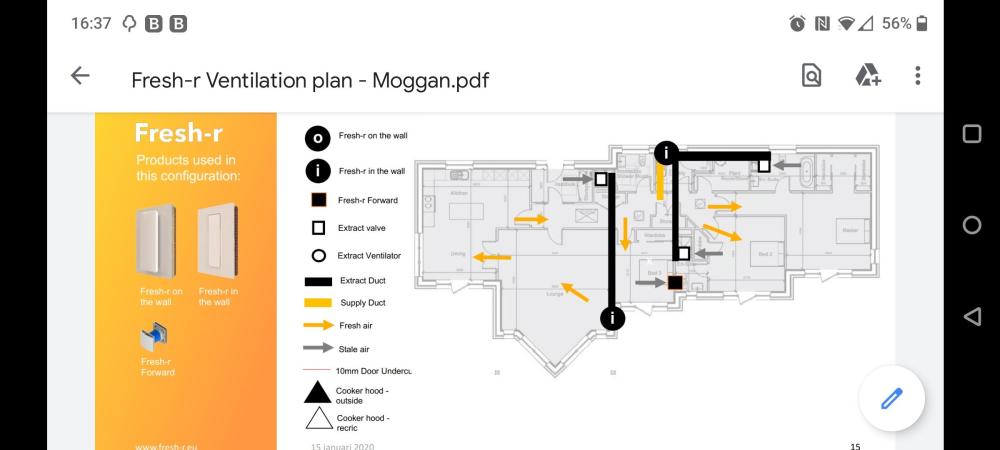
-
Will I be eligible for ASHP Grant?
JohnMo replied to richo106's topic in Air Source Heat Pumps (ASHP)
Approved install only for the grant. Assume they would organise the EPC -
Additional electricity load on home with GSHP
JohnMo replied to 8Coops8's topic in Consumer Units, RCDs, MCBOs
There are only single or three phase, as far as I am aware, so you are really asking for two single phase meters. Double the standing charge of a single meter. No wonder they are confused. You seem to indicate you have there 100 amp fuses, only one is being used. So did your house at some point have 3 phase, hence the three fuses? -
Storage combi or UVC choices for new build
JohnMo replied to ruggers's topic in Boilers & Hot Water Tanks
As mentioned if going weather compensation, don't waste money on flashy thermostats, the radiator just need TRVs, UFH as single zone. Set up weather compensation so UFH runs all the time without overheating the house, flow temps will be closer to 25 than 45 degrees. Radiators are you too late to increase size to future proof, set up with a max flow temp suitable for a heat pump. Boiler sizing can be difficult with a combi, as you want a big one for DHW, but they tend to be huge in a well insulated house for heating. So may benefit from a buffer to ensure long boiler run times. We have a big combi (Atag A35ECX) with only a max heating demand of around 3kW. Have a 160L buffer with a DHW coil in it for pre heating cold water to combi DHW. The buffer is also heated by solar, so big reduction in gas consumption in the summer. The water leaving the preheat coil, if it is above 45 goes straight to the taps, below 45 goes through the boiler heated to 55 degs. We can run three showers from a combi. If you are thinking combi, the only real way to get consistent performance all year round and the ability to run multiple outlets properly is with pre heat on the cold water. Not sure where low loss headers come in on a domestic install, just use close coupled tees, £2.50 instead of £250. Or if you have a buffer that gives you hydraulic desperation. I would have a pump and thermostatic mixer on each manifold for UFH, as it easily allows you to run different flow temperatures and it also automatically give hydraulic separation from boiler pump and also acts as limit stop on flow temperature to protect the floor. -
Most likely the heat will be similar to an airing cupboard. You could insulate and box in the manifold and any of the pipes. We have Louvre doors on our airing cupboard, where the UFH manifold lives. If you want Louvre doors custom made, we used these for the ones we have. Good service, doors didn't even need painting. Simply Shutters Limited. Tel: 01842 814260 Fax: 01842 814460 http://www.simplyshutters.co.uk
-
This is all it needs, https://www.screwfix.com/p/bottle-air-vent-15mm/34359?tc=TA5&ds_kid=92700055281954514&ds_rl=1249404&gclid=Cj0KCQjwwJuVBhCAARIsAOPwGASEU9pcMfS0jV7msoGiH8MQI8Z0lWWqvgrLvrNS4x4WH42gipahiZsaAiwEEALw_wcB&gclsrc=aw.ds No idea where they get the need for external venting. I would check to see what else they are putting through the external wall.
-
Knauf acoustic roll insulation for first floor
JohnMo replied to notreadyforthis's topic in Heat Insulation
For accoustic and other insulation you want no gaps. The additional for accoustic is you don't want the insulation bridging the upper, lower surfaces. Not really seeing any issues. -
We used flexible external tile adhesive from B&Q for attaching stone slips. https://www.diy.com/departments/mapei-super-flexible-grey-tile-adhesive-20kg/38144_BQ.prd?ds_rl=1272379&ds_rl=1272409&ds_rl=1272379&gclid=CjwKCAjwnZaVBhA6EiwAVVyv9IssxJV-9uIJ6KgTYlWqGQqC49F8jyGu0_3At2PzDwuMc59QgehDIhoCg3YQAvD_BwE&gclsrc=aw.ds&storeId=1217
-
MVHR design questions
JohnMo replied to Mr Blobby's topic in Mechanical Ventilation with Heat Recovery (MVHR)
Comments. En-suite, needs to be above the shower not next to the door. Master bedroom supply is in the wrong location, you want the supply air to wash across the room to the ensuite. May be better at top right corner as you suggest or by the dimension 3370. Dresser only needs a supply. Not an extract as well. Bathroom only needs one extract, the one above the bath is too close to the window, the other too close to door. May be better above the shower also. Linen room only needs a single extract. -
I think the comment is true that the earth will increase in temperature, but the rate of rise and the ultimate temperature is determined by the insulation. More over the heat loss will decrease with a better u value. So he really needs to go back to school. U value is W/(m2⋅K), so to calculate heat from s given U value, m2⋅delta T⋅U value. So for a U value of 1, you will loose 1W for each m2 for every degree temperature difference between the inside of the house and the ground. So a couple of worked examples 100m2 floor area, ground 7 degrees, house 20 degrees. 100 X (20-7) X 1 =1300. Heat loss 1300W. U value 0.1 heat loss 100 X (20-7) X 0.1 = 230 Heat loss 130W. Even if you said the ground was 15 (very unlikely) U value 1 heat loss, 500W heat loss 0.1 is 50W heat loss.
-
Should that be 100,000 m3? My main MVHR unit flow 190m3/h. The filters should really last 12 months. They are £40 a set delivered. 190 X 24 X 365 = 1,664,600 m3/a for £40, although mine last 6 months so £80/year.
-
We have two Titon units, one has the filters you are referring to, the other is a pleated filter in a card frame. Will have to get some filter roll and see what I can do for the card framed filters.
-
Ours is on the second set in 9 months, the latest set have been installed for a couple of months. In the sticks, but a couple hundred meters to the main road and very exposed and sandy site. Filters could be our main expense from the looks of it.
-
I wouldn't use it. Two tectite elbows, push fits. Likely to be cheaper than kinking pipe. But may be quicker just soldering.
-
If you are using a builder, you know, do what he is used to, no paid for learning curve or expensive mess ups If he does block work go with that...
- 1 reply
-
- 2
-

-

-
Try to operate the UFH as a single zone, from a single stat. You need a low hysteresis stat for UFH, so something like a Salus SQ610, and WQ610 for the radiators. Use Salus THB23030 Auto Balancing Actuators and a generic UFH wiring centre for wired stats or Salus one if you are for RF thermostats. You will need a mixing valve and pump on the manifold to separate the radiator flow from UFH flow. Not sure of you insulation standards, but best to get a mixer that can go below 30 degs to give you more flexibility with flow temperature. Wouldn't waste too much money on UFH control, as you need to operate at low temperatures for lengthy periods.
-
Our roof is way less complicated, but the truss manufacturing company produced cad drawings, based on the the original structural engineering ones, and produced a full set of structural calculations etc, these were then sent to my own structural engineer for sign off and approval and added to the structural engineering certificate.


