JohnMo
-
Posts
13292 -
Joined
-
Last visited
-
Days Won
200
Everything posted by JohnMo
-
 Another price hike for electricity and gas expected in October. Is it time move to fixed price deal if you are offered?
 -
Your council website should have the spec, the apron section in Scotland gets taken over by council, so has to be road spec, it also needs an approved installer to do it. Not anyone is allowed to do it.
-
Yep
-
How do i block heat from UFH in a small area?
JohnMo replied to jtothelo's topic in Underfloor Heating
A lot will depend on you temperature at the inlet to mixer and the UFH flow temp. You can insulate the pipes as they leave manifold and enter the floor until clear of cupboard, then box in and insulate the manifold. -
There's also SAHP, similar/same as Bunsen Air. For some reason people with solar assist heat pumps, don't really want to talk about them for some reason.
-
Why so much for a replacement oil combi. A very quick look online and they appear to be £2-3k incl vat. So your plumbers are wanting another £2-3k to install, they are taking the (expletive deleted). Maybe shop around. Get a labour only job and buy yourself. https://www.plumbnation.co.uk/boilers/oil-combi-boilers/?referrer=googleppc&gclid=Cj0KCQjwntCVBhDdARIsAMEwACkMWA3GBANMuO17iztLTWKeYQuCs_00LUgb-R4Xzj0McN73j4hPJxAaAl3cEALw_wcB
-
Go on to heatgeek.co.uk, they have a good write up about the advantages etc. of weather compensation.
-
Not clear from your description, but clarity Floor build up is 175mm concrete, 150mm insulation then UFH pipes, I assume. Screed above this. If so why not just staple to the insulation. Lay a thin DPM membrane on the insulation and staple pipes to the insulation. Job done. Not sure of your heat loads for the house, as that not mentioned. But looking at the practicalities of the house and UFH. A room can take more than a few hours to get up to temperature with UFH. If you don't heat it, it will be uncomfortable when you do want it warm. Heat from other rooms will migrate towards the lounge, as it cooler, but may not be that warm, so you could have an uncomfortable room, but you energy usage will be similar to heating it anyway. Are you using weather compensation, if so the thermostats become limit stops for temperature instead of temperature controller. So they can be quite simple low cost units. ASHP minimum flow requirements. Smallest zone that can call for heat needs to be able to absorb the min flow of water from the heat pump, otherwise a buffer is needed.
-
The obvious things are. Having a stored capacity doesn't buy you time when a pump fails, as you may not know the pump has failed until you have used the contents of the storage. No power, no transfer/booster pump, no UV sterilisation. Either you can't transfer to house even if you could it's not safe to drink. Why are environmental health involved, they only need to get involved when you register the borehole abstraction. They shouldn't be involved in the supply of a single house system design. If you are supplying s less than 50 people there is no risk assessment required. Go into the requirements page of your local council, see what that says.
-
As the house doesn't exist until it has a completion cert, it is not a second home, it just a piece of land. Not sure what happens when it gets a completion cert, as you are not purchasing and that is when the second home tax gets charged. So not likely to be due a tax charge then either. You may have to or likely to, have to pay stamp duty on the profit made on any sale, as you have not lived in it, if you sell when completed. Way to many variables to give an average price, depends on build spec, how it's being built and by whom. What mine cost near Elgin, on a complex hill site, very well insulated etc, but with lots of my labour will not be reflective.
-
Not sure they charge by the block around here, so more likely to work a full day.
-
There are benefits with two. Routing pipes and also the runs are shorter, so less pressure drop, lower running speed and less noise. Only part of house in boost instead of whole house, because you have a shower. Ours are split as, two spare bedrooms, one ensuite and our ensuite. We shower in our ensuite daily, so only the small system gets boosted. The rest of the house rarely in boost. Downside is two sets of filters.
-
I would ask them where this requirement comes from. Our supplier basically connected the pump to house via a 50l buffer and the treatment package.
-
Information needed for a quote from the online estimators
JohnMo replied to Indy's topic in Costing & Estimating
Didn't see any mention of airtightness? This will affect cost. PIR in cavity can be a nightmare and from reports on here never done and or not easy to do well. Mineral wood or blown bead seem to give better results. Read up about UFH heating and thermostats on buildhub. Our build started with them in every room had remove them as the heating system just started chasing its tail and used huge amounts of energy. One zone for all downstairs (it will be heated to same temperature wether you like it not anyway) one in each bedroom, wet room run all the time there is s heat demand from any room. Going lots of thermostats equals huge buffer. Option 3 why no timber stud walls and upper floor? -
Not sure I would trust, we had a company doing work for us, it went insolvent, we had paid them loads, they paid none of their suppliers, started up a new company in his wife name. Lucky for us the job was finished before the insolvency occurred.
-
Starting a 40 year old generator, not ran for 20 years.
JohnMo replied to ProDave's topic in Boffin's Corner
Or this from another suitcase Geny eBay item 392852639118 -
Daikin do a hybrid solution. They do two versions, a split and mono block. You need the mono block version. Basically you can have their solution of ASHP and gas boiler, or their ASHP and any other boiler. The heat pump does heating only. You boiler does hot water and or heating. Think Vaillant and others also do a similar solution. The heating system will run in bivalent mode, for heating which is either or not both together.
-
Bit lost on why you need WiFi on MVHR. Once set up it runs 24/7 on a set point, if you need to boost either humidity or CO2 sensor or manual switch puts into boost. A light on a panel or a timer sticker, tells you to change the filters. What am I missing?
-
Some light reading Heat-Pump-Guide.pdf
-
Do you have experience to share, others may find it helpful
-
In answer to your question about specific accreditation, not really. If you purchase a split system you need F Gas certification for the refrigerant gas side of it, not required for a mono block. Ideally a normal qualified electrician and a normal plumper can install the rest. No grants available to you.
-
Lucky you, been heavily overcast here all day, rubbish production.
-
DIY sense check please
JohnMo replied to Tilda's topic in Mechanical Ventilation with Heat Recovery (MVHR)
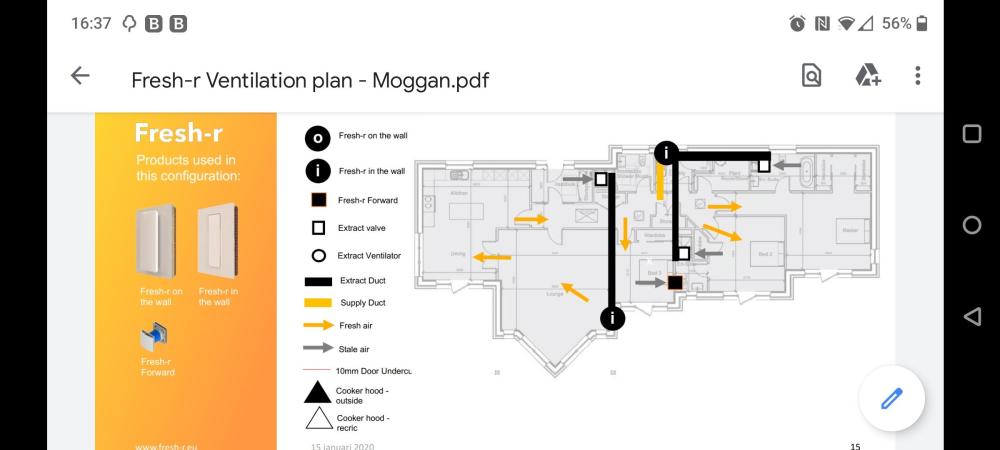
No, the layout is specifically for the Fresh R units, but can't see why it can't be adapted to other units -
Combining an air-water heat pump and solar thermal
JohnMo replied to Garald's topic in Solar Thermal (ST)
Mine is going to open vented thermal store. Direct to top and bottom of store not via a coil. -
DIY sense check please
JohnMo replied to Tilda's topic in Mechanical Ventilation with Heat Recovery (MVHR)
Some initial comments Kitchen/diner only needs an extract. Move supply and extract points away from windows and doors. You could remove extract from landing Make use of coanda effect supply and extract valves. These throw the air across a room at ceiling level, may make duct routing easier. You could remove a supply from the snug as all supply air in the lounge and family will travel through the snug prior to being extracted. 8 supply 6 extract. Anything outside the heated envelope has to be insulated. I have attached a layout drawing I got from Fresh R for our house. There are only two supply points and three extract points (200m2 floor area) so some food for thought. They have looked at the way the air would flow through the building and simplified. I didn't go that route, because Brexit was just happening at that time.