


A_L
-
Posts
652 -
Joined
-
Last visited
-
Days Won
1
Everything posted by A_L
-
Hello, so why are you not filling the cavity? Bonded bead CWI is trouble proof and you be will be able to get a subsidised install through the Energy Saving Trust (0800 444 202 in England). You could reduce the PIR to 25mm and still get a better result. If the board only has foil on one side position it on the warm side. Adding a cavity next to the foil layer will add about 10% to 15% to the thermal performance of the wall. The foil acts as a vapour barrier if the boards are taped with a vapour resistant tape. If putting in a separate VCL it should be on the warm side of all the insulation.
-
It is the force (in Pascals) required to compress it by 10%. i.e. EPS 70 requires a force of 70kPA (70000) to compress it by 10% (about 7000kg/m2 )
-
No, but it is an easy way to get your dwelling emission rate (DER) below the target emission rate (TER) if your stuck.
- 1 reply
-
- 1
-

-
Plain white EPS in this sort of application is likely to have a thermal conductivity of 0.04W/m.K and graphite EPS a conductivity of 0.032W/m.K. In more understandable terms every 32mm of graphite EPS has the same insulating effect as 40mm of standard EPS. The difference between 0.227 and 0.24 U-values is trivial
-
IMHO there are too many unknown variables to be confident about this. Particularly infiltration rate and use/heating of third floor.
-
How about Perlite/Vermiculite (Silvapor). As mentioned in the second pdf? Thermal conductivity 0.05W/m.K https://www.dupreminerals.com/wp-content/uploads/perlite/Silvaperl-silvapor.pdf
-
@TonyT, Why not use silver eps bead, thermal conductivity 0.033 Here are some examples attached refurb-case-study-1.pdf refurb-case-study-7.pdf
-
@Moggaman, Looks like you need render. See 3.2.2.1.2 of linked Irish Agrement Board cert https://h7y7d6g6.rocketcdn.me/wp-content/uploads/2021/01/KORE-Fill-NSAI-Certificate-202012.pdf
-
@Moggaman, multiple holes are drilled at the same time, IMHO any slight positive pressure used to inject the beads would escape through these and any significant pressure build up impossible. I have seen cases of fibre cavity fill accidently injected into timber frames and the plasterboard buckle as a result.
-
No, airtight does not necessarily mean vapour tight. It depends on the exact nature of the airtight layer (and possibly other layers). The loft hatch would also definitely be a suspect.
-
The Arotherm plus uses R290 (Propane)
-
MVHR and open fireplace
A_L replied to Ronan 1's topic in Mechanical Ventilation with Heat Recovery (MVHR)
And the world suffers................ -
Let it cool to ambient in the bath! ?
-
If the ventilators for a design of 5m3/m2.hr have been tightly specified they will not be large enough (about 40% more) for less than 3m3/m2.hr The house looks like it has high ceilings, reducing from 5 to 3 will save about 1kWh/m2.yr but he has to save about 5kWh/m2..yr to get the required CO2 savings.
-
@nubbins Waste water heat recovery (WWHR) fitted to all showers could get you across the line if the gap is only a few points. https://recoupwwhrs.co.uk/ https://showersave.com/
-
Pre-heater or no pre-heater....
A_L replied to djcdan's topic in Mechanical Ventilation with Heat Recovery (MVHR)
To confirm we are using the same terminology, a pre-heater heats incoming air and the vast majority of this energy is transferred to the outgoing air in the heat exchanger. (Another way of looking at it is, the incoming air is heated to be warmer than the outgoing air to prevent it cooling the outgoing air, at least at the 'outside end' of the heat exchanger) The purpose of this is to prevent ice forming in the heat exchanger passages as a result of water vapour in the outgoing air condensing and then being cooled by below 0°C air in the incoming side. There is an alternative to this strategy. Replacing the standard heat exchanger with an enthalpy heat exchanger will prevent the water in the outgoing air freezing, until the perhaps falls as low as at least -8°C, see bottom of this link :- https://www.paulheatrecovery.co.uk/components/moisture-heat-exchanger/ It achieves this by transferring water vapour from the outgoing air to the incoming air, preventing condensing/freezing in the outgoing air. -
At the simplest it is the time taken for energy at the outside of a wall to transfer through to the inside. https://www.concretecentre.com/Publications-Software/Design-tools-and-software/Dynamic-Thermal-Properties-Calculator-(1).aspx from the middle of the link :-
-
Assuming this is a modern condensing gas boiler turn the flow temperature down to a maximum off 60°C so that the return condenses the flue gases, which occurs at about 57°C. This gives 10-15% more heat from the same amount of gas.
-
It does look OK but I would prefer the Intello on the warm side of the 50mm PIR layer, much bigger difference between actual and saturated vapour pressures. Are not 25 x 50mm battens inadequate without fixing to something else?
-
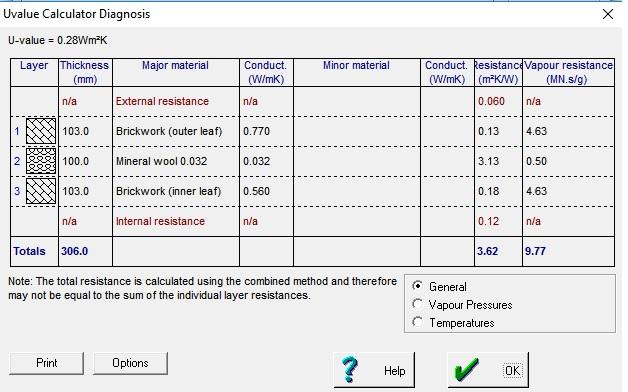
Why? Table 2 (page16) of Part L1B says 0.28 for new thermal elements in an extension https://assets.publishing.service.gov.uk/government/uploads/system/uploads/attachment_data/file/697629/L1B_secure-1.pdf The Thermalite/Plasterboard option is 0.24
-
Boarding/Sheeting between the rafters and felt
A_L replied to Kev1312's topic in Roofing, Tiling & Slating
Traditionally in Scotland six inch wide planks were nailed to rafters as 'sarking' this increased the strength of the roof in our weather conditions and slates (not tiles) would be directly fixed to them. My theory is that it is a 'sop' included to get building regs approval and has little strengthening effect (as evidenced by its fragility). -
hello and welcome, (note my location) italics and bold my edit, did you mean 'around'? ?
-
do you actually mean a sewage treatment plant (STP)? like https://premiertechaqua.co.uk/products/wastewater/conder-asp-sewage-treatment-plant.aspx
-
Hideous extensions. 'outstanding architectural merit'? - pah!!!!!!!!!!!!!!
-
Only if you intended to use 70mm or less of PIR and you use silver/graphite EPS beads.
