


billt
-
Posts
499 -
Joined
-
Last visited
Everything posted by billt
-
High speed broadband a legal requirement by 2020
billt replied to a topic in General Self Build & DIY Discussion
Apparently our exchange can offer FTTP on demand, which sounds a good idea, the catch is that you have to pay the infrastructure costs, which for 2.2km would be considerable. I'd guess that's how it would work, in the highly unlikely event that such legislation came into being. "You can have FTTP as long as you pay £10,000 for the installation." -
I haven't done the sums, but I installed hot water pumps when I revamped our heating system. (About 15M pipe to the kitchen.) You don't need to run the pump continuously, unless it's in a hotel. We insulated the hot water pipes and have found that running the pump for 2.5 minutes every 70 minutes during waking hours is enough to keep the water at the taps warm enough. I doubt tat the losses are much greater than just running lots of cold water off.
-
A Robust Non-Gas Heating / Water System for Rentals
billt replied to Ferdinand's topic in Boffin's Corner
I think the reason for placing radiators on outside walls under windows is a bit more subtle than that. With a normal house and radiators on an internal wall there will be a big temperature gradient between the inner wall and the outer wall, which makes the temperature distribution uneven leading to an uncomfortable room and a tendency to increase the room temperature. With a radiator on the outside wall the temperature distribution is much more even leading to a comfortable room at a lower temperature. There is also the issue of the warm heat source of the radiator compensating for the cold sink of the window. This may be less of an issue in a Passivhaus, but it's still going to be more effective to place radiators in the traditional place in most radiator heated buildings; windows are still a cold spot.- 28 replies
-
- 1
-

-
- all electric house
- little brown bungalow
- (and 2 more)
-
Working out ASHP min COP to beat lpg
billt replied to johny_99's topic in Air Source Heat Pumps (ASHP)
I fail to see how you can deduce anything about the air temperature from those graphs. The system uses radiators, not UFH and a lpg boiler, not an ASHP. The OP has a radiator system at the moment and it has been suggested that his best option is to keep the system as is and use a condensing boiler. I was merely suggesting that using a weather compensating controller will keep the boiler in condensing mode for as long as possible and maximise the efficiency of the system. The following discussion was about the operation of weather compensating controllers. Yes, I've got lots more data but it's not going to be any use to anyone else. -
Working out ASHP min COP to beat lpg
billt replied to johny_99's topic in Air Source Heat Pumps (ASHP)
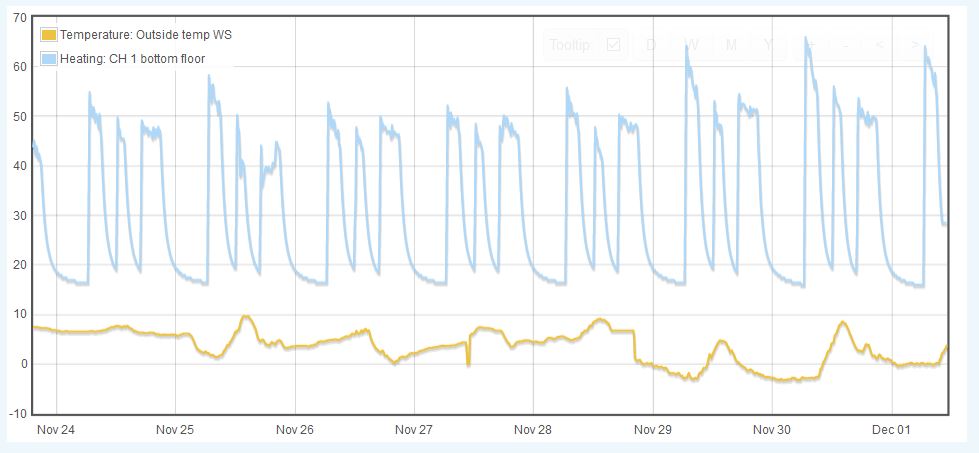
The yellow line is the outside temperature. Compare the top of the blue line to the yellow line and you should see in inverse relationship. It isn't perfect, partly as there's an internal temperature sensor which modifies the offset. The large swings are due to the heating being timed (like most domestic systems). High flow temperatures are when normal room temperatures are being demanded, low flow temperatures are during set back periods. As the house has a long thermal time constant the internal temperature doesn't usually drop to the set back temperature so the flow temperature will drop towards (internal) ambient. -
Working out ASHP min COP to beat lpg
billt replied to johny_99's topic in Air Source Heat Pumps (ASHP)
Just to demonstrate that it does work here are graphs showing outside and water temperatures for the last week, a week in June and the coldest week last winter.

-
Working out ASHP min COP to beat lpg
billt replied to johny_99's topic in Air Source Heat Pumps (ASHP)
I can only speak for the one I used (Honeywell AQ6000), but it was a lot more sophisticated than that. Yes it did optimum start, but it modulated the water temperature, which it did by cycling the burner. It also controlled the burn length and number of cycles to maximise the boiler efficiency; it was an excellent controller, much better than anything else readily available at the time. The system that I use now is controlled by an Acaso Automix 30, which drives a mixing valve on the return to the thermal store. They were both a bit fiddly to setup as you have to match the slope and offset of the temperature curves to match the characteristics of the house - something that's going to be a lot easier if you're living with it and can tweak a bit at a time over the heating season. I can see that it would be tricky to set up if you are installing for a living and don't have time for trial and error. -
Working out ASHP min COP to beat lpg
billt replied to johny_99's topic in Air Source Heat Pumps (ASHP)
This looks like a case where a weather-compensating controller would be worthwhile. They modulate the boiler flow temperature according to the outdoor temperature. Most of the time they will keep the water temperature well below 50°C even with a system designed for high water temperatures, keeping the boiler operating in the condensing range. The flow temperature will only be high for the relatively small time when the outside temperature drops towards 0°C. My system has used weather compensating controllers for the last 25 years, initially with an oil boiler, now with a big thermal store and LPG boiler. They both worked very well. Of course, if you have a near pssivhaus then the benefit is negligible. -
At one time I was very interested in the idea of straw bale building; in fact I built 2 one room huts in order to test the theory out and they worked quite well as cheap temporary accommodation. However, I would run a mile if you want to build something which you think will be part of the normal housing market and if you need to borrow money it looks as if you are. If you are building something which will be solely for your own use, you don't need to borrow money, you are doing all the work yourself or with free labour, aren't too bothered about building regs, you like the thick walls and characterful surfaces you can get with direct plastering then straw bale is great. If you want to resell at some time you are limiting your potential market drastically. Straw bale isn't a particularly cheap method of building, walls are a very small part of the cost of a building; if it's more than a single storey you will need additional structural support of some sort which removes a lot of the simplicity; the material cost saving will be negated by the additional time taken in plastering very uneven surfaces. Thick walls are attractive, but if you have a restricted external footprint you reduce the internal area significantly.
-
I'd guess it's because we used timber frames universally until very recently. A timber frame installed like that will rot very quickly as you'll have water resting on the top of the frame and penetrating the sides. It's much easier to minimise water penetration with traditional build methods if the window is recessed.
-
I'd echo what Crofter said; you want to run it with a hot fire to minimise pollution. Assuming you don't have howling gales through the room or damp walls you'll probably find that the smallest stove that you can get will be enough. We have 3 wood burners. The first one we installed in our lounge years ago is much too big for the room (22 sq.m.) I don't know what the output is but it's too much. The other 2 we installed are Franco Belge Belforts which were as small as we could find (upto 5.5 kW, and the looks suit our old house). The output is completely adequate for the rooms they are in, one 21 sq.m. and the hall which is 39 sq.m. At one time we were running the hall fire continuously while the main heating system wasn't working and it kept the chill off the house quite satisfactorily, although we were burning coal not wood in it at that time.
- 14 replies
-
- 1
-
-
- log burner
- wood
- (and 1 more)
-
Gave up collecting grass years ago. If you cut regularly you can get away without a mulching mower, and if you don't a mulching mower's likely to struggle. I've got 3 Stigas, one with push button start, one with key start (both B&S engines) and one with pull start (Honda engine). My experience is that B&S engines are just as reliable and easy to start as Honda - Honda have just got better advertising.
-
I really don't see what your problem is. All the codes let you do is to confirm the details of occupiers of the property online, you can't change anything.
-
If they're inaccessible (and I would have thought beams were out of reach) so not subject to wear why coat them with anything? They will change colour with time whatever fairly clear finish is used. Redwood should be wood from a Sequoia, but in Europe it's a generic name for timber from one of many pine species, but probably Scots pine. IOW it's more or less meaningless. In theory it might be slightly more dense and stable than what is sold as whitewood, which could be timber from a number of other conifers.
-
I don't think I'll get another petrol walk behind mower. Our garden is big and has a few fairly steep slopes; the drive has failed on all the self propelled mowers that I've tried, including the most recent, eye-wateringly expensive, so-called professional, Stiga Honda powered 55cm. They still cut, but as they're heavy they are a real pain to use once the drive has gone. Replacing the drive is disproportionately expensive. (The cast deck has lost chunks as well, which isn't reliability commensurate with the price.) I decided to try a cheap mains mower for the lawns near the house (costs nothing to run). They work very well. Not self powered, but very light so they don't need it. With a 30M extension lead they will get anywhere that I need them and they cut perfectly adequately. They will take a fair amount of abuse, but they are so cheap that you can buy 1 a year over 10 years for the price of the Stiga.They're 43cm 1800W mowers from Aldi/Lidl for about £80. Of course, they're no good if you want over engineered, heavy mowers.
-
I think your plumber friend is ill advised. "Pressure testing of pipelines should normally be carried out using water. Only in exceptional circumstances should pneumatic pressure testing using compressed inert gas or air be used, and then only under carefully controlled conditions. The reason for this is because water is virtually incompressible (as are other liquids) and only a small quantity of energy needs to be introduced to increase the pressure significantly. Air, however, (like all gases) is compressible and, as a result, much more energy has to be put into the gas to raise its pressure. In fact, at the pressure ranges normally used for testing water-piping systems 200 times more energy is stored in compressed gas compared to water at the same pressure and volume. So, should a joint, pipe, or any other component fail under test pressure when using compressed gas, the energy can be released with deadly force!"
-
The loading valve (hence pump) wants to be as near the stove as possible. Its main function is to ensure that the boiler gets to operating temperature quickly raising efficiency and reducing pollution. If there's a long pipe run between heat source and loading valve you've got a much bigger mass of water to heat as well as more heat loss so the system will take longer to reach operating temperature. Can't see the relevance of flammability. It must be an enclosed stove, so no significantly greater fire risk than a gas or oil boiler.
-
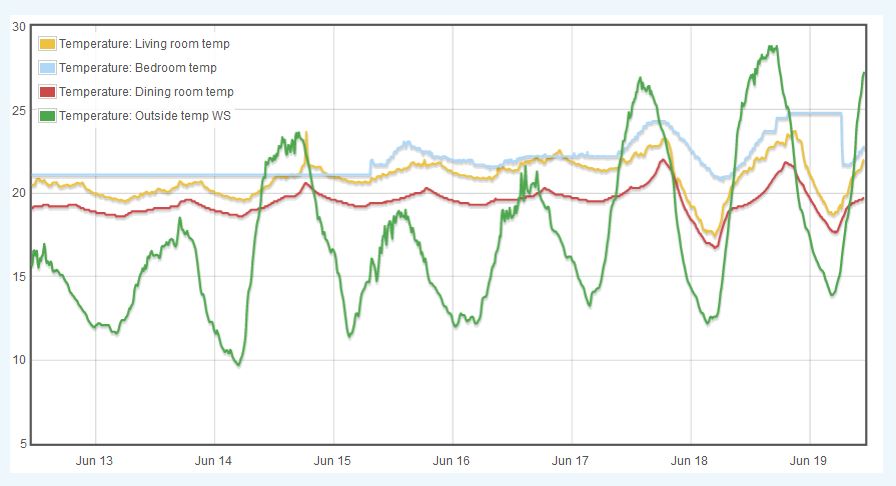
Our old house is on 3 floors with distinct zones. Bottom floor is built into a bank with thick stone walls and small windows, max temp was 22, middle floor has thick stone walls and small windows, max temp 24, top floor single brick walls with 70mm internal insulation and largish S facing windows max 25. Maximum outside temperature 29. For the last few days curtains/blinds and windows have been closed during the day and opened when the outside temperature has dropped.
-
They're more interesting than EPS. They seem to be made of recycled wood fibres in a cement matrix with insulation inside the holes on one side, but with the concrete fill towards the inside of the wall. That implies that they should be stronger than EPS ICF, less likely to burst, and the thermal mass (non permitted term) is near the inside of the wall and not surrounded by insulation so has some effect. See the link in the first post.
-
Is Self- Building a viable option for First Time Buyers in London
billt replied to MattBetts's topic in Research Resources
Historically, when houses were all built from small components by hand, labour costs dominated the cost of a house and land cost was relatively small. If you could supply the labour yourself (true self-build) you could save a lot of money. It's much less true now, when many components are pre-assembled and there is lots of expense involved in complying with the enormous bureaucracy. Of course, the self-build entertainment industry has built up the claims of money saving, even if you use a turnkey package - I suspect most of those claimed savings are just property inflation. I did self build a colour TV in the early 70s, when they were incredibly expensive. In the end it didn't save much (just like house building) but it was a very valuable experience. And people do make railways, boats and planes. http://www.bbc.co.uk/news/world-asia-39945650- 16 replies
-
- 1
-
-
- london
- furst time buyers
- (and 2 more)
-
Round trip efficiency might not all that much if you are grid connected and just trying to stop exporting, but it is significant if you are off grid - every joule saved counts.
-
I have a project to go off grid (because I can, not because I need to). The initial plan was to use 24 100Ah fork lift batteries as the cheapest option, but a lot more research changed my mind and I decided to use LiFEPO4 batteries instead. They seem to be more expensive per kWh, but in fact the cost in terms of real capacity is similar. When I did my calculations cheap FLA fork lift batteries would have been about £6,600 for a 48V pack with a notional capacity of 48kWh; I choose to use 400Ah LiFePo4 batteries with a cost of about £7,000 for a nominal capacity of 19kWh. In real life, in order get a long life out of the FLA cells you can't discharge them less than 50% which reduces the capacity to about 24kWh. The LiFEPO4 batteries can be run down to 20% without ill effect, which gives a capacity of about 15kWh for my example. Over the expected battery lifetime the costs per kWh were very similar. Having decided that the lifetime costs were similar the LiFEPO4 batteries have overwhelming advantages. They're much lighter and easier to handle, which was an issue for me as the chosen location is difficult to access. They are much more efficient - charge/discharge efficiency is over 90% FLA is of the order of 80%. They have low self discharge. They are low maintenance - no hazardous electrolyte to check and top up, no hydrogen to ventilate. They have simpler charge requirements, you don't need to do equalisation charges etc. Although some sort of battery monitoring system is essential in order to ensure that they don't get overcharged. Peukert effect (or equivalent) is virtually non existent. You can discharge at very high rates without significant loss of capacity. I wouldn't consider NiFE. They are very expensive and difficult to get hold of, but mainly they are appallingly inefficient, about 65%. There are a couple of useful discussions https://www.photovoltaikforum.com/speichersysteme-offgrid-f108/nissan-leaf-battery-in-an-sunny-island-setup--t102414.html discusses using Nissan leaf batteries in a Sunny Island system. This enormous thread http://www.cruisersforum.com/forums/f14/lifepo4-batteries-discussion-thread-for-those-using-them-as-house-banks-65069.html discusses real life use of LiFEPO4 batteries in off grid situations (boats) and has some useful information about how to ensure a good lifetime, unfortunately there's a lot of dross in there as well.
- 34 replies
-
- 1
-
-
- electricity
- off-grid
- (and 2 more)
-
Sounds like a potential fire hazard if there's a space between the un-plastered bales and the OSB - a nice chimney. The generally accepted way of making bales fire resistant is to plaster both sides thoroughly to make sure that air can't get to the surface. Some years ago I built a couple of straw bale huts as temporary accommodation, partly in order to assess suitability for an outbuilding I was going to reconstruct. In the end I decided it wasn't a practical system. The relative cheapness of the materials is outweighed by the much wider foundations needed and the very large amount of labour input to plaster the walls. I've just been disposing of some left over bales on a bonfire, and seeing the ease with which they burn, I would want to make sure any building using them was very carefully plastered.
-
Yes you can, but 1-wire is very sensitive to reflections, so if you are daisy chaining you need to make sure that any stubs are as short as possible. Ideally you would loop the cable at each sensor. I have several runs with multiple sensors attached without stubs using passive mode and they are pretty reliable.
-
And quite rightly too. The EPC rating is completely without meaning to the average non-technical house buyer; it doesn't relate in any meaningful way to the energy costs of any particular house, which would be the only interest they would have in it. The EPC/SAP rating is completely without meaning to the technical house buyer. One would assume that it relates closely to the energy usage and hence cost of running a building, but it doesn't. As far as I can see it is supposed to correlate with some not clearly defined environmental cost of energy. That results in completely bizarre ratings where the type of fuel used and any renewal energy generation scheme completely outweighs the standard of insulation and construction. If you want an A rating use mains gas and have 4kW of PV. Everything else has minimal effect on the SAP score.
