Dan F
-
Posts
1431 -
Joined
-
Last visited
-
Days Won
2
Everything posted by Dan F
-
Electrician I was talking to the other day said that Knightsbrige are almost as good as Hamilton but fair bit cheaper. Just googled them and they seem to have screwless versions. Cheaper well-known safe bet I thnk he mentioned was MK (https://www.mkelectric.com/en-my/Products/WD/Superswitch/screwless/Pages/default.aspx)
-
What U-value should these insulated foundations give
Dan F replied to Thorfun's topic in Foundations
Initially I thoght you wouldn't achieve 0.10W/m2K on basement foundation, but seems you are achieving this via 30mm of some kind of PIR product under the screed. The problem with this is that, the basement walls aren't insulated in the same way so: i) You won't achieve same u-value for walls. iii) You'll have a situation surely, where the heat in the concrete in the walls will bridge to some extent to the concrete under the floor PIR, making the foundation not quite a effective as the numbers might make it seems. Can you use the same 30mm PIR on the walls too? Or simplify things and just use 250mm EPS everywhere. What function does the PIR sirve? On a seperate note, wondering why you need the screed? -
What U-value should these insulated foundations give
Dan F replied to Thorfun's topic in Foundations
Talk to Andrew at KORE, he'll run the calulcation for you if you send them foundation design. I would assume the basement wall needs to be treated in a similiar way to foundation. Your 0.10 target, is that "in ground" u-value or "cassete" u-valye? -
What U-value should these insulated foundations give
Dan F replied to Thorfun's topic in Foundations
There a different ways to calculate foundation u-value and each approach gives a different result. It comes down to if you consider it a "cassete" and purely look at the materials and their thermal resistence, or if you look at the foundation system in the ground, in which case the caculation works slightly different and gives better (lower) values. Also, each foundation design will have different size ring-beams and/or areas that need thicker concrete, which will both impact the overall u-value of the foundation. In our case about 60% of the slab needed 250mm concrete which meant EPS was reduced to just 200mm. This had a non-insignificant impact on the overall u-value meaning it wasn't really very close at all to the MBC quoted 0.105W/m2K. In the end we added an extra 100mm EPS. -
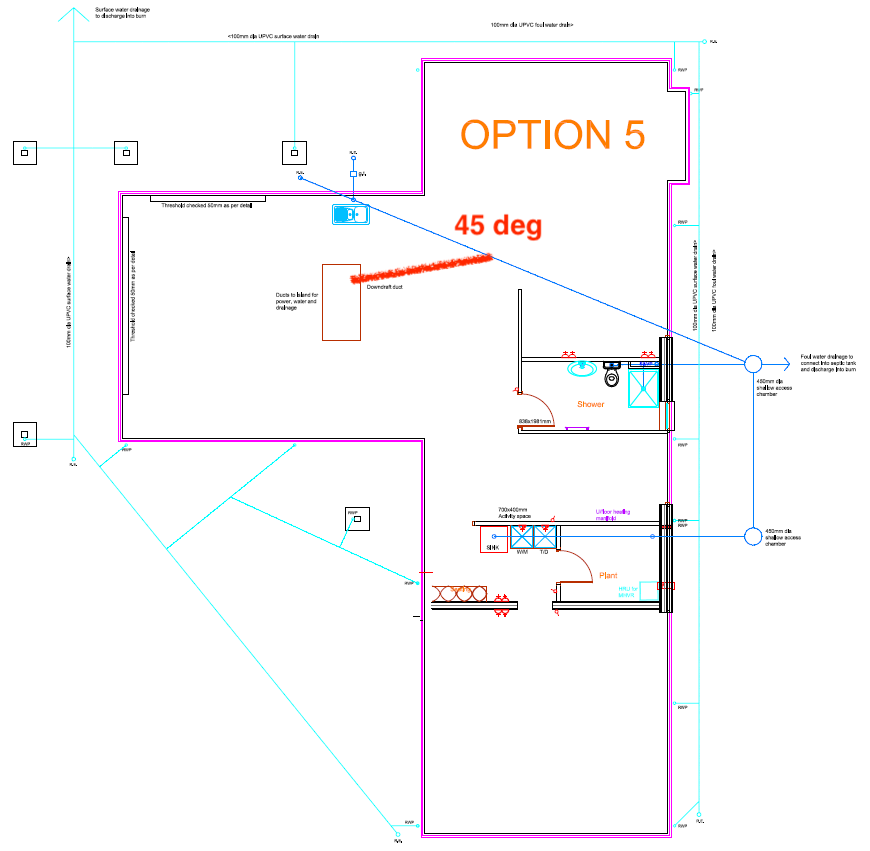
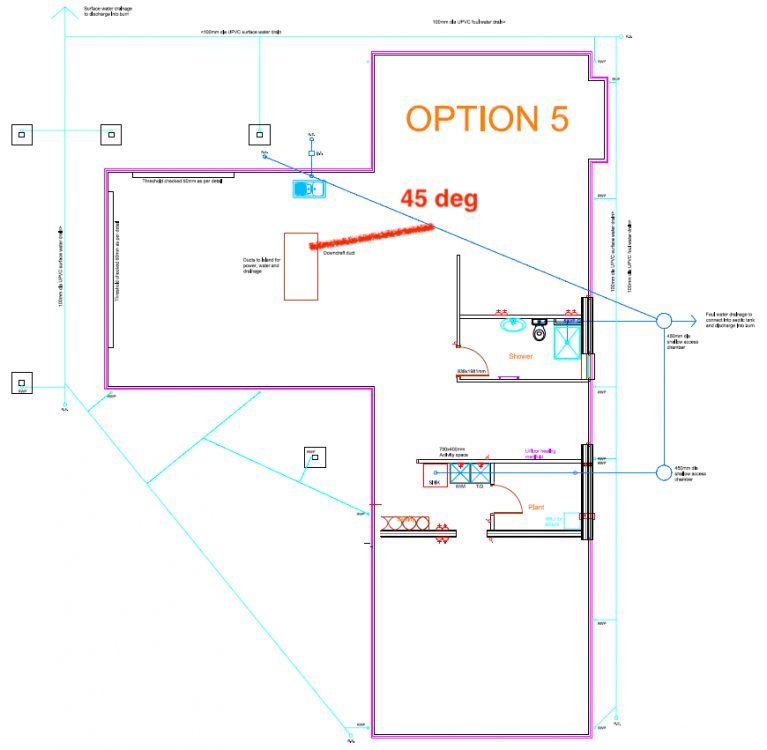
We had three of these y-junctions under the slab. Was no hassle and additional no cost. We just ensured that toilets and kitchen sinks weren't on a Y-junction as per guidance I shared which seems very sensible. - Kitchen island (just in case) - UVC overflow - Water-softender + ComfoPost
-
@SuperJohnG Leave the island drain in, it'll cost you nothing and leaves the option open!! Why not this..
-
It's advisable to avoid putting both toilets or kitchen sinks on branches, anything else is OK. (according to NHBC anyway) See attachment Note also, that length of runs around the house will impact invert levels. Your original option 2 looks the simplest, but your main drain at the front of RHS of he house as drawn will need to be somewhat lower.. which may be an issue. Y-junctions-in-drains-under-buildings.pdf
-
Did you find the databook? 80Mb of info Ecodan fun! https://library.mitsubishielectric.co.uk/pdf/book/ATW_Databook_R32_2020
-
We have: 2.4m first floor (+ 50mm allowance for screedboard+flooring) 2.5m ground floor (+ 100mm allowance for ceiling void/pb or whatever we do there)
-
Wow! A 72mm build-up on top decking! And I thought potentially putting a 35mm Knauf Gifafloor FHB (with 10mm WF resilient layer) on top of 22mm caberdeck might be overkill. Will have to study the whitebook. We were thinking of putting fireboard under joists on resiliant bars (we have fair amount of steel) and then using a second layer of PB on hangers for light-fittings. Surely if you just use suspended ceiling but then have lots of downlights, it's not quite as effective?
-
Apparently there are significant availability issues with Ecodan currently. If you need it soon, I'd ask about availability before finalizing details. Also told that the availability of some other brands is also being impacted by Ecodan shortage. What has your supplier told you @joth? Or was yours ordered some time ago?
-
@nod - Do you have a British Gypsum for system reference for the approach you are taking? Keen to take a look at the details.. - What did you do on top of joists/decking?
-
Thanks. Just got to work out if it makes sense to future proof now ?. Think a CAT6 just in case is probably overkill though!! haha
-
Mind sharing link to supplier? Not looked at Grohe frames yet but will do. Tapnshower.com seem to have Grohe shower sets at close to german prices.
-
Any idea if Reuter (or Megabad/Skybad) are still delivering to the U.K. Need to order (for now at least) some Gerebit frames and Grohe shower sets. I know people have mentined big savings buying from Germany, but more recently (and assuming you shop around in U.K) what have peoples experiences been on cost savings vs. any additional complexity/delay?
-
Anyone used any of these screedboard alternatives for reducing noise in timber-frame build that have worked well? Screedboard28 at around £35 isn't cheap! Chipboard + 10mm Foam - Cellecta Deckfon Chip. 26mm - JCW Acoustic Deck. 28mm - Karma Overlay. 26mm Gypsum + 10mm Wood Fibre - Knauf Brio 28mm - Knauf Girafloor UB 28mm - Knauf Girafloor DLH/FHB 35mm - Karma Smart Floor 28mm Cellecta Deckfon seems to be available for around £15/m2, but my feeling is that a gypsum board is better option for impact noise and is also potentially better for bathrooms too. Hard to know what the practical difference is though as I expect manufactuer values for noise reduction aren't really comparable.
-
It's likely referring to 465L@45C (usable after mixing) from a 300L@60C tank (installed). Something along those lines anyway..
-
Few mid-range italian brands I've seen on the high-street here are: - Scavolini - Miton - Domio
-
New Build Passive House (Donegal - Ireland)
Dan F replied to Donegalsd's topic in Introduce Yourself
Same here. Have to share notes on central relay vs. nano relays vs. wireless actuator. We are starting first fix in 2wks approx. -
New Build Passive House (Donegal - Ireland)
Dan F replied to Donegalsd's topic in Introduce Yourself
Going to automate them? It's interesting when you can raise/lower them based on room temperature even if you're not at home ? -
New Build Passive House (Donegal - Ireland)
Dan F replied to Donegalsd's topic in Introduce Yourself
Nothing stops you. Our PHPP model was done remotely.- 11 replies
-
- 1
-

-
- passivhaus
- timberframe
- (and 2 more)
-
Interesting. I was looking at how to do 5A switchable lighting sockets with Loxone and while I'd prefer to wire-in everything there is a fairly signifinnat price different between a Loxone nano relay and a Shelly 2.5, so this might be a good idea. I think with our external blinds though I'd want to stick to a wired-in relay as it's harder to take things apart later if needed. Where are you using the smart relays? At the price (£11 for dual relay Shelly 2.5), you could potentially consider putting one in quite a lot of sockets in the house, behind faceplate. Not too keen on using wi-fi for automation, but truth is that it'll work and if it's only for easily accessible sockets and not heating control or blinds, not a major concern. To me though, it seems there is a gap in the market for a "smart" consumer unit that talks to sockets via "powerline" style communication for switching and consumption monitoring. Or does something like this exist?
-
Which model are you looking at? The 7kW model does seem to be have one of the lowest "sound power" numbers on the market at 55dB. The 10kW on the other hand which is 1.5m tall, has dual-fans and isn't anything special at 60dB. I'm not sure how Mitsubishi get their "sound pressure" numbers as they don't seem to make sense. Unless they are calculated with no reflective surfaces... i.e. suspended in the air.
-
Induction downdraft hobs requirements (Bora etc)
Dan F replied to SuperJohnG's topic in Kitchen & Household Appliances
Our kitchen has 60m3/hr extract specificed, so lot less but not quite tiny. Think we'll try to keep it from directly over the hob, but other than that not worry too much.. -
This is exactly what we are doing. 3-phase in garage for PV and future car charging, but keep house on single-phase. Keeping house on single-phase is simpler IMO, and means that if you install something like a Powerwall, you can backup house with 1 battery and don't need 3. 3-phase for PV means it's much easier to get a decent size array approved by DNO. No down-side with having 3-phases, you can just use one of them if you like. Until recently we only have a single-phase meter connected to one of the supply phases.