


Dan F
-
Posts
1431 -
Joined
-
Last visited
-
Days Won
2
Everything posted by Dan F
-
Yes, but only marginally due to the intial heat-up time. The main thing is that a 30-50% saving is worth a lot more (in monetary terms) the more you shower. An instantaneous WWHRS doesn't need to be close to cyclinder. Not seen this one, any idea how it differs to showersave/recoup? Is it not instantaneous and therefore more bath-compatible? Interesting!
-
Depends on if you shower, how long you shower for, how long you plan to live in the house and how much you pay for your DHW. For us 30+ % reduction in costs of heating hot water (as well as 30% more effective UVC capacity for showers) is very much worth the £450 this unit cost, given we plan to live in the house long-term. For others, may make less/no sense... How does this work?
-
What do you meant paying for points? It will also save you a lot of gas (assuming you shower rather than use bath)! Showers don't actually need to be close to the hot water tank. You can use them in "system B" where the WWHRS just pre-heats the cold feed to the shower. It's not quite as effiecient, but still saves a fair bit and will give you almost as many SAP points.
-
Do a quick search and you'll find lots of views ?
-
You might need to find a different supplier! A good solar-glass is near enough transparent and will let almost as much light through as standard glass while reducing the solar gain. There may be other manufactuers available also, but this is the moslty commonly used stuff AFAIK: https://www.saint-gobain-glass.com/products/cool-lite-skn Looking at the spec (when made up in double-glazing) this is what you are looking at: - The 0.39 g version give 65% solar gain for 96% of light. - The 0.36 g version give 60% solar gain for 84% of light. - The 0.32 g version give 53% solar gain for 74% of light.
-
What brand did you use? We need to order one 1000x1000mm. Debating whether to make it openable though..
-
Sketchup will give you an idea of how much light enters via rooflights, but won't take into account glass spec, insulation or ventilation and tell you how much your house will/won't overheat. How highly insulated is the house going to be? If its going to be pasive standard and have numerous rooflights then the best approach would be to model in PHPP, else I think you'd just be guessing as to what solar glass and/or shading you do/don't need. If house is not quite so highly insulated, airtight or you don't have MVHR then its maybe less critical and you could go with fairly minimal solar glass probably and not worry.
-
Best spec for high pressure hot water to multiple outlets?
Dan F replied to sendu's topic in Boilers & Hot Water Tanks
If you use the auto-adapt pump you wouldn't need a timer (assuming they work well). With the others it depends how much heat loss you want to avoid. As they are low-flow and temperature controlled then will minimize energy usage, but you are still keeping return loop hot all day without a timer. Also depends on you usage patterns. I've gone with 15mm (11.5mm internal) for the kitchen sink as velocity is bit too high with decent flow rate otherwise. For bathrooms sinks, I think @Nickfromwales is referring to 10mm radial to basins, rather than a loop in 10mm. (10mm is plenty for a single basin, but not for 2/3+ basins that may be used at the same for IMO) -
Best spec for high pressure hot water to multiple outlets?
Dan F replied to sendu's topic in Boilers & Hot Water Tanks
There is no additional tank. A larger tank and PHE solve two slightly different, but overlapping, concerns: - Large tank gives more stored hot water. - PHE helps improve the ability to supply hot water (e.g. for a third shower) when the tank is at low temp and still reheating, which is the scenario @AliG mentioned. I agree that a larger tank is easiest/cheapest approach to get more water but there is the dilution/reheat nuance that needs be be considered. If you are using a boiler and tank re-heat time is only 20min this is clearly a non-issue, it's when using an smallish ASHP with longer reheat times then hot water availability, and not just capacity, needs some thought too. -
Best spec for high pressure hot water to multiple outlets?
Dan F replied to sendu's topic in Boilers & Hot Water Tanks
Or use 300 liter + WWHRS. The WWHRS means (depending on system used) that the cold water is closer to 28C than 10C, meaning the water in your UVC goes a fair bit further. There are couple of approaches/products that are supposed to mitigate this dilution issue and improve hot-water availability. - https://www.mcdonaldwaterstorage.com/products/plateflow-plate-heat-exchanger - https://www.mixergy.co.uk/ You can get pumps than recirculate based on temperature and can even "learn" usage patterns if you want to avoid PIR''s. I'm not sure I'd worry about the noise, if you've ever lived in a house with central heating there is a pump pumping the water around. https://product-selection.grundfos.com/products/comfort -
Pre-heater or no pre-heater....
Dan F replied to djcdan's topic in Mechanical Ventilation with Heat Recovery (MVHR)
Other option, depending on size of house and number of occupants, is to use an enthalpy exchanger. Freezing of condensation in extract is not a problem, at least in UK climate, with an enthalpy heat exchanger as humidity is recovered -
Does this help? We had to replace 90deg bends for slow bends with concrete below for first-floor SVP's, after BRegs visit.
-
The Grohe thermostatic mixers we'll be using say: "Hot water temperature at supply connection min. 2 °C higher than mixed water temperature"
-
We have utility below, so will isolate in a the top of cupboard in the utility. We'll also likely install TMV here, which I beleive is required for BRegs.
-
Argument against is: - It's overkill as CAT6a supports 10GBASE-T up to 100m. - If you want to future-proof for more than 10GBASE-T then run multiple CAT6a. - You need tranceivers/extenders etc. to use fiber. The argument for is: - Supports faster speeds and no potential interference. - Uncompressed 8K TV (and whatever else that comes along in next 10-20yrs) will need more than 10GBASE-T for sure. - You can avoid termination concerns, buy simply patch buying cables in customizable lengths. - It's potentially cheaper/easier to run fibre than to run conduit for future proofing. A 15m duplex OM3 patch cable is only £8 [1], 15m of 25mm conduit is probably around £10 (screwfix prices) and need fitting with nice bends etc. (Of course if you want to go crazy with your future prooding, you maybe want to look at using a 4/6/8 strand breakout cable. but even that is only £40 per drop.) Anyone done this? What rooms did you take it to, what product did you use and how many strands did you use? [1] https://www.fs.com/uk/products/41735.html?attribute=226&id=99217
-
@TerryE Seems your system works very well, but wouldn't an ASHP also reduce your DHW costs where an air-con unit couldn't?
-
If you have a local bathroom manifold then you need 15 or 22mm to the bathroom, which increases the delay for hot water, unless you rely on secondary circulation. The goal of central manifold and 10mm radial feeds to basins is to: - Avoid need for secondary circulation but still get short delay for hot water. - Reduce heat losses (due to less water in pipes). - Central isolation point is also useful.. and for some people this is preffered over finding suitable locations for manifolds in bathrooms. In our case our basins are at 4, 5, 6, 12, 13 and 14m. With 10mm it'll take between 2.5 and 8 seconds at 6 l/min to empty these runs yet with 15mm that goes up to 6->20 seconds. (With 22m it's 13->42 seconds). Given the maximum 8 seconds is a guest en-suite, we'll likely not bother with any secondary circulation at all. Planning to use Uponor 12mm (8.8mm ID) as the Hep2o 10mm only has 6.7mm ID which would mean 2.8m/s velocity at 6 l/m (vs. 1.6m/s)
-
Completely agreee. Main point though, was that I'm not sure I would trust that calculator for design for domesitc hot supply suply (vs. hoses) as it looks like it's baking in some assumptions which gives rather different results. A better concrete example is that it suggests that the max length of 10mm pipe (8.8mm ID) to achieve 6l/min with 3bar is just 1.8m. If this was the case then using 10mm for basins (as a lot of people do) would be a terrible idea.
-
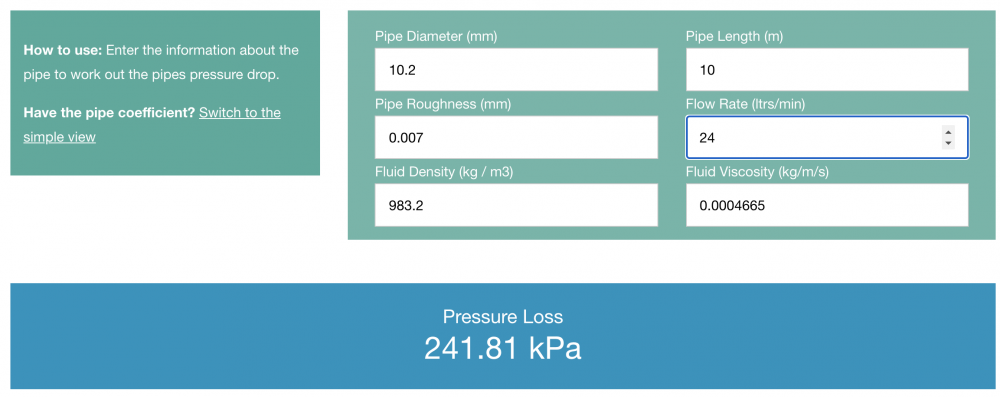
Do we know what assumptions this calculator uses though? I get 24 l/min (using the Copely pressure loss calcutor) assuming: 3bar supply, 10.2mm ID, 10m length, 60C water, roughness of 0.007mm (hep2o) and assuming that the fitting needs 0.5bar. The velocity at 24 l/min is 5m/s though, so you wouldn't want to do more than 10 l/min with this pipe diameter. That's a rather different result to 4.6 l/min! Wondering if I've done something very wrong, or that flow rate calculator is mis-leasding. Interested because the flow rate calculator/graphs also suggests that 10mm (8.8mm ID) can't be use for runs longer than 1.8m if you want to acchive 6 l/min, which doesn't seem to map to peoples experiences using this approach.
-
Right, I didn't see that, but that makes complete sense now! 15mm to manifold will work for one shower, but I agree I can see that being an issue, even with decent pressure, if you want to use much more than one shower. Seems a bit silly for a new build with 4 bathroom! Out of interest, how do you get to 4.6l/min?
-
To be fair it's hard to know if those are final construction issue designs or just a draft that have been added as artwork but agree it raises a number of questions. Few novice questions/comments to see how much I do/don't understand this though: This seems logical as best practice, but surely even if feeds are both the same bore isn't it unlikely that, in most typical install, this will necesarilly mean that the presure is balanced just because cold/hot piping may have different lengths, different numbers of fittings and are used differently. Surely this depends on the incoming water pressure and the pipe lengths though? If lengths are short and the flow rate can be achieved then don't see why this would be an issue in itself. Again, doesn't this depend on pipe length and desired flow rate. The proposed shower (hot feed) flow rate is only 7l/min and the furthest shower seems to be max 10m away from manifold so, using 12mm OD (8.8mm ID) MLP pipe, that gives a pressure drop of 0.5bar which isn't much if the system it at 3bar. That said, I wouldn't personally plan for 7l/min showers and would want to ensure 2-3 showers could be used concurrrently (which would almost certainly mean >22mm supply and >12mm for showers). Neither would I use boiler and radiators in a passive house.
-
BTW, I've been looking at this over the last week too, and here are some other useful resources: - https://www.marshflattsfarm.org.uk/wordpress/?page_id=925 (and various linked pages) - https://www.houseplanninghelp.com/hph202-designing-the-ventilation-heating-and-hot-and-cold-water-systems-for-bens-house-with-alan-clarke/ (see plumbing schematic) - https://www.garykleinassociates.com/writings.html I did get a pressure gauge and have got readings between 4.5 and 6 bar. I'm not using this to calculate anything but think I'm right in assuming that this means that, along with a with 32mm supply pipe, that the DHW system will almost certainly be up at the limited value of 3 bar and no accumulator is needed. In terms of the sizing of the specific radial runs, I was trying to use that calculator and model everything... but I think the best approach for sizing the radial runs is just to ensure that each radial run has a maximum of 1bar pressure drop for the desired flow rate and a maximum velocity of 2m/s. From the UVC to manifold currently assuming probably 28mm as it will be very short, but I do like the idea of a seperate smaller manifold for basins to avoid needing to heat a larger manifold and improve time to hot water (although I'm not sure TMV is really required).
-
You can simulate things, based on schematic, with this tool. You'll need to get the density/roughness etc all correct and ensure you use internal pipe dimensions.. https://www.engineeringtoolbox.com/water-supply-system-design-d_2157.html Interested to hear if/how well it works, as I'm trying to do the same... don't have a schematic yet though...
-
Exactly. Don't have personal experience as only got MCS-approved install quotes. But from what other have said on the forum, you can either DIY or use a plumber that isn't MCS-approved and doesn't have the same overheads. See:
-
Yes, you send cold water around the UFH pipes. Cold enough to cool the slab but not too cold so as to cause condensation to form. The cold water comes from ASHP running in reverse, which most support.

