


Dan F
-
Posts
1431 -
Joined
-
Last visited
-
Days Won
2
Everything posted by Dan F
-
Please critique my HA design
Dan F replied to Hilldes's topic in Networks, AV, Security & Automation
We are using Loxone relays for all 230v switching. We have bathroom UFH, bathroom towel rails and external blinds which all need 230v switching. The relays/dimmers will all be in the lower (230v zone) of the cabinet. I may avoid using the relay outputs on the miniserver itself though, just to keep 230v away from top half of the cabinet. Minirserver relay outputs will be used for motorized lock on front door (24v), and potentially heating controls that need low-voltage. relay output too. Well it has siren + light, so two relays maybe. You have thought they would have put a temperature/humidity sensor in here at least, but seems not. -
I asked them how this works, didn't get a clear answer. Wondering though, if 30W is enough to dry a towel...
-
Where to buy Loxone kit (DIY)
Dan F replied to Hilldes's topic in Networks, AV, Security & Automation
You can plan and dwisgn the whole thing yourself. Loxone is still quite open in this regard compared to other systems. https://www.loxone.com/enen/support/downloads/ There is a planning tool inside this app, seperate to designer. -
Where to buy Loxone kit (DIY)
Dan F replied to Hilldes's topic in Networks, AV, Security & Automation
Who doesn't list prices? Download Loxone Config, and use the project planner tool, it will output a spreadsheet with a parts list and all prices -
I think for a bath towel, the idea is that you would use 3-5 of them. That could be up to 150W . I agree single ones would be good for hand towels though.
-
Any used these (or other brands)? Any thoughts? They certainly look a fair bit nicer than a traditional towel rail.. https://www.thermosphere.com/products/heated-towel-bars/
-
Where to buy Loxone kit (DIY)
Dan F replied to Hilldes's topic in Networks, AV, Security & Automation
I was going to have our electrician do the cabling but their per-point price was quite high and there were quite a lot of first-fix only connections (window/door sensors). So, in the end I bought 900m of CAT7 cable and did all the Loxone cabling myself, leaving all the 230v stuff to the electricians, including wring for blinds/UFH/towel rails to Loxone relays. One of the challenges with DIY, is the termination/sign-off. You need someone to sign-off all the 230v, and if you turn up with your own DIY panel.. you need to be able to convince your electriciation to terminate into this and sign-off. We initialy agreed that our electirician would supply all Loxone kit at retail prices (vs. discounted) in exchange for doing all of this (as I think @joth also agreed with his electrician). I need to reach out to him and confirm this is still the agreement though. -
Where to buy Loxone kit (DIY)
Dan F replied to Hilldes's topic in Networks, AV, Security & Automation
It's actually a DALI limit of 64 per bus. But Loxone could have built an extension with support for 2 or 4 buses. At £450/64 fittings it's not cheap, but the Loxone dimmers aren't cheap either and DALI gives you more flexability. The DALI fittings are generally £10 more each, so that's £17/fitting for DALI vs. £88 per zone for Dimmer. So depending on your fittings/zone ratio, DALI isn't necesarily more expensive that Dimmers. That said, if the Pi HAT works that's just £0.30/address, so approx £10.30/fitting. https://www.amazon.co.uk/ATX-LED-Raspberry-DALI-control/dp/B081TNRGMN Only if you use DT6, but that's a pain to control as you then need to control warm/cool white seperalty. DT8 (which Loxone has now suported for 6-9mths) is just one address and takes indpendant intensity/kelvin inputs and then drives two LED channels to produce this. We've decided against using tunable white for downlights and are sticking to 3000K. We are using tunable white LED tape everywhere though, apart from a couple of specific location where we are putting RGBW (kids rooms). How would this work? Each LED tape/fitting has two channels, in the same way that RGBW tape has 4 channels. -
Where to buy Loxone kit (DIY)
Dan F replied to Hilldes's topic in Networks, AV, Security & Automation
I never really looked at this approach (not sure why). I have gone down the indivdually addressable DALI route where each fittings has it's own driver doing the dimming. For LED's I was going to use Loxone RGBW extensions for these, but given we are doing tunable white and Loxone support for this is bad, now looking at driving LED's with EldoLED constant voltage DALI DT8 drivers. Good to hear you've had good experience with EldoLED. Makes me even more sure about finding an LED-tape supplier that provides EldoLED drivers and not another brand or unbranded. -
Where to buy Loxone kit (DIY)
Dan F replied to Hilldes's topic in Networks, AV, Security & Automation
The Loxone DALI extensions cost a lot though at £450 each!! Did you use these or do somethng else? I've just bought a Raspberry PI DALI hat, which can control up to 256 DALI addresses for £80. I'm trying to get it working, and expose HTTP calls for use in Loxone now. -
So 20% less than spec. Surely this is heating and not cooling?
-
That calculation assumes the ASHP uses maximum power output across the full range of air/water temperatures and this isn't the case. At A7W55 the 12kW unit only consumes 2.94kW delivering 9.1kW heating ouput (COP 3.1). Your calculation would assume it uses 5.4kW and give a COP of 1.7 which seems low and neither does it match the datasheet. UK datasheet only gives the COP for A7W55. but if you look elsewhere you can find A-2W55=2.7, so the reality is probably around 2.8 for A0W55, (on paper of course).
-
Which "max output tables" are you referring to? Only value I've seen is A7/W55 COP is 2.9 (7kW version),
-
We weren't told we required this, but our permission may expire before we get hold of a powerwall, so this could be a concern if it's a change in policy. Can you share exactly what you were told and by who?
-
Interesting. Our plumber has done the same, but BRegs does seem to be clear that 75mm is the minumum for vent size for discharge stacks. I see that 50mm AAV do exist, but I'd be concerned that the airflow rate supported by 50mm AAV is not going to be the same as a larger AAV, and there is therefore a higher risk of siphoning and breaking seals on basin (and smells/noises), even if you aren't having any specific issues with your setp. What size vent-pipe/AAV have others used, or seen used, for first-floor stack with toilet (i.e. not for branch with basins/sinks)?
-
I'm going to try and answer some of my own questions, based on reading... Anyone want to mark my answers? ? No, but it would be advisable to only reduce to a vent-pipe above the "spill level" No, but bends need to be kept to a minumum, falls respected and swept bends used. Avoid wherever possible. You shouldn't need to avoid them "at all costs", unless you've undersized your pipe to start with. Swept bends is best practice. Building regs only requires in specific situations: i) 75mm branch -> stack ii) Junctions on branch pipes of about same diameter. Swept bends are also strongly advisable for food waste disposal units. Yes. Although building regs only requires 40mm for showers, 50mm is advisable. According to building regs: one size down from discharge stack is permitted in 1-2 storey houses, but never less than 75mm.
-
8 ) Is the use of 50mm vent-pipes (to AAV in loft) OK, or should 75mm be used? 9) To what extend is supply piping supposed to be fixed (including when going through webbed-joists)?
-
As mentioned in another thread, am finding some issue with work our plumber is doing, but I'm not 100% clear on what is expected, so have various random questions. Is there a list of best practices I can find somewhere on the forum or the internet I wonder? Otherwise, I'll jot them down here as they come up, as might be useful for others too: 1) Is there a miniumum height, at which an SVP should be reduced down to a 50mm vent-pipe next to a first-floor WC? 2) Is there a maximum number of bends between WC and main vertical SVP pipe? 3) When using MLP, am I right in assuiming 90 degree bends should really be avoided at all costs? 4) I've read about Uponor, Hep20 & copper options for supply pipe, but when it comes to santiary/drainage pipework, what are the recommended products? 6) Should all drainage everywhere have swept bends, or is this only important in some key areas? e.g. 50mm+ 7) Are these sizes right - Shower 50mm - Bath 40mm - Basins 32mm - Kitchen/Utility Sink 50mm
-
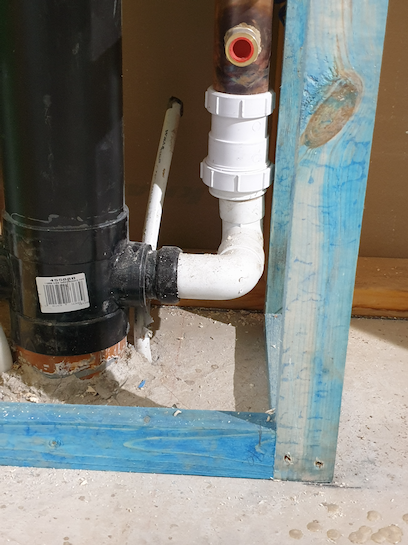
Exactly! The solvent weld stuff in itself isn't bad is it? Rather, it's just the way they've reduced to 40mm and the 90deg bends, right? This is below:
-
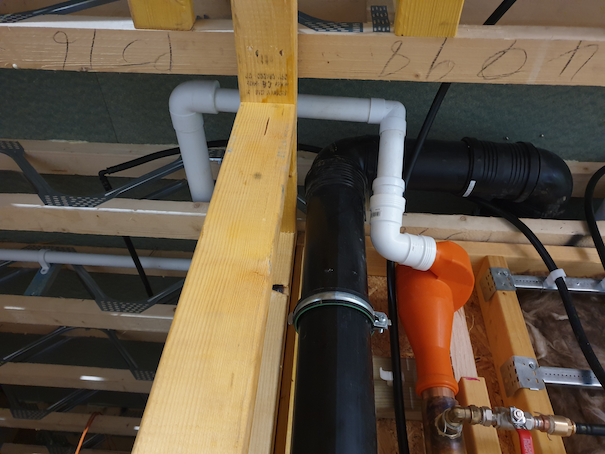
@Nickfromwales Here you go, this is the one that serves two showers
-
Thanks. We are using a local plumber and they are somewhat out of their depth with some of our non-standard requirements: - Silient-PP - 50mm shower drainage - Showersave - MLP - Single central hot manifold next to UVC - 12mm for basins (3 with 12mm hot return)
-
Will do. More than "as requested", assume it's also what's correct/expected, especially given shower pipe/showersave are both in 50mm. We actually have one showersave picking up two showers (which may occasionaly be used at the same time), so probably even more important here.. Thanks,
-
50mm
-
@PeterW @Nickfromwales Thanks. I did talk them into using 50mm, but: - They've used 40mm for bath. - They've connected 50mm pipe from the shower trap to the top of the showersave with what looks like some 40mm pipe and elbows. - They've connected bottom of showersave to SVP, again, with what looks like 40mm pipe and elbows. Will the 40mm not have any real impact if it's only these connections? Or, will they negate the use of 50mm pipe from shower, or even worse create a bottleneck of some sort? I thought I had a photo on my phone.. but seems not, will post one tommorowow..
-
Good points, let's see what I can sort out. 3-phase to house isn't because there is 3-phase equipment, but simply because once you deduct 16-32A (on each phase) to future proof for car charger(s) and another 16-20A (house phase) for the ASHP, that doesn't leave any/much headroom at all, especially when house has no gas supply.

