


Dan F
-
Posts
1431 -
Joined
-
Last visited
-
Days Won
2
Everything posted by Dan F
-
We went with 7021 (black-grey) for both outside and inside of alu-clad windows. Not your standard anthracite grey, but not quite black either. Due to be fitted next week, so if you want to see some photos send me a PM.
-
@joth We are at £1.30/W including installation (including fire membrane!!) with a solaredge setup (optimizers, 3-phase inverter and consumption monitoring) and all-black REC Alpha panels. So quite good vs PV Sol RIS seems, only thing that not great about the standard panels is we have hipped roof so never going to look at good a gb sol setup designed for the roof shape.
-
@joth Right. I forgot to get a design/quote from GB sol, for some reason i assumed they just did the ov slate. Cau you share any data on price/watt and watts/m2 for panels only?
-
Well, the inverter is still connected to the grid isn't it, so aren't you still exporting excess but can't be paid for it?
-
Do you not plan to export any excess production at any time of the year? In order to get export payments under SEG (not FIT) my understanding is that you need an MCS certified install.
-
Large house MVHR- Airflow Adroit DV245
Dan F replied to Conor's topic in Mechanical Ventilation with Heat Recovery (MVHR)
Heard they are very good, U.K made and PH certified. We've gone with Zehender because the Q600 is big enough for our house and supplier recommended this unit. Video of a unit installed (along with brine ground heat exchanger I think) here: https://www.youtube.com/watch?v=BzveC3u8cak -
How much are the 310W all-black panels? We're about to put an order in for 360W all-black panels at about £180..
-
From the datasheets the panels look almost identical and only difference I can see is backsheet color and wattage. They have same temperature co-efficient and anual degredation at least from what I saw, which are two other things to look at when comparing panels. The color of the backsheet is purely aesthetic,
-
Yes, I'm behind on the blog posts, but MBC are almost done.. just putting roof membrane on and fixing a few issues this week. You can read more about this here: http://www.windandsun.co.uk/products/PV-Mounting-Structures/GSE-Integration-Roof-Integrated#.X1uJ3JNKjUY But, for MCS certification you need a fire tested panel/tray combination or a AA rated fire-proof substrate. You weren't going to use GSE though were you?
-
Found a suitable product called "THATCH FLEXI" and have managed to convince PV installer to install this as part of their work. It's a shame, as it adds an additional cost when the fire certificate is due in a month or two, but we can't delay on the panel installation and untested panel/tray combination, without fire membrane, means no MCS certificate and in turn no SEG payments from what I understand. Now just need to work out if it's best to put the membrane under or on-top of the counter-battens: - Under: Less roof ventilation, 25mm PV panel ventilation, potentially harder for the PV installer to do at same time as the trays. - Over: More roof ventilation, almost no PV panel ventilation, easier for PV installer to installer under trays.
-
A must as it is mandated for SEG (paid export) and we'll be exporting a lot in the summer.
-
Hi, Has anyone used a fire membrane below an in-roof PV instlallation or know of a suitable product? We plan to use REC Alpha panels as they seem to be a great option from a price/performance/warranty standpoint. We also plan to use GSE trays for in-roof integration. The issues is that for an MCS certified install the specific GSE tray and panel combination needs to have been "BroofT4" tested. Due to COVID the planned testing of this tray/panel combination hasn't yet been completed. Given this, we either need to switch to a different panel, or do what MSC012 says which is: Sounds fairly easy solution to be able to use the panels or our choice, but the PV installer doesn't want to do this (they don't have expertise apparently), and it seems that finding a suitable membrane isn't that easy as a lot of them are only designed for internal use or specifically for verticial or horizontal applications and not for a pitched roof. Also, while the PV installer seems happy enough to certify the install even if they don't supply/fit the membrane, our main contractor isn't that keen on this arrangement given potential grey lines around who designed and approved suitability of the fire membrane. Any thoughts?
-
Building Contracts for your project
Dan F replied to tlogic's topic in New House & Self Build Design
We plan to use RIBA domestic contract. It's simpler than the JCT contracts and doesn't require a contract administrator if you don't want to use one I beleive. Even the simplest JCT contract seems over the top. See: https://www.architecture.com/knowledge-and-resources/resources-landing-page/riba-domestic-building-contract You can see a sample here: https://parsefiles.back4app.com/vy3GQS8Kt0HZRRnFkyglGgQUysHXN5BXjYUpP5vC/e6b45cf06053fef08fe35411d5bff7e0_bdom2.pdf In our view using a existing contract model ensure we cover everything important. The concern being that if we put something together ourselves then there is a risk of us missing out key things that could be an isse later. So, for the £30 the contract costs, it was a no brainer in our opinion. -
It's based on projected footprint of the thermal envelope so does not favour large houses. It does adversly affect bungalows though.. Those numbers are a bit mixed up: - The 45kWh/m2.a mentioned is max energy demand (PER) - The 6000kWh/a that was mentioned is generation for 100m2 footprint. If your house footprint is 50m2, then PV generation required for PH+ would be 3000 kWh/yr. In the south-east this would require around 9 x 350W south-facing panels. If PER is closer to 30kWh/m2.a (because of ASHP/WWHRS etc) then this is reduced to 1900kWh/yr and 6x350W panels.
-
The 6000kWh figure was for generation (not energy usage) for 100m2 footprint. The other value of 45 kWh/(m²a) is PER (Primary Energy Renewable) which is quite different to heating demand.
-
With solaredge optimizers you'll be looking at about £45 for each optimizer + £1,500 for a 10kW inverter, so £3,300. That said, unless you have shading, strings split across mutiple roofs or specifically want per-panel monitoring you don't have to use either. The difference with the micro-inverters (e.g. enphase) is that they convert to AC on the roof.
-
We are going to go with the Cupa R12 in the end. Cheaper than SSQ Del Carmen, @makie advised against any other SSQ slates, and we prefer grey to black/blue anyway. Spoke to Burton roofing as suggested and they recommended R12 as it's thinner/smoother so a good fit for a fairly contempory build in south-east. We'd be looking at the Heavy 3 if we were up in Scotland though..
-
Internorm: Order with solar glass, or apply external film later?
Dan F replied to tanneja's topic in Windows & Glazing
I'm not sure where I got those numbers from now. I assume you doubled checked them with supplier? The datasheets all talk about 70% but unclear if that is double or triple-glazed. If in doubt you can use https://calumenlive.com/ to run the calcluation, but exact numbers will depend on glass thickness, cavity thickness and other low-e coatings etc. When I posted the previous numbers calumen live was down so couldn't run the numbers, tried running just now and seems LT may be around 64%, still only -10% LT, for -30% reduction in solar gain though.. -
Still plan to use REC or LG rather than switch to a more value brand. The REC n-power 315W represents a good quality/value IMO at £150 retail for leading brand all-back panel and comes with 25yr product/performance/labour warranty if you get it installed by an approved supplier. You obvisiouy get cheaper 315W panels though...
-
Self Demolishing A House
Dan F replied to Internet Know How's topic in New House & Self Build Design
In area area at least you need to submit a demolition notice and obtain a demolition license before you can start. The requirements for this were: 1) Site Plan 2) Planning Permission 3) Asbestros Type 3 Survey 4) Full demolition method statement. (You also need to inform gas/electricity suppliers.) The demolition license then has some conditions about burning things etc.. -
MVHR with active cooling
Dan F replied to worldwidewebs's topic in Mechanical Ventilation with Heat Recovery (MVHR)
Don't have price no. In my view it comes down to heating/cooling load. If heating/cooling load is low (due to level of insulation and blinds) then doing this via MVHR vs. a seperate system seems a no brainer to me. Whereas if heating/cooling load is higher then of course seperate fancoil system makes more sense to meet capacity. -
Internorm: Order with solar glass, or apply external film later?
Dan F replied to tanneja's topic in Windows & Glazing
They look very simialir to the Roma textible screens. We never considered these and instead when with the venetian blinds but they look like a very good option, especially if you can get them independant quite easily and you aren't limited to specific window supplier who resell Roma. -
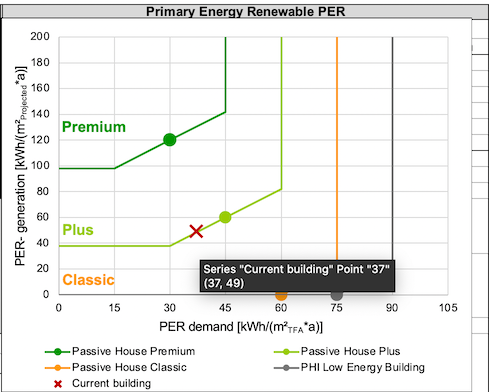
How much generation you need to meet PH+ depends on your PER, and isn't fixed. Lark Rise has a PER of 37kWh/m2.yr so needs 48 Wh/m2.yr in generation (see below). That said, they installed 79kWh/m2.yr, so around 60% more than they needed for certification. How the PH+ requirement translates into a PV array size will depend on area of country, orientation of roof, pitch and any shading though. So you know what you projected area will be, your roof area/type or any of this yet? Also, you should think about array size based on expected usage and not just certification if possible.
-
Internorm: Order with solar glass, or apply external film later?
Dan F replied to tanneja's topic in Windows & Glazing
We paid around 750+vat for initial model which analysed a couple of variables. -
Internorm: Order with solar glass, or apply external film later?
Dan F replied to tanneja's topic in Windows & Glazing
There are a number of consultants that will model house in PHPP for you, if you don't want to do it yourself. Where about are you based? We saw doing this modelling as an investment, as we felt it was best to get the overhangs, window sizes and type of glass right upfront. If you use solar glass but don't need it, for example, then your heating costs will be higher and the house may not be as bright internally.

