
Conor
-
Posts
4165 -
Joined
-
Last visited
-
Days Won
12
Everything posted by Conor
-

VAT evidence to HMRC
Conor replied to Moonshine's topic in Self Build VAT, Community Infrastructure Levy (CIL), S106 & Tax
We've bought a lot of stuff online, and so far we only have the digital invoices. Is this what we need for the VAT reclaim or does it need to be a receipt with payment confirmation details? -
Cleanable Waste Chute next to cutting board
Conor replied to puntloos's topic in Kitchen Units & Worktops
We're putting in a small prep sink on the island with an insinkerator. Just slide the waste in to the sink, and as I say to my 11month old, "all gone!!!" -
Pile it up and let it dry out for a couple months before burning. It'll burn far faster and cleaner and not annoy people as much. We're we are we're allowed 4 fires per year... Any more and it can be considered a nuisance.
-
Can't you just paint it in intumescent paint if it's hidden? That's what I'm doing with all my (many, many) steels.
-
I'd stick to the one feature stove . Good quality room sealed DEFRA approved stoves are not cheap, same for the flues etc. Can't go wrong with lots of insulation, cold bridge detail, airtightness and MVHR.
-
"meeting" SAP / EPC shouldn't be an issue for a new build as the standarda are so low compared what can be achieved easily with modern design and materials. You should be aiming for high levels of insualtion and airtightness, so the dependence on a heating system is much lower. And ASHP is the obvious choice. And question do you need to log burners in a highly insulated house.
-
Up the 50mm rigid insualtion to 100mm (assuming it's going under the rafters)
-
I wanted to put all our downpipes within the 150mm core of the ICF walls... architect pretty much laughed at me. The consequences of a blocked and flooding down pipe within the envelope of the building are pretty much inevitable, catastrophic and expensive.
-
Sorry, another realistic build costs post!
Conor replied to dawsonhousehold's topic in Costing & Estimating
Doubtful, and if you are relying on trades to do most of the work you are going to have to save lots on materials and you'll end up with a lower quality build that won't reflect the market's expectations for £750k + houses. For that money people will expect nicely finished bathrooms, high end kitchen and tiles floors. Even if you aren't selling, you have to bear in mind mortgage valuations. We are in a similar position and are having to stretch more than we'd like as we know if we built a smaller 3bed house to our original budget, it won't be comparable with other house on similar plots in the area and as we paid so much for the plot, we wouldn't get our money back of we sold or would struggle to get a mortgage. (Standard on our street is 250m² or more and 4/5 bedrooms) -
Small MVHR in only part of a house?
Conor replied to ashthekid's topic in Mechanical Ventilation with Heat Recovery (MVHR)
https://www.bpcventilation.com/ultra-d-105-a Not sure if that is up to the job if you have four bathrooms. -
Look for "room sealed" stoves.
-
Small MVHR in only part of a house?
Conor replied to ashthekid's topic in Mechanical Ventilation with Heat Recovery (MVHR)
Single room MVHRs might be a better option. BPC have a few I think. -
ICF Opening Spans Achievable
Conor replied to Brian Ireland's topic in Insulated Concrete Formwork (ICF)
Just remembered we have a 5m cantilevered corner all in ICF.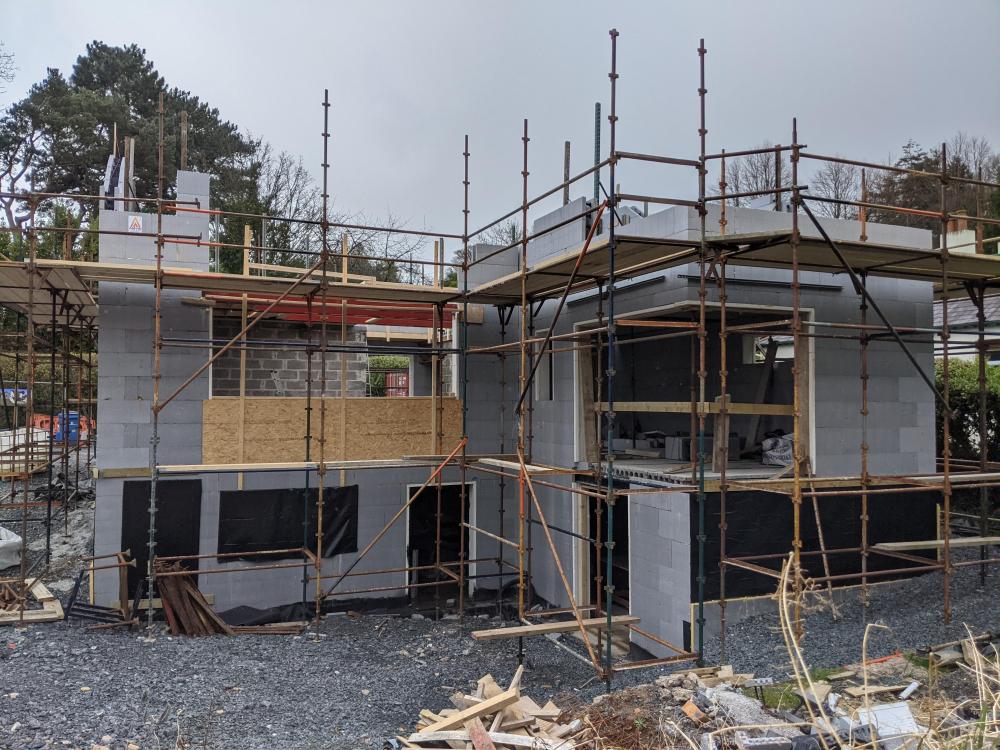
-
A developer wants to put a drain through our land...
Conor replied to Conor's topic in Party Wall & Property Legal Issues
@TonyT yep he has. Thing is I've already got a combined sewer connection and a separate surface water discharge to the same river! Tho a connection at that side of the house will save me at least one MH and 10m of pipe. -
A developer wants to put a drain through our land...
Conor replied to Conor's topic in Party Wall & Property Legal Issues
Update. We're going ahead with this. Agreed a route down the other side of the house where we'd never develop as it's only 5m from the boundary, and agreed an acceptable fee for the wayleave rights. We got some advice and the fee we were recommend to ask for was pretty much double what we had initially thought... Put this the developer and they agreed. They've no alternative really. Best of all.... We don't see a penny of this as it goes straight to the mortgage company ? -
2.4m is too narrow for 3 pane bifolds, you'll be looking at frames. We had a 3m opening which meant ~900mm doors with ~700mm panes. Was great, but wouldn't want want any narrower. (Remember 100mm frame at each end, 200mm frame for each leaf)
-
New build ph design now - add ph extension later
Conor replied to goatcarrot's topic in New House & Self Build Design
@goatcarrot easily. Having done an extension and now a new build. Basic economies of scale, cost of mobilisation, professional fees, equipment hire, tieing in services, cost of materials (less bulk discounts). Basically the bigger something is, the cheaper it is to build. But... Sounds like your annex is substantial enough? If you do go down this road, definitely get the drainage, waste and foundations done. You can also have your future opening preprepared with lintels etc in place. -
A basic garage single skin garage with cheapo roof and floor should come in around £250-£300/m², that quote is closer to 500/m but the filled cavity wall easily accounts for it.
-
New build ph design now - add ph extension later
Conor replied to goatcarrot's topic in New House & Self Build Design
It will cost you twice as much to build it in the future as it would now, especially if you are building to a high standard and need to eliminate cold bridging. We're strapped for budget as well, and instead of building smaller, we're leaving several rooms unfinished, until money and time allows. Is it cash flow or future mortgage repayments that are the constraints? -
We fitted them, removed them, painted, rehung. Easy.
-
I got brand new ridgefence panels from Ridgeway for about £20 each and £3 for feet.
-
Sorry @SteamyTea should say that I'm probably saving more on slates than I'm paying for the trays!!
-
I'm doing integrated panels using GSE mounting system. Adds about £1k to the job but I think it looks much better.
-
ICF Opening Spans Achievable
Conor replied to Brian Ireland's topic in Insulated Concrete Formwork (ICF)
Yes, as long as you have at least 25mm all around for concrete coverage. We've not poured that bit yet and I'm not sure how the concrete is going to get around the steel.... We had something similare in the basement but they didnt form ICF around it, instead they'll fix EPS to the beam. The beam will sit on the concrete piers indicated on the drawing. It will also be welded to the rebar. -
Mortgage completion vs Builder contract timing
Conor replied to aims's topic in Self Build Mortgages
we paid 3% of project total at the end of the first week of works. We then paid in four main stages plus a 5% retention.