Declan52
-
Posts
4449 -
Joined
-
Last visited
-
Days Won
10
Everything posted by Declan52
-
Yeah the splash won't be helping. It will need dug down and rebuilt so it ends up 150mm below your dpc. To do the artifical grass correct you will need a sub base of 150mm of well compacted hard-core. On top of that then you screed either sharp sand or quarry dust level. Then you can roll out your grass. The sand / dust will mean it will drain and the hard core means it won't sink. You can't skimp on either of these steps.
-
That just needs ripped out. It would take longer to patch up. None of them joists are treated timber. There is a real lack of fixings holding the joists to the posts, maybe a single nail. Your looking at a joiner to get it done correct so it will last. Some garden companies will do this type of work as well. Some in your area might have a Facebook page where you can at least see pics from jobs plus comments and reviews from customers.
-
It's cracking as the deck is swelling and putting pressure on the render. Your going to have to lift a few boards and try to prise it out from the house. A spade or a crow bar should be enough to move it. As for laying artificial grass on hardboard I don't know what to say about how bad that is. Artificial grass is full of holes to allow rain to drain through. Yours is draining beneath but has no where to go so is rotting the hardboard. It will all need ripped out, no other way round it. Your either going to have to redo the top with deck boards or treated timber and then relay the grass. Going from these photos I would highly doubt what is below the deck is done right either. You might be better lifting it all then examine what's been done and then do it right. Otherwise you might end up going through it some day.
-
A hammer. Tap the screw left right up and down repeatedly and it will snap.
-

Do people really not realise this?
Declan52 replied to Jeremy Harris's topic in Networks, AV, Security & Automation
Its useful when your are looking to know where they are. You can turn it off if you want. -
All that motar would have been mixed in a silo so they have messed with the mix. Not exactly sure what "there was far more sand in the mix than you would expect for a home in that area" means. It's either there is enough cement or there isn't. Doesn't matter if your mixing it in the skye or Isle of Wight the mix should be the same.
-
Kwikstage scaffolding questions
Declan52 replied to Vijay's topic in General Self Build & DIY Discussion
There might be a standard in the way, it just depends on how it works out. If so then just use round bar and clamps. 100mm is just to stop you falling down and also to leave enough room if it sways when it's being loaded up. It will move in and out so you don't want it hitting the wall. -
Kwikstage scaffolding questions
Declan52 replied to Vijay's topic in General Self Build & DIY Discussion
You use a return transoms to tie together 2 different runs. It won't fit if there is a standard in the way. If you want to tie standards together you use clamps and short round bar or another ledger if it's a wider gap. As for the size of the hop, that's up to you. You could use a double board and set it 100mm from the wall and that would give plenty of room. -
How wide are the founds at the top??? If your lucky and they are 450mm wide then your laughing. That would get you wide enough for a very well insulated block build. What type of construction where you leaning towards, block or timber frame or even icf??. We don't have cil here so that's a positive. How big is the current Sunroom that you think is too small??
-
The existence of snagging lists indicates that a lot has gone wrong during the build.
-
Grand Designs at Graven Hill starts tonight on Channel 4
Declan52 replied to ProDave's topic in Property TV Programmes
I thought it was a more realistic portrayal than you normally ever see on grand designs. It did feel a bit uncomfortable watching that poor woman have a melt down but these things happen when you start building. I would have been making the architect or structural engineer pay for the roof. It was designed wrong and failed and could have been a lot worse if it had slid another inch. -
MVHR - sucking in polluted air
Declan52 replied to Moggaman's topic in Mechanical Ventilation with Heat Recovery (MVHR)
Not stupid at all. There is a neighbour beside me who I swear must burn tyres in his house as the smoke is black. When the wind is blowing it my way I have to turn the mhrv of as the smell gets into the house. The filters will take out the bad particles but can't stop the smell. Luckily it only happens 3-4 times a year. -
Grand Designs at Graven Hill starts tonight on Channel 4
Declan52 replied to ProDave's topic in Property TV Programmes
4 births, 1 divorce, 3 with not enough money to finish,4 architect changes and at least 4 with bits you know have no chance of passing building regs. -
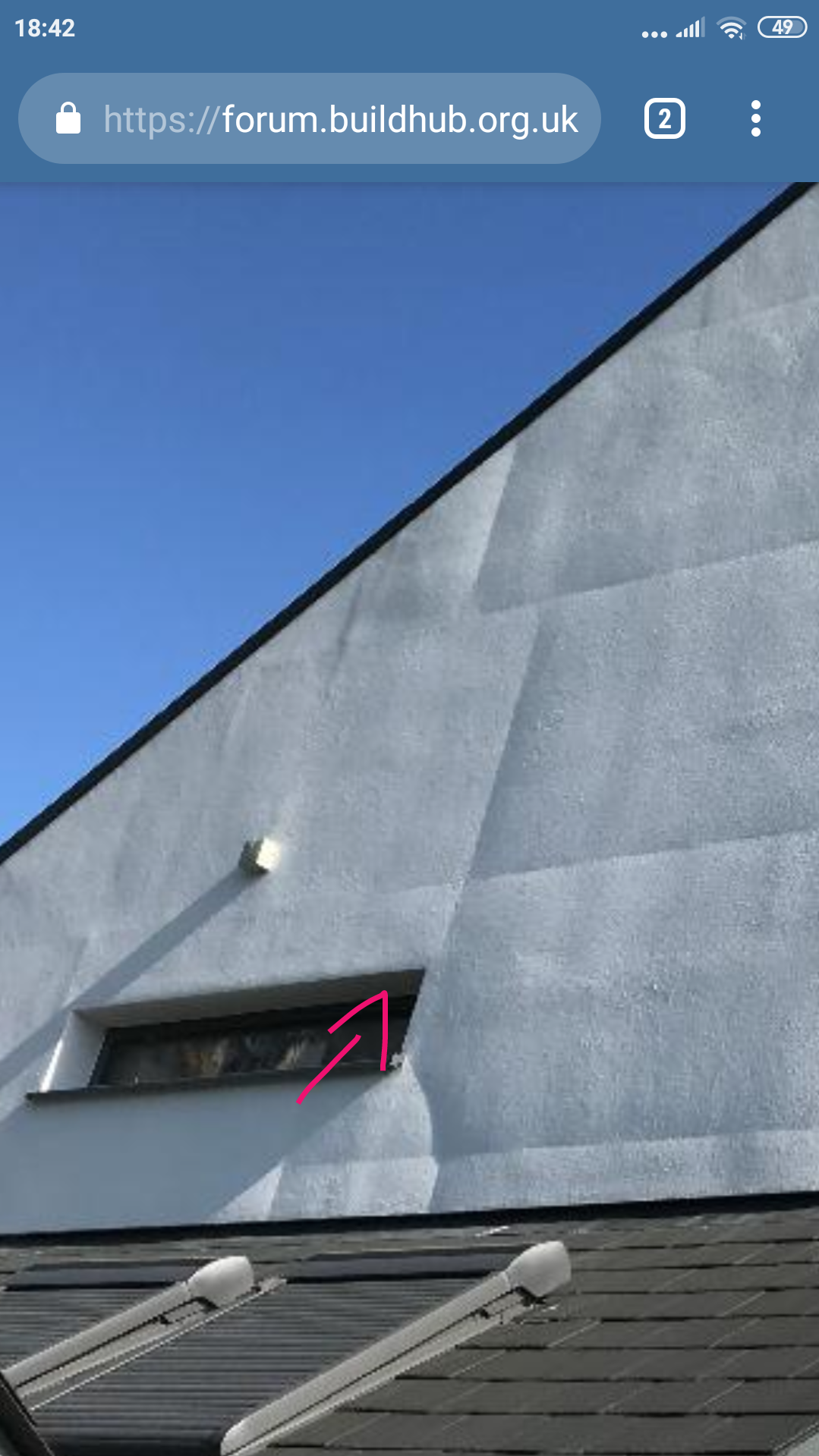
Could you drill a hole at the window head and push the probe up?? Would be easier to get at by standing on the lower roof. They didn't really stagger the boards much.
-
Would go for either increasing the roof truss thickness or went for a warm roof type build up. At that stage every pound was a prisoner so just didn't have the money. Would still go block build as I done it myself. If money was no option I think I would go down the icf route. Has plenty of plus points and is easier to lift than normal blocks. I think for my heating I am not sure I would go for a pellet boiler. It is working fine 4 years in but just think now by reading about various builds here I would choose an ashp. Just at the time the knowledge base in NI was very poor so I didn't want to take the risk. I would definitely not pick my high gloss porcelain tiles in my kitchen and Sunroom. Absolutely beautiful when they are cleaned up and shining but if a fly lands on them and takes a few steps you can see it a mile away.
-
Greetings from Glasgow from a novice handym’am
Declan52 replied to Gow's topic in Introduce Yourself
Yep any gap or crack in the structure that will allow heat to escape. It is via these that you will be pushing out the damp air. No gaps or cracks then no where for the air to escape. -
Welcome conor. Very nice looking house indeed. I just accept that there are some days here where we actually get the sun to shine far enough into the house that it makes an impact, which is definitely not today. It's mainly an issue when the sun is low in the sky otherwise we just close the blinds. Have you been to visit any other icf builds here?? What was the reason for going down this route as I haven't seen to many in my travels here??
-
Setting out will depend on how random your stone sizes are. For Windows and doors mine came with L shaped pieces for these areas. The tile adhesive is similar to what you would use for swimming pools so it will not let any water through. Mine was stuck onto a block wall so no chance of water getting through to the inside with a cavity filled with insulation. These are the guys I got mine from.
-
I used a stone veneer on mine. It's more like tiling than stone work. You mix enough adhesive up to build what you think you can do in 30 mins then put it on and tile away. You can build it dry with no joints or joints. That's up to you. YouTube has plenty of videos to show you how you go about it.
-
Wait until it goes light in colour. Might take a while if there are plenty of showers though. 3 days maybe. Once it's dry it will really suck the paint in. So you won't have to wait long between coats.
-
The cill will sit as you have it as if you are using a cill that suits a traditional build. You do as you have said and wrap the cill in dpc. It will sit in the cavity what ever distance it needs to be to have the raised lip edge in the correct position that you want the window to be. But you can get concrete cills that are for timber frame that are shorter so don't sit in the cavity. You can see examples here http://www.doranconcrete.ie/bp_cills.htm
-
For that kind of money that would be a no. I used a tool similar to this. https://www.screwfix.com/p/roughneck-mortar-gun-kit/1983t It won't matter really what you use the difficult bit is getting the mix right so it flows correct and the constant cleaning you need to do to keep it flowing. After every 3 tubes i dunked mine in a bucket of water to rinse it out.
-
Once it goes of and is solid you could always sand down any real bad bits.
-
The float is easier to use. Like grand master mister miyagi you do the wax on wax off movement. Don't apply much pressure. Your just touching it and Polish it up. When you say trowel with a rounded top are you using a gauging trowel?? https://www.screwfix.com/p/forge-steel-gauging-trowel-7/1191c
-
You have to let it sit. It won't go smooth with a float until it has dried out a tad. How long you wait will depend on how much water is in your mix plus how warm it is and wind all help in speeding up the drying out.